On this page
The solar panel price trend in Pakistan through 2026 has been upward, then flat. Imported Tier-1 panels went from a low of about Rs22 per watt in 2025 to around Rs33 per watt in January 2026, held in the Rs33 to 40 range through spring, spiked before the June budget, and have since settled. Today’s market average on our price table is Rs 41.3 per watt, and the most likely path for the next few months is sideways, not a sharp drop.
Below is what happened each month, why, and what the signals say about the coming winter. Historical numbers are as reported by Pakistani newspapers at the time. Today’s figures come from our live price table, which updates as dealer rates change.
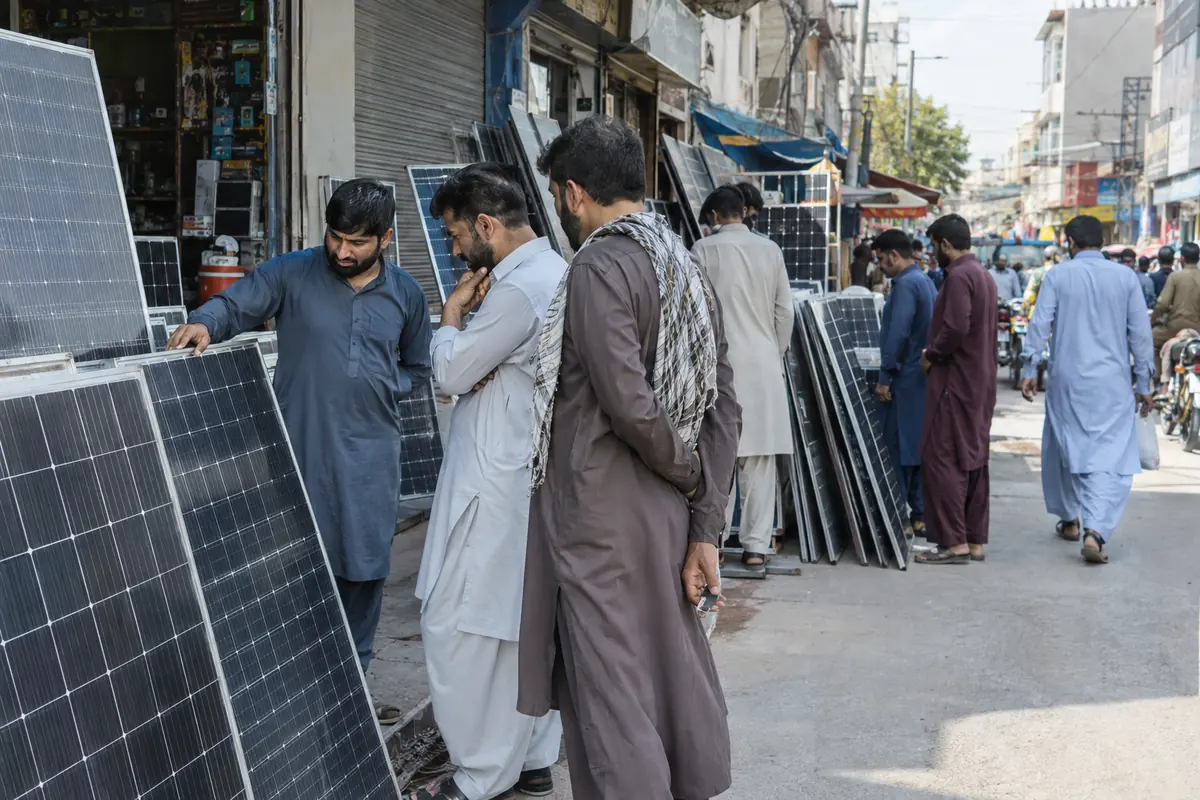
The short version: three forces moved prices in 2026
Almost every panel sold in Pakistan is made in China, so local prices follow three things more than anything else:
- China’s export rebate. China used to refund part of the VAT on exported solar panels. It cut that refund from 13% to 9% in December 2024 and, according to Caixin Global (January 2026), removed it completely for PV products on 1 April 2026. That alone makes every container more expensive at the factory gate.
- Pakistani taxes and the budget calendar. GST on imported panels has been 10% since the 2025-26 budget. Every time there is talk of raising it, dealers raise prices first and ask questions later.
- Demand at home. Net billing, load shedding, summer heat and wedding season all change how hard buyers push. Pakistan imported roughly 17 to 21 GW of panels in 2025 (sources disagree on the exact figure), and 2026 imports are running below that pace.
Exchange rates and freight matter too, but in 2026 they were background noise compared with these three.
Solar panel price trend in Pakistan, month by month
This table only includes per-watt figures that a newspaper actually reported. Where no reliable number was published, we say so rather than fill the gap with a guess.
| Period | Reported price level | What drove it |
|---|---|---|
| Mid to late 2025 | About Rs22/W (the bottom) | Oversupply in China, heavy competition between importers |
| January 2026 | About Rs33/W, importers expecting Rs40 | China announces rebate removal; panic buying worldwide |
| February 2026 | No separate figure reported | NEPRA notifies Prosumer Regulations 2026 on 9 February; net billing replaces net metering for new applicants |
| March 2026 | No separate figure reported | Buyers rush ahead of the April rebate deadline |
| April 2026 | Rs33 to 40/W | PV rebate fully removed on 1 April; regional tensions and higher import costs |
| Late May to early June 2026 | Roughly Rs46 to 50/W in Karachi (calculated from reported panel prices) | Fear that GST would rise from 10% to 18% in the budget |
| Mid June 2026 | Pressure eases | GST increase dropped; rate stays at 10% |
| July to September 2026 | No single national figure reported | Chinese module prices soften; Pakistani imports slower than 2024-25 |
| Today | Rs 41.3 per watt (market average) | Live figure from our dealer price table |
The late May and June row needs care. Daily Pakistan reported in June 2026 that Karachi dealers had raised prices by Rs7,500 to 9,000 per panel in a matter of days because of the tax rumours. Converting the panel prices it quoted into per-watt terms gives roughly Rs46 to 50 per watt, but that is our calculation, and it describes a short panic in one city rather than a stable national price.
January: the rebate news lands
The Express Tribune reported in January 2026 that panel prices had surged at the start of the year, from about Rs22 per watt at the 2025 low to around Rs33 per watt, and that importers expected Rs40. The same report said battery prices had risen about 10% in a month. The trigger was China’s announcement that export rebates on solar and batteries would be phased out. PV Tech reported the same month that TOPCon export quotes had jumped and that Jinko expected module prices to rise by as much as 30 to 40% in the first quarter.
February and March: policy shock, buying rush
On 9 February 2026 NEPRA notified the Prosumer Regulations, replacing net metering with net billing for new applicants. You might expect that to cool demand, since exported units now earn far less. In practice it pushed many people to file applications before the cut-off and pushed others toward hybrid systems with batteries. With the April rebate deadline approaching, importers also front-loaded orders. No newspaper published a clean per-watt figure for these two months, so we have not invented one.
April: the rebate disappears
Dawn reported in April 2026 that imported panels were selling at Rs33 to 40 per watt and rising again because of regional tensions and higher import costs. This is the month the PV export rebate went to zero. That is the main reason 2025’s Rs22 per watt is not a realistic benchmark any more: part of that low price was a Chinese tax refund that no longer exists.
May and June: the budget scare
ProPakistani reported in late May 2026, and pv magazine in early June, that an IMF-linked proposal could raise GST on panels from 10% to 18%. Prices jumped before anything was decided. Then, as Business Recorder reported on 11 June 2026, the increase was dropped and the rate stayed at 10%. The National Assembly passed the Finance Bill on 23 June. We found no report of a solar GST change in the passed bill. For the full tax picture, see our page on tax and GST on solar panels.
July to September: China cools off
EnergyTrend reported in September 2026 that Chinese domestic TOPCon module prices from leading makers were around RMB 0.70 to 0.72 per watt, with polysilicon inventories above 540,000 tonnes and a modest further decline expected. Meanwhile The Friday Times reported in October 2026 that Pakistan imported about 7.2 GW of panels from January to July, slower than the 2024 and 2025 pace. Softer supply prices plus slower local buying is the classic recipe for prices that stop rising.
Where prices stand today, by panel size
These figures update automatically from our price table, so they are as current as the page you are reading. They show the cheapest listed panel in each size, which is useful for spotting the trend but not a substitute for a dealer quote.
| Panel size | Cheapest today | Per watt |
|---|---|---|
| 550 W | Rs 20,900 | Rs 38 |
| 585 W | Rs 23,400 | Rs 40 |
| 620 W | Rs 24,800 | Rs 40 |
| 650 W | Rs 27,950 | Rs 43 |
| 720 W | Rs 29,520 | Rs 41 |
Two patterns are worth knowing. First, older P-type sizes such as 550 W are now mostly leftover stock, so their per-watt price can look cheap but you are buying older technology. Second, the large 700 W-plus N-type panels sometimes come in at a lower per-watt price than mid-sized ones, because fewer panels means less structure, wiring and labour. Our price per watt breakdown tracks this in more detail, and the full solar panel price list shows every brand.
For a complete house, the panels for a 5 kW system using 585 W modules cost about Rs 210,600 today (9 panels). Inverter, structure, cabling and installation come on top.
Will solar prices go down? What to watch next
Nobody can promise a direction, but these are the signals that will decide it over the coming winter.
Signals pointing to stable or slightly lower prices
- Chinese oversupply. Large polysilicon stocks and softening module quotes, as EnergyTrend described in September 2026, put a ceiling on what exporters can charge.
- Slower Pakistani demand. Imports in 2026 are running below the previous two years. Dealers holding stock into winter tend to discount to move it.
- Seasonal lull. November to January is quieter for solar sales in Punjab and KP, because bills are lower and output drops in fog and smog.
Signals pointing the other way
- The rebate is not coming back. The April 2026 removal of China’s PV export rebate is a permanent cost. A return to 2025’s Rs22 per watt would need a much larger collapse in Chinese prices than anyone is currently reporting.
- “Anti-involution” policy in China. Beijing has been pushing manufacturers to cut output and stop selling below cost. EnergyTrend noted that if these output cuts take hold, the expected price decline may not happen.
- Next year’s budget. The GST rate survived June 2026, but the pressure to raise it has not gone away. Expect the same rumour cycle before the 2027-28 budget.
Batteries are a separate story
China’s export rebate on batteries fell from 9% to 6% on 1 April 2026 and is scheduled to reach 0% on 1 January 2027, according to Caixin Global. Our reading, which is an inference and not a reported forecast, is that lithium battery prices in Pakistan could face upward pressure around the turn of the year even if panel prices stay flat. If you plan to add a battery, check current solar battery prices before December rather than after.
How to read price news without getting played
Price news in Pakistan’s solar market moves fast and is often driven by people who hold stock. A few habits help:
- Compare per watt, not per panel. A 720 W panel will always cost more than a 585 W panel. The question is how much per watt.
- Check the technology. A cheap per-watt figure on a P-type PERC panel is not comparable with an N-type TOPCon or HJT panel. Ask which cell type the quote is for.
- Treat “prices will rise next week” with suspicion. Sometimes it is true, as in January and June 2026. Often it is a sales line. Ask what the reason is and whether it has been reported anywhere.
- Get at least two written quotes. Hall Road in Lahore, Brandreth Road dealers and Karachi importers can differ by a noticeable amount on the same brand on the same day.
- Remember the panels are only part of the bill. On a typical home system, inverter, structure and installation add a large share of the cost, and those prices did not all move in step with panels this year.
Bottom line: buy now or wait?
As of October 2026, the evidence points to a market that has stopped climbing rather than one about to fall sharply. The single biggest cost increase of the year, the end of China’s PV export rebate, is permanent. The softening in Chinese factory prices since mid-2026 should keep a lid on things through winter, and slower local demand may give you room to bargain.
If your electricity bill is high, waiting for a small possible discount usually costs more in units than it saves. If your bill is modest and you are not in a hurry, winter is a reasonable time to collect quotes, compare per-watt figures against our live table, and buy when a dealer offers a fair price on A-grade N-type stock. Either way, size the system properly first with the solar panel calculator, and keep an eye on the 585 watt panel price today, the most widely stocked size and the best single indicator of where the market is heading.
We review this post every week and add each month’s movement as it is reported.
Frequently asked questions
Will solar panel prices go down in Pakistan?
A big fall is unlikely in the next few months. Chinese factory prices have softened since mid-2026, which should stop further increases, but China's export tax rebate on panels is gone and is not coming back, so the very low prices of 2025 are not expected to return soon.
What is the solar panel price per watt in Pakistan today?
The market average today is Rs 41.3 per watt, updated from our price table. Brand, wattage and whether the stock is A-grade all move the figure up or down.
Why did solar panel prices increase in 2026?
Mainly because China removed its export VAT rebate on solar panels on 1 April 2026, after cutting it in December 2024, which made every imported panel more expensive at source. Fears of higher sales tax before the June 2026 budget and regional tensions added short spikes on top.
Is GST on solar panels in Pakistan still 10 percent?
Yes, as far as reported. A proposal to raise it to 18 percent was dropped from the 2026-27 budget, and Business Recorder reported in June 2026 that the rate would stay at 10 percent.
Should I wait for winter to buy solar panels?
Winter usually brings weaker demand, so dealers are more willing to negotiate, but there is no reported evidence of a coming price crash. If your bill is high, the units you lose by waiting usually cost more than any discount you might get.