| Model | Watt | Price per panel | Per watt | This week | Trend |
|---|---|---|---|---|---|
| Jinko Tiger Neo N-typeN-type TOPCon | 580 W | Rs 24,505 | Rs 42.3 | No change |
On this page9 min read
- 580 watt solar panel specifications
- 580 W vs nearby wattages: which should you buy?
- How many 580 W panels for 3, 5 and 10 kW (with price)
- How many units does a 580 watt panel produce in Pakistan?
- What can a 580 watt solar panel run?
- Best inverter for 580 W panels
- Buying tips before you pay
- Frequently asked questions
If you are checking the solar panel 580 watt price in Pakistan today, you are probably weighing it against a 585 W plate from the same shop. The live brand rates sit in the dated table above. This page explains what a 580 watt solar panel really is, how the two 580 W models you may be offered differ, and when it is the smarter buy for a home, a shop or a tubewell.
At the moment the lowest A-grade 580 W rate on our sheet is Rs 24,505, or Rs 42.3 per watt. Keep that per-watt figure in mind; it is the only fair way to compare plates of different sizes.
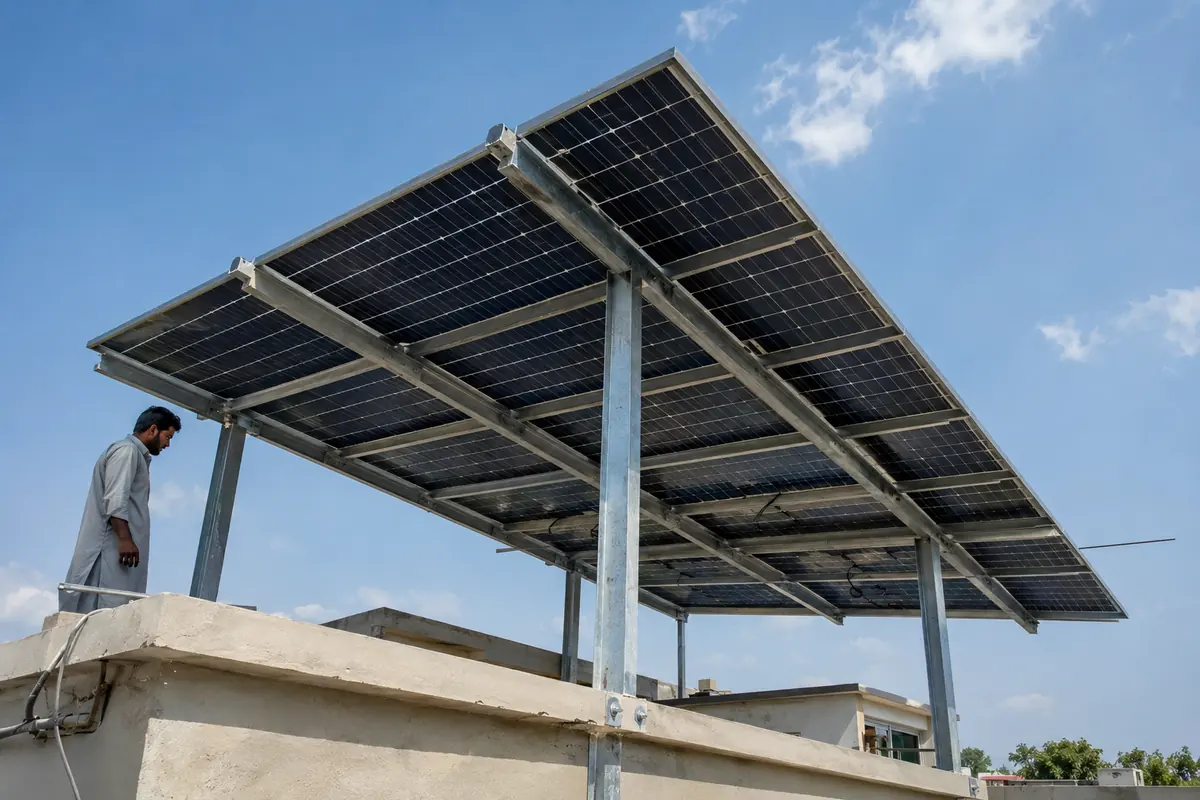
580 watt solar panel specifications
A 580 W panel is not a different design from a 585 W one. Factories test every finished module and sort it into power bins. Panels that test between roughly 580 and 584.9 W get the 580 label; the next bin up becomes 585 W. Same glass, same frame, same cells. That is why the 580 watt solar panel price in Pakistan usually sits just under the 585 W rate.
Two models have made up nearly all 580 W stock here, and they are built in quite different ways. Only the Jinko Tiger Neo 580 W is on our price sheet now. LONGi has replaced the Hi-MO 6 with the Hi-MO X7 (585 W) and Hi-MO X9 (600 W), so a Hi-MO 6 580 W on offer is likely to be old stock.
| Spec (maker datasheet) | Jinko Tiger Neo JKM580N-72HL4-V | LONGi Hi-MO 6 LR5-72HTH-580M (replaced, may be old stock) |
|---|---|---|
| Cell technology | N-type TOPCon, 144 half-cut cells | N-type HPBC back-contact, 144 half-cut cells |
| Size | 2278 × 1134 × 35 mm | 2278 × 1134 × 35 mm |
| Size in feet | 7.47 × 3.72 ft | 7.47 × 3.72 ft |
| Weight | 28 kg | 27.5 kg |
| Voc / Isc | 51.02 V / 14.47 A | 52.21 V / 14.20 A |
| Vmp / Imp | 42.37 V / 13.69 A | 44.06 V / 13.17 A |
| Efficiency | 22.45% | 22.5% |
| Power temp. coefficient | -0.29%/°C | -0.29%/°C |
| Voc temp. coefficient | -0.25%/°C | -0.23%/°C |
| Warranty (product / power) | 12 / 30 years | 15 / 25 years |
TOPCon or back contact: does it matter?
- Looks: LONGi’s HPBC cells have no silver busbars on the front, so the panel looks plain dark blue-black. Jinko’s TOPCon front shows thin grid lines. Purely cosmetic.
- Voltage: the LONGi runs about 1.7 V higher at its working point and draws a little less current. On a long string that gives slightly more voltage headroom to watch in winter.
- Heat: identical -0.29%/°C, so summer output loss is the same.
- Warranty: LONGi gives a longer product warranty, Jinko a longer power warranty.
In daily units on a Pakistani roof you will not tell them apart. Pick on rate, stock and the distributor behind the warranty card. Our LONGi solar panel price page and Jinko 580 watt price page list the current rates model by model.
580 W vs nearby wattages: which should you buy?
The most useful comparison for a 580 W buyer is not 585 W. It is 550 W, because some quotes still offer old-stock Mono PERC 550 W plates at a lower price per plate.
| Wattage | Cheapest A-grade | Price per watt | Cell type | Temp. coefficient |
|---|---|---|---|---|
| 550 W | Rs 20,900 | Rs 38 | Mono PERC, old stock | about -0.34 to -0.35%/°C |
| 580 W | Rs 24,505 | Rs 42.3 | N-type | -0.29%/°C |
| 585 W | Rs 23,400 | Rs 40 | N-type | -0.29%/°C |
Why the cheaper 550 W plate can cost you more
Take a June afternoon in Faisalabad with cells at 60°C, 35 degrees above test conditions.
| 550 W Mono PERC | 580 W N-type | |
|---|---|---|
| Heat loss at 60°C cell temperature | about 12.3% | about 10.2% |
| Output per plate at that moment (before other losses) | about 483 W | about 521 W |
| Difference | about 38 W more per plate, close to 8% |
The nameplate gap is 5.5%, but on a hot roof the real gap is closer to 8%. Over 10 years that difference often covers the higher price per plate. If the price per watt of 580 W is within a rupee or so of 550 W, the N-type plate is the better buy. If the gap is wide, read our 550 watt solar panel price page before deciding.
Against 585 W, the choice is simpler: pay the lower price per watt. If you are adding to an existing 585 W array, our 585 watt page explains how far you can mix bins.
When 580 W is the wrong choice
- Your roof is tiny and every watt counts. A 600 W or 620 W plate squeezes more out of each slot, if the structure can take it.
- You are extending an old 540 or 550 W system on the same inverter input. Adding N-type 580 W plates to a PERC string drags the newer panels down to the older ones’ current. Put them on a separate MPPT or stay with the old wattage.
- The dealer only has a mixed lot of brands. Buy one model for the whole job, even if that means a different wattage.
- You need a lighter plate for a weak shed roof. Smaller 500 W panels are easier to handle and spread less load per fixing.
How many 580 W panels for 3, 5 and 10 kW (with price)
| Target system | 580 W panels | Actual DC size | Panel cost at the cheapest live rate |
|---|---|---|---|
| 3 kW | 6 | 3.48 kW | Rs 147,030 |
| 5 kW | 9 | 5.22 kW | Rs 220,545 |
| 7.5 kW | 13 | 7.54 kW | Rs 318,565 |
| 10 kW | 18 | 10.44 kW | Rs 441,090 |
These are the plates only. Inverter, structure, cabling, protection and labour come on top, and those items vary far more between installers than the panel rate does.
Example: a shop in Faisalabad
A garments shop open 10 am to 8 pm uses about 20 units a day in summer: 10 ceiling fans, LED tube lights, two computers, a water dispenser and one 1.5 ton inverter AC. Daytime use is high, which suits solar well.
- Daily need during sun hours: about 14 units (the rest is after sunset).
- One 580 W plate in Faisalabad gives about 2.9 units a summer day.
- 14 ÷ 2.9 is roughly 5 plates for summer, but winter output halves, so the owner goes for 9 plates (5.22 kW).
- A 5 kW on-grid inverter covers it, with the remaining evening load still on WAPDA.
How many units does a 580 watt panel produce in Pakistan?
The answer depends heavily on where you live. These figures are monthly units for one panel, based on long-term solar data for each city at a south-facing tilt, minus about 22% for heat, dust, wiring and inverter losses.
| City | Summer month | Autumn month | Winter month | Spring month | Per year |
|---|---|---|---|---|---|
| Faisalabad | about 86 units | 64 | 46 | 88 | about 870 |
| Peshawar | about 106 units | 72 | 54 | 92 | about 985 |
| Hyderabad | about 90 units | 74 | 66 | 98 | about 1,000 |
| Quetta | about 116 units | 84 | 68 | 102 | about 1,120 |
Yearly units for a 9-panel (5.22 kW) system
- Faisalabad: about 7,800 units a year
- Peshawar: about 8,900 units a year
- Hyderabad: about 9,000 units a year
- Quetta: about 10,100 units a year
Quetta wins because of its dry air and clear skies; the cold also helps panel efficiency. Hyderabad’s winters are mild and sunny, so its output is the most even through the year. Faisalabad and the rest of central Punjab lose the most in December and January, when smog and fog can cut a week’s output sharply.
Roof direction changes these numbers
The table assumes panels face south at a good tilt. Many Pakistani roofs do not allow that, so here is a rough guide to how much you keep with other layouts.
| Layout | Share of the south-facing output | When it makes sense |
|---|---|---|
| South, tilted 20–30° | 100% | Standard flat roof with space |
| Flat or near flat (5–10°) | about 90–93% | Tin sheds, low wind loads; clean more often |
| East-west split | about 85–90% | Narrow roofs; spreads output across morning and evening |
| West only | about 80–85% | Shops that peak in the afternoon |
| Shaded by a water tank for 2 hours | much lower on that string | Move the tank, or put shaded panels on their own MPPT |
Low tilt also means dust sticks. In Faisalabad and Multan a panel left unwashed for a month in May can lose a noticeable share of its output, so budget for a wash every one to two weeks in the dusty season.
Since February 2026, new rooftop connections fall under NEPRA’s net billing rules, which credit exported units well below the price of imported ones. For a shop that uses most of its power in daylight, that hardly matters. For a home that is empty all day, it is a reason to add a battery or to size the system smaller.
What can a 580 watt solar panel run?
Think in two numbers: watts at midday (what you can run at once) and units per day (how long you can run it). A 580 W plate gives about 430 to 470 W of usable AC power on a clear summer afternoon and roughly 2.4 units across an average day in Faisalabad.
| Load | Approximate draw | One 580 W plate at noon | Panels to cover the daily use |
|---|---|---|---|
| LED tube lights (20 W each) | 20 W | about 20 tubes | 1 panel for 10 tubes over 10 hours |
| Desktop computer with monitor | 100–150 W | 3 computers | 1 panel for 2 computers all day |
| Deep freezer | about 2–3 units a day | runs it | 1 panel, more in winter |
| Ceiling fans (AC type) | 75–90 W | 5 fans | 1 panel for about 3 fans all day |
| 1.5 ton inverter AC | about 1 kW on a hot afternoon | no | 3–4 panels |
| 1 HP motor (30 minutes a day) | about 750 W | no, needs 2 | the motor’s 0.4 units fit easily in any 3+ panel system |
For a tubewell or a farm motor, size differently. A 1 HP surface pump on a solar pump drive needs roughly 1.5 to 2 times its rating in panels, so two or three 580 W plates. Larger submersible pumps are better handled with a dedicated solar pump inverter than a home hybrid.
A useful rule for shops: one 580 W plate per two fans, one per AC ton, and one more for lights and electronics. It is rough, but it stops buyers from under-sizing.
Best inverter for 580 W panels
Because the Jinko and LONGi 580 W plates have slightly different voltages, the string count depends on which one you buy. Always use the cold-morning Voc, not the label figure.
| Jinko JKM580N | LONGi LR5-72HTH-580M | |
|---|---|---|
| Voc at 25°C | 51.02 V | 52.21 V |
| Voc at 0°C (approx.) | 54.2 V | 55.2 V |
| Max panels per string, 500 V input | 9 | 9 |
| Max panels per string, 1000 V input | 18 | 18 |
| Working voltage of a 9-panel string | about 381 V | about 397 V |
Steps to match an inverter:
- Find the inverter’s maximum PV input voltage on the label or datasheet.
- Divide by the 0°C Voc and round down. That is your longest safe string.
- Check the working voltage (Vmp × panels) falls inside the MPPT range, including on hot days when it drops about 10%.
- Check MPPT input current is at least 14.5 A, the panel’s Isc.
- On a three-phase 10 kW on-grid inverter, two strings of 9 on separate MPPTs is the common layout.
| Choice | Best for | Watch out for |
|---|---|---|
| On-grid (grid-tie) | Daytime users with steady supply | Shuts down during load-shedding by design |
| Hybrid with battery | Homes with outages and evening load | Lower PV voltage limit, so shorter strings |
| Off-grid with battery | Farms and sites with no grid | Battery size drives the cost, not the panels |
For a home with load-shedding, a single-phase hybrid lets you run fans and lights through outages. For a shop open in daylight with a three-phase connection, an on-grid inverter gives more units per rupee.
Buying tips before you pay
The 580 W bin has its own traps, mostly around labels and mixing.
- Read the label, not the carton. The back label should show the exact model, for example JKM580N-72HL4-V or LR5-72HTH-580M, with tolerance 0 to +3%.
- Check the name. LONGi sold this family as Hi-MO 6 and later Hi-MO X6, both now replaced by the Hi-MO X7 and X9. If you are offered a LONGi 580 W, ask the dealer for the datasheet that matches your exact model code.
- Mixing 580 and 585 W plates of the same model in one string is fine. The current is almost identical. Mixing brands in one string is not.
- Get serial numbers on the bill. Without them, a warranty claim is very hard.
- Insist on the distributor’s warranty card at the time of sale, not “later”.
- Inspect every plate before the truck leaves: corners, glass, junction box and cable connectors.
- Ask about the structure. A 2278 mm panel needs proper rails; old structures built for 1956 mm 72-cell panels need new purlins.
Questions to ask before you sign
- Which exact model and bin is in stock, and can I see the label before payment?
- Who is the importer or distributor, and who handles warranty claims in my city?
- Is the price per plate including delivery to the roof, or only to the gate?
- What structure will hold the panels, and is it designed for a 2278 mm plate in a 100 km/h wind?
- Will the string plan be shown in writing, with the winter voltage worked out?
A good installer answers all five without hesitation.
For the full range of sizes and prices, see the solar panel price list. If you are fitting plates into a tight roof, our solar panel size in feet guide gives the measurements for each wattage, and the Canadian solar panel price page covers the nearest Canadian alternatives.
Frequently asked questions
What is the 580 watt solar panel price in Pakistan today?
A-grade 580 watt panels start from Rs 24,505 on our sheet as of 9 Oct 2026. The Jinko Tiger Neo is the A-grade 580 W plate on our sheet, and the table at the top shows its rate and price per watt.
What is the difference between a 580 W and a 585 W solar panel?
They are normally the same model from the same production line, sorted into different power bins after testing. Size, weight and design are identical, so buy whichever has the lower price per watt.
Which is better at 580 watts, Jinko or LONGi?
Jinko's Tiger Neo 580 uses TOPCon cells and has a 30-year power warranty, while LONGi's Hi-MO 6 580 uses back-contact cells and has a 15-year product warranty. Both have the same heat loss rating, so real output is almost identical. LONGi has since replaced the Hi-MO 6 with the Hi-MO X7 and X9, so a Hi-MO 6 580 is likely to be old stock. Choose by price and by how reliable the local distributor is with warranty claims.
How many 580 watt panels do I need for 5 kW?
Nine panels of 580 W give 5.22 kW, which suits a 5 kW inverter. For 10 kW you need 18 panels, usually wired as two strings of nine.
How many units does a 580 watt solar panel produce per month?
In Faisalabad expect about 46 units in a winter month and 86 to 88 in summer and spring. Quetta and Peshawar produce more in summer, and Hyderabad stays the most even through the year.
What is the size of a 580 watt solar panel?
Both main models measure 2278 × 1134 × 35 mm, about 7.5 × 3.7 feet, and weigh 27.5 to 28 kg. Allow extra roof space for gaps and walkways between rows.
Can I add 580 watt panels to my old 550 watt system?
You can, but put the new 580 W panels on a separate MPPT input. In the same string, the different current of the older PERC panels pulls the newer ones down and you lose output.
Is a 580 watt panel good for a shop?
Yes, especially for shops open during daylight, because most of the power is used as it is produced. That matters more now that net billing pays much less for exported units than you pay for imported ones.