On this page15 min read
- Solar panel price in Pakistan by type: Mono PERC, N-type and bifacial
- Why solar panel rates change every day in Pakistan
- Complete solar system price in Pakistan: 3 kW, 5 kW, 10 kW
- A-grade vs B-grade vs used solar panels
- How to check an original solar panel
- Net metering and net billing in Pakistan: how it works and payback
- Where to buy solar panels in Pakistan
- Tier 1 solar panel brands sold in Pakistan
- Frequently asked questions
The solar panel price in Pakistan is set by three things: the panel’s wattage, its cell technology and the brand behind it. The table above is updated from dealer rates, so use it for the number and use this guide to understand what you are paying for. Below we cover prices by panel type, what moves the market, full system costs, grades, how to spot a fake plate, net billing and where to buy.
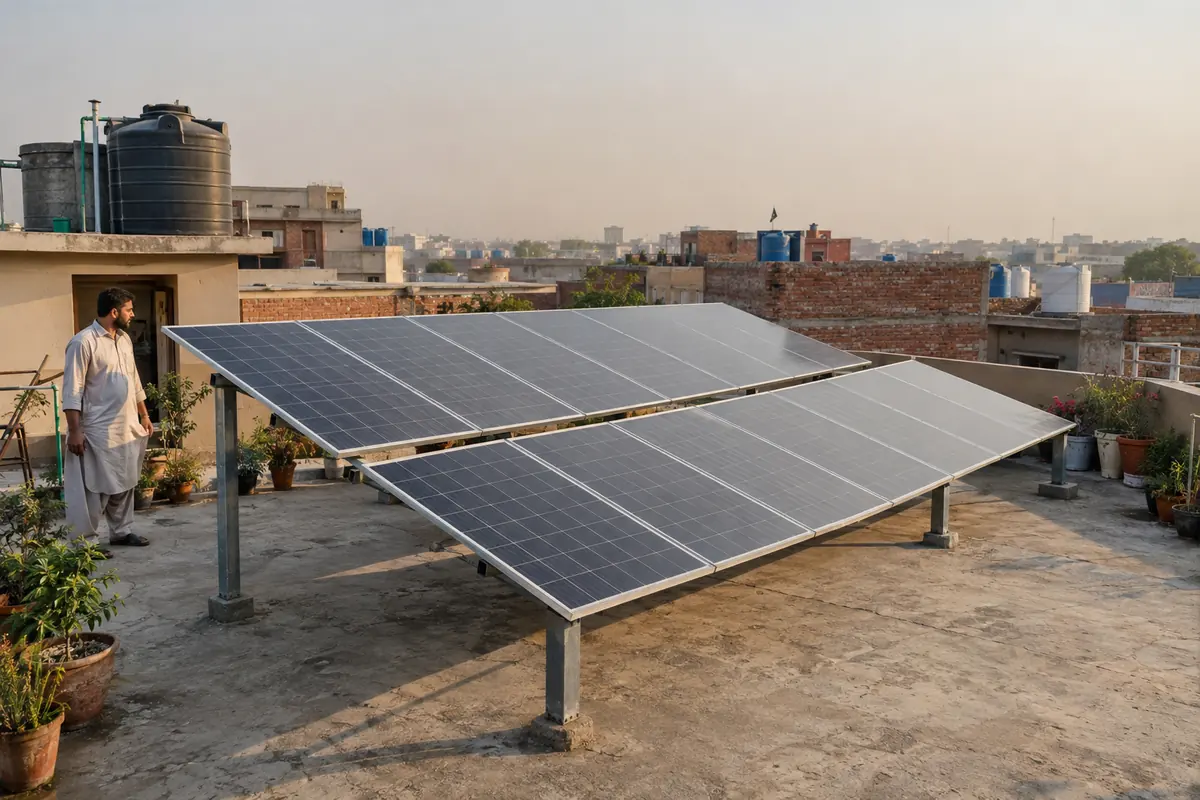
Most buyers today are looking at large A-grade N-type panels in the 580 to 620 watt range for rooftop systems. If you only need one panel for a fan or a few lights, the smaller sizes on our solar panel price list will suit you better, and they are priced differently.
Solar panel price in Pakistan by type: Mono PERC, N-type and bifacial
Almost every panel sold in Pakistan today is monocrystalline. The difference is in how the cell is built. Older Mono PERC cells are cheap and proven. Newer N-type cells (TOPCon, HPBC, ABC and HJT) produce more units from the same roof, lose less output in heat and degrade more slowly, which matters a lot in a Pakistani summer when roof temperatures cross 60°C.
The fairest way to compare them is price per watt, not price per plate. A 585 W panel will always cost more than a 550 W panel, but it may still be the better deal per watt.
| Cell type | Example in our sheet | Price per watt | Who it suits |
|---|---|---|---|
| Mono PERC | Jinko Tiger Pro 550 W (old stock) | Rs 38 | Tight budgets, off-grid setups, buyers with plenty of roof space |
| N-type TOPCon | Jinko Tiger Neo 585 W | Rs 43.5 | Most homes; the default choice for on-grid and hybrid systems |
| N-type TOPCon bifacial | Canadian TOPBiHiKu6 590 W | Rs 43 | Raised structures and light-coloured roofs where the back side gets reflected light |
| N-type HPBC | Longi Hi-MO X9 600 W | Rs 44 | Buyers who want a clean all-black look and strong heat performance |
| N-type ABC | Aiko Stellar 1N ABC 620 W | Rs 40.5 | Small roofs where every watt per square foot counts |
| HJT | Risen Hyper-ion 700 W | Rs 42 | Commercial roofs, farms and large ground-mounted arrays |
The market average for branded A-grade panels of 500 W and above sits at Rs 41.3 per watt. Here are the large panels from 500 W upward, cheapest per size first:
| Model | Watt | Price per panel | Per watt | This week | Trend |
|---|---|---|---|---|---|
| Trina Vertex N UltraN-type i-TOPCon | 740 W | Rs 30,340 | Rs 41.0 | No change | |
| Risen Hyper-ion Pro HJTN-type HJT | 720 W | Rs 29,520 | Rs 41.0 | No change | |
| Risen Hyper-ion HJTN-type HJT | 700 W | Rs 29,400 | Rs 42.0 | No change | |
| Aiko Stellar 1N+ ABCN-type ABC | 650 W | Rs 27,950 | Rs 43.0 | No change | |
| Crown N-type bifacial 20BBN-type TOPCon | 620 W | Rs 24,800 | Rs 40.0 | No change | |
| Trina Vertex N bifacialN-type i-TOPCon | 620 W | Rs 25,110 | Rs 40.5 | No change | |
| Aiko Stellar 1N ABCN-type ABC | 620 W | Rs 25,110 | Rs 40.5 | No change | |
| Inverex Mustang double glassN-type | 620 W | Rs 26,350 | Rs 42.5 | No change | |
| Jinko Tiger Neo 3.0 bifacialN-type TOPCon | 620 W | Rs 26,660 | Rs 43.0 | No change | |
| Inverex Jolywood dual glassN-type | 600 W | Rs 25,500 | Rs 42.5 | No change | |
| Longi Hi-MO X9N-type HPBC 2.0 | 600 W | Rs 26,400 | Rs 44.0 | No change | |
| Trina Vertex N bifacialN-type i-TOPCon | 590 W | Rs 23,600 | Rs 40.0 | No change | |
| Canadian TOPHiKu6 bifacialN-type TOPCon | 590 W | Rs 25,370 | Rs 43.0 | No change | |
| Crown N-type bifacial 16BBN-type | 585 W | Rs 23,400 | Rs 40.0 | No change | |
| JA Solar DeepBlue 4.0 N-type bifacialN-type | 585 W | Rs 23,545 | Rs 40.2 | No change | |
| Astronergy ASTRO N5 bifacialN-type TOPCon | 585 W | Rs 23,985 | Rs 41.0 | No change | |
| Inverex Mustang bifacialN-type TOPCon | 585 W | Rs 24,280 | Rs 41.5 | No change | |
| Longi Hi-MO X7 bifacialN-type | 585 W | Rs 25,010 | Rs 42.8 | No change | |
| Canadian TOPHiKu6 bifacialN-type TOPCon | 585 W | Rs 25,155 | Rs 43.0 | No change | |
| Jinko Tiger Neo N-type bifacialN-type TOPCon | 585 W | Rs 25,420 | Rs 43.5 | No change | |
| Jinko Tiger Neo N-typeN-type TOPCon | 580 W | Rs 24,505 | Rs 42.3 | No change | |
| Jinko Tiger Pro P-type (old stock)Mono PERC | 550 W | Rs 20,900 | Rs 38.0 | No change | |
| Longi Hi-MO 5 (old stock)Mono PERC | 545 W | Rs 21,255 | Rs 39.0 | No change | |
| Jinko Tiger Pro P-type (old stock)Mono PERC | 540 W | Rs 20,520 | Rs 38.0 | No change |
Which type should you pick?
- Small budget, big roof: Mono PERC still works. You will need a few more plates for the same output.
- Normal house roof in Punjab or Sindh: N-type TOPCon gives the best balance of price and heat performance.
- Raised structure on a white roof or over a car porch: bifacial panels can add some extra yield from the rear face.
- Very limited roof: back-contact (ABC or HPBC) panels squeeze more watts into the same area, at a higher price per watt.
For a deeper explanation of each technology, read our guide to types of solar panels.
Does N-type pay back its extra cost?
In most cases, yes. The gap between a Mono PERC plate and an N-type plate of similar size is usually small per watt, while the N-type panel loses less output in heat and ages more slowly. Over 20 years on a hot roof in Multan or Hyderabad, that slower ageing adds up to many extra units.
| Point | Mono PERC | N-type (TOPCon and others) |
|---|---|---|
| Upfront cost per watt | Lower | Slightly higher |
| Output on a 45°C day | Drops more | Drops less |
| Yearly ageing | Faster | Slower |
| Bifacial versions | Rare | Common |
| Best for | Short-term or off-grid budgets | Long-term grid-tied homes |
The exception is a small off-grid setup where you have plenty of roof and every rupee counts. There, a cheaper Mono PERC plate still does the job.
Price of one solar panel in Pakistan
Many people just want to know what a single plate costs. Here is the cheapest A-grade option at the sizes people ask about most, from a small 150 W panel for a DC fan to a 650 W panel for a large roof:
| Panel size | Typical use | Cheapest price now |
|---|---|---|
| 180 W | One DC fan and a few lights, small shop | Rs 10,000 |
| 550 W | Home systems on a budget; mostly old PERC stock now | Rs 20,900 |
| 585 W | The standard rooftop panel in most new homes | Rs 23,400 |
| 600 W | Homes with limited roof space | Rs 25,500 |
| 650 W | Larger roofs, commercial sites | Rs 27,950 |
Small panels look cheap per plate but cost more per watt. That is why installers rarely use anything under 500 W on a house roof. If you are building a full system, compare the solar panel price per watt rather than the price of one panel.
Why solar panel rates change every day in Pakistan
People often ask why the solar panel rate today is different from last week. Almost every panel sold here is imported, mostly from China, so local prices follow a chain of costs that can move at any point.
| Factor | How it moves the price | What to watch |
|---|---|---|
| Rupee-dollar rate | Panels are bought in dollars. A weaker rupee raises the landed cost of every container | Interbank and open-market rate |
| Factory prices in China | When Chinese factory prices fall or rise, Pakistani wholesale rates follow within weeks | Industry news on module prices |
| Sales tax | The 2025-26 budget placed 10% GST on imported solar panels. The 2026-27 budget kept that rate rather than raising it | Federal budget each June |
| Port stock and clearing | Large shipments arriving at Karachi push rates down; delays and shortages push them up | Dealer talk about “new stock” |
| Season | Demand peaks before and during summer, when load-shedding and AC bills hit hardest | March to July usually firmer |
| Net billing rules | Changes to buyback rates change how many people install, which changes demand | NEPRA notifications |
Two practical lessons follow from this. First, a quote is only good for a short time, often a day or two, because dealers reprice when the dollar moves. Second, the winter months are usually a calmer time to buy and book an installer, because fewer people are rushing to beat the heat.
When is a good time to buy?
- October to February: demand is lower, installers have free slots and dealers are more willing to negotiate.
- Before the June budget: buyers sometimes rush in case taxes rise, which can firm up prices for a few weeks.
- After a big rupee move: wait a few days if you can. Rates often overshoot and then settle.
Whatever the month, ask for the model number, grade and quantity in writing and pay only when the stock is ready to load.
If you want the full picture of duties and taxes, our page on solar panel tax in Pakistan explains what is charged at import and what you see on your invoice.
Complete solar system price in Pakistan: 3 kW, 5 kW, 10 kW
Panels are only part of the bill. A working system also needs an inverter, a mounting structure, DC and AC cabling, breakers, earthing and installation labour, plus batteries if you want backup at night.
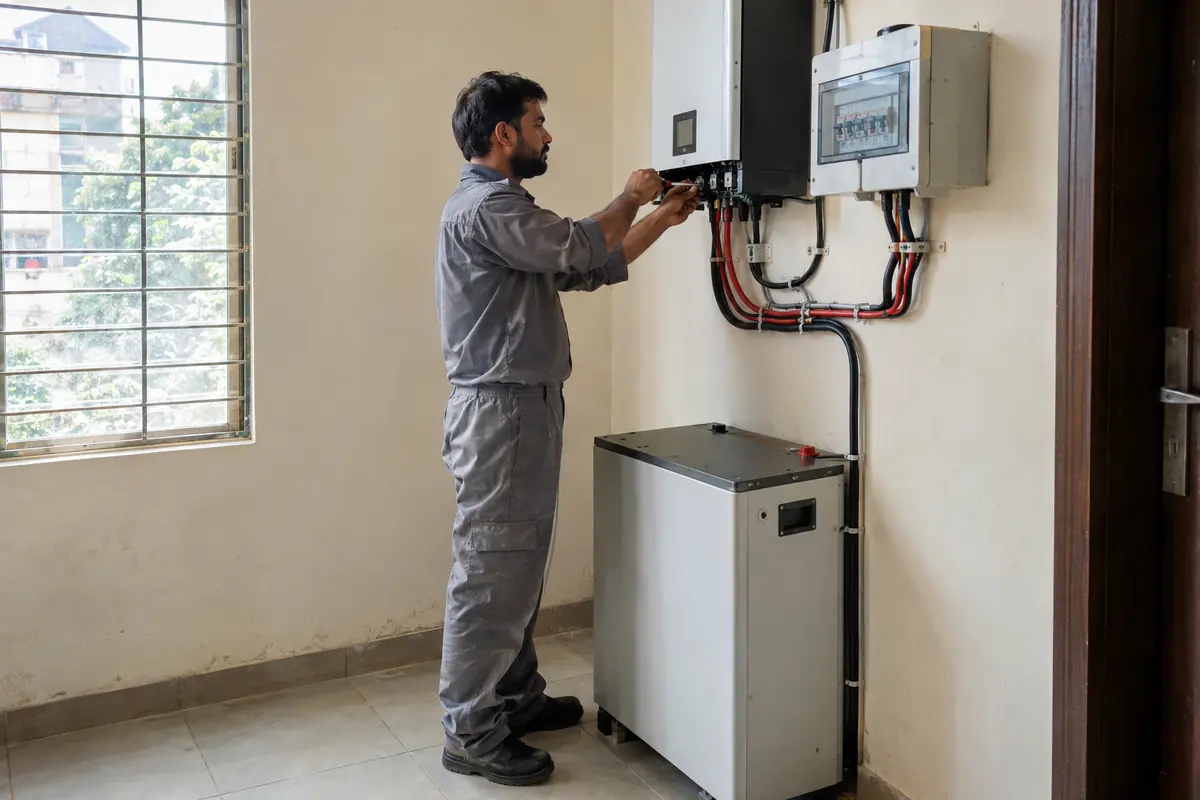
Here is the panel share for common system sizes using 585 W plates. These figures update automatically with the price sheet.
| System size | 585 W panels needed | Panel cost |
|---|---|---|
| 3 kW | 6 | Rs 140,400 |
| 5 kW | 9 | Rs 210,600 |
| 10 kW | 18 | Rs 421,200 |
The other parts are not on our price sheet, so we checked installer quotes and Pakistani retail listings. These are rough ranges as of October 2026 and vary by brand, city and roof:
| Component | 3 kW home | 5 kW home | 10 kW home |
|---|---|---|---|
| Inverter (on-grid or hybrid) | about Rs 70,000 to 200,000 | about Rs 100,000 to 250,000 | about Rs 250,000 to 500,000 |
| Mounting structure (standard rooftop) | about Rs 15,000 to 35,000 | about Rs 25,000 to 60,000 | about Rs 50,000 to 110,000 |
| Cables, MC4 connectors, breakers, earthing | about Rs 10,000 to 25,000 | about Rs 18,000 to 40,000 | about Rs 35,000 to 70,000 |
| Installation labour | about Rs 15,000 to 35,000 | about Rs 20,000 to 50,000 | about Rs 40,000 to 90,000 |
Batteries are the biggest swing item. Lithium (LiFePO4) banks were commonly quoted at roughly Rs 45,000 to 70,000 per kWh of storage as of October 2026, with premium brands higher. Tubular lead-acid batteries cost less upfront but need replacing every few years.
Quick rules of thumb
- An on-grid system with no batteries is the cheapest way to cut a bill, but it switches off during load-shedding.
- A hybrid system with a small lithium bank keeps fans, lights and the fridge running through outages.
- Elevated (girder) structures cost noticeably more than standard rooftop frames, but they keep the roof usable.
How many units will each system make?
A useful rule of thumb in most of Pakistan is that 1 kW of well-placed panels makes around 4 to 5 units a day on average across the year, more in May and June and less in foggy December and January in Punjab. Shading, dust and the roof direction all lower that figure.
| System size | Average units per day | Rough units per month |
|---|---|---|
| 3 kW | 12 to 15 | 360 to 450 |
| 5 kW | 20 to 25 | 600 to 750 |
| 10 kW | 40 to 50 | 1,200 to 1,500 |
Match the system to your bill. Look at your last twelve bills, find the average monthly units and size the system to cover most of the daytime use. Our solar panel calculator does the maths for you.
For a full breakdown with examples, see our solar system price in Pakistan guide.
A-grade vs B-grade vs used solar panels
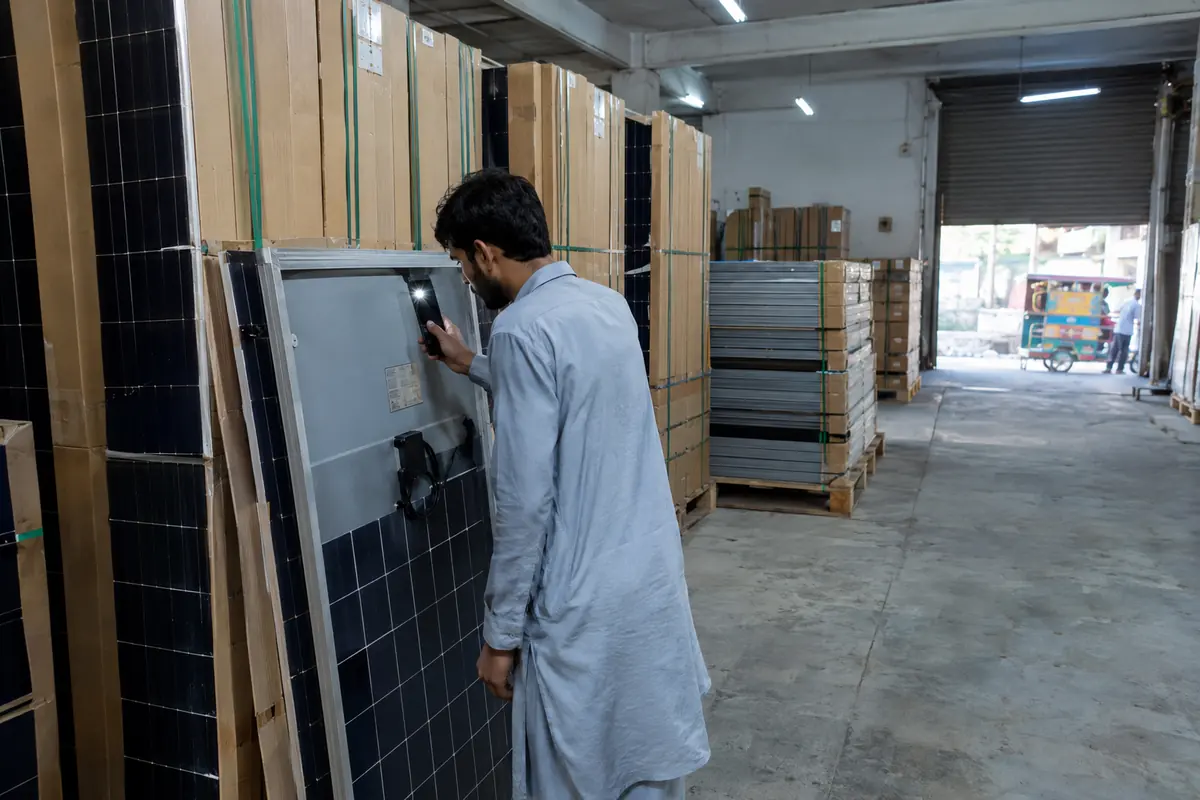
When a dealer quotes a very low solar panel plate price, the first question to ask is: what grade is it? The same model can be sold in different grades, and the difference shows up years later, not on day one.
| A-grade | B-grade | Used / second hand | |
|---|---|---|---|
| What it is | First-quality panel that passed every factory check | Panel with cosmetic or minor electrical flaws, sorted out at the factory | Panel removed from an older installation, often imported from abroad |
| Price | Full market rate | Noticeably cheaper | Cheapest per watt |
| Warranty | Full maker warranty when bought through an authorised importer | Often limited or dealer-only | Usually none |
| Output | Matches the label and flash report | May be slightly below label | Depends on age and handling; test it |
| Risk | Low | Medium | High |
Who should buy which?
- Grid-tied home system meant to last 20+ years: buy A-grade only. The saving on B-grade is small compared with the output you could lose over the life of the system.
- Tube well, farm or temporary site: B-grade can make sense if you see the panel tested in front of you.
- Single panel for a fan or a shop light: a tested used panel is a low-risk way to save money.
Used panels can be good value, but only if you measure the open-circuit voltage and short-circuit current against the label. Our used solar panels page explains how to test one.
Signs a “new A-grade” panel is not what it claims
- The price is far below every other dealer for the same model.
- The dealer cannot show a flash report or name the importer.
- The frame has scratches, old clamp marks or dust ingrained in the junction box.
- The wattage on the label is not a size the maker actually lists for that series.
How to check an original solar panel
Fake labels and re-stickered panels are a real problem in the market. Before you pay, run through these checks.
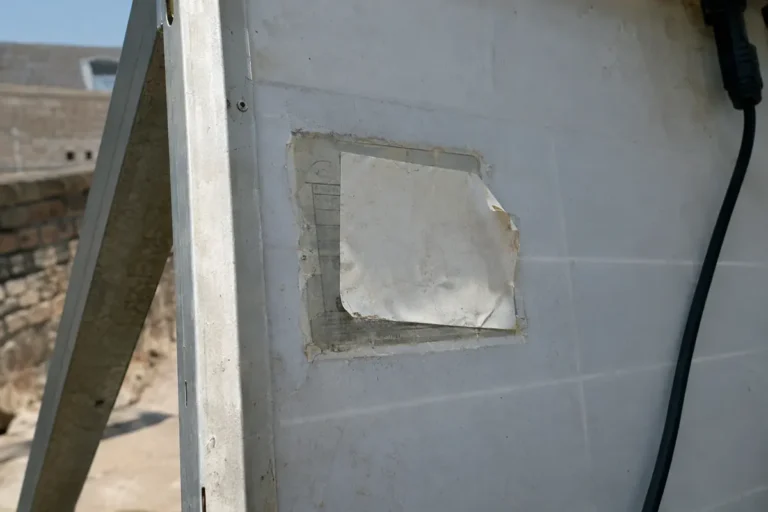
- Match the serial number. The serial on the back label, the frame sticker and the barcode should all be the same. A label stuck over an older label is a warning sign.
- Verify with the maker. Several big brands let you check a module’s serial or QR code on their official website. Longi, for example, has an authenticity checker on longi.com. For Jinko, follow the steps on our Jinko solar panel verification page.
- Ask for the flash report. Each genuine panel is tested at the factory. The report lists its measured power, voltage and current, and it should match that serial.
- Check the label details. The model number, wattage, Voc, Isc and certifications (IEC 61215 and IEC 61730) should match the maker’s published datasheet for that model.
- Get a warranty card or invoice. It should name the importer or distributor and the panel serials. A bill with no serials is not much use if a claim is needed.
- Look at the build. Uneven cell spacing, bubbles in the back sheet, a loose junction box or a thin frame point to a low-quality or fake panel.
Warranty terms to look for
Warranties only count if the panel came through a channel the maker recognises. Here is what a Tier 1 panel normally carries, so you can compare a quote with what you should get:
| Warranty | What it covers | Typical Tier 1 term |
|---|---|---|
| Product (material and workmanship) | Defects in the panel itself, such as a failed junction box or delamination | Usually 12 to 15 years, longer on some premium lines |
| Linear power | Guaranteed output over time | Usually 25 to 30 years |
| First-year loss | Output drop allowed in year one | Around 1% for N-type panels |
For example, Jinko lists a 30-year power warranty for its Tiger Neo range, with no more than 1% loss in the first year and 0.4% a year after that. Always read the datasheet for the exact model you are buying, because terms differ between series.
Net metering and net billing in Pakistan: how it works and payback
Net metering changed in 2026. On 9 February 2026 NEPRA notified new prosumer regulations that replaced the old net metering rules with net billing for new applicants. If you already had a net metering agreement before that date, it continues on its old terms until it expires.
| Old net metering (existing users) | Net billing (new users) | |
|---|---|---|
| How units are counted | Exported units offset imported units one for one | Imports and exports are billed separately |
| Export rate | Fixed rate in the original agreement | National average energy purchase price, reported at around Rs 11 per unit when the rules came in |
| Import rate | Normal tariff on the net units | Normal slab tariff on every imported unit |
| Agreement length | 7 years | 5 years, renewable |
| System size | Up to sanctioned load | Up to sanctioned load, maximum 1 MW |
How to apply
- Pick an installer who handles the DISCO paperwork (LESCO, IESCO, MEPCO, FESCO, GEPCO, PESCO, K-Electric and the others all have their own forms).
- Keep the system size within your sanctioned load. If you need more, apply for a load extension first.
- Submit the application with the CNIC, latest bill and system details.
- The DISCO inspects the site, then installs the bidirectional (green) meter.
- Sign the agreement and keep a copy.
Paperwork, meter and installer service charges for a home system commonly came to roughly Rs 15,000 to 30,000 as of October 2026, depending on the DISCO and the installer.
What this means for payback
Because exported units now earn far less than imported units cost, the money is in using your own solar during the day. A simple example: a home on a high slab paying around Rs 50 a unit saves that full Rs 50 on every solar unit it uses directly, but earns only around Rs 11 for each unit sent back. So run the AC, water pump, washing machine and iron in daylight. Homes that shift most of their use to the day still recover their system cost in a few years, while homes that export most of their output take noticeably longer. A small battery can also help by storing midday surplus for the evening peak.
Sizing a system under net billing
- Size for daytime use first. Add up the load that runs between about 9 am and 4 pm (ACs, pumps, fridge, fans) and cover that.
- Do not oversize just to export. Extra panels now earn a low export rate, so the return on the last few plates is weaker than before.
- Remember the limits. The system cannot exceed your sanctioned load, and a DISCO can refuse new connections on a transformer that already has a lot of solar on it.
Where to buy solar panels in Pakistan
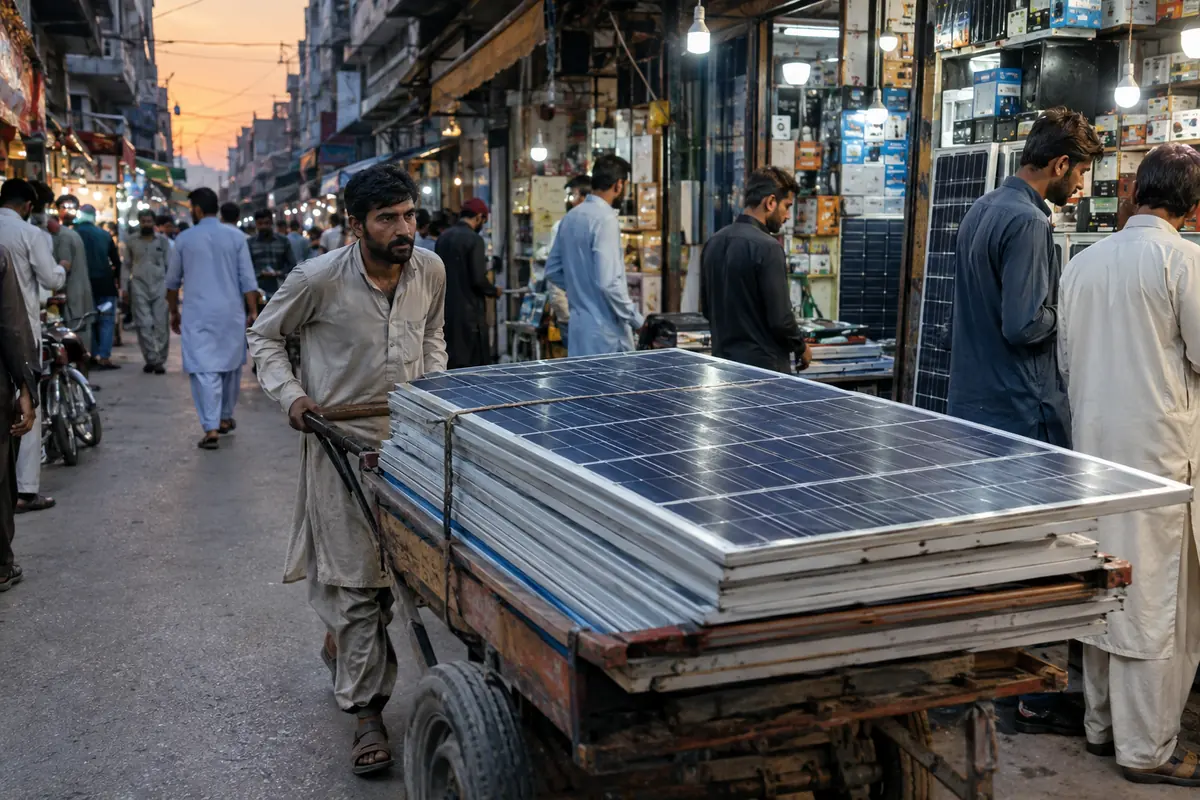
You can buy from wholesale markets, authorised distributors, installers or online sellers. Each has trade-offs.
| Where | Good for | Watch out for |
|---|---|---|
| Wholesale markets (for example Hall Road in Lahore) | Lowest cash rates, wide choice of brands | Mixed grades on the same shop floor; check serials yourself |
| Authorised distributors of the brand | Genuine stock and a warranty you can actually claim | Slightly higher rates |
| Installer packages | One contract for panels, inverter, structure and net billing | Compare the panel model and grade in the quote |
| Online stores and marketplaces | Easy price comparison, delivery | Pay only after inspection; avoid full advance to unknown sellers |
Questions to ask any dealer
- What is the exact model and wattage, and is it A-grade?
- Who is the importer, and will the warranty be honoured through them?
- Can I see the flash report for these serials?
- Is the rate for cash or bank transfer, and how long is it valid?
- Is delivery to my city included, and who pays if a panel breaks in transit?
Buying online safely
- Ask for the exact model number and grade in writing before paying.
- Prefer sellers that offer cash on delivery or a refundable token amount.
- Check the serials against the maker’s verification page on delivery.
- Keep the invoice, the warranty card and the delivery photos together.
Most stock lands at Karachi port and travels north by truck, so buyers in Peshawar, Multan or Faisalabad may see a small freight difference on each plate. Local competition matters too: a city with many dealers in one market usually has tighter rates than a town with two or three shops. Ask whether the quoted rate is ex-market or delivered to your door, and whether loading and unloading are included, because those small charges add up on a 20-panel order. See our city pages for Lahore, Karachi and Rawalpindi.
Tier 1 solar panel brands sold in Pakistan
Tier 1 makers have large factories, bank-backed finance and a long track record. These are the names you will see most in Pakistani markets.
- Jinko: the Tiger Neo N-type TOPCon range is one of the most common panels on Pakistani roofs. Compare models on our Jinko solar panel price page.
- Longi: known for its Hi-MO series, including back-contact HPBC panels. See the Longi solar panel price page.
- Canadian Solar: HiKu and bifacial TOPBiHiKu panels, popular on raised structures. See Canadian solar panel prices.
- JA Solar: the DeepBlue series, a common alternative to Jinko in the same sizes. Check JA Solar panel prices.
- Trina: Vertex N panels, including some of the largest sizes in the market. See Trina solar panel prices.
- Aiko, Astronergy and Risen: Aiko sells ABC back-contact panels, Astronergy competes on price with TOPCon, and Risen sells high-wattage HJT panels. See Aiko, Astronergy and Risen.
| Brand | Popular series | Cell type |
|---|---|---|
| Jinko | Tiger Neo | N-type TOPCon |
| Longi | Hi-MO X7, Hi-MO X9 | N-type, HPBC 2.0 back-contact on Hi-MO X9 |
| Canadian Solar | TOPBiHiKu6 | N-type TOPCon (bifacial options) |
| JA Solar | DeepBlue 4.0 | N-type TOPCon |
| Trina | Vertex N, Vertex N Ultra | N-type TOPCon |
| Aiko | Stellar 1N, Stellar 1N+ | N-type ABC |
| Astronergy | ASTRO N5 | N-type TOPCon |
| Risen | Hyper-ion | HJT |
You will also see local brands such as Inverex and Crown, and generic A-grade panels with no famous name on them. These are often cheaper. They can be fine for smaller systems, but check who actually made the cells, what the warranty says and who stands behind it in Pakistan before you choose one over a Tier 1 brand.
Not sure which one to choose? Our full comparison of solar panel brands in Pakistan covers local and lesser-known names too.
Frequently asked questions
What is the solar panel price in Pakistan today?
A-grade panels of 500 W and above start from Rs 20,520 as of 4 Nov 2026. The exact rate depends on wattage, brand and cell type, so check the live table at the top of this page for every size.
What is the price of one solar panel in Pakistan?
It depends on the size. A small panel for a fan costs a fraction of a 585 W rooftop panel, but it costs more per watt. Compare the price per watt when you are buying panels for a full system.
Why do solar panel rates change so often?
Panels are imported and paid for in dollars, so the rupee rate, Chinese factory prices, sales tax and port stock all move the local price. Summer demand also pushes rates up. That is why most dealer quotes are valid for only a day or two.
Which solar panel is best for a home in Pakistan?
For most grid-tied homes, an A-grade N-type panel in the 580 to 600 W range from a Tier 1 brand is the safest choice. It handles heat better than older Mono PERC panels and comes with a longer power warranty.
How many solar panels do I need for a 5 kW system?
With 585 W panels you need 9 plates for a 5 kW system. With 550 W panels you need 10. Check your roof space too, since each large panel takes roughly 2.6 square metres.
Is net metering still available in Pakistan?
New applicants now get net billing under NEPRA's 2026 prosumer regulations. Imported units are charged at your normal tariff and exported units are bought at a lower rate. People who signed net metering agreements before February 2026 keep their old terms until the agreement ends.
Is it safe to buy B-grade or used solar panels?
They can work for a tube well, a shop light or a temporary site if you test them first. For a home system meant to last 20 years, A-grade panels with a proper warranty are the better buy.
How can I check that a solar panel is original?
Match the serial number on the label, frame and barcode, then check it on the maker's verification page where one exists. Ask for the flash report and a warranty card that lists the serials.