| Model | Watt | Price per panel | Per watt | This week | Trend |
|---|---|---|---|---|---|
| Crown N-type bifacial 16BBN-type | 585 W | Rs 23,400 | Rs 40.0 | No change | |
| JA Solar DeepBlue 4.0 N-type bifacialN-type | 585 W | Rs 23,545 | Rs 40.2 | No change | |
| Astronergy ASTRO N5 bifacialN-type TOPCon | 585 W | Rs 23,985 | Rs 41.0 | No change | |
| Inverex Mustang bifacialN-type TOPCon | 585 W | Rs 24,280 | Rs 41.5 | No change | |
| Longi Hi-MO X7 bifacialN-type | 585 W | Rs 25,010 | Rs 42.8 | No change | |
| Canadian TOPHiKu6 bifacialN-type TOPCon | 585 W | Rs 25,155 | Rs 43.0 | No change | |
| Jinko Tiger Neo N-type bifacialN-type TOPCon | 585 W | Rs 25,420 | Rs 43.5 | No change |
On this page9 min read
- 585 watt solar panel specifications
- 585 W vs nearby wattages: which should you buy?
- How many 585 W panels for 3, 5 and 10 kW (with price)
- How many units does a 585 watt panel produce in Pakistan?
- What can a 585 watt solar panel run?
- Best inverter for 585 W panels
- Buying tips before you pay
- Frequently asked questions
The 585 watt plate is the panel most Pakistani installers quote by default, so the solar panel 585 watt price in Pakistan today is the number most buyers check first. The dated table above shows the live rate for every brand. Below we cover what you actually get for that money: real datasheet specs from four makers, how many plates you need for 3, 5 and 10 kW, units per season in four cities, and the checks to do before you hand over cash.
Right now the cheapest A-grade 585 W panel on our sheet is Rs 23,400, which works out to Rs 40 per watt. The market average across all large panels is Rs 41.3 per watt, so you can see at a glance whether 585 W is sitting above or below the pack.
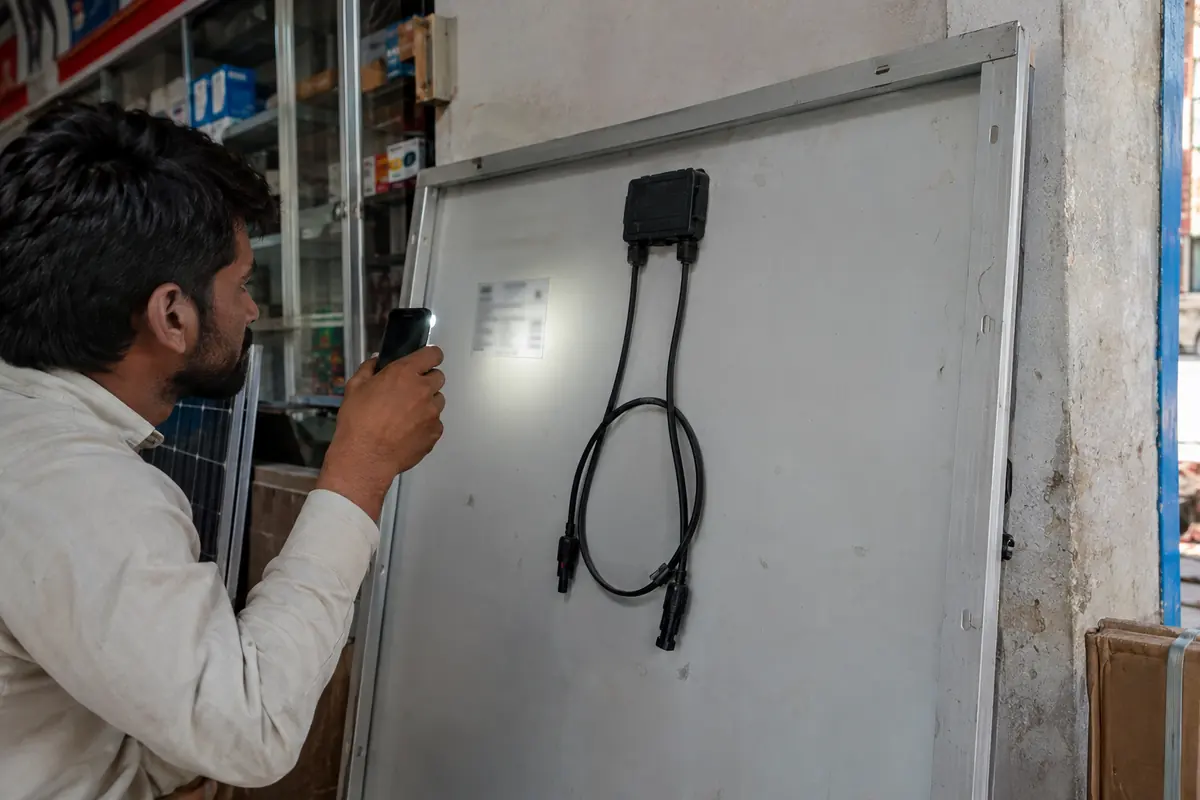
585 watt solar panel specifications
Many brands now sell a 585 watt solar panel in Pakistan, and the four compared here are Jinko, LONGi, JA Solar and Astronergy. All four use the same 2278 × 1134 mm frame, which is why installers treat 585 W as a standard size. LONGi has replaced its Hi-MO 6 with the Hi-MO X7 at this size, so the Hi-MO 6 figures below are for reference; ask for the X7 datasheet before you buy. Where they differ is weight, cell design and whether the back is glass.
| Spec (maker datasheet) | Jinko Tiger Neo JKM585N-72HL4-V | LONGi Hi-MO 6 LR5-72HTH-585M (now replaced by Hi-MO X7) | JA DeepBlue 4.0 JAM72D40-585/MB | Astronergy ASTRO N5 585 |
|---|---|---|---|---|
| Size (mm) | 2278 × 1134 × 35 | 2278 × 1134 × 35 | 2278 × 1134 × 30 | 2278 × 1134 × 30 |
| Size (feet) | 7.47 × 3.72 | 7.47 × 3.72 | 7.47 × 3.72 | 7.47 × 3.72 |
| Weight | 28.0 kg | 27.5 kg | 31.8 kg | 32.1 kg |
| Voc | 51.16 V | 52.36 V | 52.16 V | 52.42 V |
| Isc | 14.55 A | 14.27 A | 13.89 A | 14.07 A |
| Efficiency | 22.65% | 22.6% | 22.6% | 22.6% |
| Cells | 144 half-cut, N-type TOPCon | 144 half-cut, N-type HPBC (back contact) | 144 half-cut, N-type, bifacial | 144 half-cut, N-type TOPCon, bifacial glass-glass |
| Power temp. coefficient | -0.29%/°C | -0.29%/°C | -0.29%/°C | -0.29%/°C |
| Warranty (product / power) | 12 / 30 years | 15 / 25 years | 12 / 30 years | 15 / 30 years |
Two things stand out. First, the bifacial glass-glass panels (JA and Astronergy) weigh about 4 kg more each. On a 9-panel roof that is roughly 36 kg extra, which matters for light iron structures. Second, every one of them has a temperature coefficient of -0.29%/°C, which is much better than the -0.35%/°C of the older Mono PERC plates. In a Multan June, when cell temperature can sit around 60 to 65°C, that gap is worth a few percent of output every afternoon.
Monofacial or bifacial at 585 W?
The LONGi and Jinko plates above are monofacial: glass on the front, a backsheet behind. The JA and Astronergy versions are bifacial, so light reflected off the roof also reaches the back of the cells. Whether that extra is worth paying for depends on how the panels are mounted.
- Flush on a dark roof or a low tin shed: almost no rear gain. Buy whichever 585 W is cheaper per watt.
- On a raised iron structure 4 to 6 feet above a white or light-grey roof: a bifacial plate can pick up a few extra percent, more over white chips or a painted slab.
- Over a ground-mounted farm array on light soil: bifacial gain is real, and the glass back also resists moisture better.
- On a weak or old structure: the 4 kg extra per plate counts. Have the installer check the frame first.
If you can’t decide, ask the installer for the rear-side reflectivity of your roof.
If you need exact roof measurements, our guide to solar panel size in feet shows spacing and walkway allowances. For the LONGi range beyond 585 W, see our LONGi solar panel price page.
585 W vs nearby wattages: which should you buy?
The jump between 580, 585, 590 and 600 W is small on paper. In practice the decision usually comes down to price per watt on the day you buy and what your installer has in stock. This table pulls live numbers from our price sheet.
| Wattage | Cheapest A-grade price | Price per watt | Panels for 5 kW | Notes |
|---|---|---|---|---|
| 580 W | Rs 24,505 | Rs 42.3 | 9 | Same frame and family as 585 W |
| 585 W | Rs 23,400 | Rs 40 | 9 | Widest brand choice |
| 590 W | Rs 23,600 | Rs 40 | 9 | Fewer models, mostly bifacial |
| 600 W | Rs 25,500 | Rs 42.5 | 9 | Top bin, often a premium |
How to read it:
- If 580 W is cheaper per watt by even a few paisa, buy 580 W. It is the same panel from a slightly lower power bin. Our 580 watt page breaks this down.
- If the 600 W price per watt is close to 585 W, the 600 W plate gives you more output from the same frame size. See the 600 watt solar panel price page for the models.
- Canadian Solar also sells its TOPHiKu6 N-type at 585 W, currently Rs 25,155, and a 590 W version listed on our Canadian solar panel price page.
Brand prices at exactly 585 W
| Brand | Live price | Price per watt |
|---|---|---|
| Jinko | Rs 25,420 | Rs 43.5 |
| LONGi | Rs 25,010 | Rs 42.8 |
| JA Solar | Rs 23,545 | Rs 40.2 |
| Astronergy | Rs 23,985 | Rs 41 |
The spread between the cheapest and dearest 585 W brand is usually a few hundred rupees per plate. On a 10 kW job that adds up, but so does a stronger dealer warranty. For model-level detail on the most popular one, see the Jinko 585 watt price page.
How many 585 W panels for 3, 5 and 10 kW (with price)
Divide the system size by 585 and round up. Rounding up means you get a little more than the nameplate kW, which is no bad thing because real output is always below the label.
| System | Panels needed | Actual DC size | Panel cost (cheapest 585 W) | Panel area |
|---|---|---|---|---|
| 3 kW | 6 | 3.51 kW | Rs 140,400 | about 167 sq ft |
| 5 kW | 9 | 5.27 kW | Rs 210,600 | about 250 sq ft |
| 10 kW | 18 | 10.53 kW | Rs 421,200 | about 500 sq ft |
Panel area is just the plates themselves. Leave about 25% more roof for gaps, walkways and the parapet shadow, so a 5 kW array needs a clear roof patch of roughly 310 to 320 sq ft.
The panel cost above is only the plates. A complete system also needs an inverter, structure, DC and AC cabling, breakers, earthing and labour. When you compare quotes, ask each installer to list these items separately so you can see what the plates cost against everything else. Our full solar panel price list shows every wattage side by side if you want to price an alternative layout.
A practical example. A family in Johar Town with a 5 kW sanctioned load and a south-facing roof takes 9 plates of 585 W. That gives 5.27 kW DC, which pairs well with a 5 or 6 kW inverter. If the roof only fits 8 plates, they would be at 4.68 kW and still inside a 5 kW inverter’s comfort zone.
How many units does a 585 watt panel produce in Pakistan?
A single 585 W panel produces roughly 1.6 to 3.9 units (kWh) a day depending on city and season. The figures below use long-term solar data for each city at a good south-facing tilt, with about 22% taken off for heat, dust, wiring and inverter losses. They are averages; a cloudy week will be lower.
| City | Summer (per day) | Autumn | Winter | Spring | Average per month |
|---|---|---|---|---|---|
| Lahore | 2.9 units | 2.2 | 1.6 | 3.0 | about 73 units |
| Karachi | 2.8 units | 2.6 | 2.4 | 3.4 | about 83 units |
| Islamabad | 3.1 units | 2.3 | 1.7 | 2.9 | about 75 units |
| Multan | 3.0 units | 2.3 | 1.8 | 3.1 | about 77 units |
Multiply by your panel count for a system figure. Nine plates in Lahore average about 650 units a month, but expect roughly 440 in December and January and close to 800 in April and May. Karachi is steadier across the year because its winters are sunnier, while Lahore and Islamabad lose a lot to fog and haze in December and January.
A 9-panel, 5.27 kW system through the year
| Season | Lahore per month | Karachi per month | Islamabad per month | Multan per month |
|---|---|---|---|---|
| Summer | about 780 units | about 740 | about 840 | about 820 |
| Autumn | about 590 | about 690 | about 620 | about 620 |
| Winter | about 440 | about 640 | about 460 | about 490 |
| Spring | about 800 | about 930 | about 790 | about 830 |
The gap between the best and worst month is what catches most buyers out. A Lahore family that uses 600 units a month will be covered through spring and summer, run close in autumn, then fall short in December and January. Plan the bill for those two months, not for May.
Under the NEPRA (Prosumer) Regulations 2026, new solar connections are on net billing, where exported units are credited at a much lower rate than the units you buy from the grid. That makes the winter figure more important than the summer one: size for what you use, not for how much you can export.
What can a 585 watt solar panel run?
On a clear afternoon a 585 W panel delivers about 430 to 480 W of usable AC after heat and inverter losses. Over a day in Lahore that averages around 2.4 units. Here is what that covers.
| Appliance | Typical draw | How many on one panel at midday | Daily units covered by one panel |
|---|---|---|---|
| DC inverter ceiling fan | 30–40 W | 11–13 fans | about 6 fans for 10 hours |
| Standard AC ceiling fan | 75–90 W | 5 fans | about 3 fans for 10 hours |
| LED bulb | 10–15 W | 30+ bulbs | lights for a whole house |
| Inverter fridge | about 1–1.5 units per day | runs easily | one fridge plus spare |
| 1.5 ton inverter AC | 0.6–1.6 kW, varies with heat | not alone | needs 3–4 panels on a hot afternoon |
| 1 HP water motor | about 750 W running | not alone | 2 panels plus inverter headroom for startup |
The usual mistake is to count panels against the AC alone. A 1.5 ton inverter AC that runs eight hours in June can easily use 8 to 10 units, which is four plates’ worth in Lahore. Add fans, fridge and the motor and you see why most homes in Punjab end up with 9 to 12 plates rather than five.
Best inverter for 585 W panels
The two numbers to match are voltage and current. A 585 W panel has a Voc of about 51 to 52.4 V at 25°C, and that voltage rises in cold weather. On a 0°C January morning in Islamabad, a LONGi 585 can reach about 55 V. Always size the string on the cold figure.
| Inverter type | Typical max PV voltage | 585 W panels per string | Fits |
|---|---|---|---|
| Single-phase hybrid, 4–6 kW | 450–550 V (check label) | 7–9 | Homes with batteries or heavy load-shedding |
| Single-phase on-grid, 5–6 kW | about 550–600 V | 9–10 | Net billing homes, no battery |
| Three-phase on-grid, 10–15 kW | 1000–1100 V | up to 17–18 | Large homes, shops, offices |
Current matters too. These panels push 13.9 to 14.6 A short-circuit current, so pick an inverter whose MPPT input is rated for at least 15 A per string. Many new models are rated higher, but some older hybrid units are not.
On-grid or hybrid? With net billing paying less for exports, a hybrid with a modest battery makes more sense than it did a few years ago, especially in areas with long load-shedding. If you have stable supply and use most of your power in daytime, an on-grid inverter is still the cheapest per unit. Whatever you choose, get the string layout in writing from the installer, with the cold-weather voltage calculation shown.
Buying tips before you pay
Most problems with 585 W panels come from paperwork and handling, not the cells. Use this checklist.
- Check the grade. Ask for A-grade in writing. The label on the back should show the full model code, such as JKM585N-72HL4-V or LR5-72HTH-585M, and a serial number that matches the box.
- Verify the serial. Jinko lets you check serials online, and other makers’ distributors will confirm a serial on request. Our Jinko verification guide shows the steps.
- Get the warranty card from the official distributor, not just the dealer’s stamp. The power warranty only helps if the panel can be traced to an authorised import.
- Inspect on delivery. Panels should travel upright in their cartons. Refuse any plate with chipped glass, a bent frame or a cracked junction box.
- Ask for a flash test report if you buy a full container or pallet. It lists the measured watts for each serial.
- Get a proper bill with brand, model, wattage, quantity, serial numbers and date. You need it for warranty claims and for your net billing file.
- Do not mix models in one string. A Jinko 585 and a LONGi 585 have different voltages, so keep each brand on its own MPPT.
Bought right and installed on a sound structure, a 585 W N-type panel should still be making about 87 to 89% of its rated power after 25 to 30 years, going by the makers’ power warranties.
Frequently asked questions
What is the 585 watt solar panel price in Pakistan today?
The cheapest A-grade 585 watt panel on our sheet starts from Rs 23,400 as of 9 Oct 2026. Brand prices differ by a few hundred rupees per plate, so check the table at the top of the page for Jinko, LONGi, JA Solar and Astronergy rates side by side.
What is the size of a 585 watt solar panel in feet?
Most 585 W panels sold in Pakistan measure 2278 × 1134 mm, which is about 7.5 × 3.7 feet. Thickness is 30 or 35 mm depending on the model, and weight runs from about 27.5 kg for monofacial plates to about 32 kg for glass-glass bifacial ones.
How many units does a 585 watt panel make per day?
In Lahore one 585 W panel averages about 2.4 units a day across the year, from about 1.6 in winter to nearly 3 in spring. Karachi and Quetta do better, while Lahore, Faisalabad and Islamabad drop most in December and January because of fog and haze.
How many 585 watt panels do I need for a 5 kW system?
You need 9 panels of 585 W, which gives 5.27 kW. That fits a 5 or 6 kW inverter well. If your roof only fits 8, you get 4.68 kW, which still works with a 5 kW inverter.
Is Jinko or LONGi better at 585 watts?
Both are N-type and both use the same frame size; the Tiger Neo and the older Hi-MO 6 both have a -0.29%/°C temperature coefficient, so real output is very close. Jinko's Tiger Neo carries a 30-year power warranty, while LONGi's Hi-MO 6 had a longer 15-year product warranty. LONGi has now replaced it with the Hi-MO X7, so check the X7 datasheet for its terms. Choose on price per watt and on which distributor gives a proper warranty card.
Can a 585 watt solar panel run an AC?
One panel cannot run a 1.5 ton inverter AC on its own. On a hot afternoon such an AC can draw 1 kW or more, so plan on 3 to 4 panels for the AC alone, plus more for fans, fridge and lights.
Is a 585 watt panel better than a 580 watt panel?
They are usually the same model from a slightly different power bin, with identical size and design. Buy whichever is cheaper per watt on the day; 5 watts per plate makes almost no difference to your bill.
Should I buy a bifacial 585 watt panel?
Bifacial plates only pay off when mounted high above a light-coloured roof or ground. Flush on a dark roof the rear side gets very little light, so a cheaper monofacial 585 W panel is the better buy.