| Model | Watt | Price per panel | Per watt | This week | Trend |
|---|---|---|---|---|---|
| Jinko Tiger Neo 3.0 bifacialN-type TOPCon | 620 W | Rs 26,660 | Rs 43.0 | No change | |
| Jinko Tiger Neo N-type bifacialN-type TOPCon | 585 W | Rs 25,420 | Rs 43.5 | No change | |
| Jinko Tiger Neo N-typeN-type TOPCon | 580 W | Rs 24,505 | Rs 42.3 | No change | |
| Jinko Tiger Pro P-type (old stock)Mono PERC | 550 W | Rs 20,900 | Rs 38.0 | No change | |
| Jinko Tiger Pro P-type (old stock)Mono PERC | 540 W | Rs 20,520 | Rs 38.0 | No change |
On this page12 min read
Jinko solar panels price in Pakistan moves with the dollar, freight and dealer stock, so the table above is updated from the market and the rest of this page explains what you are actually paying for. Below you will find every Jinko model that is common in Pakistani shops, what the warranty really covers, how to confirm a plate is genuine, and how Jinko compares with Longi, JA, Canadian and Trina before you commit your money.
If you only want a quick number, the cheapest Jinko panel on our sheet right now costs Rs 20,520, and the popular Tiger Neo 585 W sells for about Rs 25,420 a plate, or Rs 43.5 per watt.
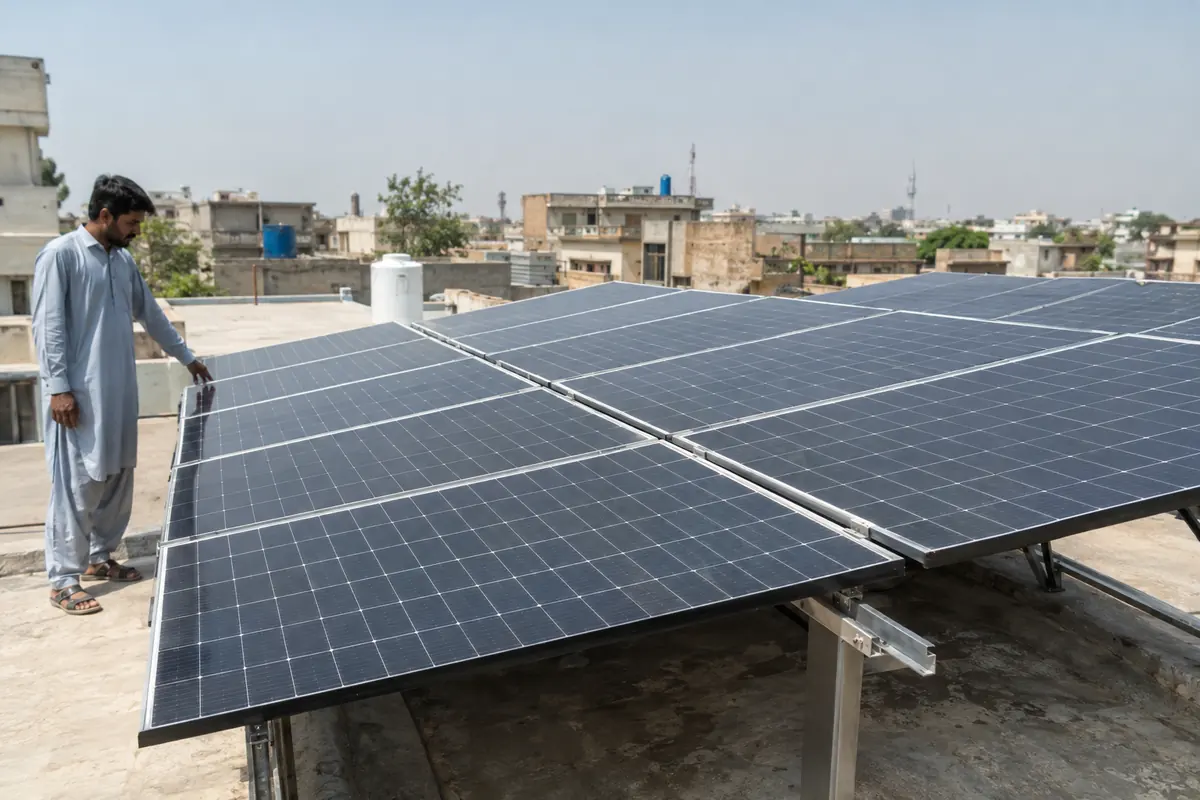
About Jinko solar
JinkoSolar is a Chinese manufacturer founded in 2006. It makes its own wafers, cells and modules, sells in well over a hundred countries, and has been one of the largest module shippers in the world for most of the last decade. It is listed on BloombergNEF’s Tier 1 list, which is a bankability ranking used by lenders. Tier 1 does not mean a panel is “the best”, but it does mean the factory is large, financed and still going to exist when you make a warranty claim in year eight.
In Pakistan, Jinko is the name most buyers ask for first. In January 2026 the company said it had shipped a cumulative 13 GW of modules to Pakistan, including 5.5 GW in 2025 alone, and claimed close to 40% of the local module market. It launched its Tiger Neo 3.0 range at an event in Lahore with around 300 distributors and partners. Those are the company’s own figures, but anyone who has walked through a solar market in Lahore, Karachi or Rawalpindi knows the brand is everywhere.
| Fact | Detail |
|---|---|
| Founded | 2006, China |
| What it makes | Wafers, cells, modules, storage |
| Main panel family today | Tiger Neo (N-type TOPCon) |
| Older family still in stock | Tiger Pro (P-type mono PERC) |
| Pakistan shipments (company figure) | 13 GW cumulative, 5.5 GW in 2025 |
| Bankability | BloombergNEF Tier 1 list |
That popularity is a double-edged sword. Because “Jinko” sells itself, it is also the most copied brand in the country, which is why checking serials matters more for Jinko than for any other brand.
What Tier 1 does and does not tell you:
- It does tell you the maker is large, financed by banks and likely to be around for the length of the warranty.
- It does not tell you that a particular plate in a particular shop is genuine, A-grade or stored properly.
- It does not rank efficiency, heat performance or price. Those you compare model by model, as we do below.
Jinko solar panel models explained
Most Jinko panels sold in Pakistan fall into two families. Tiger Pro is the older P-type mono PERC range that dominated rooftops a few years ago and is now sold only as old stock. Tiger Neo is the newer N-type TOPCon range that now makes up most new stock. Dealers often just say “Jinko N-type” or “Jinko 585”, so it helps to know which family a wattage belongs to.
| Series (model code) | Cell type | Wattage sold here | Max module efficiency (datasheet) | Live price |
|---|---|---|---|---|
| Tiger Pro 72HC (JKM540M-72HL4-V) | P-type mono PERC, 144 half-cells | 540 W | about 21% | Rs 20,520 |
| Tiger Pro 72HC (JKM550M-72HL4-V) | P-type mono PERC, 144 half-cells | 550 W | 21.33% | Rs 20,900 |
| Tiger Neo 72HL4-(V) (JKM580N) | N-type TOPCon, 144 half-cells | 580 W | 22.45% | Rs 24,505 |
| Tiger Neo 72HL4-(V) (JKM585N) | N-type TOPCon, 144 half-cells | 585 W | 22.65% | Rs 25,420 |
| Tiger Neo 78HL4-BDV (JKM620N) | N-type TOPCon bifacial, dual glass, 156 half-cells | 620 W | about 22.2% | Rs 26,660 |
Reading a Jinko model code
The back label tells you more than the shop will. Here is how to read a Jinko code such as JKM585N-72HL4-V:
| Part of the code | Meaning |
|---|---|
| JKM | Jinko module |
| 585 | Rated power in watts at standard test conditions |
| N or M | N = N-type (Tiger Neo); M = mono PERC (Tiger Pro) |
| 72 or 78 | Cell layout: 72 for the standard 144 half-cell size, 78 for the longer 156 half-cell size |
| BDV | Bifacial, dual glass |
| V at the end | Rated for 1500 V systems (versions without it are 1000 V) |
If the dealer’s invoice says “Jinko 585 N-type” but the label reads JKM550M, you are looking at a Tiger Pro PERC panel, not a Tiger Neo. That one check alone catches a lot of mis-selling.
Tiger Pro: the budget Jinko
The 540 W and 550 W Tiger Pro plates are now old stock, still around because some buyers want the Jinko name at the lowest cost. They are good panels, but PERC loses more power in heat (a temperature coefficient of about -0.35%/°C against -0.29%/°C for Tiger Neo) and ages faster. If you are searching for the Jinko solar panel 550 watt price in Pakistan today, the live figure is Rs 20,900, and you can compare other brands at the same size on our 550 watt price page.
Tiger Neo: what most people buy now
Tiger Neo 580 W and 585 W are the same physical panel, 2278 x 1134 x 35 mm and about 28 kg, sorted into power bins at the factory. The 585 W bin is simply the higher-output cells. We cover the difference in detail on the Jinko 585 watt and Jinko 580 watt pages.
Tiger Neo 620 W bifacial
The 620 W plate is a longer 78-cell, glass-glass bifacial module. It makes sense on raised steel structures over a light-coloured roof, where the back side catches reflected light. At roughly 2465 x 1134 mm and close to 35 kg, it is heavy and awkward to carry up a narrow staircase, and on a flat concrete roof with a low frame the bifacial gain is small.
How many Jinko plates for a typical home
Most homes in Pakistan size a system by the bill, not the roof. As a rough guide, this is how many Tiger Neo 585 W plates you need for common system sizes, rounded up:
| System size | 585 W plates needed | Approx. roof area for panels | Typical use |
|---|---|---|---|
| 3 kW | 6 | about 15 to 18 square metres | Fans, lights, fridge, one small inverter AC in the day |
| 5 kW | 9 | about 25 to 30 square metres | A typical 5 marla to 10 marla house with one or two ACs |
| 10 kW | 18 | about 50 to 60 square metres | Large house or small shop, two to three ACs |
Multiply the plate count by the Jinko 585 W rate in the table above to get the panel cost. Inverter, structure, wiring and labour come on top. Our 5 kW solar system price page breaks down a full system.
Jinko has also launched Tiger Neo 3.0, rated up to 670 W for utility projects. Large sizes like that show up mainly in commercial jobs, not on house roofs.
Jinko solar panel warranty in Pakistan
Every Jinko datasheet lists two different warranties, and buyers often mix them up.
- Product warranty: covers manufacturing defects such as delamination, broken junction boxes or frame faults. Tiger Neo and Tiger Pro datasheets both list 12 years.
- Linear power warranty: promises how much output the panel keeps over time. Tiger Neo: 30 years, with no more than 1% loss in year one and 0.40% per year after that, so at least 87.4% of rated power in year 30. Tiger Pro: 25 years, 2% in year one and 0.55% per year, ending around 84.8%.
| Model | Product warranty | Power warranty | Year-1 loss | Yearly loss after |
|---|---|---|---|---|
| Tiger Neo 580/585 W | 12 years | 30 years | 1% | 0.40% |
| Tiger Pro 540/550 W | 12 years | 25 years | 2% | 0.55% |
Who honours a claim here? Jinko’s warranty is tied to the region a panel was officially sold into, and Jinko’s own serial check tells you whether a module is eligible in your country. In practice your first call is the dealer and the distributor who imported the container. Ask before you pay: “If a plate fails, who collects it, who tests it, and how long does a replacement take?” Get the answer on the invoice, with the serial numbers written on it. A shop that cannot tell you which importer the stock came through is a shop that will not be around for a warranty claim.
What a Jinko warranty claim needs
If a panel does fail, the claim moves much faster when you have the paperwork ready from day one:
- The original invoice showing model code and serial numbers
- Photos of each panel’s back label taken before installation
- Installation date and the installer’s name
- Photos or a video of the fault, plus any reading the installer took with a meter
- The serial check result from Jinko’s site showing the panel was sold into Pakistan’s region
Power warranty claims are harder than defect claims, because you have to show the panel is producing less than the guaranteed curve under test conditions. A single dusty afternoon reading on your inverter app is not proof. Ask your installer to measure open-circuit voltage and short-circuit current on a clear day and compare with the datasheet.
Physical damage from bad handling, hail, a falling object or poor installation is not a manufacturing defect, so it is not covered. Keep photos of the panels on delivery day.
How to check an original Jinko panel
Fake and relabelled Jinko plates are a real problem. The good news is that Jinko gives you a free way to check. Here is the short version; the full step-by-step is on our Jinko serial number check guide.
- Find the 24-digit serial number. Jinko says it is printed in one corner on the front of the module and in the centre of the label on the back.
- Go to Jinko’s official serial number authentication page, which is hosted on Jinko’s own customer service site (cs.jinkosolar.com). Select Pakistan as the country and enter the serial.
- Read the result. Jinko’s tool says whether the serial is genuine and whether it was sold into your country’s sales region, which affects warranty support.
Other checks that take two minutes in the shop:
| Check | Genuine Jinko | Warning sign |
|---|---|---|
| Serial on front and back | Same number, cleanly printed | Missing, mismatched or a sticker over a sticker |
| Back label | Model code like JKM585N-72HL4-V, electrical data matches datasheet | Wrong Voc/Isc values, spelling mistakes, blurry print |
| Size and weight | Tiger Neo 585: about 2278 x 1134 mm, about 28 kg | Noticeably lighter or a different size |
| Price | Close to market average | Far below Rs 23,400 for a “585 W Jinko” |
| Verification site | Jinko’s own domain | Look-alike sites with “jinko” in a different domain name |
That last point matters. Several websites with names like “jinko verification” are not run by Jinko. Only trust a page on a jinkosolar domain.
Jinko vs other Tier 1 brands
Most Pakistani buyers shortlist Jinko against Longi, JA Solar, Canadian Solar and Trina. All five are Tier 1 and all sell good panels. The differences are in technology, warranty fine print and how easy the brand is to find and resell.
| Brand | Main high-watt model here | Cell type | Power warranty | Live price (closest size) |
|---|---|---|---|---|
| Jinko | Tiger Neo 585 W | N-type TOPCon | 30 years | Rs 25,420 |
| Longi | Hi-MO X7 585 W | N-type bifacial | check the datasheet | Rs 25,010 |
| JA Solar | DeepBlue 4.0 585 W | N-type, bifacial | 30 years | Rs 23,545 |
| Canadian | TOPHiKu6 590 W | N-type TOPCon bifacial | 30 years | Rs 25,370 |
| Trina | Vertex N 590 W | N-type TOPCon | varies by version | Rs 23,600 |
What this means in practice:
- Price: Jinko is rarely the cheapest Tier 1 plate, but it is usually close, and it resells easily because everyone knows the name.
- Efficiency: At 22.65%, Tiger Neo 585 W is on par with JA’s DeepBlue 4.0 and Longi’s Hi-MO X7 at the same size. Real output on your roof will differ by a few percent at most.
- Warranty: Jinko’s 30-year power warranty on Tiger Neo matches JA and Canadian’s N-type ranges; check the Longi Hi-MO X7 datasheet for its terms.
- Availability: Jinko is the easiest brand to find in any city, which also means it is the easiest to fake.
Why N-type matters more in Pakistan than in Europe
On a May afternoon in Multan or Jacobabad, panel cells easily run 35 to 45°C hotter than the 25°C test condition. Every degree costs output according to the temperature coefficient on the datasheet. At 40°C above test conditions, a Tiger Pro PERC panel (-0.35%/°C) gives up about 14% of its rated power, while a Tiger Neo TOPCon panel (-0.29%/°C) gives up about 11.6%. On a 5 kW system that gap is roughly 120 watts during the hottest, most expensive hours of the day. It is the main reason we suggest Tiger Neo over Tiger Pro even when Tiger Pro is cheaper per plate.
For a full side-by-side of every brand, see solar panel brands in Pakistan and our ranking of the best solar panels in Pakistan.
Jinko solar panels: pros and cons
| Pros | Cons |
|---|---|
| Best-known brand in Pakistan, easy to resell | Most counterfeited brand in the market |
| Tiger Neo has a 30-year power warranty | Usually costs a little more than JA or Canadian at the same watt |
| Low heat loss (-0.29%/°C) suits Pakistani summers | Warranty claims depend on the local importer, not a Jinko service centre near you |
| Free official serial check | Many dealers still push older Tiger Pro PERC stock |
| Wide range from 540 W to 620 W | 620 W bifacial plate is heavy for small rooftops |
Which Jinko should you pick?
- Tight budget, small roof: Tiger Pro 550 W only if the per-watt rate is clearly lower than Tiger Neo. Otherwise skip PERC.
- Most homes: Tiger Neo 585 W. It is the best-supported size, the easiest to match with other plates later, and dealers stock it in every city.
- Raised structure, light roof, commercial job: Tiger Neo 620 W bifacial, if your installer has planned strings for its higher current.
Our honest take: if you buy Tiger Neo from a dealer who writes serial numbers on the invoice and you verify them yourself, Jinko is a safe choice. The risk with Jinko is not the panel, it is the shop.
Where to buy Jinko solar panels
Jinko does not run retail shops in Pakistan. Panels come in through importers and distributors, then go to dealers and installers in each city. That chain is fine, but you want to buy from someone near the top of it.
- Karachi: Containers land at Karachi port, so the Jinko solar panel price in Karachi is often the same or slightly lower than inland cities. Up-country, add a few hundred rupees per plate for freight and loading.
- Lahore, Rawalpindi, Islamabad, Faisalabad, Multan: Large dealer markets carry Jinko stock; compare at least three quotes for the same model code, not just “Jinko 585”.
- Installers: Many installers buy in bulk and pass on a fair price in a full system quote. Ask for the model code and serial list before installation day.
Why two dealers quote different Jinko prices
It is normal to get three different quotes for “Jinko 585” in the same market on the same day. The reasons are usually one of these:
| Reason | What to ask |
|---|---|
| Different model code (mono-facial vs bifacial, 1000 V vs 1500 V) | “Is it JKM585N-72HL4-V or a BDV version?” |
| Old stock bought at a lower dollar rate | “When did this container clear?” |
| Delivery and loading included or not | “Is the price at your godown or at my house?” |
| Single plate vs full-system rate | “What is the rate for my full quantity?” |
| B-grade or relabelled stock | “Can I check the serials on Jinko’s site right now?” |
Before you pay, run through this list:
- Ask for the full model code (for example JKM585N-72HL4-V), not just the wattage.
- Get the serial numbers on the invoice.
- Check two or three serials on Jinko’s official site in the shop.
- Confirm who handles a warranty claim and write it on the bill.
- Compare the quote with today’s sheet; if it is far below Rs 23,400, walk away.
If you are pricing a full rooftop job, our 585 watt solar panel price page compares every brand at the most popular size, and the home page shows today’s rates across all wattages.
Frequently asked questions
What is the Jinko solar panel price in Pakistan today?
The headline Jinko rate on this page is Rs 20,520, updated 9 Oct 2026. Prices change with the dollar and dealer stock, so check the table at the top of the page for each model and wattage before you buy.
Which Jinko solar panel is best for a home in Pakistan?
For most homes the Tiger Neo 585 W is the safest pick. It is N-type TOPCon, loses less power in summer heat than the older Tiger Pro PERC panels, carries a 30-year power warranty and is stocked in every city.
Is Jinko N-type better than Jinko Tiger Pro?
Yes, for Pakistani conditions. Tiger Neo N-type has a lower temperature loss (-0.29%/°C against about -0.35%/°C), slower yearly ageing (0.40% against 0.55%) and a 30-year power warranty instead of 25 years. Tiger Pro only makes sense if its price per watt is clearly lower.
How do I check if my Jinko solar panel is original?
Find the 24-digit serial number on the front corner and back label, then enter it with Pakistan as the country on Jinko's official authentication page on its own jinkosolar domain. Also match the model code, size and weight with the datasheet, and avoid look-alike verification websites.
What warranty do Jinko solar panels have in Pakistan?
Tiger Neo panels carry a 12-year product warranty and a 30-year linear power warranty. Tiger Pro panels carry 12 years on the product and 25 years on power. Claims go through the dealer and importer, so get serial numbers written on your invoice.
Why is the Jinko solar panel price in Karachi sometimes lower?
Most panels are imported through Karachi port, so Karachi dealers do not pay inland freight. In Lahore, Islamabad or Multan the same plate usually costs a little more to cover transport and handling.
Is Jinko better than Longi or JA Solar?
All three are Tier 1 brands with similar efficiency at 580 to 585 W. Jinko is the easiest to find and resell, JA and Canadian are often slightly cheaper, and Longi now sells the N-type Hi-MO X7 and the back-contact Hi-MO X9. Choose on price per watt, warranty terms and the dealer's reliability.
How many Jinko 585 W panels do I need for a 5 kW system?
You need nine 585 W panels to reach just over 5 kW. Plan for roughly 25 to 30 square metres of shade-free roof, plus space to walk between rows for cleaning.