| Model | Watt | Price per panel | Per watt | This week | Trend |
|---|---|---|---|---|---|
| Jinko Tiger Neo N-typeN-type TOPCon | 580 W | Rs 24,505 | Rs 42.3 | No change |
On this page11 min read
The Jinko solar panel 580 watt price in Pakistan is Rs 24,505 per plate on today’s sheet, or Rs 42.3 per watt. The 580 W is the quieter sibling of the famous Jinko 585: same Tiger Neo panel, same size, same warranty, sorted into a slightly lower power bin. This page explains when the 580 is the smarter buy, what the bifacial 580 is for, and how to check the plate before you pay.
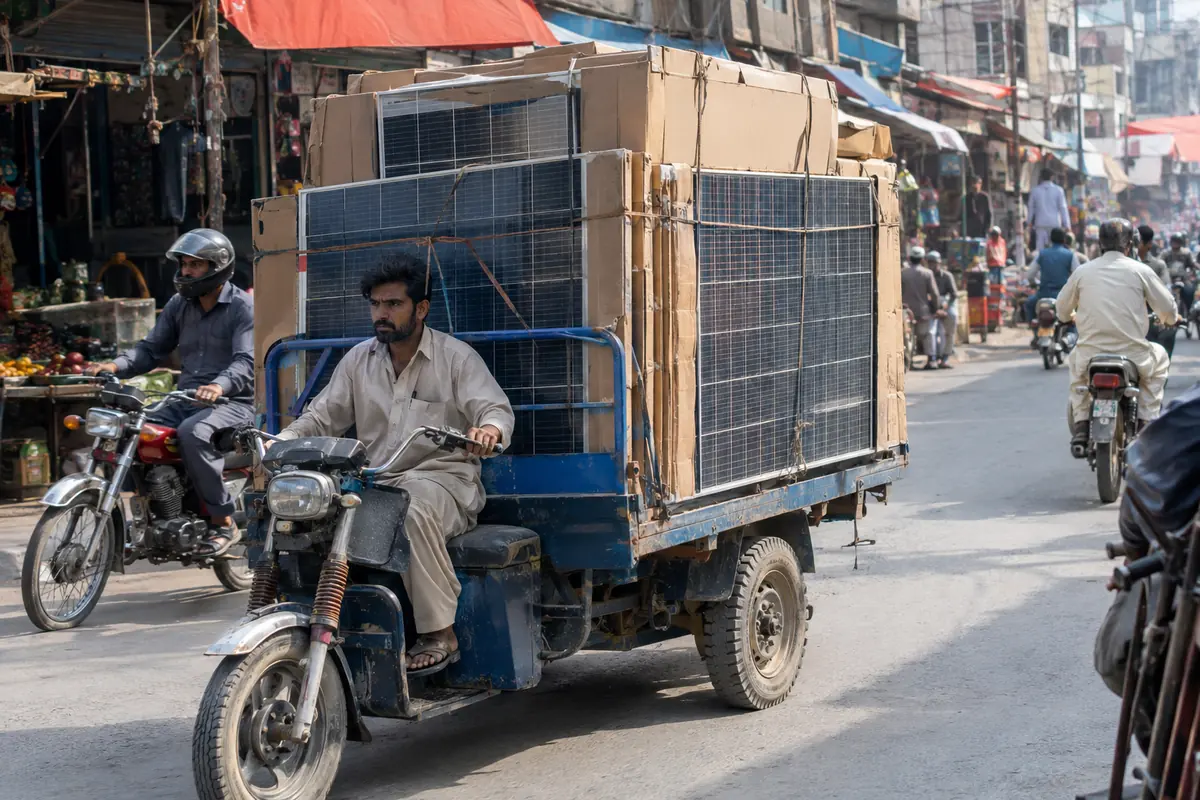
About the Jinko 580 watt panel
Jinko is a Tier 1 Chinese manufacturer founded in 2006 and, by its own account, the market leader in Pakistan, with a cumulative 13 GW of modules shipped here by the end of 2025. Its Tiger Neo N-type range is the one you see on most new rooftops.
The 580 W you will find in Pakistani shops is usually one of two Tiger Neo models:
- JKM580N-72HL4-V, the mono-facial version with a white backsheet, from the 565 to 585 W range.
- JKM580N-72HL4-BDV, the bifacial glass-glass version, which is the top power bin of a 560 to 580 W bifacial range.
Factories measure every panel at the end of the line and sort it into 5 W “bins”. A 580 W plate is not a different design from the 585 W; its cells simply tested a little lower. That is why the two are priced close together, and why the 580 is often the better value per watt.
| What is the same as the 585 | What is different |
|---|---|
| Tiger Neo N-type TOPCon, 144 half-cells | 5 W less output per plate |
| 2278 x 1134 mm frame | Slightly lower current and voltage |
| 12-year product, 30-year power warranty | Efficiency 22.45% instead of 22.65% |
| Same structure, clamps and cables | Usually a little cheaper per plate |
Why does 580 stock exist at all? Every production run gives a spread of results. Most Tiger Neo 72HL4 panels test somewhere between 570 and 585 W, and the factory sells each bin to the markets that want it. Pakistani importers mostly order the top bins, so you will usually see 580 and 585 side by side, with 575 or 570 turning up now and then in clearance deals. A lower bin is not a lower grade: it is the same A-grade panel with a slightly lower measured output.
For the full Jinko line-up, see the main Jinko solar panel price in Pakistan page.
Jinko 580 watt models explained
Mono-facial vs bifacial Jinko 580
| Datasheet spec | JKM580N-72HL4-V (mono-facial) | JKM580N-72HL4-BDV (bifacial) |
|---|---|---|
| Module efficiency | 22.45% | 22.45% (front side) |
| Back | White backsheet | 2.0 mm heat-strengthened glass |
| Front glass | 3.2 mm tempered, anti-reflective | 2.0 mm, anti-reflective |
| Frame depth | 35 mm | 30 mm |
| Weight | about 28 kg | about 32 kg |
| Vmp / Imp | 42.37 V / 13.69 A | 42.59 V / 13.62 A |
| Voc / Isc | 51.02 V / 14.47 A | 51.47 V / 14.37 A |
| Temperature coefficient (Pmax) | -0.29%/°C | -0.29%/°C |
| Power warranty | 30 years, 87.4% at year 30 | 30 years, 87.4% at year 30 |
Two practical points come out of this table:
- The bifacial plate is 4 kg heavier. Over 18 plates on a 10 kW job, that is roughly 70 kg more load on the structure, and harder work for labour carrying plates up the stairs.
- The bifacial plate only earns extra on the right roof. Its rear glass collects light reflected from the surface below. On a raised structure over a white-painted or light tiled roof, it can add a useful few percent. On a low frame over a dark roof, the gain is close to nothing.
When does bifacial make sense?
| Roof situation | Mono-facial 580 | Bifacial 580 |
|---|---|---|
| Flat concrete roof, frame 1 to 2 feet high | Good choice | Little extra gain |
| Raised steel structure, 6 feet or more, white roof below | Fine | Worth considering |
| Car porch or shade structure | Fine | Good: light comes from below and the glass back looks neat |
| Ground-mounted on a farm with light soil | Fine | Good |
| Tight budget, many plates | Better value | Pay only if rear light is available |
Jinko 580 in a typical system
Here is how many 580 W plates you need for common system sizes:
| System size | Jinko 580 W plates | Actual DC size |
|---|---|---|
| 3 kW | 6 | about 3.48 kW |
| 5 kW | 9 | about 5.22 kW |
| 8 kW | 14 | about 8.12 kW |
| 10 kW | 18 | about 10.44 kW |
Notice that a 5 kW system needs nine plates whether you buy the 580 or the 585. The 585 gives you 45 W more in total. If the 580 is cheaper per watt, you save money and lose almost nothing.
What “580 W” means on a real Pakistani roof
The 580 W rating is measured at standard test conditions: 1,000 W/m² of sunlight and a cell temperature of 25°C. Your roof in June is nothing like that. Here is a rough idea of what one plate really delivers at midday:
| Condition | Cell temperature | Approx. output of one Jinko 580 |
|---|---|---|
| Test lab (STC) | 25°C | 580 W |
| Cool clear day in February | about 40°C | about 555 W |
| Hot clear day in June | about 65°C | about 510 W |
| Hot day with a layer of dust | about 65°C | about 470 to 490 W |
These figures use the datasheet temperature coefficient of -0.29%/°C and ignore wiring and inverter losses. The point is not the exact number. It is that heat and dust matter more than the 5 W gap between a 580 and a 585, so spend your attention on cleaning, airflow under the panels and a good tilt.
Pairing Jinko 580 plates with your inverter
Use the panel’s Voc (51.02 V for the mono-facial 580) with a 10% margin for cold winter mornings to estimate how many plates fit in one string:
| Inverter max PV voltage | Rough max plates per string |
|---|---|
| 450 V | 8 |
| 500 V | 8 |
| 550 V | 9 |
| 600 V | 10 |
| 1,000 V | 17 |
Also check the inverter’s input current: each MPPT should accept at least 14.47 A (the 580’s short-circuit current). This is a quick check, not a design. Your installer should confirm it with the inverter’s own sizing tool.
Fitting Jinko 580 plates on a house roof
Each plate covers about 2.58 square metres. A nine-plate 5 kW system needs roughly 23 square metres of panel area, and closer to 30 square metres once you allow walking space and gaps between rows. On many 5 marla houses, water tanks, the stair room and parapet shade leave room for around 9 to 12 plates, which is why 5 kW is such a common size. On a 10 marla or 1 kanal house you usually have space for 10 kW or more. For a full cost breakdown of a typical home job, see the 5 kW solar system price page.
Jinko 580 watt warranty in Pakistan
Both Jinko 580 versions carry the same Tiger Neo warranty:
- Product warranty: 12 years against material and workmanship defects.
- Linear power warranty: 30 years. No more than 1% loss in the first year, then no more than 0.40% a year, with at least 87.4% of rated power left at year 30.
| Year | Guaranteed minimum | On a 580 W plate |
|---|---|---|
| 1 | 99.0% | about 574 W |
| 5 | 97.4% | about 565 W |
| 10 | 95.4% | about 553 W |
| 20 | 91.4% | about 530 W |
| 30 | 87.4% | about 507 W |
A Jinko 580 in year 20 is still guaranteed to make about as much as a brand-new 530 W PERC panel. That long tail is the real reason N-type panels are worth paying for.
Who handles warranty in Pakistan?
Jinko does not repair panels at a local service centre. Claims move from you to the dealer, from the dealer to the importer, and from the importer to Jinko. Jinko’s official serial check also tells you whether a module was sold into the Pakistan sales region; panels diverted from other markets may be genuine but not supported locally. So:
- Buy from a dealer who names the importer.
- Get every serial number on the invoice.
- Check a few serials on Jinko’s site before installation.
- Keep the invoice and back-label photos for the life of the system.
How to check an original Jinko 580 panel
The 580 is faked less often than the 585, simply because fewer people ask for it by name, but the same rules apply. Our Jinko solar panel verification guide covers the full process; here is the short version.
| Check | What to look for on a genuine Jinko 580 |
|---|---|
| Serial number | 24 digits, printed in a front corner and on the back label, both matching |
| Official serial check | Jinko’s authentication page on its own jinkosolar domain, with Pakistan selected |
| Model code | JKM580N-72HL4-V or JKM580N-72HL4-BDV; “N” means N-type |
| Label values | Mono-facial: Voc 51.02 V, Isc 14.47 A. Bifacial: Voc 51.47 V, Isc 14.37 A |
| Weight | About 28 kg mono-facial, about 32 kg bifacial |
| Price | In line with the live rate; far below Rs 24,505 is a warning |
A trick to watch for
Some sellers take lower-bin or B-grade panels and print a new label with a higher wattage. A 580 that measures like a 560 is a loss of 20 W per plate, every day, for 30 years. Ask your installer to measure the open-circuit voltage and short-circuit current of a few plates in full sun. A genuine plate reads close to its label values (a little lower on hot afternoons). A plate that reads well below its neighbours is suspect.
Jinko 580 vs other Tier 1 brands
At this size the obvious comparison used to be Longi’s Hi-MO 6 580 W, but it has been replaced and is now hard to find. The nearest current Longi plate is the Hi-MO X7 585 W bifacial. Jinko’s own 585 W is the other alternative.
| Panel | Cell technology | Efficiency (datasheet) | Power warranty | Live price |
|---|---|---|---|---|
| Jinko Tiger Neo 580 W | N-type TOPCon | 22.45% | 30 years | Rs 24,505 |
| Jinko Tiger Neo 585 W | N-type TOPCon | 22.65% | 30 years | Rs 25,420 |
| Longi Hi-MO X7 585 W | Bifacial | see datasheet | see warranty card | Rs 25,010 |
Price per watt is the only fair comparison
| Panel | Price per watt today |
|---|---|
| Jinko 580 W | Rs 42.3 |
| Jinko 585 W | Rs 43.5 |
| Longi Hi-MO X7 585 W | Rs 42.8 |
| Market average, all panels | Rs 41.3 |
How to read this:
- If the Jinko 580 is cheaper per watt than the 585, buy the 580. You lose under 1% of output and keep every other feature.
- Longi’s older Hi-MO 6 580 W had almost the same efficiency and a back-contact design, with a 25-year power warranty against Jinko’s 30. It has been replaced by the Hi-MO X7 and Hi-MO X9, so check the datasheet and warranty card of whichever Longi plate you are offered.
- The Jinko 580 lists a -0.29%/°C temperature coefficient, the same as the older Hi-MO 6, so summer heat affected them about equally.
A 10 kW example
Say you need 18 plates for a 10 kW system. The choice between bins looks like this:
| Option | Total DC size | Extra output vs Jinko 580 |
|---|---|---|
| 18 x Jinko 580 W | 10.44 kW | baseline |
| 18 x Jinko 585 W | 10.53 kW | 90 W more, roughly 11 to 12 units a month |
| 18 x Longi Hi-MO X7 585 W | 10.53 kW | 90 W more, same nameplate as Jinko 585 |
Now multiply the per-plate price difference in the live table by 18. If paying for the 585 bin costs you much more than a year or two of those extra 11 to 12 units would save on your bill, the 580 is the better deal.
30 years vs 25 years, side by side
Longi’s older Hi-MO 6 580 W guaranteed at least 88.9% of rated power at year 25. Jinko’s Tiger Neo guarantees about 89.4% at year 25 (99% after year one, minus 0.40% for each of the next 24 years), and then keeps the guarantee going to 87.4% at year 30. Over the first 25 years the two promises are close. The real difference is the last five years, which matter if you plan to stay in the house.
For every brand at this size, see the 580 watt solar panel price in Pakistan page. For the most popular size, compare the Jinko 585 watt page.
Questions to ask the dealer about a Jinko 580
- Is this the mono-facial (V) or bifacial (BDV) version?
- What are the 580 and 585 rates today, per plate and for my full quantity?
- Can I check the serials on Jinko’s site before paying?
- Which importer brought in this container, and when?
- Is delivery to my roof included?
- If a plate fails, who collects it and how long does a replacement take?
Jinko 580 watt: pros and cons
| Pros | Cons |
|---|---|
| Same panel as the 585, often cheaper per watt | Slightly less output per plate |
| 30-year power warranty with 0.40% yearly loss | Not every dealer keeps 580 stock, so matching later can be harder |
| Bifacial version available for raised structures | Bifacial version is 4 kg heavier |
| N-type heat performance suits Pakistan | Still a target for relabelling |
| Fits standard 2278 x 1134 mm structures | Warranty depends on importer and dealer |
Adding to an existing system
A very common question: “I already have Jinko 580s. Can I add 585s?” Yes, with care. Their currents at max power are close (13.69 A for the 580, 13.76 A for the 585), so mixing them in one string costs very little. The cleaner option is to put the new plates on a separate inverter input. Avoid mixing a Jinko 580 with an old 540 or 550 W PERC plate in the same string, because their current and voltage are further apart.
Our verdict
The Jinko 580 is a value choice, not a compromise. You get the same Tiger Neo build, the same 30-year power warranty and the same heat performance as the 585 that everyone asks for. The only thing you give up is 5 W per plate, under 1%. When the per-watt price is lower, which happens often because fewer buyers ask for it, the 580 is the plate we would put on our own roof. When the two are priced the same per watt, take the 585 simply because it is easier to match later.
Who should buy the Jinko 580?
- Buyers who compare price per watt and see the 580 come out lower
- Anyone extending a system that already uses Jinko 580 W plates
- Car porch, shade structure or raised-frame jobs that suit the bifacial version
Common mistakes when buying a 580
- Paying the bifacial price for a low roof. If light cannot reach the back, buy the mono-facial plate and save the difference.
- Comparing per plate instead of per watt. A 580 that is cheaper per plate can still be dearer per watt than a 585. Always divide.
- Buying a few plates now and a few later. Bins and batches change. Buy the full quantity together if you can.
- Accepting “Jinko 580” without a model code. The invoice should show JKM580N-72HL4-V or -BDV.
- Skipping the serial check because the shop “is trusted”. It takes two minutes and protects 30 years of output.
Where to buy Jinko 580 watt panels
Most large solar dealers in Karachi, Lahore, Islamabad, Rawalpindi, Faisalabad and Multan carry Jinko, but 580 W stock comes and goes because importers order the bins the market asks for. A few tips:
- Ask for both bins. Ask the dealer for the 580 and 585 rates together, and pick on price per watt.
- Confirm the version. “Jinko 580” can mean the mono-facial or bifacial plate. Ask for the model code and the weight.
- Order the full quantity at once. It is easier to get matching serials from one batch than to come back later.
- Check freight. Prices in Karachi are closest to the port; inland cities add transport and loading.
Karachi or up-country?
Panels are landed and cleared at Karachi, so Karachi dealers often have the widest choice of bins, including 580 W stock. In Lahore, Islamabad, Rawalpindi, Faisalabad or Multan the same plate can cost a few hundred rupees more once freight and handling are added. If you are buying a large quantity up-country, ask the dealer whether he can order directly from the importer’s stock rather than from another dealer’s godown, which usually saves a margin.
Before you pay:
- Write the model code and every serial on the invoice.
- Verify at least two or three serials on Jinko’s official page.
- Inspect every plate on delivery for cracked glass, bent frames and damaged connectors.
- Agree in writing who handles warranty claims.
You can compare all brands and models on solar panel brands in Pakistan or see our shortlist of the best solar panels in Pakistan.
Frequently asked questions
What is the Jinko solar panel 580 watt price in Pakistan today?
The Jinko 580 W Tiger Neo is Rs 24,505 per plate on our sheet, updated 9 Oct 2026. Compare it per watt with the Jinko 585 in the live table, because the cheaper option changes from week to week.
Is the Jinko 580 watt panel N-type?
Yes. The Jinko 580 W sold in Pakistan is a Tiger Neo N-type TOPCon panel, model JKM580N-72HL4-V (mono-facial) or JKM580N-72HL4-BDV (bifacial). The "N" after 580 in the model code confirms it.
What is the difference between Jinko 580 and 585?
They are the same Tiger Neo panel with the same size, weight and warranty. Factories sort panels by measured output, so the 580 simply tested 5 W lower. The 580 has 22.45% efficiency against 22.65% for the 585.
Should I buy the bifacial Jinko 580?
Only if light can reach the back of the panel, such as on a raised structure over a white roof, a car porch or a ground mount. On a low frame over a dark concrete roof, the mono-facial version gives almost the same output, weighs about 4 kg less and costs less.
What warranty does the Jinko 580 watt panel have?
A 12-year product warranty and a 30-year linear power warranty. Output is guaranteed at 99% after year one, falling no more than 0.40% a year to at least 87.4% at year 30.
How many Jinko 580 W panels do I need for 5 kW?
Nine plates, which gives about 5.22 kW. A 10 kW system needs eighteen plates and roughly 55 to 60 square metres of open roof including walking space.
Can I mix Jinko 580 and 585 panels?
Yes. Their currents at maximum power are very close, so mixing them costs very little output. Putting each type on its own inverter input is cleaner if your inverter has two MPPTs.
How do I check a Jinko 580 is genuine?
Match the 24-digit serial on the front and back label, then verify it with Pakistan selected on Jinko's own authentication page. The mono-facial label should read Voc 51.02 V and Isc 14.47 A.