On this page
Solar panel prices in Pakistan per watt are the simplest way to compare two panels of different sizes or brands: divide the price by the rated wattage and you get one number you can line up side by side. The figures on this page are worked out live from our A-grade price sheet, so they move with the market. Below we show the per-watt rate for every size, brand and cell type, how we calculate it, and the traps that make a “cheap per watt” quote expensive.
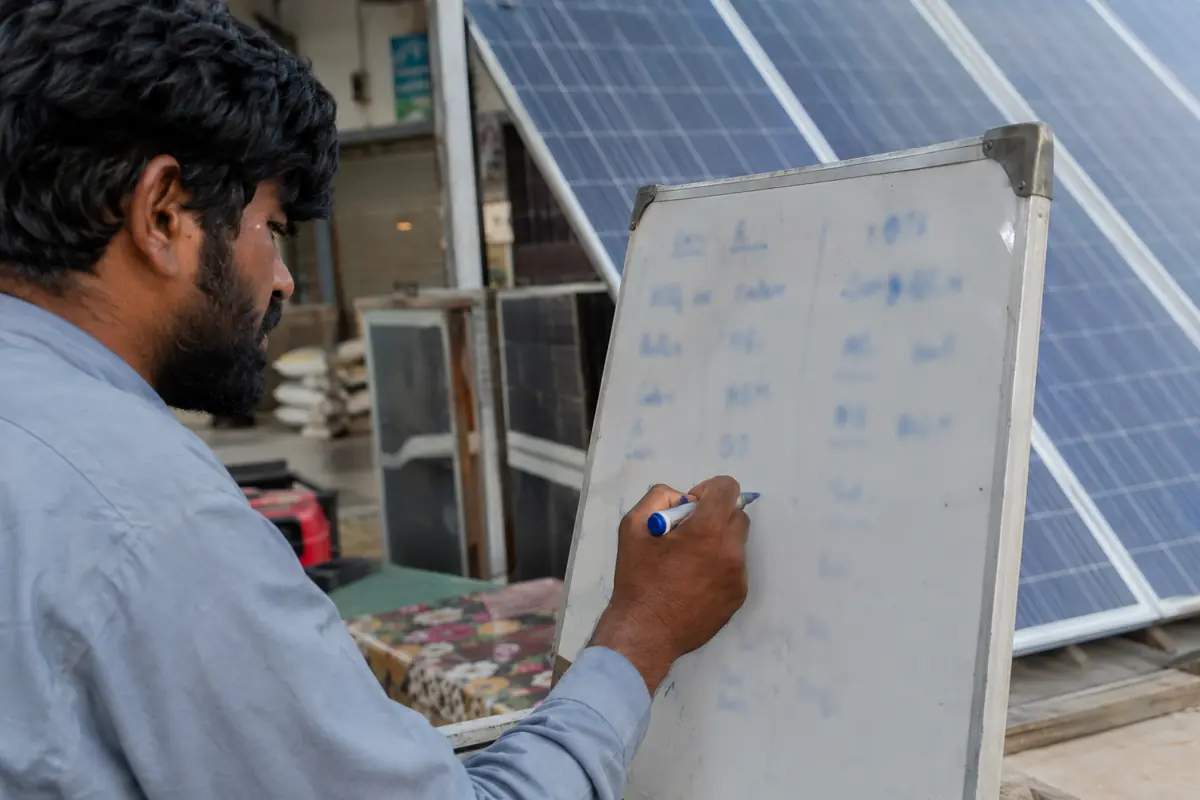
Quick answer: solar panel price per watt today
The market average for branded A-grade panels of 500 W and above is Rs 41.3 per watt. The cheapest large rooftop panels sit below that average, premium technologies sit above it, and small panels cost noticeably more per watt.
| Panel | Price per watt now | Price per panel now |
|---|---|---|
| 180 W (small, Inverex mono PERC) | Rs 55.6 | Rs 10,000 |
| 550 W (cheapest brand) | Rs 38 | Rs 20,900 |
| 585 W (cheapest brand) | Rs 40 | Rs 23,400 |
| 650 W (cheapest brand) | Rs 43 | Rs 27,950 |
The gap between the cheapest and the dearest large panel is mostly technology. A Mono PERC plate and a back-contact plate can both be A-grade and Tier 1, yet sit at quite different per-watt rates because one is cheaper to make. Neither figure is “right”; they buy different things, which the tables below explain.
If you are buying for a home system, compare panels in the 540 to 650 W range on price per watt. If you are buying one small panel for a fan, the price per plate matters more than the per-watt figure.
How we checked this
Per-watt figures are only useful if everyone calculates them the same way. Here is our method.
- Price source: dealer rates for A-grade panels from our price sheet. Each row is one brand and model at one wattage.
- Wattage used: the rated power on the label (STC rating, measured at 25°C cell temperature and 1,000 W/m² of sunlight). This is the number the market quotes.
- Calculation: price ÷ rated watts, rounded to one decimal place.
- Average: the market average is the mean price per watt across all branded A-grade panels of 500 W and above. Small and generic panels are left out so they do not distort the figure for home buyers.
- Not included: delivery, loading, installation, inverter, structure or batteries. Those are system costs, covered separately below.
| What the figure tells you | What it does not tell you |
|---|---|
| Which panel gives the most rated watts per rupee | How many units it will actually make on your roof |
| How brands compare at the same size | Warranty strength or after-sales support |
| How much extra a new technology costs | Whether the panel is genuine; that needs a serial check |
Which panels are on our sheet
Our sheet covers the brands most buyers in Pakistan actually ask for: Jinko, Longi, Canadian Solar, JA Solar, Trina, Aiko, Astronergy, Risen, Crown and Inverex in the large sizes, plus generic A-grade panels in the small sizes from 150 W to 500 W. If a brand or size you want is missing, use the closest size from the same technology as your benchmark.
Why we do not use the “per unit” price
Some sellers quote panels per unit of electricity they will produce. That depends on your city, roof angle, shade and cleaning habits, so no two homes get the same figure. Price per rated watt is fixed for a given panel and is the fairest starting point. We show a simple way to estimate cost per unit later on this page.
How often per-watt rates move
Per-watt rates in Pakistan can change several times a month. The main triggers are:
- a move in the rupee-dollar rate, which changes the landed cost of every container;
- a change in Chinese factory prices, which reaches Pakistani wholesale rates within weeks;
- budget measures on sales tax and duties, announced each June;
- seasonal demand, which is strongest before and during summer.
That is why we calculate per-watt figures live from the price sheet instead of printing a fixed number.
Solar panel price per watt by size, brand and cell type
By size
Here is the cheapest current price per watt at every size on our sheet. The pattern is clear: per-watt cost falls as panels get bigger, then flattens out across the large sizes.
| Size | Cheapest price per watt | Typical use |
|---|---|---|
| 180 W | Rs 55.6 | One DC fan, lights and a small battery |
| 540 W | Rs 38 | Home systems |
| 550 W | Rs 38 | Home systems |
| 585 W | Rs 40 | Most new rooftop systems |
| 600 W | Rs 42.5 | Tighter roofs |
| 620 W | Rs 40 | Larger homes |
| 650 W | Rs 43 | Large homes, commercial |
| 700 W | Rs 42 | Commercial, farms |
| 740 W | Rs 41 | Large commercial roofs |
For the full price of every size and brand, see our solar panel price list.
Worked comparison: 550 W vs 585 W for a 5 kW home
Per-watt figures matter most when you scale them up to a whole system. Here is the same 5 kW target built two ways:
| 550 W panels | 585 W panels | |
|---|---|---|
| Panels needed | 10 | 9 |
| Actual installed watts | 5,500 W | 5,265 W |
| Panel cost now (cheapest brand) | Rs 209,000 | Rs 210,600 |
| Clamps, rails and connectors | One more panel to mount and wire | One fewer panel |
| Typical cell type | Mostly Mono PERC | Mostly N-type |
Because panel counts are rounded up, the 550 W option actually gives you a little more capacity, while the 585 W option saves a panel’s worth of mounting and usually brings newer technology. Compare the panel cost per installed watt, not just the per-watt figure on one plate.
By brand at the same size
Comparing brands at one wattage removes the size effect and shows what each name charges per watt:
| Brand (585 W unless stated) | Cell type | Price per watt now |
|---|---|---|
| Jinko Tiger Neo | N-type TOPCon | Rs 43.5 |
| Longi Hi-MO 6 | N-type HPBC | Rs 42.8 |
| JA Solar DeepBlue 4.0 | N-type TOPCon | Rs 40.2 |
| Astronergy ASTRO N5 | N-type TOPCon | Rs 41 |
| Canadian TOPBiHiKu6 (590 W) | N-type TOPCon bifacial | Rs 43 |
| Trina Vertex N (590 W) | N-type TOPCon | Rs 40 |
By cell type
| Cell type | Example | Price per watt now | What you get for the extra |
|---|---|---|---|
| Mono PERC (old stock) | Longi Hi-MO 5 545 W | Rs 39 | Older technology; more heat loss and faster ageing |
| Mono PERC (Tier 1) | Jinko Tiger Pro 550 W | Rs 38 | Tier 1 warranty on older technology |
| N-type TOPCon | Jinko Tiger Neo 585 W | Rs 43.5 | Better heat performance, slower ageing |
| N-type HPBC 2.0 | Longi Hi-MO X9 600 W | Rs 44 | Back-contact design, clean look |
| N-type ABC | Aiko Stellar 1N+ ABC 650 W | Rs 43 | High efficiency for small roofs |
| HJT | Risen Hyper-ion 720 W | Rs 41 | Large format, strong heat performance |
What pushes the per-watt price up or down
- Panel size: fixed parts (frame, glass, junction box) are spread over more watts on a big panel.
- Cell technology: newer cells cost more per watt to make, at least for now.
- Brand demand: popular brands hold their price.
- Rupee and import costs: every per-watt figure moves with the dollar, Chinese factory prices and the 10% GST on imported panels.
- Order size: a full pallet is often cheaper per watt than a few loose plates.
Price per watt for small off-grid buyers
If you need one or two small panels for a fan, a light or a camera, per-watt comparisons can mislead you. A 150 W panel will always cost more per watt than a 300 W panel, but if 150 W is all you need, it is still the cheaper buy. For small setups:
- Work out the watts you need first (add up the appliances and allow some margin for heat and dust).
- Pick the smallest panel that covers it.
- Then compare brands at that size on price per watt.
Why panel prices per watt fell so far
Over the past several years, solar panel prices per watt have dropped sharply worldwide as Chinese manufacturers expanded production and moved to larger, more efficient cells. Pakistan, which imports almost all its panels, felt that drop directly, and it is the main reason rooftop solar spread so quickly across Pakistani cities. The per-watt rate can still rise for a while when the rupee weakens or taxes change, but the long-run direction has been down.
Does price per watt change by city?
Slightly. Most stock arrives through Karachi and is trucked north, so freight adds a little to each plate in Punjab and Khyber Pakhtunkhwa. Cities with large dealer markets, like Lahore with its Hall Road traders, tend to have tight competition that offsets part of that freight. The difference per watt is usually small compared with the gap between brands and technologies, but it is worth asking whether a rate is ex-market or delivered. Our Lahore and Karachi pages show local notes.
From price per watt to cost per unit of electricity
Price per watt tells you what you pay upfront. Cost per unit tells you what each unit of electricity really costs over the panel’s life. You can estimate it in three steps:
- Yearly units: in most of Pakistan, 1 W of panel makes about 1.5 to 1.8 units a year (4 to 5 units per kW per day).
- Lifetime units: multiply by 25 years and knock off around 10% for ageing and dust. A 585 W panel therefore makes very roughly 19,000 to 24,000 units over its life.
- Cost per unit: divide the panel price by that lifetime figure.
At today’s rates, that works out to a small fraction of what you pay per unit on a WAPDA bill, which is why the panels themselves are rarely the weak point of a solar investment. The inverter, batteries and installation make up most of the rest of the system cost.
System cost per watt
Installers sometimes quote a whole system “per watt”. That figure includes the inverter, structure, cabling and labour, so it is always much higher than the panel price per watt, and a hybrid system with batteries is higher still. When comparing installer quotes, ask for the panel price per watt separately from the rest so you can check it against the figures on this page.
| Quote type | What is included | How to compare |
|---|---|---|
| Panel only, per watt | Panels | Against the live figures on this page |
| On-grid system, per watt | Panels, on-grid inverter, structure, wiring, labour | Ask for a line-by-line breakdown |
| Hybrid system, per watt | All of the above plus batteries and a hybrid inverter | Compare battery kWh separately; it changes the total the most |
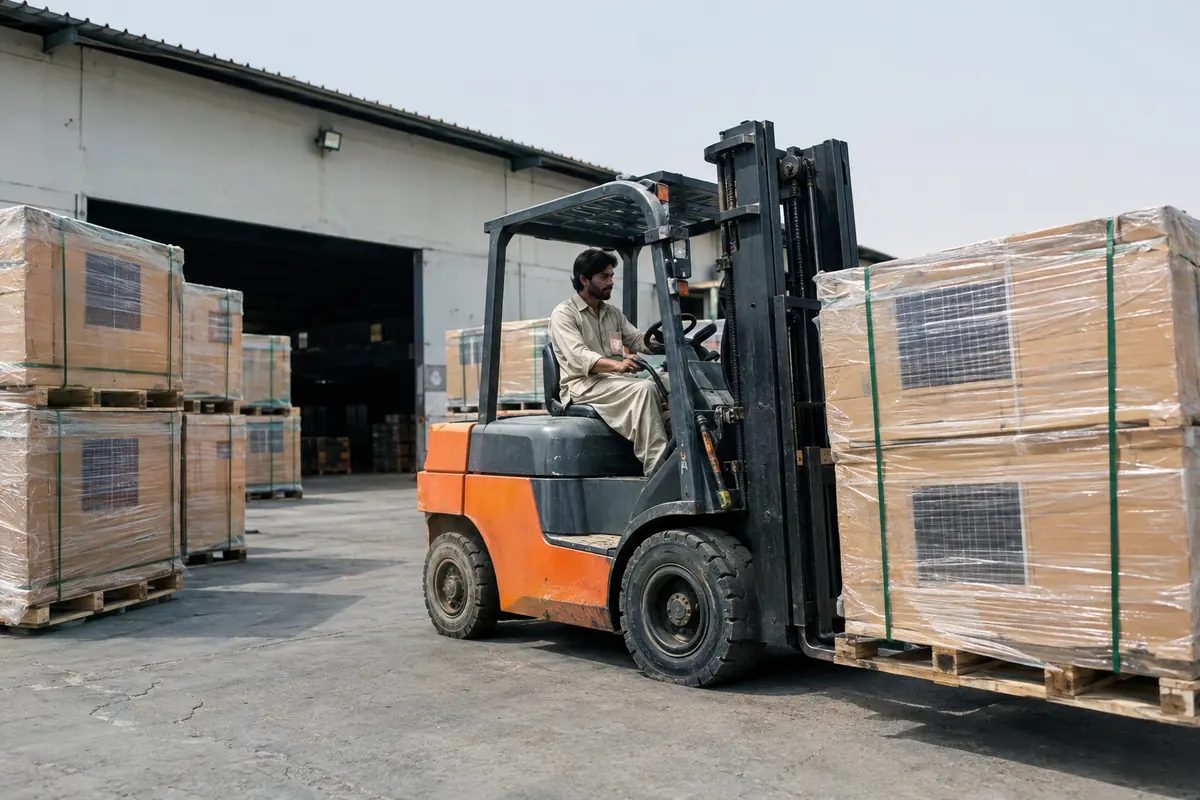
Comparison table: small vs large, PERC vs N-type
| Small panel (150 to 350 W) | Large Mono PERC (540 to 550 W) | Large N-type (580 to 650 W) | |
|---|---|---|---|
| Price per watt now | Rs 55.6 (Inverex 180 W); other sizes vary by brand and grade | from Rs 38 (550 W) | from Rs 40 (585 W) |
| Watts per square metre | Lower | Medium | Highest |
| Output on a hot afternoon | Drops more | Drops more | Drops less |
| Typical warranty | Varies, often shorter | Tier 1 terms if branded | Longest power warranties |
| Best for | Fans, lights, small off-grid | Budget home systems | Most new home systems |
The cheapest per watt is not always the best value. A large N-type panel can cost a little more per watt than a Mono PERC panel of similar size, but it usually makes more units over 25 years on a hot Pakistani roof, which lowers the real cost per unit.
If you are torn between technologies, our guide to types of solar panels explains the differences in plain terms, and the 585 watt solar panel price page shows every brand at the most popular home size.
Buying checklist
Use these steps to compare per-watt quotes fairly before you buy.
- Convert every quote to price per watt. Divide each panel price by its rated wattage.
- Compare the same grade. Only compare A-grade with A-grade. B-grade and used panels look cheaper per watt but carry more risk.
- Check the power tolerance. Tier 1 panels usually have a positive-only tolerance (for example 0 to +3%), so they never deliver less than the label at test conditions. Avoid panels with a minus tolerance.
- Check bifacial ratings. Bifacial panels are rated on the front face only. Any rear-side gain is a bonus, not part of the per-watt figure.
- Confirm the model and series. “Jinko 550” could be an older PERC or a newer N-type panel. Ask for the exact model number.
- Ask whether the rate is per watt or per plate. Wholesale dealers often quote per watt; retail shops often quote per plate.
- Check what is included. Delivery to your city, loading and unloading can add a noticeable amount on a small order.
- Verify the serials. Cheap per-watt rates on fake or re-labelled panels are a known problem. Check the serial with the maker where possible.
- Compare against today’s average. If a quote is far below the Rs 41.3 per watt average for a branded A-grade panel, ask why.
For a shortlist of panels that offer good value per watt, see the best solar panels in Pakistan.
Getting a better per-watt rate
- Buy the whole system’s panels in one order. Dealers give better rates on a full pallet.
- Be flexible on brand within the same technology. A same-size TOPCon panel from another Tier 1 maker may be cheaper this week.
- Pay on delivery, not in advance. You keep the bargaining power until the stock is in front of you.
- Ask for the rate in writing with a date. It stops last-minute changes when you come to collect.
Questions to ask the dealer
- What is the price per watt for this exact model, and is it valid today?
- Is the panel A-grade, and who is the importer?
- What is the power tolerance on the datasheet?
- Will you give the flash report for these serials?
Per-watt checks at delivery
When the panels arrive, take five minutes before the truck leaves:
| Check | What to look for |
|---|---|
| Label | Same model and wattage as the quote on every panel |
| Serial numbers | Match the invoice and the flash report |
| Glass and frame | No cracks, chips or bent corners |
| Junction box | Sealed, with both cables and MC4 connectors intact |
Common mistakes to avoid
| Mistake | Why it costs you | Better approach |
|---|---|---|
| Comparing a small panel’s per-watt price with a large panel’s | Small panels always cost more per watt | Compare panels in the same size band |
| Choosing only on lowest per-watt rate | You may get older PERC cells, weak warranty or unknown importer | Weigh per-watt price with technology and warranty |
| Treating bifacial rear gain as extra watts you paid for | The rated watts are front-side only | Compare on the front rating; count rear gain as a bonus |
| Mixing per-watt panel quotes with per-watt system quotes | System quotes include inverter and labour | Ask for a separate panel line |
| Ignoring tolerance and flash report | Some panels deliver below the label | Ask for positive tolerance and the flash test |
| Buying the cheapest per watt but the wrong size for the roof | Extra panels need extra structure and roof space | Size the system first, then compare per watt |
One more trap: “per watt” on a damaged panel
Panels with cracked cells, scratched glass or a bent frame are sometimes sold at a tempting per-watt rate. Micro-cracks are hard to see and can cut output over time. Inspect every panel at delivery, in daylight, and refuse any with visible damage. A low per-watt figure is worthless if the panel fails in two years.
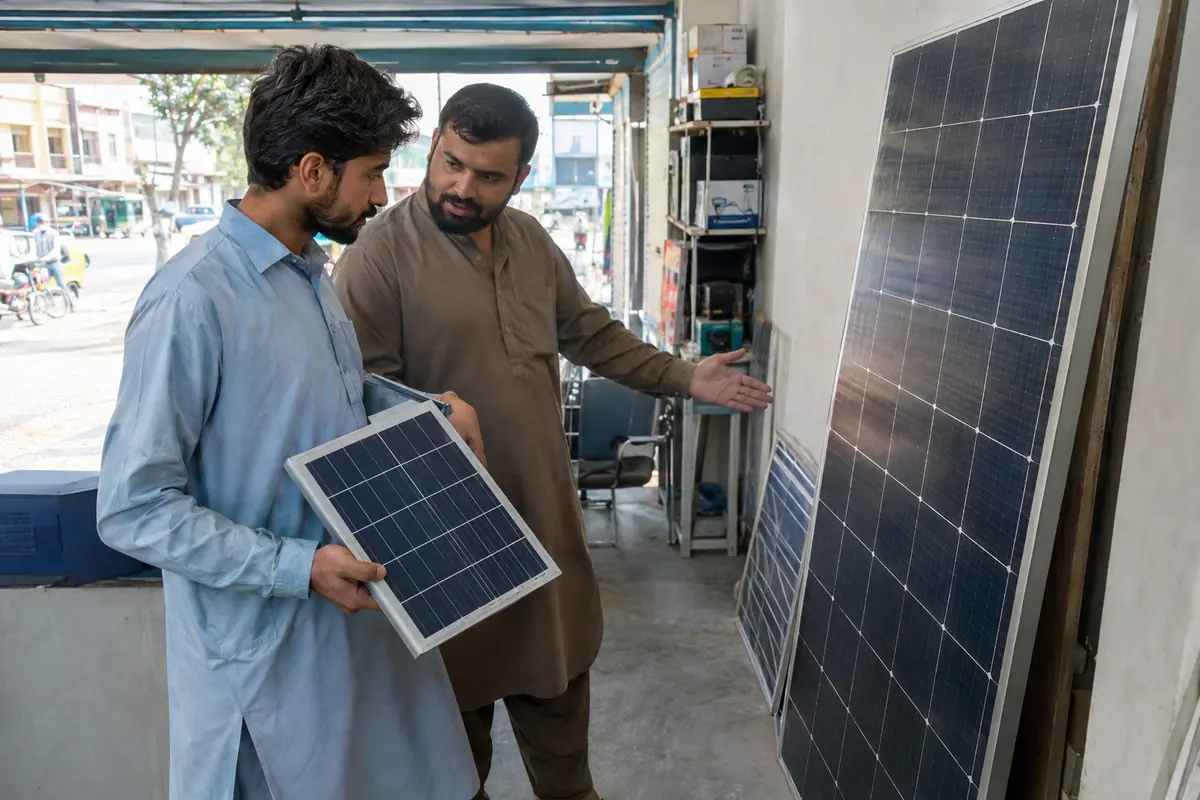
Red flags
- A per-watt rate well below every other dealer for a branded panel.
- A quote that gives a wattage and “A-grade” but no brand or model.
- A dealer who will not put the per-watt rate and validity in writing.
To work out how many panels you need and what the panels will cost, use our solar panel calculator, or go back to the main solar panel price in Pakistan page for today’s full table.
Frequently asked questions
What is the solar panel price per watt in Pakistan today?
The live average for branded A-grade panels of 500 W and above is shown at the top of this page, along with the cheapest per-watt rate at every size. Rates move with the dollar and dealer stock, so check the page date before you compare quotes.
How do I calculate solar panel cost per watt?
Divide the panel price by its rated wattage on the label. For example, divide the price of a 585 W panel by 585 to get its price per watt, then compare that figure across brands and sizes.
Why are small solar panels more expensive per watt?
Every panel needs a frame, glass, junction box and cables, so these fixed costs make up a bigger share of a small panel's price. Large panels spread them over many more watts.
Is the cheapest price per watt always the best buy?
No. A slightly higher per-watt rate can buy N-type cells that lose less output in heat and age more slowly, which lowers the real cost of each unit over 25 years. Also check the grade, warranty and importer.
Does price per watt include the inverter and installation?
Not on this page. Our figures cover the panel only. Installers who quote a whole system per watt include the inverter, structure, wiring and labour, so their figure is always higher.
What is the cost per unit of electricity from a solar panel?
Divide the panel price by the units it will make over its life. In most of Pakistan a 585 W panel makes very roughly 19,000 to 24,000 units over 25 years, so the panel cost per unit is a small fraction of a grid tariff.
Do bifacial panels cost more per watt?
Sometimes slightly. Bifacial panels are rated on the front side only, so any extra output from the back is a bonus that can improve value on raised structures or light-coloured roofs.
Is price per watt the same in every city?
It is close, but not identical. Freight from Karachi and local competition between dealers can change the rate slightly, so ask whether a quote is ex-market or delivered to your door.