On this page
Most people searching for a 1000W solar panel price in Pakistan actually need a 1kW solar system: two large panels, a small inverter and, if they want backup, a battery. Single 1000 watt panels are not a normal product here, so this page shows what a 1kW setup really costs today, what it can and cannot run, and how to buy one without overpaying for the wrong parts.
Quick answer
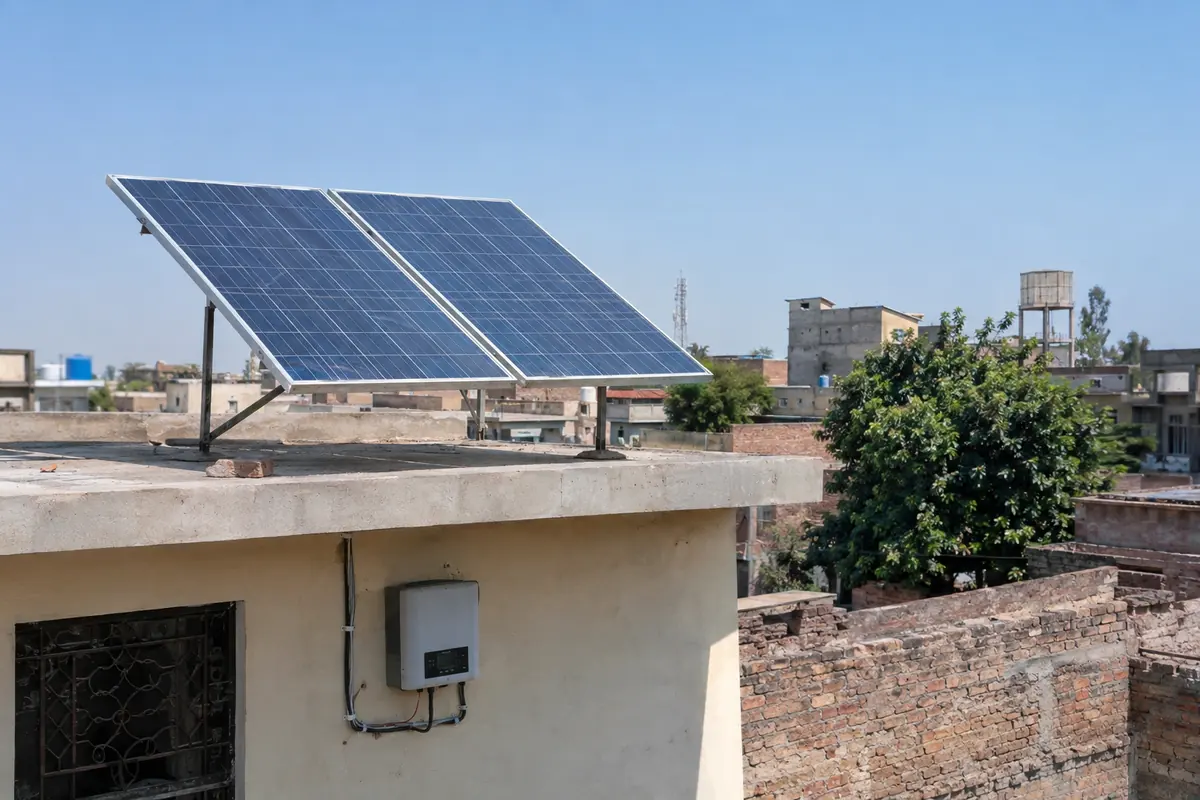
A 1kW solar panel set in Pakistan is usually two 550 W panels (1.1 kW) or two 500 W panels. At today’s cheapest listed rates, two 550 W panels cost about Rs 41,800, and two 585 W panels cost about Rs 46,800.
The panels are the cheaper part. On a complete 1 kilowatt solar panel system with inverter, stand, wiring and fitting, the inverter alone usually costs more than both panels together, and a battery, if you add one, costs more again.
| What you buy | What it includes | Good for |
|---|---|---|
| Panels only | 2 × 500 to 585 W plates | Adding to an existing UPS or inverter |
| 1kW system without battery | Panels, 1 to 2.2 kW solar inverter, stand, cable, fitting | Daytime fans, lights, fridge; cuts the bill |
| 1kW system with battery | All of the above plus a 24V battery | Lights and fans through evening load-shedding |
A 1kW system makes about 4 units a day on average in Punjab, roughly 120 to 130 units a month. It runs fans, lights, a fridge and a TV in the daytime. It does not run an AC on its own.
How we checked this
Prices for solar parts move every week in Pakistan, so we split this page into two kinds of numbers.
Panel prices are live. Every panel figure on this page is pulled from our price sheet, which we update from dealer rates. When the market moves, the numbers here move with it. That is why you will not find a typed panel price in the text.
Everything else is a range. Inverter, battery, structure, cable and labour costs do not have a live feed, so we give ranges as of October 2026. We built them by:
- Checking listed prices of 1 kW to 3 kW solar inverters and 24V batteries at large Pakistani online retailers in October 2026
- Comparing published installation cost breakdowns from Pakistani installers dated mid to late 2026
- Scaling the per-kW structure and labour figures down to a 2-panel job, where minimum charges apply
Rules come from official sources. For net metering and net billing we used NEPRA’s 2026 prosumer rules as reported by national newspapers. For tax, we used the 2025-26 budget, which set 10% sales tax on imported panels, and the 2026-27 budget, where the FBR said no new tax was added.
| Figure on this page | Source type | How often it changes |
|---|---|---|
| Panel prices | Live price sheet | Daily |
| Inverter and battery | Retail listings, October 2026 | Monthly |
| Structure, cable, labour | Installer breakdowns, scaled | A few times a year |
| Net billing rules | NEPRA, national news | When NEPRA revises them |
What the ranges leave out: transport outside the main cities, a DB box upgrade if your house wiring is old, any civil work on a weak roof, and dealer discounts for cash or for buying a full set from one shop. A 1kW system in a small town can also cost a little more, because the installer travels for a small job.
If a quote you get is far outside our ranges, ask the seller to itemise it. Usually the difference is the inverter brand or the battery.
What a 1kW solar system costs and what it runs
The panel options
You can reach 1 kW with different plates. Two large panels is the usual choice because it needs the fewest connections and the smallest stand.
| Panel choice | Panels needed | System size | Panels cost today |
|---|---|---|---|
| 550 W | 2 | 1.1 kW | Rs 41,800 |
| 585 W | 2 | 1.17 kW | Rs 46,800 |
Smaller plates like 250 W and 330 W usually cost more per watt and need more stand and wiring. Their prices vary a lot by brand and grade, so get a dealer quote if you need them. They make sense only when roof space comes in awkward small pieces, or when you are matching panels you already own.
Today’s live rates for the large plates most people use:
| Model | Watt | Price per panel | Per watt | This week | Trend |
|---|---|---|---|---|---|
| Inverex Jolywood dual glassN-type | 600 W | Rs 25,500 | Rs 42.5 | No change | |
| Longi Hi-MO X9N-type HPBC 2.0 | 600 W | Rs 26,400 | Rs 44.0 | No change | |
| Trina Vertex N bifacialN-type i-TOPCon | 590 W | Rs 23,600 | Rs 40.0 | No change | |
| Canadian TOPHiKu6 bifacialN-type TOPCon | 590 W | Rs 25,370 | Rs 43.0 | No change | |
| Crown N-type bifacial 16BBN-type | 585 W | Rs 23,400 | Rs 40.0 | No change | |
| JA Solar DeepBlue 4.0 N-type bifacialN-type | 585 W | Rs 23,545 | Rs 40.2 | No change | |
| Astronergy ASTRO N5 bifacialN-type TOPCon | 585 W | Rs 23,985 | Rs 41.0 | No change | |
| Inverex Mustang bifacialN-type TOPCon | 585 W | Rs 24,280 | Rs 41.5 | No change | |
| Longi Hi-MO X7 bifacialN-type | 585 W | Rs 25,010 | Rs 42.8 | No change | |
| Canadian TOPHiKu6 bifacialN-type TOPCon | 585 W | Rs 25,155 | Rs 43.0 | No change | |
| Jinko Tiger Neo N-type bifacialN-type TOPCon | 585 W | Rs 25,420 | Rs 43.5 | No change | |
| Jinko Tiger Neo N-typeN-type TOPCon | 580 W | Rs 24,505 | Rs 42.3 | No change | |
| Jinko Tiger Pro P-type (old stock)Mono PERC | 550 W | Rs 20,900 | Rs 38.0 | No change | |
| Longi Hi-MO 5 (old stock)Mono PERC | 545 W | Rs 21,255 | Rs 39.0 | No change | |
| Jinko Tiger Pro P-type (old stock)Mono PERC | 540 W | Rs 20,520 | Rs 38.0 | No change |
The rest of the system, as of October 2026
| Part | Typical range (October 2026) | Notes |
|---|---|---|
| Solar inverter, 1 to 2.2 kW | about Rs 30,000 to Rs 85,000 | Hybrid or “solar UPS” type for backup; brand and IP rating drive the price |
| Lithium battery, 24V 100Ah (about 2.4 to 2.6 kWh) | about Rs 100,000 to Rs 135,000 | Longer life, lighter, no water topping |
| Tubular battery, 12V | about Rs 45,000 to Rs 80,000 each | Two needed for a 24V inverter; cheaper upfront, shorter life |
| Mounting stand for 2 panels | about Rs 6,000 to Rs 15,000 | Depends on height and steel gauge |
| DC cable, breakers, earthing | about Rs 6,000 to Rs 12,000 | Short runs keep this low |
| Installation labour | about Rs 5,000 to Rs 10,000 | Minimum charges apply to small jobs |
Put together, a 1kW system without battery usually lands in the range of panels plus about Rs 50,000 to Rs 120,000 for the rest. With a lithium battery, add the battery range on top. For live inverter and battery comparisons, see our solar inverter price and solar battery price guides.
What 1kW can run
A 1kW system in Lahore makes about 4.2 units on an average day: more in May and June, less in foggy January. Here is what that covers:
| Load | Running watts | Works on 1kW in daytime? |
|---|---|---|
| 4 ceiling fans | 300 to 400 W | Yes |
| 10 LED lights | 100 to 200 W | Yes |
| Refrigerator | 150 to 250 W | Yes |
| LED TV and router | about 100 W | Yes |
| Laptop or desktop | 50 to 200 W | Yes |
| 1 hp water motor | about 750 W | Yes, but alone, around midday |
| Washing machine | 300 to 500 W | Yes, around midday |
| 1 ton inverter AC | about 1,000 W | No, not reliably; needs about 3 large panels |
| 1.5 ton AC | 1,450 W and up | No |
| Iron or electric kettle | 1,000 W and up | Only briefly, with the inverter near its limit |
If AC is the goal, a 1kW system is the wrong starting point. For a whole-house answer from your bill, use the solar panel calculator.
How much a 1kW system saves
A 1kW system produces roughly 120 to 130 units a month across the year. How much that saves depends on your tariff slab, because the units you do not buy from the grid come off the most expensive end of your bill. For a family hovering just above a slab boundary, the saving can be larger than the unit count suggests, since it can bring the whole bill into a cheaper slab. For a shop on a commercial tariff, each unit saved is usually worth more than at home.
To estimate your own saving, look at the per-unit rate on your last bill, multiply it by about 120, and treat the answer as a monthly ceiling. Real savings are a little lower because some daytime output goes unused on cloudy days, and a little higher in the months when the system pushes you into a lower slab.
Two points to keep realistic:
- Units are only saved when you use them. With no battery and no net metering, unused daytime power is lost. Plan to run the motor, washing and ironing around midday.
- Net metering on 1 kW rarely pays. NEPRA’s rules allow it from 1 kW, but the meter and application costs are a large share of a small system’s price, and under the 2026 net billing rules exported units earn much less than imported units cost.
When 1kW is the right size
| Your situation | Is 1kW right? |
|---|---|
| Bill under about 150 units, mainly fans and lights | Yes |
| You want fans and lights during daytime load-shedding | Yes, with a hybrid inverter |
| You want lights and fans after sunset | Yes, with a battery |
| Bill of 300 units or more | No; look at 3 to 5 kW |
| You want to run an AC | No; see the 5kW option |
| You are renting and may move | Yes; a small set is easy to take with you |
For bigger homes, our 5kW solar system price page covers the most popular family size, and solar system price in Pakistan compares every size side by side.
On-grid, hybrid or off-grid on 1kW
The inverter type decides what your 1kW system does during load-shedding:
| Type | During load-shedding in daytime | At night | Typical use on 1kW |
|---|---|---|---|
| On-grid | Switches off for safety | Nothing | Rare at this size |
| Hybrid | Keeps running from panels | From battery, if fitted | The most common choice |
| Off-grid / solar UPS | Runs from panels and battery | From battery | Homes with long outages or no reliable grid |
At 1kW almost everyone chooses a hybrid or solar UPS type. A pure on-grid inverter makes little sense on two panels, because it stops working exactly when the grid goes down, and net billing on such a small system pays back slowly.
How long a battery backs you up
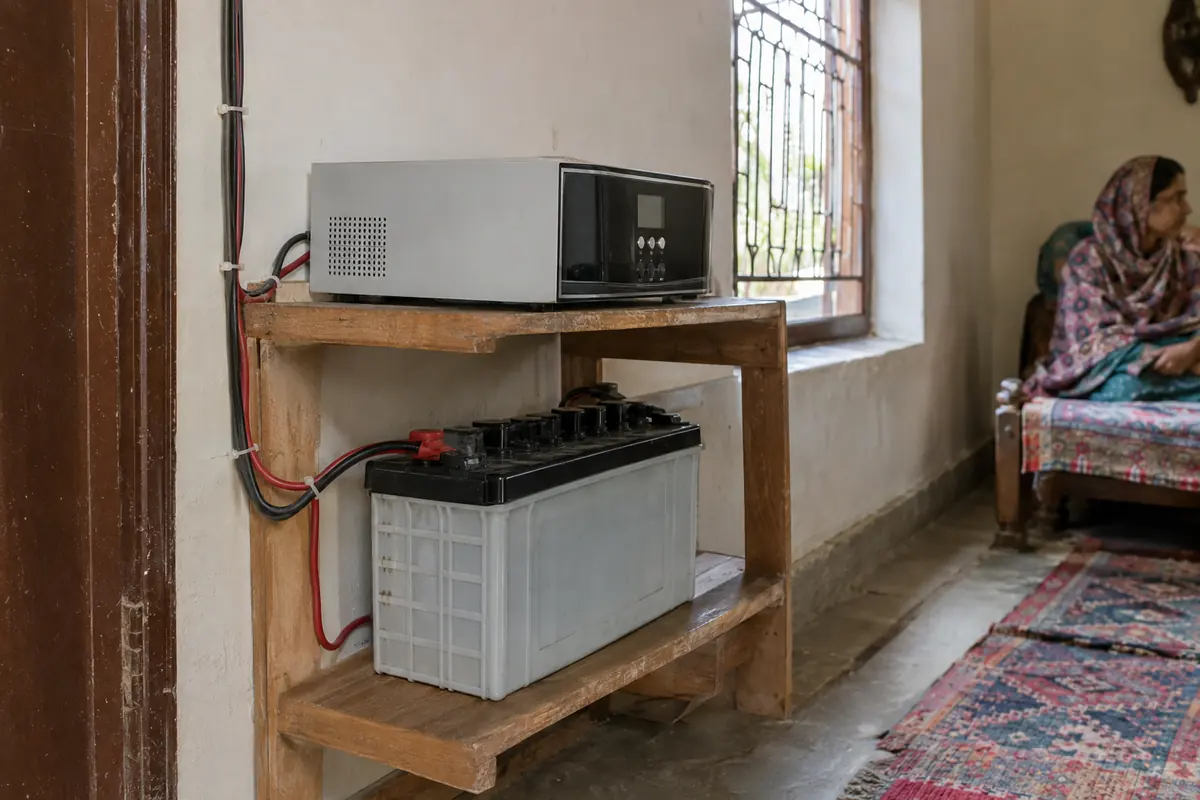
Backup time depends on what you run and the battery’s usable energy. A 24V 100Ah lithium battery stores about 2.4 to 2.6 kWh, and most of it is usable. Two 12V tubular batteries of the same Ah, wired in series for 24V, store the same energy on paper, but you should use only about half of it if you want them to last.
| Load at night | Lithium 24V 100Ah | 2 × 12V 100Ah tubular, used to half |
|---|---|---|
| 2 fans and 4 lights (about 200 W) | 10 hours or more | about 5 to 6 hours |
| 4 fans, 6 lights, router (about 400 W) | about 5 to 6 hours | about 3 hours |
| Fridge only (about 1.5 units overnight) | Through the night | Most of the night |
These are rough guides for planning. Old batteries, hot rooms and high loads shorten them.
Comparison table
How the common 1kW builds compare. Panel cost is live; the rest are October 2026 ranges.
| Panels only | 1kW without battery | 1kW with tubular battery | 1kW with lithium battery | |
|---|---|---|---|---|
| Panels | 2 × 550 W, about Rs 41,800 | Same | Same | Same |
| Inverter | Use your existing one | 1 to 2.2 kW solar inverter | 1 to 2.2 kW hybrid, 24V | 1 to 2.2 kW hybrid, 24V |
| Battery | None | None | 2 × 12V tubular | 1 × 24V lithium |
| Backup at night | Depends on your UPS | None | A few hours of fans and lights | A few hours of fans and lights, deeper discharge |
| Battery life | Not applicable | Not applicable | Shorter; needs water checks | Longer, maintenance-free |
| Weight | Low | Low | Heavy | Light |
| Best for | Upgrading a UPS | Daytime savings | Tight budget backup | Long-term backup |
Panels only vs a full system
If you already have a UPS or an older solar inverter that accepts panels, buying just two panels is the cheapest way in. Check the inverter’s maximum PV input voltage and wattage first. Many older home UPS units only accept 12V or 24V panels through a charge controller, which wastes most of a 550 W panel’s output.
Buying checklist
Before you pay for a 1kW solar system, go through these steps.
- Confirm your load. Add up the fans, lights, fridge and anything else you want on solar. If the total running watts are above about 900 W, step up to a bigger system.
- Choose two large A-grade panels. Ask for the brand, exact model and wattage on the invoice. Check that the label on the back matches. The live table above lists current options from 500 to 600 W.
- Pick the inverter for the job. For backup, choose a hybrid inverter. Make sure its PV input handles two large panels in series. Ask about the warranty period and where it is honoured.
- Decide on a battery now, not later. If you might add a battery, buy an inverter that supports the battery voltage you plan to use, 24V being the most common for 1kW.
- Check the stand. Galvanised or painted steel, properly anchored, facing south at a tilt close to your latitude.
- Ask for proper protection. A DC breaker, an AC breaker, surge protection and earthing are basic. Do not accept a quote without them.
- Get an itemised quote. Panels, inverter, battery, stand, cable, labour, each on a separate line.
- Keep your papers. The invoice with serial numbers is what the warranty depends on.
| Ask the seller | Good answer | Warning sign |
|---|---|---|
| Panel brand and model? | Exact model, e.g. Jinko Tiger Neo | “A-grade, Chinese, same as Jinko” |
| Panel warranty? | Product and performance warranty from the maker | “Shop warranty, 6 months” |
| Inverter warranty? | Written period, local service centre | No paper |
| Is earthing included? | Yes, with a rod | “Not needed for small systems” |
If your bill is under 200 units and you live in Punjab, check whether you qualify for the free 1.1 kW system under the CM Punjab solar panel scheme before buying. It is decided by ballot, so do not wait on it if you need power now.
Checking panels at delivery
Fake labels and mixed stock are a real problem in the small-system market, where buyers often pick up two panels from a shop. When the panels arrive:
- Match the model and wattage on the back label to the invoice.
- Note both serial numbers and check them on the maker’s verification page where one exists. Our Jinko verification guide shows how for the most common brand.
- Look for cracks, scratched glass, bent frames and a firmly fixed junction box with proper MC4 connectors.
- Make sure both panels are the same model. Two different panels in series perform like the weaker one.
Common mistakes to avoid
Small systems are where buyers most often get poor value, because the inverter and accessories cost a lot relative to two panels.
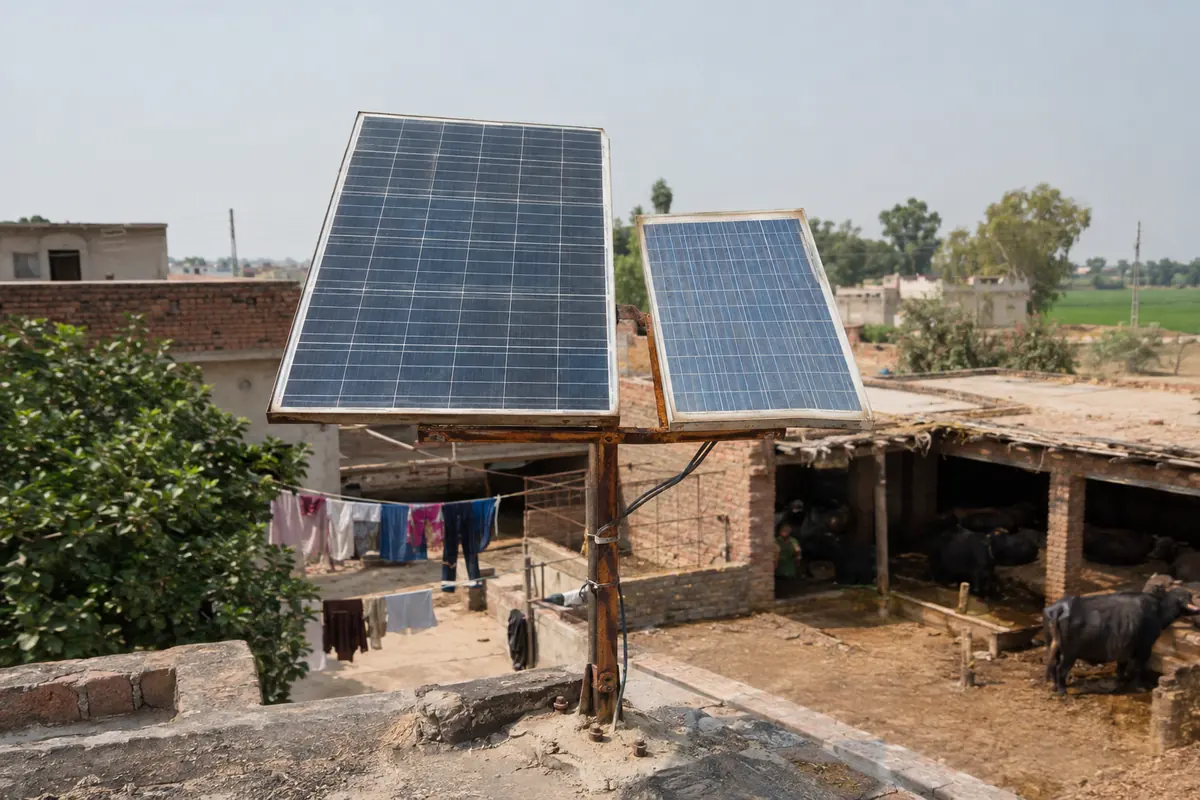
- Searching for a single 1000 watt panel. Large home panels top out around 700 to 750 W, and they are big and heavy. Two panels of 500 to 585 W are the practical way to reach 1 kW.
- Buying B-grade or “cut” panels to save a little. On a two-panel system, saving a small amount per panel can cost you years of lower output. Insist on A-grade with a maker’s warranty.
- Pairing big panels with an old UPS. A 550 W panel through a basic 12V charge controller gives only a fraction of its rating. Use an inverter with a proper MPPT input sized for the panels.
- Expecting AC on 1kW. Even a 1 ton inverter AC needs about three large panels. A 1kW system with an AC switched on will drain the battery or pull from the grid.
- Skipping earthing and breakers. Protection costs very little compared with a burnt inverter after a lightning storm or a short circuit.
- Laying panels flat or facing them the wrong way. Flat panels stay dusty and produce less in winter. Face south at your city’s tilt.
- Paying for net metering on 1 kW. Under 2026 rules the payback on a tiny export is weak. Use your solar units yourself in the daytime.
- Comparing totals instead of parts. Two “1kW systems” at very different prices usually differ in inverter brand, battery type or whether a stand is included.
| Red flag in a quote | What it usually hides |
|---|---|
| Panel brand missing | Mixed or B-grade stock |
| Inverter listed as “1kW hybrid” with no brand | Unbranded unit with no service support |
| Battery “200Ah” with no voltage or type | Old lead-acid battery |
| One lump-sum price | Missing stand, cable or protection |
Planning to grow beyond 1kW later
Many families start with 1kW and add panels after a summer or two. That works well if you plan for it on day one:
- Buy an inverter rated above your first array, for example a 2.2 kW or 3 kW unit, so you can add one or two panels without replacing it.
- Leave stand space and keep the same panel family, ideally the same wattage, because mixing very different panels in one string lowers output.
- Size the DC cable for the bigger array from the start. Pulling new cable later costs more than buying thicker cable now.
If you already know the house will need an AC on solar within a year, it is often cheaper to install 3 kW straight away than to build up from 1kW in steps.
Before you buy, check today’s panel rates on the home page so you know what a fair price for the panels is.
Frequently asked questions
What is the 1000 watt solar panel price in Pakistan?
There is no common single 1000 watt home panel, so 1kW is normally two 500 to 585 watt panels. The live table on this page shows what two panels cost today, and the inverter, stand and fitting are extra.
How many panels make a 1kW solar system?
Two large panels: two 500 watt panels make exactly 1 kW, and two 550 or 585 watt panels give a little more. Smaller 250 or 330 watt panels need four, which means more stand and wiring.
Can a 1kW solar system run an AC?
Not reliably. Even a 1 ton inverter AC needs about three large panels, and a 1.5 ton AC needs four or more. A 1kW system is best for fans, lights, a fridge and a TV.
How many units does a 1kW solar system produce in Pakistan?
About 4 units a day on average, or roughly 120 to 130 units a month. Output is higher in May and June and lower in foggy winter months in Punjab.
Do I need a battery with a 1kW solar system?
Only if you want power after sunset or during evening load-shedding. Without a battery, a hybrid inverter still runs your daytime load from the panels and cuts your bill.
Which inverter is best for a 1kW solar system?
A hybrid or solar UPS type rated about 1 to 2.2 kW with a proper MPPT charger that accepts two large panels in series. Choosing a slightly larger inverter lets you add panels later.
Is net metering worth it for 1kW?
Usually not. The meter and application costs are a large share of a small system's price, and under NEPRA's 2026 net billing rules exported units earn much less than the units you buy.
Lithium or tubular battery for 1kW?
Lithium costs more upfront but lasts longer, weighs less and needs no maintenance. Tubular batteries are cheaper to buy but should only be discharged to about half and need water checks.