On this page
Solar panel size decides how many plates fit on your roof, how heavy the structure has to be, and even whether a loader can carry the panel up your stairs. This guide converts the common panel sizes sold in Pakistan into feet and inches, explains why a 585 watt plate is so much bigger than an old 330 watt one, and shows how to work out the roof space for your own system before you speak to an installer.
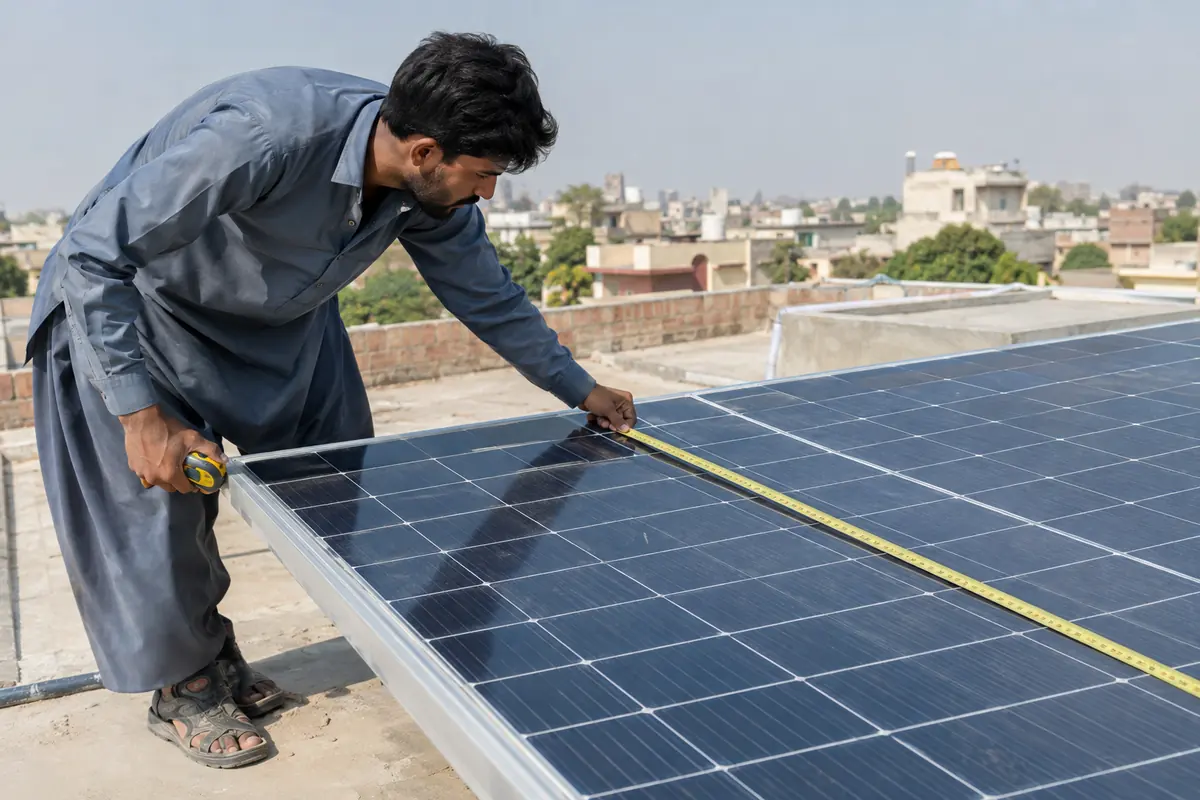
Quick answer: common solar panel size in feet
Most panels sold in Pakistan for homes today fall into three size families. The 72-cell (144 half-cell) panel used for 540 to 590 watt models measures about 7.5 ft by 3.7 ft (2278 x 1134 mm), roughly 28 square feet. The newer 66-cell rectangular-wafer panel used for 600 to 630 watt models is about 7.8 ft by 3.7 ft (2382 x 1134 mm). The large 132-cell panels rated 700 watts and above are about 7.8 ft by 4.3 ft (2384 x 1303 mm), close to 33 square feet and heavy enough to need two people on the roof.
So the 580 watt solar panel size in feet and the 585 watt solar panel size in feet are almost always the same: about 7 ft 6 in long and 3 ft 9 in wide. Wattage goes up inside a size family because the cells get more efficient, not because the plate gets bigger.
- 540 to 590 W: about 7.5 x 3.7 ft
- 600 to 630 W: about 7.8 x 3.7 ft
- 700 to 750 W: about 7.8 x 4.3 ft
- 150 to 200 W small panels: roughly 4.5 to 5 ft long and 2.2 to 2.7 ft wide, varying a lot by maker
How we checked these sizes
Panel sizes are not something to guess, because a 10 cm difference changes how many plates fit in a row and where the structure legs land. We took every dimension on this page from the manufacturer datasheets of models that are actually imported and sold in Pakistan, and then converted millimetres to feet and inches ourselves.
Here is what we looked at:
- Datasheet dimensions. Length, width and frame depth in millimetres, as printed by Jinko, Longi, Risen and other makers. For example, the Jinko Tiger Neo 72HL4 range (the panel most buyers call “Jinko 585”) is listed at 2278 x 1134 x 30 mm, and the Longi Hi-MO 6 LR5-72HTH-585M at 2278 x 1134 x 35 mm.
- Weight. Datasheet weight per panel, because it decides the structure gauge and the labour.
- Electrical values. Open-circuit voltage (Voc) and maximum-power voltage (Vmp), because they decide how many panels go in one string on your inverter.
- Version differences. The same wattage can come in slightly different frames for different markets. One Australian-market version of the Jinko 585 W, for example, is listed at 2335 x 1134 mm, so we tell you to check the label on the plate you are buying.
We did not use dealer WhatsApp images or marketplace listings for dimensions, since those are often copied from older models. Prices are not typed into this page. Where you see a rupee figure, it comes from our live price sheet, the same one behind the solar panel price list.
Solar panel sizes and wattage explained
Why size depends on cells, not on wattage
A solar panel is a grid of cells under glass. Two things set its outer size: the size of each cell (the silicon wafer) and how many cells are in the grid. Wattage is the result of size multiplied by efficiency.
That is why the solar panel sizes and wattage relationship looks odd at first. A 545 W Mono PERC panel and a 585 W N-type TOPCon panel can share the same 2278 x 1134 mm frame. The N-type plate simply turns more of the same sunlight into power. If you see a 585 W panel that is noticeably bigger than a 550 W one, it is usually a different cell format, not a “stronger” panel.
Thickness, glass and frame
The third dimension matters less, but it still shows up on site. Most modern panels have a 30 mm or 35 mm aluminium frame, so they stand just over an inch thick. Single-glass panels have a white or black backsheet behind the cells. Double-glass (bifacial) panels have glass on both sides, which adds a few kilograms and makes the plate stiffer. If you plan an elevated structure where light reaches the back, the double-glass version can give a small extra yield from reflected light. On a normal low-tilt home roof, the difference is modest, so do not pay a big premium for it.
Glass thickness on the front is usually 2 mm on double-glass panels and 3.2 mm on single-glass ones. Both are tested for hail, but thinner glass panels should never be walked on during cleaning.
The size families you will meet in the market
| Size family | Typical wattage | Dimensions (mm) | Size in feet | Area | Typical weight |
|---|---|---|---|---|---|
| 60-cell (166 mm wafer, older) | 360 to 380 W | 1755 x 1038 | 5 ft 9 in x 3 ft 5 in | about 19.6 sq ft | 19 to 21 kg |
| 72-cell (166 mm wafer, older) | 440 to 455 W | 2094 x 1038 | 6 ft 10 in x 3 ft 5 in | about 23.4 sq ft | 23 to 25 kg |
| 72-cell (182 mm wafer) | 540 to 590 W | 2278 x 1134 | 7 ft 6 in x 3 ft 9 in | about 27.8 sq ft | 27 to 29 kg |
| 66-cell (rectangular 210R wafer) | 600 to 630 W | 2382 x 1134 | 7 ft 10 in x 3 ft 9 in | about 29.1 sq ft | 30 to 34 kg |
| 66 or 132-cell (210 mm wafer) | 650 to 750 W | 2384 x 1303 | 7 ft 10 in x 4 ft 3 in | about 33.4 sq ft | 33 to 39 kg |
Feet figures are rounded to the nearest inch. Weight depends on whether the panel is single glass with a backsheet or double glass, so treat it as a range.
580 and 585 watt solar panel size in feet
These two wattages are the most searched because they are the default choice for 5 kW and 10 kW home systems. Both sit in the 72-cell 182 mm family:
- Length: 2278 mm = 7.47 ft = 7 ft 5.7 in
- Width: 1134 mm = 3.72 ft = 3 ft 8.6 in
- Frame depth: 30 or 35 mm (just over an inch)
- Area: 2.58 square metres = about 27.8 square feet
- Weight: about 27 to 28.5 kg depending on version
If you are comparing brands, the cheapest 585 W plate on our sheet right now is Rs 23,400, and the cheapest 580 W is Rs 24,505. Since they are the same size, the choice between them is about price per watt and brand, which is covered on the 585 watt solar panel price page and its 580 W sibling.
Highest watt solar panel and the biggest solar panel
The highest watt solar panel you can realistically buy for a rooftop in Pakistan is in the 700 to 750 watt class. These use the large 210 mm wafer, usually in a 132 half-cell layout, with heterojunction (HJT) or TOPCon cells. A Risen HJT module in this class, for example, is listed at 2384 x 1303 x 35 mm and 38 kg. In mid-2025 Risen reported a mass-production average of about 740 W for its HJT line, which gives you a sense of where the ceiling is for now.
The biggest solar panel is not always the best for a house:
- A 4 ft 3 in wide plate catches more wind on a roof with a low parapet.
- At 33 to 39 kg it needs two people and a heavier structure.
- Many home inverters have a maximum input current per MPPT. Large-format panels carry higher current, so check the inverter datasheet first.
- On a small roof with water tanks and stair rooms, smaller plates often fill gaps better.
For open ground, tube-well and commercial roofs, the 700 W class makes sense because fewer panels means fewer clamps, fewer joints and less labour per kilowatt. See the 700 watt solar panel page for current rates.
Solar panel voltage and why it matters for size planning
Size and voltage are linked through the cell count. A 72-cell (144 half-cell) 585 W panel has an open-circuit voltage of about 51 to 52 V and a working voltage (Vmp) of about 42 to 43 V. A 132-cell 720 W panel sits around 50 V Voc as well, but with much higher current.
| Panel | Voc (approx.) | Vmp (approx.) | What it means |
|---|---|---|---|
| Jinko Tiger Neo 585 W | 51 V | 42.5 V | 8 to 10 in a string on most 5 to 10 kW hybrid inverters |
| Longi Hi-MO 6 585 W | 52 V | 43 V | Similar string length; check winter Voc |
| Risen HJT 720 W class | 50 V | 42 V | Higher current, check MPPT current limit |
| 150 to 200 W small panel | about 22 to 24 V | about 18 to 20 V | Made for 12 V battery charging with a controller |
Never put more panels in a string than your inverter’s maximum DC voltage allows on a cold winter morning. Panel voltage rises when it is cold, and northern cities like Islamabad and Peshawar get cold enough for this to matter.
Solar panel capacity per square foot
A useful rule: a modern 72-cell panel gives about 21 watts per square foot of panel area (585 W divided by 27.8 sq ft). Older 330 W poly panels gave around 16 to 17 watts per square foot. So if your roof is small, newer N-type panels give you more solar panel capacity from the same space.
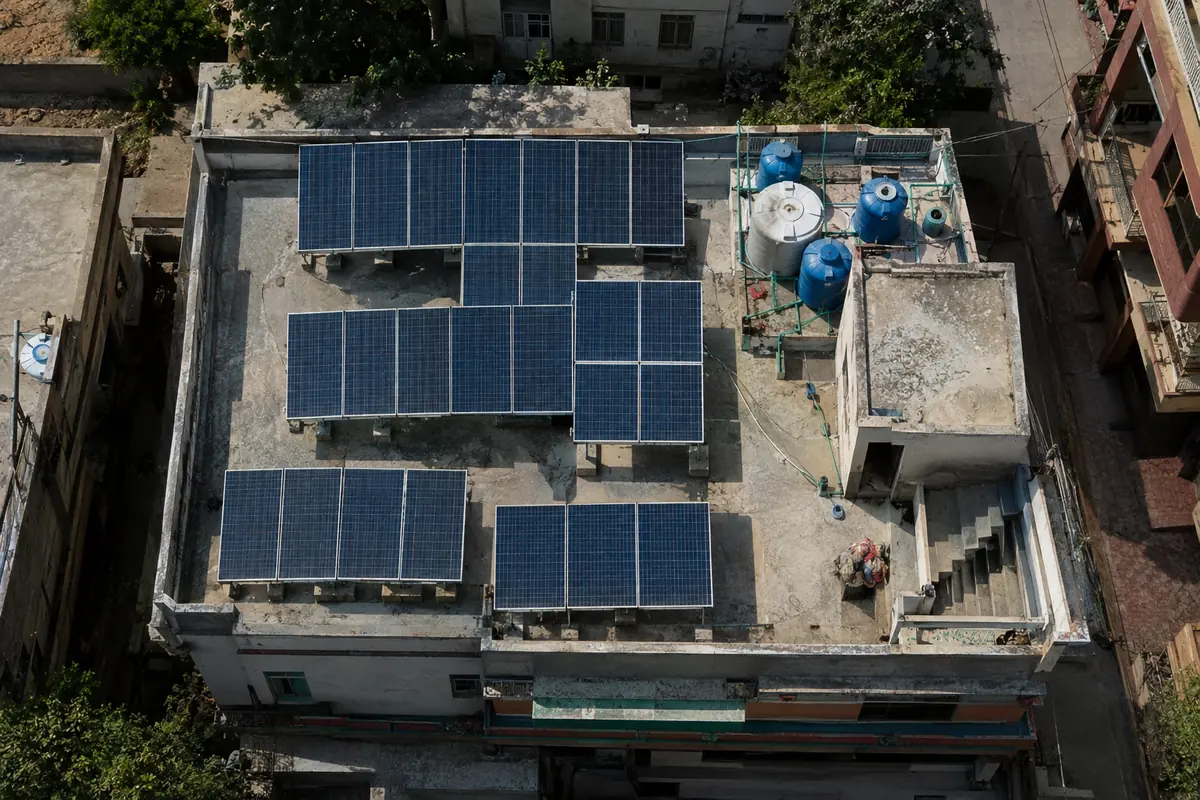
Comparison table: roof space by system size
The table below uses 585 W panels (7.5 x 3.7 ft) because they are the most common choice. Panel counts come from our calculator logic and update automatically. Roof space includes a realistic allowance for row gaps, walkway and structure on a flat Pakistani roof with tilted frames.
| System | Panels (585 W) | Panel area only | Roof space you should keep free |
|---|---|---|---|
| 3 kW | 6 | about 170 sq ft | 250 to 300 sq ft |
| 5 kW | 9 | about 250 sq ft | 400 to 450 sq ft |
| 10 kW | 18 | about 500 sq ft | 750 to 900 sq ft |
| 15 kW | 26 | about 725 sq ft | 1,100 to 1,300 sq ft |
| 20 kW | 35 | about 975 sq ft | 1,500 to 1,750 sq ft |
A 5 marla house in Lahore usually has a usable roof of 600 to 900 sq ft after the stair room and tanks, which fits a 5 to 8 kW system comfortably. A 10 marla roof can usually take 10 to 12 kW. If your roof is tight, a single raised structure (elevated frame) lets you use the space under the panels for tanks or drying clothes.
How many panels fit in one row
Installers in Pakistan normally mount panels in portrait, which means the 3.7 ft side runs along the row. Allow about 1 inch between panels for the mid clamps. Here is a quick way to see how many fit along a wall:
| Row length available | 585 W panels in portrait (3.7 ft each) | 585 W panels in landscape (7.5 ft each) | 700 W class in portrait (4.3 ft each) |
|---|---|---|---|
| 20 ft | 5 | 2 | 4 |
| 30 ft | 7 | 3 | 6 |
| 40 ft | 10 | 5 | 9 |
| 50 ft | 13 | 6 | 11 |
Portrait rows are cheaper to build because the structure uses fewer long rails. Landscape helps when the roof is shallow from front to back, for example a long narrow shop roof in an old bazaar.
Solar panel size in Pakistan for different uses
Not every buyer is fitting a house roof. The right panel size changes with the job:
- Home rooftop (3 to 15 kW): 540 to 590 W plates. They fit standard structures, two people can lift them, and spare parts and clamps are easy to find in any city market.
- Tube-well and farm pumps: 585 W to 720 W plates on ground-mounted frames. Bigger plates mean fewer joints across a large field array.
- Shop shade, kiosk or fan-and-light backup: 150 to 350 W panels. They fit small frames and charge a 12 V or 24 V battery through a controller.
- Rickshaw, cart or camping use: 100 to 200 W panels, often flexible or thin-frame. Flexible panels trade efficiency for low weight.
- Factory and warehouse roofs: 620 to 750 W plates, where crane or lift access makes heavy panels practical.
The live table below shows the current panel rates for the 540 to 600 watt range, which all share the same or very similar size.
| Model | Watt | Price per panel | Per watt | This week | Trend |
|---|---|---|---|---|---|
| Inverex Jolywood dual glassN-type | 600 W | Rs 25,500 | Rs 42.5 | No change | |
| Longi Hi-MO X9N-type HPBC 2.0 | 600 W | Rs 26,400 | Rs 44.0 | No change | |
| Trina Vertex N bifacialN-type i-TOPCon | 590 W | Rs 23,600 | Rs 40.0 | No change | |
| Canadian TOPHiKu6 bifacialN-type TOPCon | 590 W | Rs 25,370 | Rs 43.0 | No change | |
| Crown N-type bifacial 16BBN-type | 585 W | Rs 23,400 | Rs 40.0 | No change | |
| JA Solar DeepBlue 4.0 N-type bifacialN-type | 585 W | Rs 23,545 | Rs 40.2 | No change | |
| Astronergy ASTRO N5 bifacialN-type TOPCon | 585 W | Rs 23,985 | Rs 41.0 | No change | |
| Inverex Mustang bifacialN-type TOPCon | 585 W | Rs 24,280 | Rs 41.5 | No change | |
| Longi Hi-MO X7 bifacialN-type | 585 W | Rs 25,010 | Rs 42.8 | No change | |
| Canadian TOPHiKu6 bifacialN-type TOPCon | 585 W | Rs 25,155 | Rs 43.0 | No change | |
| Jinko Tiger Neo N-type bifacialN-type TOPCon | 585 W | Rs 25,420 | Rs 43.5 | No change | |
| Jinko Tiger Neo N-typeN-type TOPCon | 580 W | Rs 24,505 | Rs 42.3 | No change | |
| Jinko Tiger Pro P-type (old stock)Mono PERC | 550 W | Rs 20,900 | Rs 38.0 | No change | |
| Longi Hi-MO 5 (old stock)Mono PERC | 545 W | Rs 21,255 | Rs 39.0 | No change | |
| Jinko Tiger Pro P-type (old stock)Mono PERC | 540 W | Rs 20,520 | Rs 38.0 | No change |
Buying checklist: measure before you pay
Before you pay an advance, take ten minutes with a measuring tape. It saves arguments with the installer later.
- Measure the usable roof. Leave about 2 ft clear from the parapet on each side and keep the area in front of water tanks free for maintenance.
- Mark obstacles. Stair room, tanks, dish antennas and the neighbour’s taller wall all cast shadows. In winter the sun is low and shadows are long, so measure the shadow at around 9 am and 3 pm if you can.
- Pick the panel family first. Decide between the 7.5 ft (540 to 590 W) and 7.8 ft (600 W plus) family. Mixing them in one string is a bad idea.
- Ask for the exact model number. “585 watt” is not a model. Ask for something like JKM585N-72HL4 or LR5-72HTH-585M, then check the datasheet dimensions.
- Check the label on the delivered plate. The sticker on the back lists power, Voc, Isc and usually size and weight. Match it to the quotation.
- Plan the layout. Portrait (long side up the slope) or landscape. Most Pakistani installers use portrait in one or two rows. Ask for a simple sketch.
- Confirm the structure size. The frame must suit the panel length. A structure made for older 6 ft 10 in panels will not hold a 7.5 ft panel safely. Our solar panel stand price guide covers the options.
- Run the numbers. Use the solar panel calculator to check how many panels you need for your units, then compare that with how many fit.
- Check the tilt. A steeper tilt needs more row gap. The tilt angle calculator gives the best angle for your city.
Common mistakes to avoid with solar panel size
These come up again and again on Pakistani rooftops.
- Buying by wattage only. A dealer may offer a “bigger” 620 W plate thinking it is an upgrade, but it is 10 cm longer and may not fit the structure you already paid for.
- Ignoring weight on old roofs. Twenty 585 W panels weigh more than half a tonne before you add the steel. On older houses with weak slabs, spread the legs and avoid putting everything on one beam.
- Mixing sizes in one string. Panels of different sizes usually have different current ratings. The weakest panel drags the whole string down.
- No walkway. Without a gap you cannot wash the panels, and dust is the biggest loss in Punjab and Sindh. Leave at least one walkway of 1.5 to 2 ft.
- Using the wrong size estimate for small panels. A 150 W or 200 W panel is not a fixed size. Some are long and thin, some square. Measure the exact plate if it goes on a rickshaw roof, a shop shade or a tube-well stand.
- Trusting “same size” claims on used plates. Used imported panels may be older 60 or 72-cell types. Check the label before you plan rows.
- Forgetting the parapet shadow. A 3 ft parapet wall can shade the first row in winter. Raise the structure or shift the first row back.
Choosing the right size is the first step. Once you know what fits, compare brands on our best solar panels in Pakistan page and check today’s rates on the home page.
Frequently asked questions
What is the 585 watt solar panel size in feet?
Most 585 watt panels, including the Jinko Tiger Neo and Longi Hi-MO 6, measure 2278 x 1134 mm. That is about 7 ft 6 in long and 3 ft 9 in wide, or roughly 28 square feet. Always check the label, because a few market versions are slightly longer.
Is a 580 watt panel the same size as a 585 watt panel?
Yes, in almost every case. Both use the same 72-cell (144 half-cell) frame of about 7.5 x 3.7 ft. The extra 5 watts comes from slightly better cells, not a bigger plate.
What is the highest watt solar panel available in Pakistan?
Panels in the 700 to 750 watt class are the largest commonly imported for rooftops and ground mounts. They measure about 7.8 x 4.3 ft and weigh 33 to 39 kg, so they suit commercial roofs and farms more than small houses.
How much roof space do I need for a 5 kW solar system?
With 585 watt panels, a 5 kW system needs 9 plates covering about 250 square feet. Including walkways and row gaps, keep 400 to 450 square feet of clear, unshaded roof.
What is the voltage of a 585 watt solar panel?
A typical 585 watt panel has an open-circuit voltage of about 51 to 52 volts and a working voltage of about 42 to 43 volts. It is not a 12 V or 24 V panel, so it needs an inverter or MPPT controller rated for that input.
How heavy is a solar panel?
A 540 to 590 watt panel weighs about 27 to 29 kg. Double-glass and 700 watt class panels weigh 33 to 39 kg, so plan for two people and a stronger structure.
Can I mix different panel sizes in one system?
You can on separate MPPT inputs, but not in the same string. Different sizes usually have different currents, and the weakest panel pulls the whole string down.
What size is a 150 or 200 watt solar panel?
Small panels vary by maker. Most 150 to 200 watt panels are 4.5 to 5 ft long and 2.2 to 2.7 ft wide, so measure the exact plate before building a frame for it.