| Model | Watt | Price per panel | Per watt | This week | Trend |
|---|---|---|---|---|---|
| Aiko Stellar 1N+ ABCN-type ABC | 650 W | Rs 27,950 | Rs 43.0 | No change |
On this page10 min read
- 650 watt solar panel specifications
- 650 W vs nearby wattages: which should you buy?
- How many 650 W panels for 3, 5 and 10 kW (with price)
- How many units does a 650 watt panel produce in Pakistan?
- What can a 650 watt solar panel run?
- Best inverter for 650 W panels
- Buying tips before you pay
- Frequently asked questions
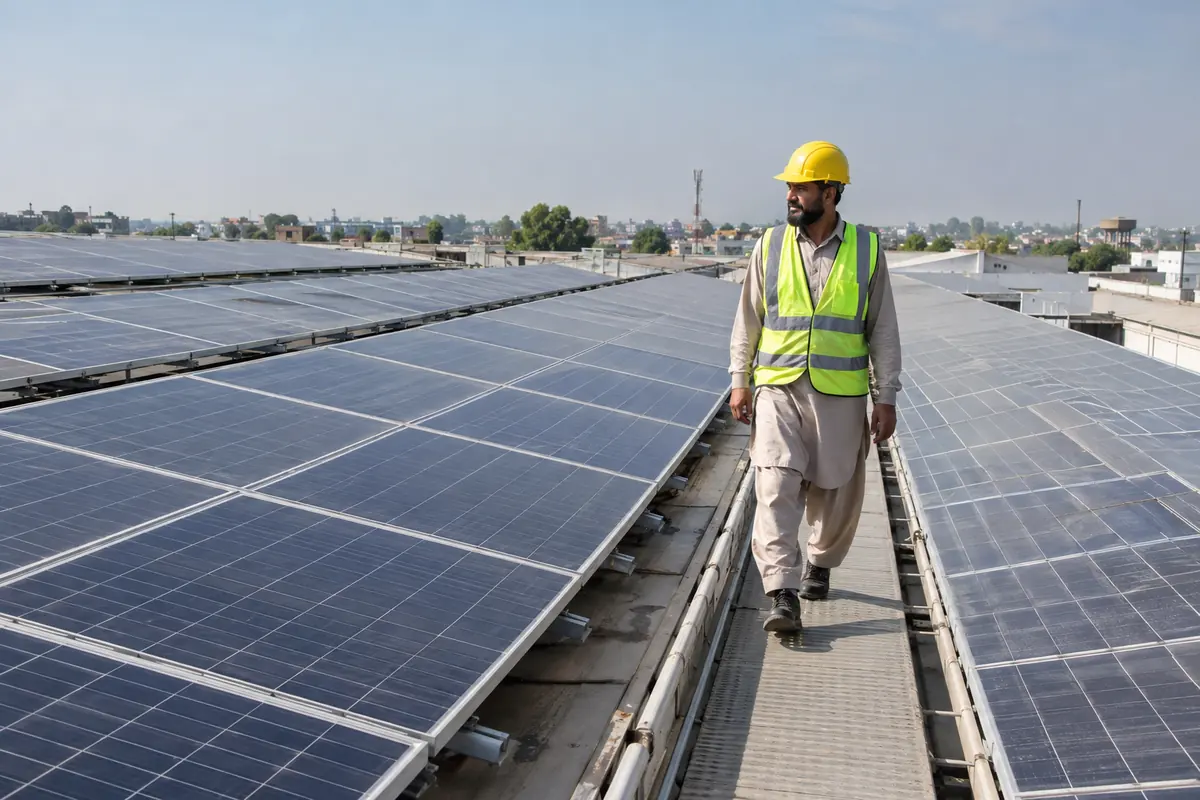
The 650 watt solar panel price in Pakistan is the top of the range most dealers stock for rooftops, and the two 650 W designs sold here could hardly be more different. One is Canadian’s wide, heavy HiKu7 PERC plate built for commercial roofs and ground mounts; it is now hard to find, and most stock on offer is B-grade. The other is AIKO’s slim, light back-contact plate, now sold as the Stellar 1N+ ABC, which squeezes 650 W into a frame barely bigger than a 600 W panel. It is the only A-grade 650 W plate on our sheet. The live rates are in the dated table above. This page explains which buyer each one suits, and what each one asks of your inverter and structure.
The cheapest A-grade 650 W panel on our sheet is currently Rs 27,950, or Rs 43 per watt. The average across large panels is Rs 41.3 per watt, so you can see straight away whether the extra size is costing you a premium.
650 watt solar panel specifications
| Spec (maker datasheet) | Canadian Solar HiKu7 CS7N-650MS | AIKO Comet 2U AIKO-G650-MCH72Mw |
|---|---|---|
| Cell type | 132 cells (2 × 66), large-format mono PERC | 144 cells, N-type all back contact (ABC) |
| Size | 2384 × 1303 × 35 mm | 2382 × 1134 × 33 mm |
| Size in feet | 7.82 × 4.27 ft | 7.81 × 3.72 ft |
| Area | 33.4 sq ft | 29.1 sq ft |
| Weight | about 34 to 36 kg, depending on version | 28.2 kg |
| Voc / Isc | 45.0 V / 18.39 A | 54.5 V / 15.08 A |
| Vmp / Imp | 37.9 V / 17.16 A | 45.31 V / 14.35 A |
| Efficiency | 20.9% | 24.0% |
| Power temp. coefficient | -0.34%/°C | -0.26%/°C |
| Faces | monofacial, glass and backsheet | monofacial |
| Warranty | product and power terms vary by version; check the card | 15-year product; about 88.85% power at year 30 |
The Canadian HiKu7 CS7N-650MS is a mono PERC module, and it is no longer on our price sheet because dealers now mostly offer it as B-grade. If you are offered one, ask for the exact model code: if it ends in MS, it is the PERC plate described here. The AIKO column uses the Comet 2U datasheet; AIKO now sells its 650 W as the Stellar 1N+ ABC, so check the datasheet for the exact model you buy.
Wide format versus slim format
The headline difference is width. The Canadian HiKu7 is 1303 mm wide, about 17 cm wider than almost every other panel on a Pakistani roof. The AIKO is 1134 mm, the same width as a normal 540 to 600 W plate.
- Wide plate: fewer, larger cells, lower voltage and very high current, around 17 A at the working point.
- Slim plate: higher efficiency, so 650 W fits the standard width and length.
- The wide plate covers about 4.3 extra square feet per panel for the same 650 W.
- The slim plate weighs roughly 6 to 8 kg less, which adds up on a long shed.
Which matters more depends on your roof. On a big ground mount, area is cheap and the wide plate’s lower price per watt (when it is lower) wins. On a tight rooftop, the slim plate’s watts per square foot win.
Watts per square foot
| Plate | Area | Watts per sq ft | 10 plates cover |
|---|---|---|---|
| Canadian 650 W (wide) | 33.4 sq ft | about 19.5 | about 334 sq ft |
| AIKO 650 W (slim) | 29.1 sq ft | about 22.3 | about 291 sq ft |
| Typical 585 W N-type | about 27.9 sq ft | about 21 | about 279 sq ft |
These figures are plate area only. Add roughly 25% for gaps, walkways and row spacing when you plan a roof. Our solar panel size in feet guide explains how to measure for this.
650 W vs nearby wattages: which should you buy?
| Wattage | Cheapest A-grade | Price per watt | Format | Typical buyer |
|---|---|---|---|---|
| 620 W | Rs 24,800 | Rs 40 | 1134 mm wide, glass-glass | large roofs, sheds |
| 650 W | Rs 27,950 | Rs 43 | 1134 mm slim ABC (wide PERC now mostly B-grade) | commercial, farms, premium homes |
| 700 W | Rs 29,400 | Rs 42 | wide 1303 mm class | utility and big ground mounts |
How to read this:
- If 650 W costs more per watt than 620 W, the only reason to pay it is fewer plates or, with AIKO, more power from the same roof.
- The 620 watt solar panel price page covers bifacial glass-glass plates, which earn more on raised frames over light surfaces. The 650 W plates here are monofacial.
- For the largest plates of all, compare with the 700 watt solar panel price. Those suit open ground, not homes.
- For a standard house on standard rails, a 650 W plate is rarely the cheapest route. Its advantage is fewer plates per kW, not lower cost.
Brand rates at 650 W
| Brand | Live price | Price per watt |
|---|---|---|
| Canadian Solar (650 W HiKu7 hard to find; TOPHiKu6 590 W shown) | Rs 25,370 | Rs 43 |
| AIKO Stellar 1N+ ABC 650 W | Rs 27,950 | Rs 43 |
Canadian’s 650 W HiKu7 is now hard to find as A-grade, so its row shows the current TOPHiKu6 590 W N-type plate instead. Compare the price per watt to see what AIKO’s back-contact cells cost over TOPCon. The Canadian Solar panel price and AIKO solar panel price pages list each brand’s other sizes.
Which 650 W plate suits which job
| Job | Better fit | Why |
|---|---|---|
| Ground mount on a farm, plenty of space | Canadian wide, if A-grade stock can be found | lower cost per watt matters more than area |
| Factory or warehouse roof with steel purlins | Canadian wide, if purlins carry the weight | fewer plates per kW, simple wiring |
| Small or shaded-edge rooftop in a city | AIKO slim | more watts per square foot |
| Older structure with 1134 mm rails | AIKO slim | same width as most plates, no new rails |
| Hot south Punjab or Sindh roof | AIKO slim | loses less power in heat |
How many 650 W panels for 3, 5 and 10 kW (with price)
| System | 650 W panels | DC size | Panel cost (cheapest 650 W) | Plate area, wide / slim |
|---|---|---|---|---|
| 3 kW | 5 | 3.25 kW | Rs 139,750 | 167 / 146 sq ft |
| 5 kW | 8 | 5.20 kW | Rs 223,600 | 267 / 233 sq ft |
| 10 kW | 16 | 10.40 kW | Rs 447,200 | 534 / 466 sq ft |
Eight plates for a 5 kW inverter (5.2 kW) and sixteen for 10 kW (10.4 kW) are both sensible, slightly oversized layouts. Five plates for 3 kW is less neat: 3.25 kW of panels on a 3 kW inverter is fine, but five plates make odd string lengths on a two-MPPT inverter.
The panel cost above is panels only. Inverter, structure, cabling, protection and labour come on top. The solar inverter price page covers the inverter side.
Commercial and farm sizes
| Project | 650 W plates | DC size | Notes |
|---|---|---|---|
| Rice mill or flour mill roof, 25 kW | 39 | 25.4 kW | wide plates, strong steel structure |
| Cold store or dairy farm, 40 kW | 62 | 40.3 kW | daytime chillers use most of the output |
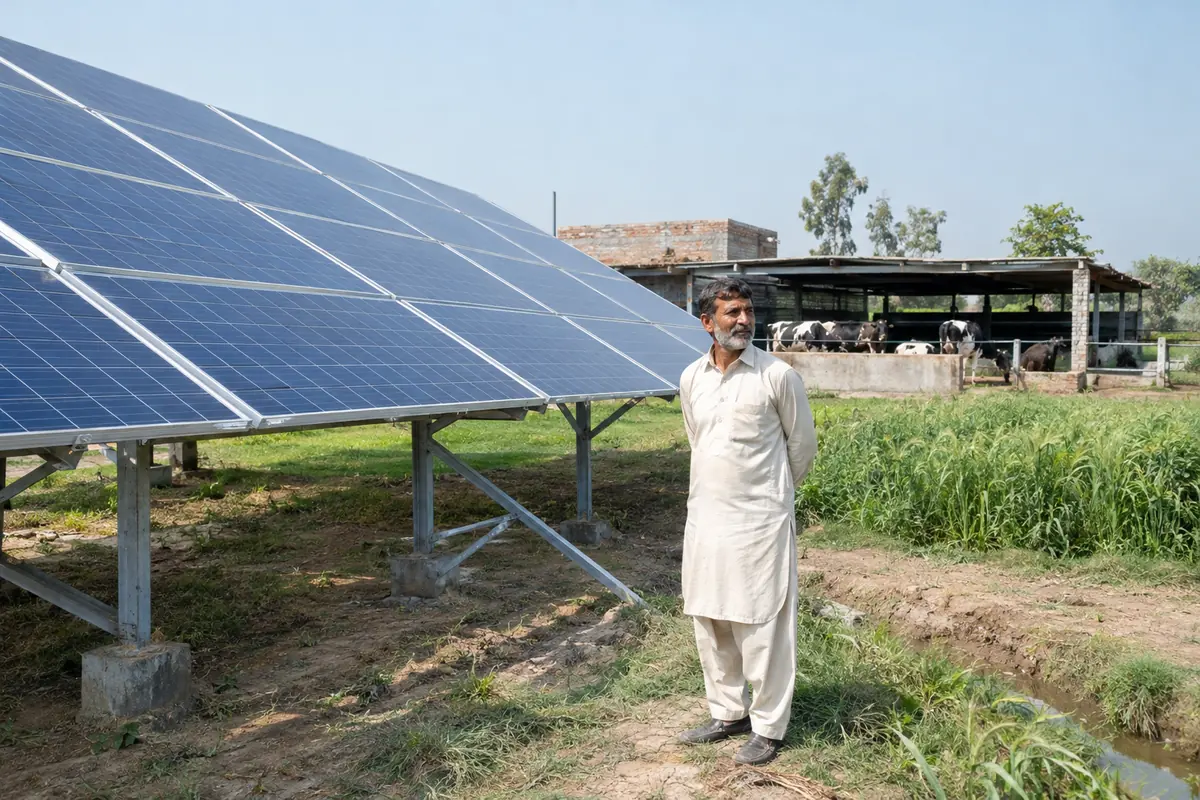
| Solar tubewell, 11 kW pump | about 22 to 25 | 14.3 to 16.3 kW | ground mount, follow the pump drive’s table |
| Premium home, 12 kW | 19 | 12.35 kW | slim AIKO plates on a limited roof |
Example: a flour mill in Faisalabad
Take a flour mill on the edge of Faisalabad with a 120-foot steel shed and machinery running from morning to evening.
- The owner wants about 30 kW of panels on the shed, which is 47 plates of 650 W (30.55 kW).
- The shed is wide and open, so area is not the limit. The wide Canadian HiKu7 is now hard to find as A-grade, so the owner picks the slim AIKO 650 W.
- Each plate weighs around 28 kg, so the purlins are checked by the installer before any rail goes up.
- Three strings of 15 or 16 plates go to a 30 kW three-phase inverter with a 1000 V input and MPPTs rated for the plate’s 15.1 A current.
- Output: roughly 45,700 units a year, from about 2,400 in a winter month to over 4,600 in spring.
How many units does a 650 watt panel produce in Pakistan?
One 650 W plate gives roughly 970 to 1,260 units a year depending on the city. These figures come from long-term solar data for each city at a south-facing tilt, with about 22% off for heat, dust, wiring and inverter losses.
| City | Per day (average) | Summer month | Winter month | Spring month | Per year |
|---|---|---|---|---|---|
| Lahore | about 2.7 units | about 96 | about 54 | about 99 | about 980 |
| Faisalabad | about 2.7 units | about 97 | about 52 | about 99 | about 975 |
| Islamabad | about 2.8 units | about 104 | about 57 | about 97 | about 1,015 |
| Karachi | about 3.1 units | about 92 | about 79 | about 114 | about 1,125 |
| Peshawar | about 3.0 units | about 118 | about 61 | about 103 | about 1,105 |
| Quetta | about 3.5 units | about 129 | about 76 | about 114 | about 1,260 |
Heat: where the two plates differ
The figures above are a fair average for both plates, but in a hot summer they will not behave the same.
- The Canadian PERC plate loses about 0.34% of its power for every degree above 25°C at the cell.
- The AIKO plate loses about 0.26% per degree.
- At a cell temperature of 65°C, common on a Multan or Hyderabad roof in June, that is about 13.6% down for the PERC plate against about 10.4% for the AIKO.
- Over a hot season, that gap is worth a few percent more units from the AIKO plate.
In mild Quetta winters or Islamabad springs, the difference shrinks. Keep an air gap under either plate; a cooler panel is a more productive panel.
Since February 2026, new rooftop connections have been moving to net billing under NEPRA’s prosumer rules. Exported units are credited far below the price of imported ones. For a 650 W commercial system, that means sizing the array to the daytime load and using the units on site.
What can a 650 watt solar panel run?
On a clear noon, one 650 W plate gives roughly 470 to 520 W of usable AC power. Because 650 W plates are mostly used on farms and businesses, here is a farmhouse in the Okara area on a 16-plate (10.4 kW) system.

| Load | Count | Approximate running power |
|---|---|---|
| Ceiling fans | 12 | about 1 kW |
| LED lights | 25 | about 0.4 kW |
| Milk chiller for the dairy | 1 | about 2 to 3 kW |
| 1.5 ton inverter AC | 2 | about 2.4 kW |
| 2 HP water motor for tanks | 1 | about 1.5 kW, short runs |
| Deep freezer and fridge | 2 | about 0.4 kW |
| Total at peak | about 8 to 9 kW |
Sixteen plates give roughly 7.5 to 8.3 kW of usable power on a hot afternoon. That covers this load most of the time; running the water motor in the morning, before the ACs come on, keeps it inside the solar output.
Solar tubewells with 650 W plates
Large plates are popular on solar tubewells because each plate covers more pump power.
- Find the pump’s rated power, for example a 15 HP (about 11 kW) submersible.
- Pump drives usually need about 1.3 to 1.5 kW of panels per kW of pump, which here means about 14 to 16.5 kW.
- That is roughly 22 to 25 plates of 650 W.
- Check the pump drive’s voltage range and match the string length to it. The Canadian and AIKO plates need different counts.
- Use a ground frame with a tilt you can adjust for summer and winter if you water year-round.
For a single plate: one 650 W panel at noon runs about 6 ceiling fans, about 14 DC fans, or a large inverter fridge with room to spare.
Best inverter for 650 W panels
This is where the two 650 W plates differ most. One is a high-current plate, the other is a high-voltage plate.
| Canadian HiKu7 650 W | AIKO Comet 2U 650 W | |
|---|---|---|
| Voc at 25°C | 45.0 V | 54.5 V |
| Voc on a 0°C morning (approx.) | 47.9 V | about 57.9 V |
| Isc | 18.39 A | 15.08 A |
| Max per string, 500 V input | 10 | 8 |
| Max per string, 600 V input | 12 | 10 |
| Max per string, 1000 V input | 20 | 17 |
| Max per string, 1100 V input | 22 | 18 |
| MPPT current rating needed | about 19 A or more | about 16 A or more |
The cold Voc figures are estimates from the datasheet temperature coefficients. Always check against the exact datasheet for the model you buy.
Current is the trap with the wide plate
The HiKu7’s 18.39 A short-circuit current is higher than many single-phase hybrid inverters accept per MPPT. Many popular home hybrids are rated somewhere between about 13 and 16 A per input.
- An inverter rated below the plate’s current will clip output every clear day.
- Paralleling two Canadian strings into one MPPT doubles the current to about 37 A, which only suits inverters built for it.
- Newer commercial three-phase inverters often have MPPTs rated for higher current; check the “max input current per MPPT” line, not just the kW size.
Steps to size a 650 W string
- Note the plate model: Canadian wide or AIKO slim.
- Divide the inverter’s maximum DC voltage by the cold Voc above, and round down.
- Multiply the working voltage (37.9 V or 45.31 V) by that count and check it sits inside the MPPT range on a hot day.
- Check the MPPT current rating against the plate’s Isc.
- Never mix the two plates on one MPPT.
For homes with load-shedding, the AIKO plate is the easier match with a hybrid inverter. For mills, cold stores and tubewells, a three-phase on-grid or pump drive with high-current inputs suits the Canadian plate.
Buying tips before you pay
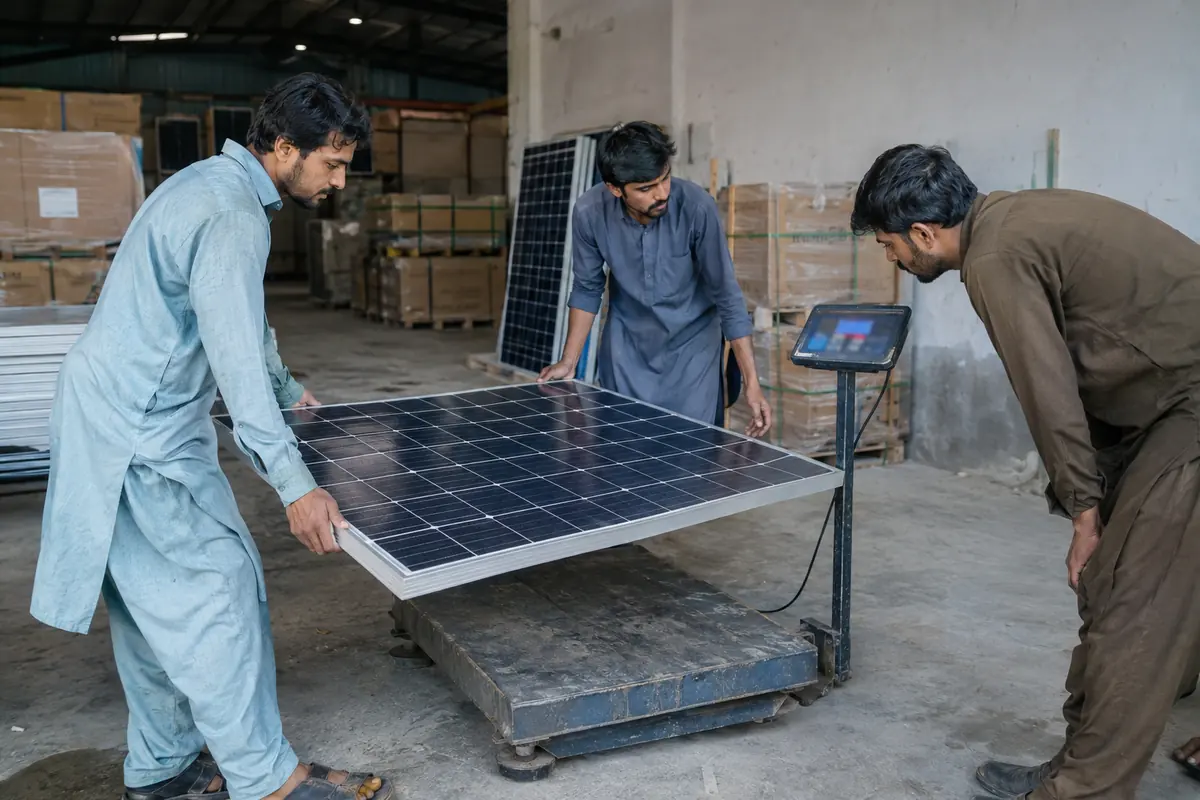
- Ask for the full model code. CS7N-650MS (PERC) and AIKO-G650-MCH72Mw (back contact) are very different plates at one wattage.
- Measure the frame width on delivery. 1303 mm means the wide plate, 1134 mm the slim one; the structure must match.
- Check the weight against the datasheet. A plate far lighter than listed is a warning sign.
- Inspect the glass and corners carefully. Wide plates flex more in transit if stacked badly.
- Plan transport: wide plates may not fit some pickups lying flat, and each is a two-person lift.
- Get the warranty card from the official distributor and keep it with the bill.
- Make sure the bill lists model, wattage, quantity, serial numbers and date.
Structure checklist for wide 650 W plates
- Rail spacing set for a 1303 mm width, not the usual 1134 mm.
- Clamps for a 35 mm frame, inside the maker’s allowed clamping zones.
- Purlins and rails rated for about 35 kg per plate, plus wind load on a 33 sq ft surface.
- Extra bracing on ground mounts in windy areas such as coastal Sindh and Balochistan.
- Galvanised or stainless fixings throughout.
For every wattage side by side, see the solar panel price list, or go back to the latest solar panel rates on the home page.
Frequently asked questions
What is the 650 watt solar panel price in Pakistan?
The cheapest A-grade 650 watt panel on our sheet is Rs 27,950 as of 1 Nov 2026. AIKO's Stellar 1N+ ABC is the A-grade 650 W plate on our sheet. Canadian Solar's HiKu7 650 W is now hard to find, and most stock offered is B-grade.
What is the size of a 650 watt solar panel?
It depends on the model. The Canadian Solar HiKu7 650 W is 2384 × 1303 mm (about 7.8 × 4.3 feet), wider than most panels. The AIKO Comet 2U 650 W is 2382 × 1134 mm (about 7.8 × 3.7 feet), the same width as a normal 600 W plate.
How much does a 650 watt solar panel weigh?
The AIKO 650 W weighs 28.2 kg. The wider Canadian Solar 650 W weighs around 34 to 36 kg depending on the version, so it needs two people and a strong structure.
Is the Canadian 650 W panel N-type or PERC?
The HiKu7 CS7N-650MS datasheet describes a mono PERC module. Check the model code on the label; a code ending in MS is the PERC version. It is now hard to find, and most stock offered is B-grade.
Which inverter is best for 650 watt panels?
For the Canadian 650 W, choose an inverter rated for about 19 A or more per MPPT, because the plate's current is 18.39 A. For the AIKO 650 W, current is lower at 15.08 A, but voltage is higher: no more than 8 plates per string on a 500 V inverter.
How many 650 watt panels are needed for 5 kW?
Eight panels give 5.2 kW, which suits a 5 kW inverter well. For 10 kW, sixteen panels give 10.4 kW.
How many units does a 650 watt panel produce?
About 980 units a year in Lahore, around 1,125 in Karachi and about 1,260 in Quetta, after typical losses. That is roughly 2.7 to 3.5 units a day on average.
Is a 650 watt panel good for a home?
The slim AIKO 650 W can suit a home with limited roof space, as it fits standard rails. The wide Canadian 650 W, now mostly sold as B-grade, is better suited to factories, farms and ground mounts with strong structures.