| Model | Watt | Price per panel | Per watt | This week | Trend |
|---|---|---|---|---|---|
| Jinko Tiger Pro P-type (old stock)Mono PERC | 550 W | Rs 20,900 | Rs 38.0 | No change | |
| Jinko Tiger Pro P-type (old stock)Mono PERC | 540 W | Rs 20,520 | Rs 38.0 | No change | |
| Longi Hi-MO 5 (old stock)Mono PERC | 545 W | Rs 21,255 | Rs 39.0 | No change | |
| Crown N-type bifacial 20BBN-type TOPCon | 620 W | Rs 24,800 | Rs 40.0 | No change | |
| Trina Vertex N bifacialN-type i-TOPCon | 590 W | Rs 23,600 | Rs 40.0 | No change | |
| Crown N-type bifacial 16BBN-type | 585 W | Rs 23,400 | Rs 40.0 | No change | |
| JA Solar DeepBlue 4.0 N-type bifacialN-type | 585 W | Rs 23,545 | Rs 40.2 | No change | |
| Trina Vertex N bifacialN-type i-TOPCon | 620 W | Rs 25,110 | Rs 40.5 | No change | |
| Aiko Stellar 1N ABCN-type ABC | 620 W | Rs 25,110 | Rs 40.5 | No change | |
| Trina Vertex N UltraN-type i-TOPCon | 740 W | Rs 30,340 | Rs 41.0 | No change | |
| Risen Hyper-ion Pro HJTN-type HJT | 720 W | Rs 29,520 | Rs 41.0 | No change | |
| Astronergy ASTRO N5 bifacialN-type TOPCon | 585 W | Rs 23,985 | Rs 41.0 | No change | |
| Inverex Mustang bifacialN-type TOPCon | 585 W | Rs 24,280 | Rs 41.5 | No change | |
| Risen Hyper-ion HJTN-type HJT | 700 W | Rs 29,400 | Rs 42.0 | No change | |
| Jinko Tiger Neo N-typeN-type TOPCon | 580 W | Rs 24,505 | Rs 42.3 | No change | |
| Inverex Mustang double glassN-type | 620 W | Rs 26,350 | Rs 42.5 | No change | |
| Inverex Jolywood dual glassN-type | 600 W | Rs 25,500 | Rs 42.5 | No change | |
| Longi Hi-MO X7 bifacialN-type | 585 W | Rs 25,010 | Rs 42.8 | No change | |
| Aiko Stellar 1N+ ABCN-type ABC | 650 W | Rs 27,950 | Rs 43.0 | No change | |
| Jinko Tiger Neo 3.0 bifacialN-type TOPCon | 620 W | Rs 26,660 | Rs 43.0 | No change | |
| Canadian TOPHiKu6 bifacialN-type TOPCon | 590 W | Rs 25,370 | Rs 43.0 | No change | |
| Canadian TOPHiKu6 bifacialN-type TOPCon | 585 W | Rs 25,155 | Rs 43.0 | No change | |
| Jinko Tiger Neo N-type bifacialN-type TOPCon | 585 W | Rs 25,420 | Rs 43.5 | No change | |
| Longi Hi-MO X9N-type HPBC 2.0 | 600 W | Rs 26,400 | Rs 44.0 | No change |
On this page9 min read
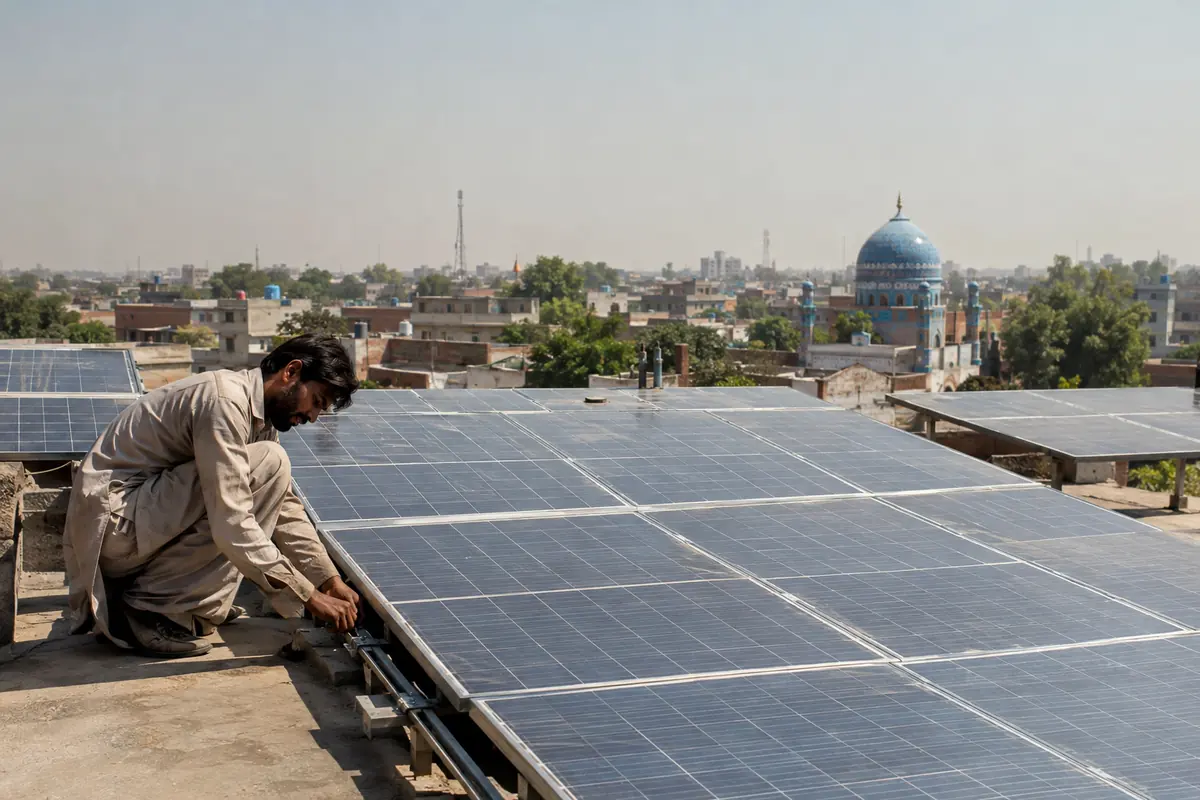
The solar panel price in Multan is set by the same national market as everywhere else, but few cities ask more of a solar system. Multan has some of the strongest sunshine in Punjab and some of the harshest heat and dust, and MEPCO covers a huge area of southern Punjab where farms, shops and homes are all going solar. The live rate table above shows today’s A-grade plate prices. Below we explain what a complete system costs here, how MEPCO’s net billing works, and how to keep panels producing through a Multan summer.
Solar panel markets in Multan
Multan is the trading hub for southern Punjab, so its electrical markets supply not only the city but also buyers from surrounding districts. We could not confirm one named solar bazaar that dominates the trade, so instead of naming streets, here is how buying works in practice.
| Where buyers go | Typical customer | What to watch |
|---|---|---|
| Electrical and electronics markets in the old city and main commercial areas | Homeowners and shopkeepers buying plates and inverters by the piece | Mixed stock, check model labels and serial numbers |
| Installers and solar companies | Families wanting a full system with MEPCO paperwork | Brand swaps between quote and delivery |
| Agricultural solar dealers | Farmers solarising tubewells across the district | Pump and panel matching, structure height in fields |
| Regional distributors | Installers and bulk buyers from nearby towns | Usually the best price for full pallets |
Panels reach Multan by road from Karachi and from distributors further north, so expect plate prices close to national rates with a small freight margin. To judge any quote, start from today’s cheapest A-grade 585 W plate at Rs 23,400 and the cheapest 580 W at Rs 24,505.
| Model | Watt | Price per panel | Per watt | This week | Trend |
|---|---|---|---|---|---|
| Crown N-type bifacial 16BBN-type | 585 W | Rs 23,400 | Rs 40.0 | No change | |
| JA Solar DeepBlue 4.0 N-type bifacialN-type | 585 W | Rs 23,545 | Rs 40.2 | No change | |
| Astronergy ASTRO N5 bifacialN-type TOPCon | 585 W | Rs 23,985 | Rs 41.0 | No change | |
| Inverex Mustang bifacialN-type TOPCon | 585 W | Rs 24,280 | Rs 41.5 | No change | |
| Longi Hi-MO X7 bifacialN-type | 585 W | Rs 25,010 | Rs 42.8 | No change | |
| Canadian TOPHiKu6 bifacialN-type TOPCon | 585 W | Rs 25,155 | Rs 43.0 | No change | |
| Jinko Tiger Neo N-type bifacialN-type TOPCon | 585 W | Rs 25,420 | Rs 43.5 | No change | |
| Jinko Tiger Neo N-typeN-type TOPCon | 580 W | Rs 24,505 | Rs 42.3 | No change | |
| Jinko Tiger Pro P-type (old stock)Mono PERC | 550 W | Rs 20,900 | Rs 38.0 | No change | |
| Longi Hi-MO 5 (old stock)Mono PERC | 545 W | Rs 21,255 | Rs 39.0 | No change | |
| Jinko Tiger Pro P-type (old stock)Mono PERC | 540 W | Rs 20,520 | Rs 38.0 | No change |
Choosing panels for Multan heat
In a city where roof temperatures in June can make glass too hot to touch, the panel’s temperature coefficient matters as much as its wattage. That figure tells you how much power the plate loses for every degree above 25 degrees.
| Cell type | Typical temperature behaviour | Good fit for Multan? |
|---|---|---|
| N-type TOPCon | Loses less power in heat than older types | Yes, the safest all-round choice |
| N-type back-contact or HJT | Among the best heat performers | Yes, if the budget allows |
| Mono PERC | Loses more in heat | Fine for budget systems, expect lower summer output |
| Used or B-grade plates | Unknown, often degraded | Only for small backup setups |
Compare brands at the most popular sizes on our 585 watt and 580 watt solar panel price pages.
Solar system installation cost in Multan
Multan homes run air conditioners for long months, so many families size their systems around cooling. The panel cost below updates with the market. Everything else is a range we checked against Pakistani market sources as of October 2026.
| 3 kW | 5 kW | 10 kW | |
|---|---|---|---|
| Plates at 585 W | 6 | 9 | 18 |
| Panel cost today | Rs 140,400 | Rs 210,600 | Rs 421,200 |
| Inverter | Rs 65,000 to 1,50,000 | Rs 95,000 to 2,60,000 | Rs 2,00,000 to 3,80,000 |
| Structure | Rs 15,000 to 30,000 | Rs 25,000 to 50,000 | Rs 50,000 to 90,000 |
| Wiring, protection, earthing | Rs 10,000 to 20,000 | Rs 18,000 to 30,000 | Rs 35,000 to 60,000 |
| Labour | Rs 15,000 to 25,000 | Rs 20,000 to 35,000 | Rs 40,000 to 60,000 |
Batteries are extra and can cost as much as the inverter. In Multan, where cooling load runs into the evening, a battery is worth considering if you want the AC to keep running after sunset.
Heat-proofing that belongs in a Multan quote
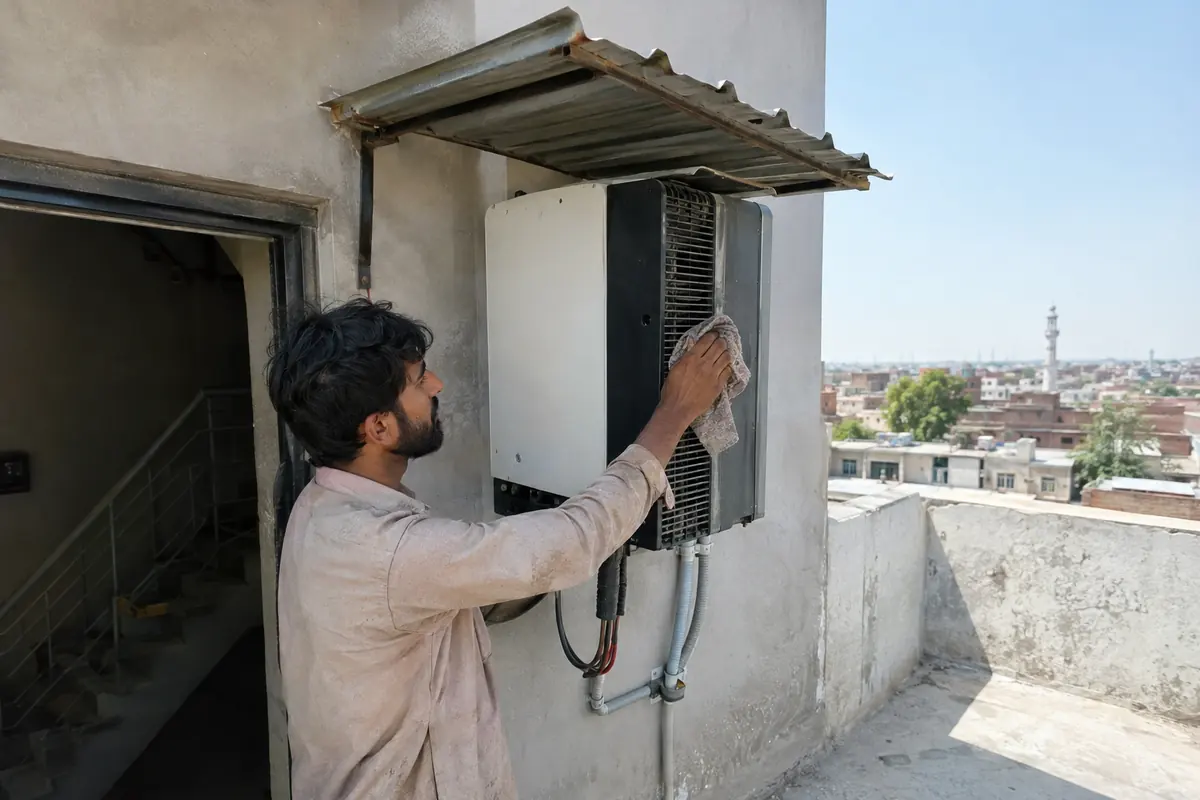
- Inverter location: mount it indoors or in a shaded, ventilated spot. Inverters cut their output (derate) when they overheat, and a unit on a sunny wall can lose power every summer afternoon.
- Raised frames: a gap of at least a foot under the plates lets air flow and keeps them cooler than plates laid close to a hot slab.
- Solar DC cable rated for high temperatures and UV, with MC4 connectors from a known brand. Cheap connectors melt or loosen in heat.
- Conduit for cable runs across the roof, so the sun does not crack the insulation.
- Breakers and surge protection in a weatherproof box out of direct sun.
For a full breakdown of fitting costs, see our solar panel installation cost guide.
Tubewells and farms around Multan
Solar tubewells have spread fast across southern Punjab. If you are solarising a pump rather than a house, the sizing logic is different:
- Find the motor size in kW (1 horsepower is about 0.75 kW).
- Plan roughly 1.2 to 1.5 kW of panels per kW of motor, so the pump keeps running in the morning and late afternoon.
- Use a solar pump drive (VFD) matched to the motor, not a household inverter.
- Set the frame high enough to clear crops and stray animals, and anchor it against dust storms.
- Keep a clear path for washing, because field dust builds up quickly.
Net metering in Multan: step by step with MEPCO
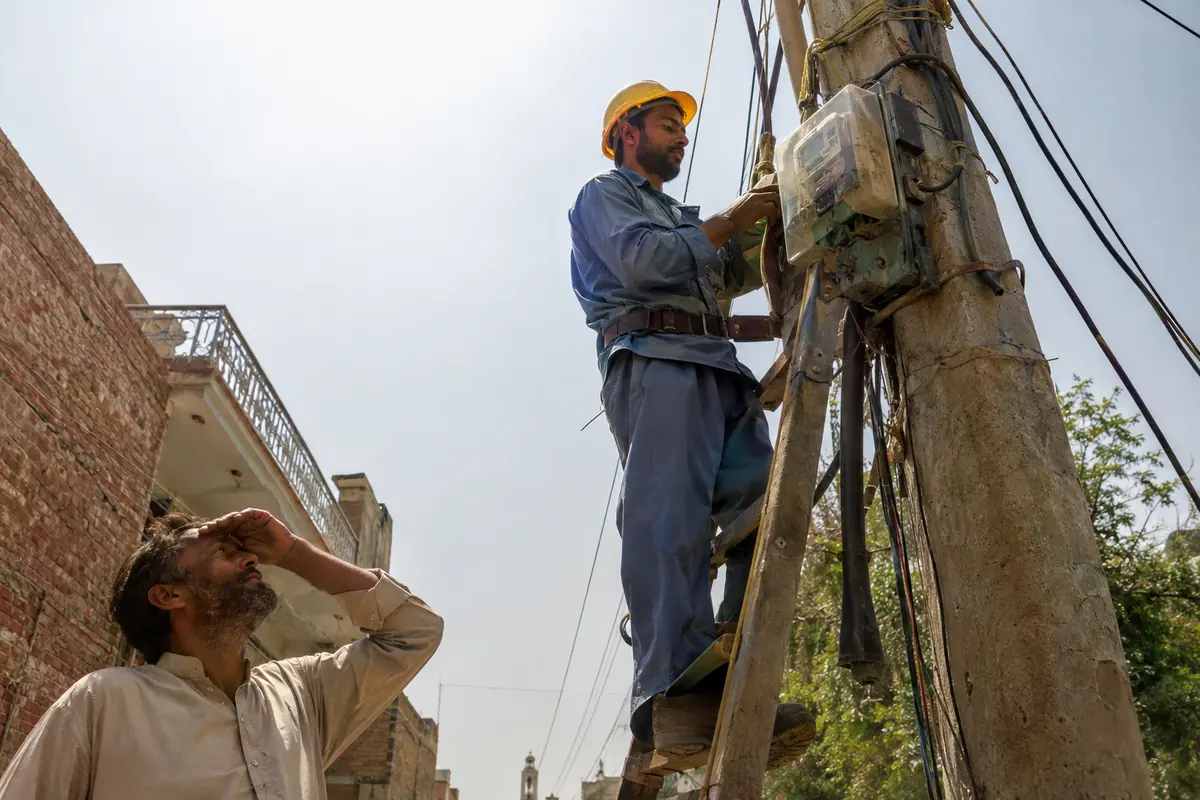
Multan is served by MEPCO, the Multan Electric Power Company, which describes itself as the largest power distribution company under PEPCO. It covers 13 districts of southern Punjab, run through zones including Multan, Khanewal, Sahiwal, Bahawalpur, Bahawalnagar, Muzaffargarh, Dera Ghazi Khan, Rahim Yar Khan and Vehari. Under NEPRA’s Prosumer Regulations 2026, notified on 9 February 2026, new solar connections are on net billing: exported units are credited at the national average energy purchase price, and imported units are billed at your normal MEPCO tariff. Earlier net metering agreements continue on their old terms until they expire.
- Eligibility check: a three-phase 400 V or 11 kV connection, and a system no larger than your sanctioned load.
- Application: your installer fills the standard form, attaches a single-line diagram, equipment details (inverter must comply with UL 1741), your bill, CNIC and ownership papers, and submits it to MEPCO.
- Acknowledgement: MEPCO confirms receipt and completeness within 5 working days.
- Technical review: within 15 working days. MEPCO can refuse if solar on your transformer has reached 80% of its capacity.
- Agreement: signed within 7 working days, then MEPCO issues a cost estimate within 7 working days, which you pay within 7 working days.
- Meter: MEPCO installs the bidirectional meter within 15 working days of payment.
- NEPRA concurrence: MEPCO forwards the file and NEPRA issues its concurrence once the Rs 1,000 per kW fee is paid. Public NEPRA records show concurrences being issued for MEPCO prosumers through 2026.
| Item | As of October 2026 |
|---|---|
| NEPRA fee | Rs 1,000 per kW, one time |
| Meter and connection work | Rs 15,000 to 50,000, by system size |
| Agreement term | 5 years, renewable |
| Credit settlement | Net credit carries to the next bill or is paid quarterly |
Net billing and a Multan cooling bill
Multan’s long cooling season works in your favour under net billing. From April to September, two inverter ACs running through the afternoon can use most of what a 5 kW roof produces, so very few units are exported at the low buyback rate. The weak spot is the evening: after sunset the AC keeps running on grid power at the full tariff.
| Time of day in June | Where the power comes from | Value to you |
|---|---|---|
| 9 am to 5 pm | Your panels, used directly | Full MEPCO tariff saved |
| Surplus at midday | Exported to MEPCO | Low NEPRA buyback rate |
| 6 pm to midnight | Grid, or a battery if fitted | Grid at full tariff, battery saves it |
Running ACs a little cooler in the afternoon (pre-cooling the house) and easing off in the evening is one of the cheapest ways to raise your savings.
Rural connections and transformer limits
Many MEPCO consumers outside the city are on long rural feeders with small transformers. The 80% solar limit on each transformer can be reached quickly in a village where several homes and tubewells go solar. If your area is crowded with solar, ask MEPCO early whether your transformer has room, or plan a hybrid system that does not export.
Sun hours and solar output in Multan
Multan gets a planning average of about 5.5 peak sun hours a day, among the best in Punjab, and it is drier than the northern cities, so the monsoon dip is milder. Heat is the real enemy: on the hottest days, panels produce less than the sunshine alone would suggest. These modelled figures come from the European Commission’s PVGIS tool (ERA5 data), with panels facing south at 30 degrees and 14% system losses.
| Month | Units per kW per day | What is happening |
|---|---|---|
| January | 4.6 | Cool, clear days, panels run efficiently |
| February | 4.9 | Excellent output |
| March | 5.0 | Peak season starts |
| April | 5.0 | Best month of the year |
| May | 4.8 | Heat and dust begin to bite |
| June | 4.4 | Very hot, dust storms |
| July | 4.0 | Humid monsoon heat |
| August | 4.1 | Monsoon cloud, but shorter than up north |
| September | 4.5 | Recovery |
| October | 4.8 | Strong again |
| November | 4.7 | Clear and mild |
| December | 4.6 | Short days, good efficiency |
That adds up to about 1,680 units per kW per year, or roughly 8,400 units from a 5 kW system. You can test your own numbers with our solar panel calculator.
Dust storms and cleaning in Multan
Dust is the single biggest controllable loss here. After a storm, a layer of fine dust can cut output sharply until the panels are washed.
| Period | Cleaning routine |
|---|---|
| April to June | Weekly, plus after every dust storm |
| July to September | Every two weeks, rain helps only partly |
| October to March | Every two to three weeks |
Wash early in the morning or after sunset with plain water and a soft brush. Spraying cold water on hot glass at midday can stress the panel. Our solar panel cleaning guide has more detail.
How to choose a solar installer in Multan
Multan’s market ranges from established companies to one-man teams who learned on the job during the solar boom. A checklist keeps you safe:
- PPIB certification: is the installer on the certified list (AEDB’s certification now sits with PPIB)? MEPCO and banks often ask for it.
- Heat experience: ask how they protect the inverter from summer heat and where they will mount it.
- Written specification: plate brand, model, wattage and serials; inverter model; cable size and brand; structure type and height.
- Earthing and surge protection: listed in the quote with the earthing pit location.
- MEPCO paperwork: who prepares the file, what it costs, and how many net billing files they have completed under the 2026 rules.
- Local references: two Multan installations that have been through at least one full summer.
- After-sales: who comes when the inverter shows a fault in June, and how quickly?
Mistakes that cost Multan owners every summer
- Plates laid flat on the slab with no air gap, cooking in June.
- The inverter fixed on a west-facing wall in full afternoon sun.
- No earthing pit, so a storm surge takes out the inverter.
- Panels left unwashed for weeks after an aandhi, losing output on the best sun days.
Start your shortlist with our guide to solar panel companies in Pakistan.
Multan vs other cities: price difference
For the same plate, buyers in Multan pay close to the national rate. What differs is how the system has to be built and how much it produces.
| Factor | Multan | Lahore | Faisalabad | Karachi |
|---|---|---|---|---|
| Plate price | National rate plus freight | Close to national rate | National rate plus freight | Often lowest |
| Utility | MEPCO | LESCO | FESCO | K-Electric |
| Yearly units per kW | About 1,680 | About 1,610 | About 1,640 | About 1,720 |
| Biggest local issue | Extreme heat and dust storms | Smog | Industrial dust | Salt air |
| Extra cost to plan for | Shaded inverter, raised frame, frequent cleaning | Weekly winter cleaning | Cleaning near factories | Corrosion-resistant hardware |
So the solar panel price Multan families pay for plates is no different from elsewhere, but a well-built Multan system spends a little more on heat protection and gets more units back each year. Compare with our Faisalabad page, or go back to the solar panel price in Pakistan home page for national rates.
Frequently asked questions
What is the solar panel price in Multan today?
The cheapest A-grade 585 W plate is currently around Rs 20,520, and the table on this page shows other brands and sizes. Multan prices are close to the national rate, usually with a small freight margin.
Which solar panel is best for Multan's heat?
N-type TOPCon, back-contact or HJT panels hold their output better in heat than older mono PERC plates. Check the temperature coefficient on the datasheet: the smaller the number, the less power the plate loses on a hot afternoon.
Does MEPCO still offer net metering in Multan?
New MEPCO connections are on net billing under NEPRA's Prosumer Regulations 2026, with exports credited at a lower NEPRA-set rate. Agreements signed before 9 February 2026 keep their old net metering terms until they expire.
How many units does a 5 kW solar system make in Multan?
About 8,400 units a year, or roughly 700 a month. March and April are the best months, and output dips in June to August because of heat, dust and monsoon humidity.
How often should I clean solar panels in Multan?
Weekly from April to June and after every dust storm, then every two to three weeks for the rest of the year. Wash early in the morning or after sunset, never with cold water on hot glass at midday.
Can I run a tubewell on solar in Multan?
Yes, and many farms across southern Punjab already do. Plan roughly 1.2 to 1.5 kW of panels for each kW of motor, use a solar pump drive matched to the motor, and anchor the frame well against dust storms.
Where should the inverter go in a Multan house?
Indoors or in a shaded, ventilated spot, away from west-facing walls. Inverters reduce their output when they overheat, so a cool location protects both your units and the inverter's life.
Can a single-phase home in Multan get net billing?
No. Net billing is available only on three-phase 400 V or 11 kV connections, and the system cannot exceed your sanctioned load. Single-phase homes can still use a hybrid or off-grid system without exporting.