| Model | Watt | Price per panel | Per watt | This week | Trend |
|---|---|---|---|---|---|
| Crown N-type bifacial 20BBN-type TOPCon | 620 W | Rs 24,800 | Rs 40.0 | No change | |
| Trina Vertex N bifacialN-type i-TOPCon | 620 W | Rs 25,110 | Rs 40.5 | No change | |
| Aiko Stellar 1N ABCN-type ABC | 620 W | Rs 25,110 | Rs 40.5 | No change | |
| Inverex Mustang double glassN-type | 620 W | Rs 26,350 | Rs 42.5 | No change | |
| Jinko Tiger Neo 3.0 bifacialN-type TOPCon | 620 W | Rs 26,660 | Rs 43.0 | No change |
On this page9 min read
- 620 watt solar panel specifications
- 620 W vs nearby wattages: which should you buy?
- How many 620 W panels for 3, 5 and 10 kW (with price)
- How many units does a 620 watt panel produce in Pakistan?
- What can a 620 watt solar panel run?
- Best inverter for 620 W panels
- Buying tips before you pay
- Frequently asked questions
The 620 watt solar panel price in Pakistan covers two very different panels that happen to share a number. One is short and pushes high current; the other is long and runs at high voltage. Both are bifacial and glass-glass, and both suit big roofs, sheds and commercial jobs better than a typical 5-marla house. The live rates are in the dated table above. This page explains how the two 620 W designs differ, and why that difference decides which inverter you can use.
The cheapest A-grade 620 W panel on our sheet is Rs 24,800 at the moment, or Rs 40 per watt.
620 watt solar panel specifications
| Spec (maker datasheet) | Trina Vertex N TSM-620NEG19RC.20 | Jinko Tiger Neo JKM620N-78HL4-BDV |
|---|---|---|
| Cell format | 132 cells, 210 mm rectangular (210R), N-type i-TOPCon | 156 half-cut cells (78 × 2), N-type TOPCon |
| Size | 2382 × 1134 × 30 mm | 2465 × 1134 × 30 mm |
| Size in feet | 7.81 × 3.72 ft | 8.09 × 3.72 ft |
| Area | 29.1 sq ft | 30.1 sq ft |
| Weight | 33.0 kg | 34.6 kg |
| Voc | 49.6 V | 55.58 V |
| Isc | about 15.9 A | 14.19 A |
| Vmp / Imp | 41.4 V / 14.99 A | 45.93 V / 13.50 A |
| Efficiency | about 22.95% | 22.18% |
| Construction | bifacial, dual glass | bifacial, dual glass |
| Power temp. coefficient | -0.29%/°C | -0.29%/°C |
| Warranty | 12-year product, 30-year power | 12-year product, 30-year power (87.4% at year 30) |
Two ways to make 620 W
- Trina uses bigger, rectangular 210R cells. Fewer, larger cells mean a shorter panel and higher current: about 15 A at the working point.
- Jinko uses the same 182 mm-class cells as its 585 W plate, just more of them: 78 full-cell positions instead of 72. That makes a longer panel, 8.1 feet, with higher voltage and normal current.
- The Trina plate is 83 mm shorter and 1.6 kg lighter, and slightly more efficient per square foot.
- The Jinko plate’s current is the same as most 585 W panels, so it fits almost any inverter’s current limit.
Which design is better? Neither, in output terms. Both have the same heat coefficient and both are bifacial. The choice comes down to your inverter and your structure. If your inverter has a modest current limit, the Jinko suits it better. If your roof is short front to back, or the rails are already cut for a 2382 mm plate, the Trina fits. If you are buying a new inverter anyway, pick the plate with the better price per watt on the day and design the strings to match it.
Weight and handling
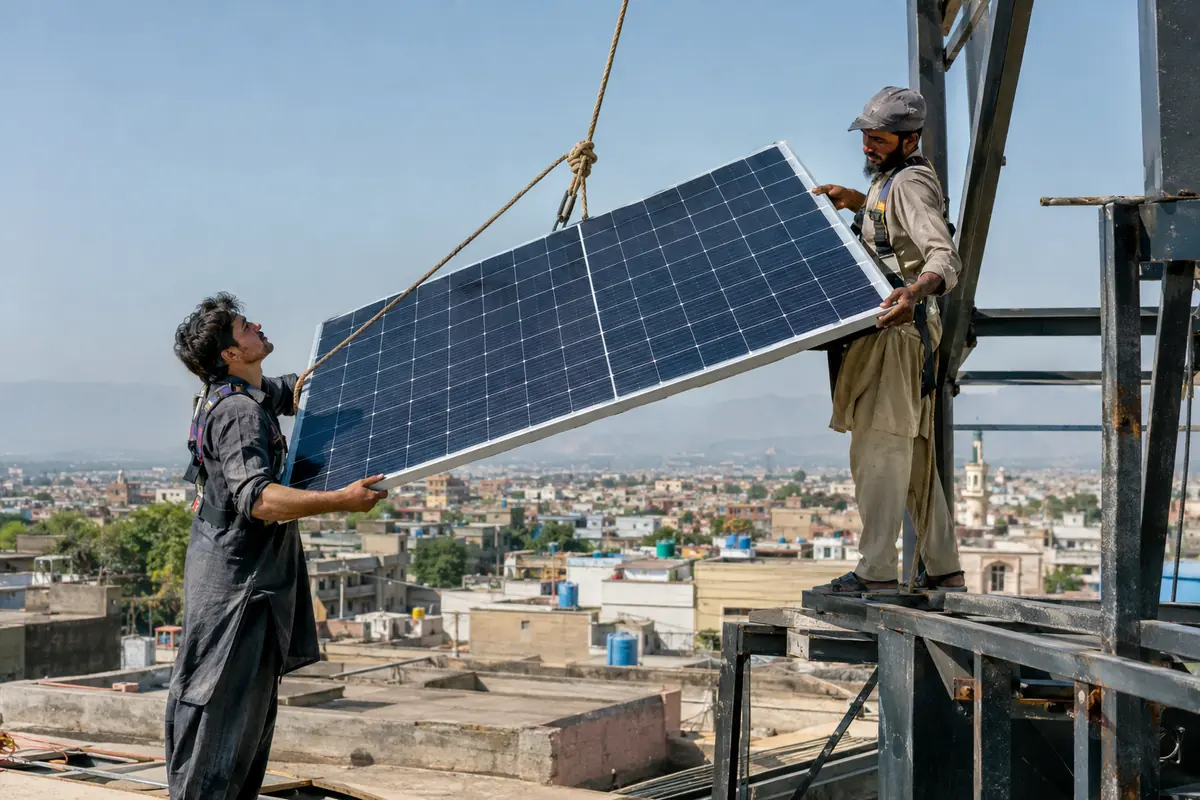
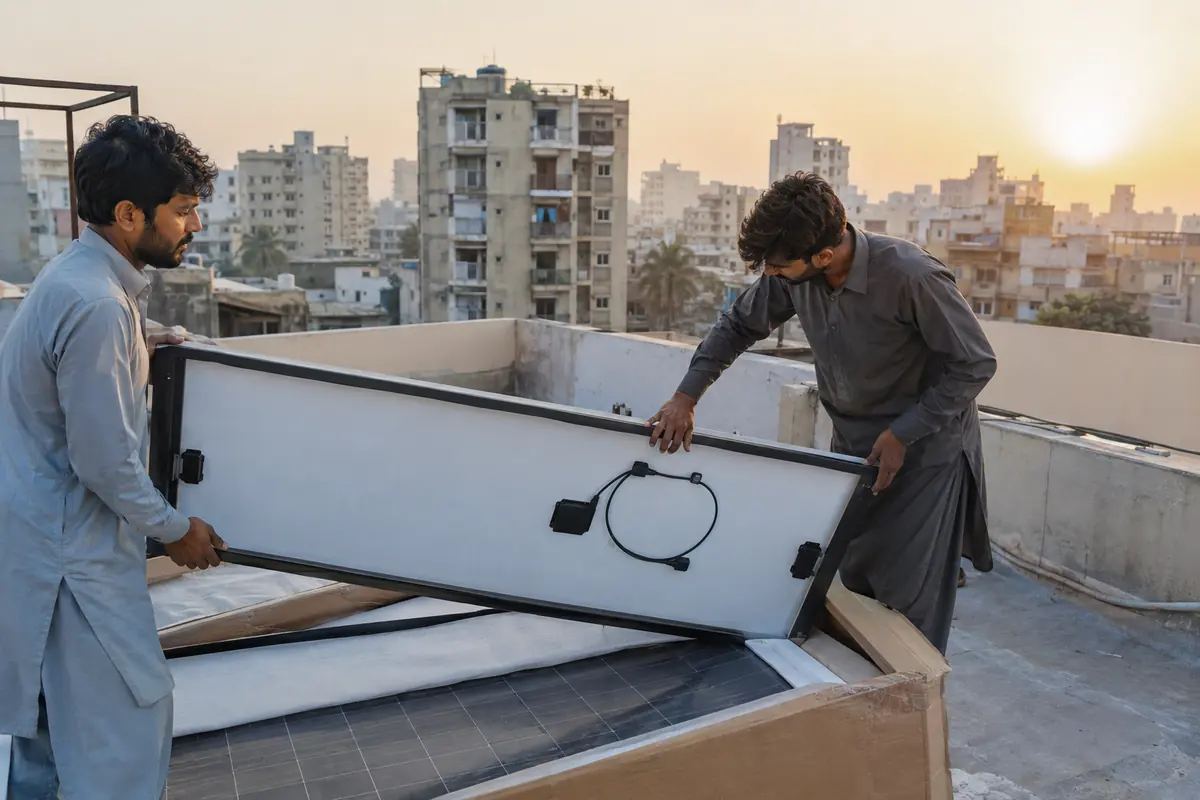
At 33 to 35 kg, these are among the heaviest plates sold for rooftops. Glass on both faces makes them tough against moisture and hail, but:
- Two people should carry each plate, on edge, with gloves.
- Lifting to a third-floor roof needs a rope and pulley or a proper ladder hoist.
- The structure must be designed for the extra weight and for wind load on an 8-foot plate.
- Never stand or walk on glass-glass panels; the rear glass cracks easily under point loads.
Our solar panel size in feet guide has spacing tables for longer plates.
620 W vs nearby wattages: which should you buy?
| Wattage | Cheapest A-grade | Price per watt | Length | Weight | Typical use |
|---|---|---|---|---|---|
| 600 W | Rs 25,500 | Rs 42.5 | 2278 mm | about 27 kg | homes with full roofs |
| 620 W | Rs 24,800 | Rs 40 | 2382 or 2465 mm | 33–35 kg | large roofs, sheds, commercial |
| 650 W | Rs 27,950 | Rs 43 | 2382 or 2384 mm | 28–36 kg | commercial, ground mounts |
How to choose:
- For a house with a standard structure, a 620 W plate is often more trouble than it is worth. The 600 watt solar panel price page covers plates that fit the usual 2278 mm rails.
- For a new structure on a large roof, 620 W cuts the number of plates, clamps and connectors per kW.
- For an elevated structure over a white roof, a car park or a ground mount, the bifacial back adds real output.
- If you need the absolute largest plate, see the 650 watt solar panel price page, which includes a wider 1303 mm format.
Who should buy a 620 W plate
- Factory, warehouse and poultry shed owners with long, open roofs and steel purlins that can take the weight.
- Schools, clinics and offices with flat concrete roofs where a new raised structure is being built anyway.
- Farm owners putting up ground-mounted arrays for tubewells or cold rooms, where the bifacial back earns its keep.
- Homeowners with a large, unshaded roof, a strong new structure and an installer comfortable lifting 35 kg plates.
If you are not in one of those groups, a 585 or 600 W plate is usually the simpler buy.
Brand rates at 620 W
| Brand | Live price | Price per watt |
|---|---|---|
| Trina | Rs 25,110 | Rs 40.5 |
| Jinko | Rs 26,660 | Rs 43 |
More on each brand is on the Trina solar panel price and Jinko solar panel price pages.
How many 620 W panels for 3, 5 and 10 kW (with price)
| System | 620 W panels | DC size | Panel cost (cheapest 620 W) | Roof needed with gaps (Trina / Jinko) |
|---|---|---|---|---|
| 3 kW | 5 | 3.10 kW | Rs 124,000 | about 180 / 190 sq ft |
| 5 kW | 9 | 5.58 kW | Rs 223,200 | about 330 / 340 sq ft |
| 10 kW | 17 | 10.54 kW | Rs 421,600 | about 620 / 640 sq ft |
For a 5 kW target, nine 620 W plates give 5.58 kW, a fair bit above 5 kW. Eight plates give 4.96 kW, which suits a 5 kW inverter almost exactly. Most installers would choose eight.
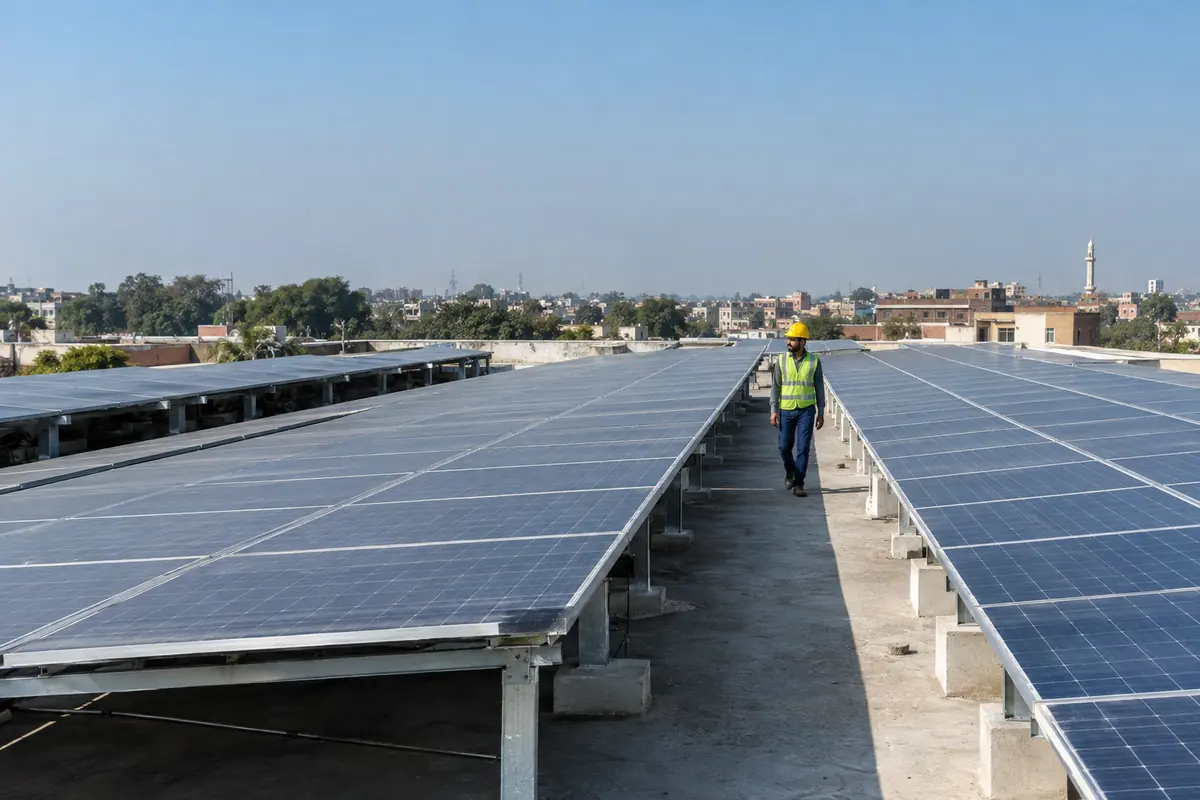
Larger jobs: where 620 W makes sense
| Project | Plates | DC size | Why 620 W helps |
|---|---|---|---|
| School or clinic roof, 20 kW | 33 | 20.5 kW | fewer plates to fix and wire |
| Factory shed, 50 kW | 81 | 50.2 kW | fewer rail runs on long purlins |
| Car park shade, 15 kW | 25 | 15.5 kW | bifacial rear catches light off the paving |
Example: a poultry shed near Multan
Say a poultry farm near Multan has a 300-foot steel shed and runs exhaust fans and lights most of the day.
- Daytime load: around 25 kW of fans in summer, much less in winter.
- Target: about 30 kW of panels, which is 49 plates of 620 W (30.4 kW).
- Choice of plate: the Trina format, because it is shorter and lighter on long spans, with a three-phase inverter rated for its higher current.
- Layout: plates run along the shed in long rows, wired in strings of 16 or 17 on two 15 kW three-phase inverters.
- Output: roughly 48,000 units a year in Multan, from about 2,800 units in a winter month to nearly 4,800 in summer.
How many units does a 620 watt panel produce in Pakistan?
The front side alone gives the figures below, from long-term solar data for each city at a good tilt with about 22% off for losses. A bifacial plate on a raised frame over a light surface can add a few percent on top.
| City | Per day (average) | Summer month | Winter month | Per year |
|---|---|---|---|---|
| Lahore | about 2.6 units | about 92 | about 52 | about 935 |
| Multan | about 2.7 units | about 97 | about 57 | about 990 |
| Karachi | about 2.9 units | about 87 | about 75 | about 1,070 |
| Hyderabad | about 2.9 units | about 96 | about 70 | about 1,065 |
| Peshawar | about 2.9 units | about 113 | about 58 | about 1,050 |
How much does the bifacial back add?
| Mounting | Typical rear-side contribution |
|---|---|
| Flush on a dark roof or tin sheet | close to nothing |
| 1 to 2 feet above a grey concrete roof | small, a few percent at best |
| 4 to 6 feet above a white-painted roof | noticeably more |
| Ground mount over light, dry soil or gravel | among the best cases |
The higher and more open the mount, and the lighter the surface underneath, the more the rear glass earns. Remember that rails and cross-members directly behind the plate shade the back, so a clean structure design matters.
Dust, heat and glass-glass panels
Glass-glass plates handle Pakistan’s conditions well, but they still need care.
- Dust settles on both faces on ground mounts. Wash the front regularly and the back now and then.
- Glass-glass plates have no plastic backsheet to crack or yellow over time, which helps in hot, sunny regions like south Punjab and Sindh.
- Keep an air gap under them on any roof; a cooler plate makes more power.
- Hail resistance is good, but large hailstones in the north can still break glass. Check whether your insurance covers it.
Since February 2026, new rooftop connections are on net billing under NEPRA’s prosumer rules, which pay far less for exported units than you pay for imports. Large 620 W systems on businesses work best when most of the power is used on site during working hours.
What can a 620 watt solar panel run?
A 620 W plate gives roughly 450 to 500 W of usable AC power on a clear afternoon. Because these plates suit bigger buildings, here is a small office or school example on a 17-plate (10.54 kW) system.

| Load | Count | Approximate running power |
|---|---|---|
| Ceiling fans | 30 | about 2.4 kW |
| LED tube lights | 60 | about 1.2 kW |
| Computers and a small server | 15 | about 1.8 kW |
| 1.5 ton inverter ACs (staff rooms) | 3 | about 3.3 kW |
| Water cooler and fridge | 2 | about 0.4 kW |
| Total at peak | about 9.1 kW |
Seventeen plates give roughly 8 kW of usable power at a hot noon, so on the hottest afternoons the grid tops up the gap. In spring, when panels run cooler, the system covers the full load.
For farms, 620 W plates are also common on solar tubewells. A three-phase submersible pump on a solar pump drive usually needs about 1.3 to 1.5 kW of panels per kW of pump. A 7.5 kW pump would therefore use roughly 16 to 18 plates of 620 W. Follow the drive maker’s voltage table, because Jinko’s higher voltage changes how many plates go in each string.
For a single plate: one 620 W panel at noon runs about 5 to 6 standard fans, 13 DC fans, or roughly half of a 1.5 ton AC.
Best inverter for 620 W panels
This is the most important section on the page. The two 620 W plates need different string designs.
| Trina 620 W | Jinko 620 W | |
|---|---|---|
| Voc at 25°C | 49.6 V | 55.58 V |
| Voc at 0°C (approx.) | 52.7 V | 59.1 V |
| Isc | about 15.9 A | 14.19 A |
| Max per string, 500 V input | 9 | 8 |
| Max per string, 1000 V input | 18 | 16 |
| Max per string, 1100 V input | 20 | 18 |
| Minimum MPPT current rating needed | 16 A or more | 15 A or more |
Steps to size a 620 W string:
- Decide which plate you are using; Trina and Jinko need different counts.
- Take the inverter’s maximum DC input voltage and divide by the cold Voc above. Round down.
- Multiply the plate’s Vmp by that count and check it sits inside the MPPT range, with room for a 10% drop on hot days.
- Check the MPPT current rating against the plate’s Isc.
- Check the total DC power against the inverter’s allowed oversizing.
What that means:
- Trina’s high current is the main issue. Older inverters with 12.5 to 15 A per MPPT will clip a Trina 620 W string at midday, wasting output. Most newer string inverters are rated well above 16 A per MPPT, but check the datasheet.
- Jinko’s high voltage is the main issue. On a 500 V hybrid you can only fit eight plates per string; on a 1000 V inverter, sixteen.
- Never mix the two in one string. Their currents and voltages are far apart.
For homes with load-shedding, a hybrid inverter can work with 620 W plates if the PV input voltage and current suit them. For commercial jobs, three-phase on-grid string inverters with 2 or more MPPTs are the usual choice.
Buying tips before you pay
- Decide on the format before you order: 2382 mm Trina or 2465 mm Jinko. The structure design depends on it.
- Check the label for the full model code (TSM-620NEG19RC.20 or JKM620N-78HL4-BDV) and the “BIF” or bifacial marking.
- Inspect both glass faces. A cracked rear glass is easy to miss in a carton.
- Ask for a delivery that reaches the roof or at least the building. Each plate is a two-person lift.
- Get the warranty card from the distributor. The 30-year power warranty means little without a traceable import.
- For a commercial job, ask for flash test data for each serial and keep it with the handover file.
- Make sure the bill lists model, wattage, quantity, serial numbers and date.
Structure checklist for 620 W plates
- Rails and purlins sized for 33 to 35 kg per plate plus wind load on an 8-foot surface.
- Clamps made for 30 mm frames, placed inside the maker’s allowed clamping zones.
- Enough height under the plates for washing and for bifacial gain where it applies.
- Galvanised or stainless fixings, especially near the coast.
- Walkways between rows so cleaners never step on glass.
For every wattage side by side, see the solar panel price list.
Frequently asked questions
What is the 620 watt solar panel price in Pakistan?
The cheapest A-grade 620 watt panel on our sheet is Rs 24,800 as of 3 Nov 2026. Trina and Jinko are the two main brands at this size, and the table at the top lists each one's rate and price per watt.
What is the size of a 620 watt solar panel?
It depends on the brand. Trina's Vertex N 620 W is 2382 × 1134 mm (about 7.8 × 3.7 feet), while Jinko's Tiger Neo 620 W is 2465 × 1134 mm (about 8.1 × 3.7 feet). Both are 30 mm thick.
How heavy is a 620 watt solar panel?
About 33 kg for the Trina and 34.6 kg for the Jinko, because both have glass on the front and back. Each plate needs two people to carry safely.
Are 620 watt solar panels bifacial?
Yes, both main 620 W models sold in Pakistan are bifacial with dual glass. The rear side adds output mainly when the plates are mounted high above a light-coloured surface.
Which inverter is best for 620 watt panels?
For Trina 620 W plates, choose an inverter rated for at least 16 A per MPPT because of their high current. For Jinko 620 W plates, watch the voltage: no more than 8 per string on a 500 V inverter or 16 on a 1000 V inverter.
How many 620 watt panels are needed for 10 kW?
Seventeen panels give 10.54 kW. For a 5 kW inverter, eight panels (4.96 kW) is usually the better fit than nine.
How many units does a 620 watt panel produce in a year?
From the front side alone, about 935 units in Lahore, 990 in Multan and around 1,070 in Karachi. A raised bifacial mount over a light surface can add a few percent.
Is a 620 watt panel good for a house?
It can be, on a large, unshaded roof with a strong new structure. For most homes with standard rails, 585 or 600 W plates are easier to handle and fit.