On this page
There are more types of solar panels on the Pakistani market now than at any time before, and the names on quotations (PERC, TOPCon, HJT, ABC, bifacial, double glass) can confuse even buyers on their second system. This guide explains each type in plain terms, how they behave in a Multan summer or a foggy Lahore winter, and which one makes sense for your roof and budget.
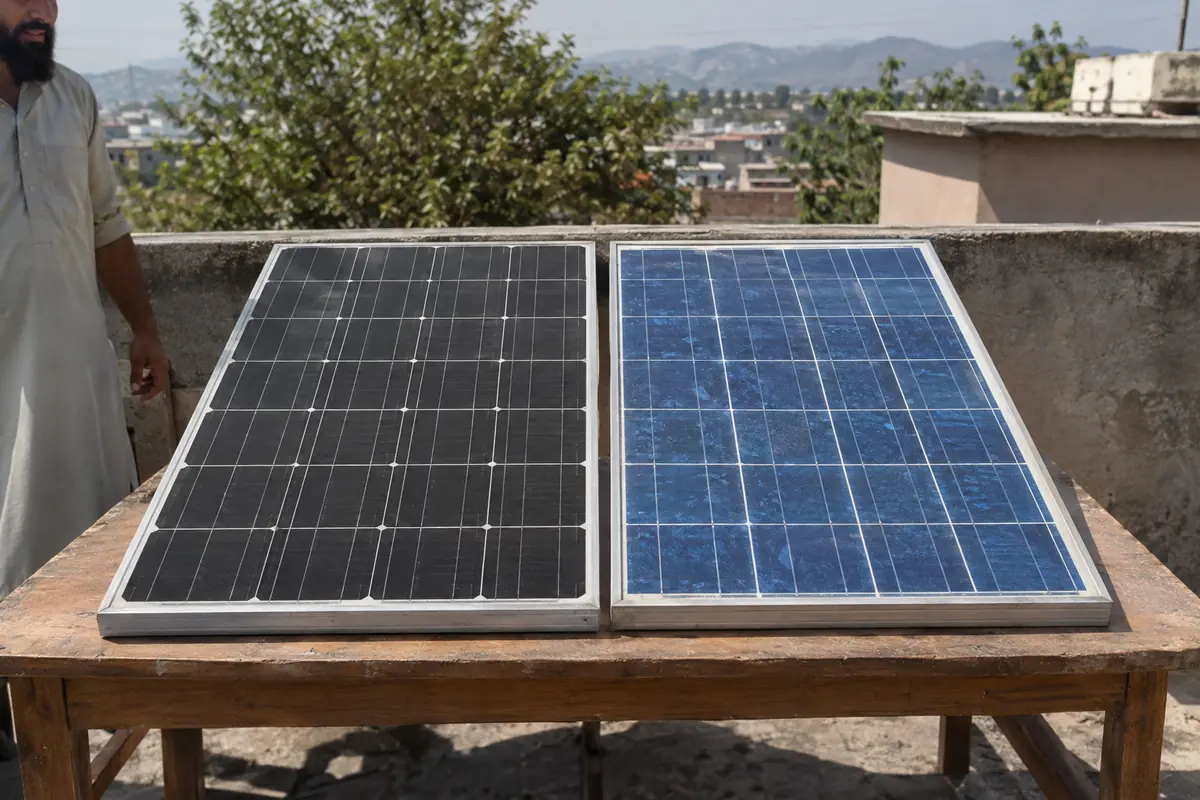
Quick answer: the main types of solar panels
Almost every panel sold for homes in Pakistan today is a monocrystalline panel. The real choice is between the cell technologies inside it:
- Mono PERC (P-type): the older option, usually 540 to 550 W, now mostly discontinued and sold as old stock. Still fine, but it loses more power in heat and degrades a little faster.
- N-type TOPCon: the current default for most buyers, usually 580 to 620 W in the same frame. Better heat performance and slower ageing.
- Back-contact (Longi HPBC, Aiko ABC): N-type cells with all wiring on the back, giving the highest efficiency per square foot at a premium.
- HJT (heterojunction): N-type cells with the best heat tolerance, mostly in large 700 W class panels.
- Polycrystalline: blue-looking older panels, now mostly found on the used market.
Bifacial and double-glass are not separate cell types. They describe how the panel is built, and you can get TOPCon, HJT or PERC in bifacial form.
If you want one line of advice: for a normal house on net metering, buy an N-type TOPCon panel from a well-known brand, and only move to back-contact or HJT if roof space or extreme heat makes the extra cost worth it. The rest of this page explains why, with the numbers behind each choice.
How we checked this
We compared panel types on the things that change your bill and your payback, not on marketing labels. For each technology we read current manufacturer datasheets for models actually imported into Pakistan, such as the Jinko Tiger Neo (TOPCon), Longi Hi-MO X9 (HPBC 2.0), Aiko Stellar (ABC), Canadian TOPHiKu6 (TOPCon) and Risen Hyper-ion (HJT), plus older PERC models still sold as old stock.
The criteria were:
- Module efficiency from the datasheet, which tells you how many watts you get per square foot of roof.
- Temperature coefficient of Pmax, the percentage of power lost for every degree above 25°C cell temperature. On a rooftop in June, cells can run 35 to 40°C hotter than that, so this number matters more in Pakistan than in Europe.
- First-year and yearly degradation in the warranty, which decides how much power is left after 10 and 25 years.
- Availability in local markets, because a great technology is no use if spare panels cannot be found when one cracks.
- Price per watt from our live price sheet, which updates as dealers change rates.
We avoided figures from lab “record” announcements. A record cell is not the panel you will get on a rickshaw from the market, so everything here is based on mass-production datasheets.
Solar panel types in Pakistan explained
Monocrystalline vs polycrystalline solar panels
Both are made from silicon. A monocrystalline solar panel uses cells cut from a single crystal, which looks uniform black or very dark blue. A polycrystalline solar panel uses cells cast from many crystals melted together, giving the familiar blue, flaky look.
| Feature | Mono solar panel | Poly solar panel |
|---|---|---|
| Colour | Black or dark blue, uniform | Blue with visible crystal pattern |
| Typical efficiency | 20 to 23.5% | 15 to 17% |
| Typical wattage today | 540 to 720 W | 250 to 340 W (mostly old stock) |
| Heat performance | Better | Weaker |
| Still made at scale | Yes, the whole market | Barely, most factories have stopped |
| Where you find it | Every dealer | Used panels, small off-grid kits |
The monocrystalline vs polycrystalline solar panels debate is settled for new installations. Mono panels now cost about the same per watt and give far more power per square foot. A poly panel only makes sense if you get a good used one very cheaply for a small load, such as a fan and lights at a shop.
Monocrystalline solar panel price in Pakistan by type
Because nearly every new panel is monocrystalline, the monocrystalline solar panel price in Pakistan depends mostly on the cell technology and the brand. As a rough order from cheapest to most expensive per watt: Mono PERC old stock, N-type TOPCon, HJT, then back-contact. The gap between PERC and TOPCon has narrowed a lot, which is why most installers now quote TOPCon by default. Live examples from our sheet:
- Jinko 550 W Mono PERC (old stock): Rs 20,900
- Jinko 585 W N-type TOPCon: Rs 25,420
- Longi 600 W HPBC 2.0: Rs 26,400
- Aiko 650 W ABC: Rs 27,950
Mono PERC: the P-type workhorse
PERC (Passivated Emitter and Rear Cell) adds a reflective layer on the back of the cell, so light that passes through gets a second chance. The 540, 545 and 550 W panels still found as old stock, such as the Jinko Tiger Pro and Longi Hi-MO 5, use P-type PERC cells. Most other PERC models, such as the Canadian HiKu6 550 W, are now hard to find.
- Efficiency around 21%
- Temperature coefficient around -0.34 to -0.35% per °C
- First-year degradation usually up to 2%, then about 0.55% a year
- Lowest price per watt of the mainstream types, currently around Rs 38 per watt for the cheapest 550 W plate on our sheet
PERC is still a sensible buy if your budget is tight and roof space is not. Most PERC models are now discontinued, so spares are getting harder to find.
N-type TOPCon: today’s default
TOPCon (Tunnel Oxide Passivated Contact) uses N-type silicon with a very thin oxide layer that reduces losses at the contacts. This is what sits inside the Jinko Tiger Neo, JA Solar DeepBlue 4.0, Trina Vertex N, Astronergy ASTRO N5 and many others.
- Efficiency about 22 to 23% in a standard 72-cell frame
- Temperature coefficient around -0.29% per °C
- Jinko lists first-year degradation of up to 1% and about 0.4% a year after that on the Tiger Neo, with a 30-year linear power warranty on its listed models
- Same 7.5 x 3.7 ft frame as PERC, but 30 to 40 more watts
For most homes, N-type solar panels using TOPCon are the best balance of price and performance right now. The cheapest 585 W TOPCon plate on our sheet is Rs 23,400.
Back-contact panels: HPBC and ABC
In a normal panel, thin silver lines run across the front of each cell and shade a small part of it. Back-contact panels move all the contacts to the back, so the front is fully black and catches more light. Longi calls its version HPBC (the current Hi-MO X9 uses HPBC 2.0), and Aiko calls its version ABC (used in its current Stellar 1N and Stellar 1N+ ranges).
- Highest efficiency per square foot among home panels; Aiko listed up to 23% on its earlier Neostar 1S datasheet
- Low temperature coefficient; the same Aiko datasheet listed -0.26% per °C
- Slightly better behaviour under partial shade, depending on the model
- Premium price; check today’s rate for the Aiko Stellar 1N 620 W at Rs 25,110
These high efficiency solar panels are worth it when roof space is the limit, for example a 5 marla house that needs 8 kW.
HJT (heterojunction)
HJT panels sandwich a crystalline N-type wafer between ultra-thin layers of amorphous silicon. They have the best heat tolerance of the common types, with temperature coefficients around -0.24 to -0.26% per °C, and they are naturally bifacial. In Pakistan you will mainly see HJT in large 700 to 720 W panels such as the Risen Hyper-ion range, used on commercial roofs, farms and tube-well systems. Current rate for the cheapest 700 W plate: Rs 29,400.
N-type vs P-type: why the letter matters
The “N” and “P” describe how the silicon wafer is doped. P-type wafers use boron, which reacts with oxygen when the panel first sees sunlight and causes a small early power drop called light-induced degradation. N-type wafers use phosphorus and largely avoid this. That is the main reason N-type solar panels carry lower first-year degradation figures and longer power warranties.
Here is what the published warranty figures mean over the life of a system, using typical datasheet values:
| Type (typical warranty terms) | Power left after year 1 | After year 10 | After year 25 |
|---|---|---|---|
| Mono PERC (2% first year, 0.55% a year after) | 98% | about 93% | about 85% |
| TOPCon (1% first year, 0.4% a year after) | 99% | about 95% | about 89% |
| Aiko ABC (1% first year, 0.35% a year after) | 99% | about 96% | about 91% |
These are warranty minimums, not promises of exact output, but they show why a slightly dearer N-type plate often pays back the difference over 25 years.
Half-cut cells and multi-busbar
Two other terms appear on almost every quotation. Half-cut means each cell is cut in two, so a “72-cell” panel actually has 144 half cells. This lowers internal resistance and reduces losses when part of the panel is shaded. Multi-busbar (MBB or 16BB) means more, thinner wires on the cell, which shortens the path electrons travel. Both are now standard on all the types above, so do not let a seller treat them as a special upgrade.
Which type suits which buyer
| Buyer | Best fit | Why |
|---|---|---|
| 5 or 10 marla house, net metering, enough roof | N-type TOPCon 580 to 590 W | Best price per watt with good heat performance |
| Small roof, high load (2 ACs) | Back-contact or high-watt TOPCon | Most watts per square foot |
| Tight budget, big roof, daytime load only | Mono PERC 540 to 550 W (old stock) | Lowest upfront cost |
| Farm, tube-well, ground mount | HJT or bifacial TOPCon 620 to 720 W | Heat tolerance and rear-side gain over light soil |
| Shop or kiosk with a battery | Small mono 150 to 350 W | Matches 12 V or 24 V battery systems |
| Karachi or coastal area | Double-glass N-type | Better resistance to humidity and salt air |
Bifacial and double glass solar panels
Bifacial solar panels collect light from both sides. The back side picks up light reflected from the roof or ground. Jinko states a bifaciality of up to about 85% for its bifacial Tiger Neo models, which means the back side could produce up to roughly 85% of what the front would under the same light. In practice the back receives only a small fraction of the light, so the real gain is much smaller.
Double glass solar panel means glass on both front and back instead of a plastic backsheet. Most bifacial panels are double glass, but not every double-glass panel is marketed as bifacial.
| Roof situation | Extra yield from bifacial (realistic) |
|---|---|
| Panels close to a dark concrete roof | Very small, often 2 to 4% |
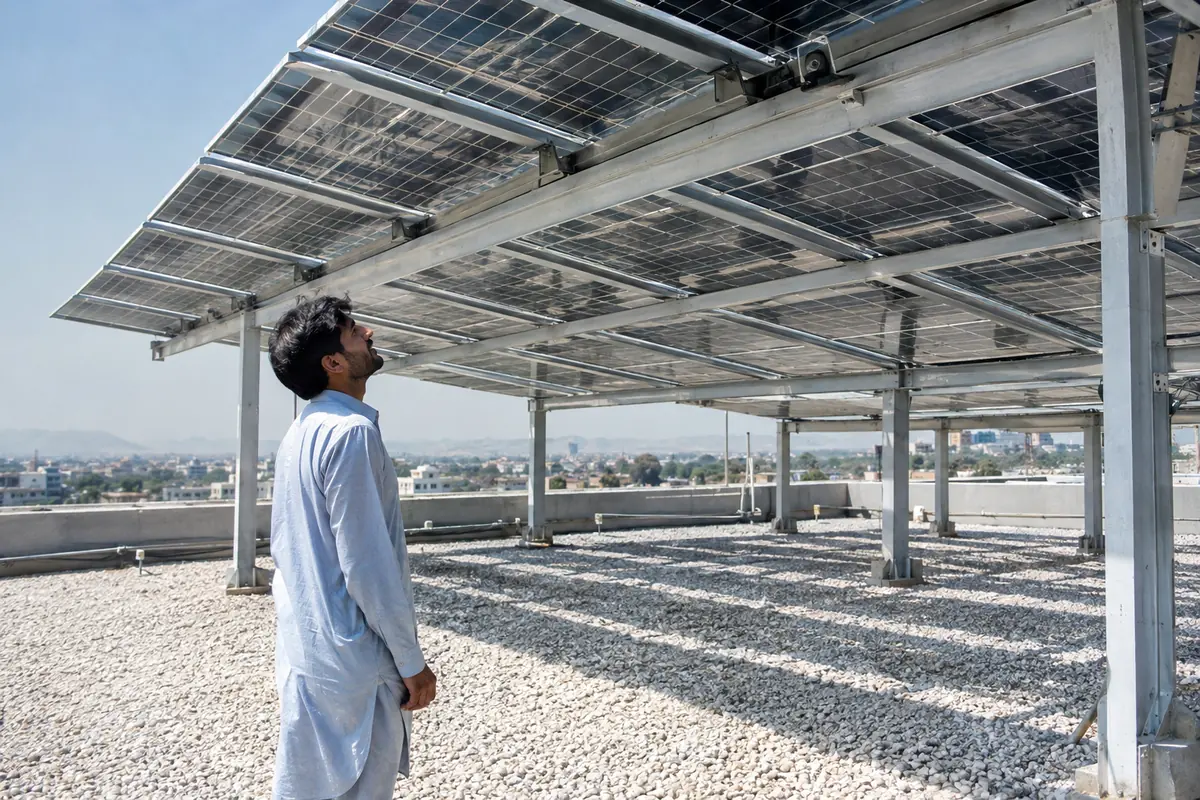
| Elevated frame over a white or light roof | Around 5 to 10% |
| Ground mount over sand or light gravel | Can reach 10% or more |
Double glass also resists moisture and micro-cracks better, which helps in humid Karachi air.
How the types behave across Pakistani seasons
Pakistan gives solar panels two very different tests every year: extreme heat from May to August, and low, hazy light from mid-November to January in Punjab. Each type handles these differently.
- Peak summer (Sindh, south Punjab, Balochistan): heat is the biggest loss. HJT and back-contact panels hold their output best, TOPCon close behind, PERC and poly lose the most.
- Smog and fog season (Lahore, Faisalabad, Gujranwala, Islamabad): light is diffuse and weak. Differences between types shrink, and keeping the glass clean matters more than the cell type.
- Monsoon: rain cleans the panels, but humidity tests the backsheet. Double-glass panels have an edge here.
- Northern areas and cold mornings: panel voltage rises in the cold. With any type, check that your string stays under the inverter’s maximum DC voltage.
Thin-film and flexible panels
Thin-film panels (CdTe, CIGS, amorphous silicon) are rare in the Pakistani home market. Flexible panels are mostly mono cells laminated on a soft sheet, used for vans, boats and camping. They are light, but lower in efficiency and life. See our flexible solar panels guide if you need one.
Comparison table: solar panel efficiency and heat performance
This is the table to keep in mind when two dealers quote different types at different prices.
| Type | Typical module efficiency | Temp. coefficient (Pmax) | Common wattage | Example models in Pakistan | Live price example |
|---|---|---|---|---|---|
| Polycrystalline | 15 to 17% | about -0.39 to -0.41% / °C | 250 to 340 W | Older stock, used panels | Used market only |
| Mono PERC | 20.5 to 21.5% | about -0.34 to -0.35% / °C | 540 to 550 W | Jinko Tiger Pro, Longi Hi-MO 5 (old stock) | Rs 20,900 |
| N-type TOPCon | 22 to 23% | about -0.29 to -0.30% / °C | 580 to 620 W | Jinko Tiger Neo, JA DeepBlue 4.0, Trina Vertex N | Rs 23,400 |
| Back-contact (HPBC / ABC) | 22.5 to 24% | about -0.26 to -0.29% / °C | 600 to 655 W | Longi Hi-MO X9, Aiko Stellar 1N, Aiko Stellar 1N+ | Rs 25,110 |
| HJT | 22.5 to 23.5% | about -0.24 to -0.26% / °C | 700 to 720 W | Risen Hyper-ion | Rs 29,400 |
What does the temperature coefficient mean in rupees? On a June afternoon in Bahawalpur, a panel’s cells can sit at 65°C, which is 40°C above test conditions. A PERC panel at -0.35% loses about 14% of its rated power at that moment. A TOPCon panel at -0.29% loses about 11.6%, and an HJT panel at -0.25% about 10%. Over a whole summer that gap shows up as more units on your net-metering bill.
The full live table for the most common home range is below.
| Model | Watt | Price per panel | Per watt | This week | Trend |
|---|---|---|---|---|---|
| Crown N-type bifacial 20BBN-type TOPCon | 620 W | Rs 24,800 | Rs 40.0 | No change | |
| Trina Vertex N bifacialN-type i-TOPCon | 620 W | Rs 25,110 | Rs 40.5 | No change | |
| Aiko Stellar 1N ABCN-type ABC | 620 W | Rs 25,110 | Rs 40.5 | No change | |
| Inverex Mustang double glassN-type | 620 W | Rs 26,350 | Rs 42.5 | No change | |
| Jinko Tiger Neo 3.0 bifacialN-type TOPCon | 620 W | Rs 26,660 | Rs 43.0 | No change | |
| Inverex Jolywood dual glassN-type | 600 W | Rs 25,500 | Rs 42.5 | No change | |
| Longi Hi-MO X9N-type HPBC 2.0 | 600 W | Rs 26,400 | Rs 44.0 | No change | |
| Trina Vertex N bifacialN-type i-TOPCon | 590 W | Rs 23,600 | Rs 40.0 | No change | |
| Canadian TOPHiKu6 bifacialN-type TOPCon | 590 W | Rs 25,370 | Rs 43.0 | No change | |
| Crown N-type bifacial 16BBN-type | 585 W | Rs 23,400 | Rs 40.0 | No change | |
| JA Solar DeepBlue 4.0 N-type bifacialN-type | 585 W | Rs 23,545 | Rs 40.2 | No change | |
| Astronergy ASTRO N5 bifacialN-type TOPCon | 585 W | Rs 23,985 | Rs 41.0 | No change | |
| Inverex Mustang bifacialN-type TOPCon | 585 W | Rs 24,280 | Rs 41.5 | No change | |
| Longi Hi-MO X7 bifacialN-type | 585 W | Rs 25,010 | Rs 42.8 | No change | |
| Canadian TOPHiKu6 bifacialN-type TOPCon | 585 W | Rs 25,155 | Rs 43.0 | No change | |
| Jinko Tiger Neo N-type bifacialN-type TOPCon | 585 W | Rs 25,420 | Rs 43.5 | No change | |
| Jinko Tiger Neo N-typeN-type TOPCon | 580 W | Rs 24,505 | Rs 42.3 | No change | |
| Jinko Tiger Pro P-type (old stock)Mono PERC | 550 W | Rs 20,900 | Rs 38.0 | No change | |
| Longi Hi-MO 5 (old stock)Mono PERC | 545 W | Rs 21,255 | Rs 39.0 | No change | |
| Jinko Tiger Pro P-type (old stock)Mono PERC | 540 W | Rs 20,520 | Rs 38.0 | No change |
Buying checklist: choosing the right type
- Start with your roof. Plenty of space and a tight budget points to PERC or the cheapest TOPCon. A small roof points to TOPCon or back-contact.
- Check the cell type on the datasheet. “Mono” on a quotation is not enough. Ask whether it is P-type PERC or N-type TOPCon, HPBC, ABC or HJT. Our sheet lists the cell type next to each model on the solar panel price list.
- Compare price per watt, not price per plate. A 585 W panel at a slightly higher plate price can be cheaper per watt than a 550 W one. The current market average is Rs 41.3 per watt.
- Read the degradation line. Look for first-year degradation and the yearly figure. Lower is better for a 25-year investment.
- Ask about bifacial only if you can use it. On a flat dark roof with low frames, pay little or nothing extra for it.
- Match the inverter. Large HJT or 210 mm panels carry higher current. Check the inverter MPPT current limit before choosing them.
- Verify the panel is genuine. For Jinko, use the method on our Jinko verification page. For any brand, the serial number should match the box and the flash test sheet.
- Compare brands within the same type. Our best solar panels in Pakistan page ranks brands, and the solar panel calculator tells you how many panels of each wattage you need.
Common mistakes to avoid
- Paying N-type prices for P-type panels. Some sellers call every black panel “N-type”. Ask for the exact model number and check it against the maker’s datasheet.
- Believing poly is better in heat. It is not. Older poly panels have the worst temperature coefficient of all the types listed here.
- Mixing types in one string. A TOPCon and a PERC panel of similar wattage have different currents and voltages. Keep each type on its own MPPT input.
- Over-paying for bifacial on a low frame. The back side needs light to reach it. Panels 6 inches above a dark roof get almost nothing.
- Judging by colour. All-black panels look premium, but colour alone does not tell you the cell type. Some PERC panels have black frames too.
- Chasing lab records. A news headline about a 27% cell does not mean that panel is in the market. Buy on mass-production datasheets.
- Ignoring local service. A rare technology with no local stock means a long wait if one plate breaks. Stick with types and brands that most dealers carry, which you can compare on our home page.
Once you have picked a type, the choice becomes a brand and price question, and the live rates above show where the best value is.
Frequently asked questions
Which type of solar panel is best for homes in Pakistan?
For most homes on net metering, an N-type TOPCon panel from a known brand gives the best balance of price, heat performance and slow ageing. Back-contact panels are worth the extra cost only when roof space is tight.
What is the difference between monocrystalline and polycrystalline solar panels?
Monocrystalline panels use single-crystal cells, look uniformly black and reach 20 to 23.5% efficiency. Polycrystalline panels are blue, reach about 15 to 17%, lose more power in heat and are now found mainly on the used market.
Are N-type solar panels better than P-type?
Generally yes. N-type cells avoid most of the early light-induced power drop seen in P-type PERC, so they usually carry lower first-year degradation, slower yearly loss and a longer power warranty.
Are bifacial solar panels worth it on a house roof?
Only if light can reach the back. On a low frame over a dark roof the gain is often just 2 to 4%, while an elevated frame over a light surface can add 5 to 10%. Do not pay a large premium for bifacial on a standard rooftop.
What is a double glass solar panel?
It has glass on both the front and back instead of a plastic backsheet. This makes it stiffer and more resistant to moisture and micro-cracks, which helps in humid coastal cities like Karachi.
Which solar panel type works best in extreme heat?
HJT and back-contact panels have the lowest temperature coefficients, around -0.24 to -0.29% per degree, so they lose the least power on hot afternoons. TOPCon is close behind, and PERC and poly lose the most.
What does high efficiency mean on a solar panel?
Efficiency is the share of sunlight the panel turns into electricity. Higher efficiency gives more watts from the same roof area, which matters most on small roofs. It does not by itself make a panel better value.
Can I mix TOPCon and PERC panels in one system?
Not in the same string, because their currents and voltages differ. You can run them on separate MPPT inputs of the inverter if it has more than one.