| Model | Watt | Price per panel | Per watt | This week | Trend |
|---|---|---|---|---|---|
| Jinko Tiger Pro P-type (old stock)Mono PERC | 550 W | Rs 20,900 | Rs 38.0 | No change | |
| Jinko Tiger Pro P-type (old stock)Mono PERC | 540 W | Rs 20,520 | Rs 38.0 | No change | |
| Longi Hi-MO 5 (old stock)Mono PERC | 545 W | Rs 21,255 | Rs 39.0 | No change | |
| Crown N-type bifacial 20BBN-type TOPCon | 620 W | Rs 24,800 | Rs 40.0 | No change | |
| Trina Vertex N bifacialN-type i-TOPCon | 590 W | Rs 23,600 | Rs 40.0 | No change | |
| Crown N-type bifacial 16BBN-type | 585 W | Rs 23,400 | Rs 40.0 | No change | |
| JA Solar DeepBlue 4.0 N-type bifacialN-type | 585 W | Rs 23,545 | Rs 40.2 | No change | |
| Trina Vertex N bifacialN-type i-TOPCon | 620 W | Rs 25,110 | Rs 40.5 | No change | |
| Aiko Stellar 1N ABCN-type ABC | 620 W | Rs 25,110 | Rs 40.5 | No change | |
| Trina Vertex N UltraN-type i-TOPCon | 740 W | Rs 30,340 | Rs 41.0 | No change | |
| Risen Hyper-ion Pro HJTN-type HJT | 720 W | Rs 29,520 | Rs 41.0 | No change | |
| Astronergy ASTRO N5 bifacialN-type TOPCon | 585 W | Rs 23,985 | Rs 41.0 | No change | |
| Inverex Mustang bifacialN-type TOPCon | 585 W | Rs 24,280 | Rs 41.5 | No change | |
| Risen Hyper-ion HJTN-type HJT | 700 W | Rs 29,400 | Rs 42.0 | No change | |
| Jinko Tiger Neo N-typeN-type TOPCon | 580 W | Rs 24,505 | Rs 42.3 | No change | |
| Inverex Mustang double glassN-type | 620 W | Rs 26,350 | Rs 42.5 | No change | |
| Inverex Jolywood dual glassN-type | 600 W | Rs 25,500 | Rs 42.5 | No change | |
| Longi Hi-MO X7 bifacialN-type | 585 W | Rs 25,010 | Rs 42.8 | No change | |
| Aiko Stellar 1N+ ABCN-type ABC | 650 W | Rs 27,950 | Rs 43.0 | No change | |
| Jinko Tiger Neo 3.0 bifacialN-type TOPCon | 620 W | Rs 26,660 | Rs 43.0 | No change | |
| Canadian TOPHiKu6 bifacialN-type TOPCon | 590 W | Rs 25,370 | Rs 43.0 | No change | |
| Canadian TOPHiKu6 bifacialN-type TOPCon | 585 W | Rs 25,155 | Rs 43.0 | No change | |
| Jinko Tiger Neo N-type bifacialN-type TOPCon | 585 W | Rs 25,420 | Rs 43.5 | No change | |
| Longi Hi-MO X9N-type HPBC 2.0 | 600 W | Rs 26,400 | Rs 44.0 | No change |
On this page9 min read
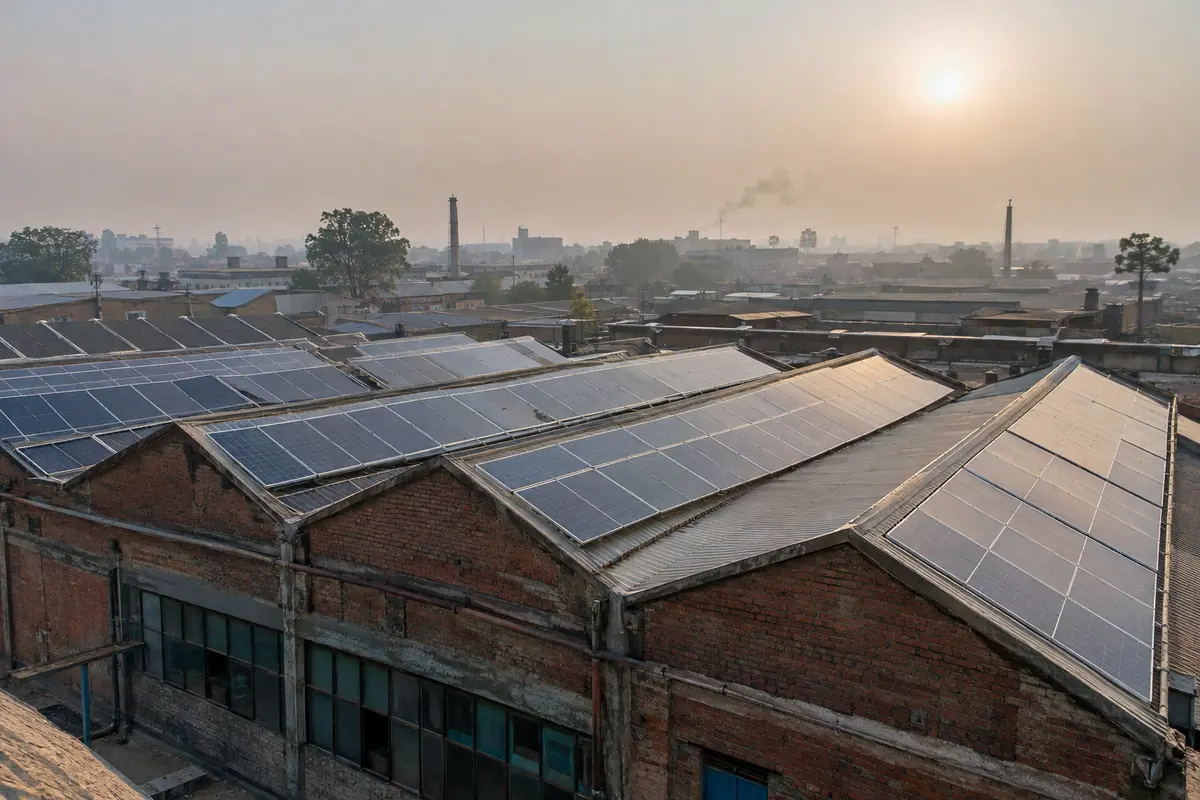
The solar panel price in Faisalabad matches the national rate for the same plate, but Faisalabad buyers are a different crowd. Alongside homes, the city is full of power-loom units, small textile workshops and shops on commercial meters, where every unit saved in daylight goes straight to the bottom line. The live table above shows today’s A-grade plate prices. This page explains full system costs for homes and small industry, FESCO’s net billing process, and how much a Faisalabad roof produces month by month.
Solar panel markets in Faisalabad
Faisalabad is one of Punjab’s biggest trading cities, and solar has become a steady line for its electrical traders. We could not verify a single named solar market that dominates the city, so here is how the trade is organised instead.
| Channel | Who uses it | Tip |
|---|---|---|
| Electrical traders in the main city bazaars | Homeowners buying a few plates, small shops | Ask for the model number and serial list on the bill |
| Local installers | Households wanting a turnkey system with FESCO paperwork | Get the panel brand and model written in the quote |
| Industrial solar contractors | Power-loom owners, workshops and factories | Ask for a load survey and a single-line diagram before the price |
| Distributors serving the FESCO region | Installers and bulk buyers from Jhang, Sargodha, Toba Tek Singh and Chiniot | Best rates for full pallets |
Buyers from Jhang, Chiniot, Toba Tek Singh and smaller towns often travel to Faisalabad for a wider choice of brands. If you do, bring back the invoice with every serial number listed, and test the plates in sunlight before the transporter leaves. A cracked cell found a week later is hard to argue about with a shop two hours away.
Plates come up by road from Karachi’s port and from distributors in Lahore, so Faisalabad prices track the national market with a small freight margin. Right now the cheapest A-grade 585 W plate is listed at Rs 23,400, and the market average is Rs 41.3 per watt.
| Model | Watt | Price per panel | Per watt | This week | Trend |
|---|---|---|---|---|---|
| Crown N-type bifacial 20BBN-type TOPCon | 620 W | Rs 24,800 | Rs 40.0 | No change | |
| Trina Vertex N bifacialN-type i-TOPCon | 620 W | Rs 25,110 | Rs 40.5 | No change | |
| Aiko Stellar 1N ABCN-type ABC | 620 W | Rs 25,110 | Rs 40.5 | No change | |
| Inverex Mustang double glassN-type | 620 W | Rs 26,350 | Rs 42.5 | No change | |
| Jinko Tiger Neo 3.0 bifacialN-type TOPCon | 620 W | Rs 26,660 | Rs 43.0 | No change | |
| Inverex Jolywood dual glassN-type | 600 W | Rs 25,500 | Rs 42.5 | No change | |
| Longi Hi-MO X9N-type HPBC 2.0 | 600 W | Rs 26,400 | Rs 44.0 | No change | |
| Trina Vertex N bifacialN-type i-TOPCon | 590 W | Rs 23,600 | Rs 40.0 | No change | |
| Canadian TOPHiKu6 bifacialN-type TOPCon | 590 W | Rs 25,370 | Rs 43.0 | No change | |
| Crown N-type bifacial 16BBN-type | 585 W | Rs 23,400 | Rs 40.0 | No change | |
| JA Solar DeepBlue 4.0 N-type bifacialN-type | 585 W | Rs 23,545 | Rs 40.2 | No change | |
| Astronergy ASTRO N5 bifacialN-type TOPCon | 585 W | Rs 23,985 | Rs 41.0 | No change | |
| Inverex Mustang bifacialN-type TOPCon | 585 W | Rs 24,280 | Rs 41.5 | No change | |
| Longi Hi-MO X7 bifacialN-type | 585 W | Rs 25,010 | Rs 42.8 | No change | |
| Canadian TOPHiKu6 bifacialN-type TOPCon | 585 W | Rs 25,155 | Rs 43.0 | No change | |
| Jinko Tiger Neo N-type bifacialN-type TOPCon | 585 W | Rs 25,420 | Rs 43.5 | No change | |
| Jinko Tiger Neo N-typeN-type TOPCon | 580 W | Rs 24,505 | Rs 42.3 | No change | |
| Jinko Tiger Pro P-type (old stock)Mono PERC | 550 W | Rs 20,900 | Rs 38.0 | No change |
Big plates for big roofs
Factory sheds and flat industrial roofs in Faisalabad have room for large-format plates, which cut the number of panels, clamps and connectors you need. The cheapest 620 W plate is currently Rs 24,800.
| Plate size | Where it fits best | Watch out for |
|---|---|---|
| 540 to 550 W | Small house roofs, tight spaces | More plates per kW |
| 580 to 590 W | Most homes and shops | The best-stocked size, easy to replace later |
| 600 to 650 W | Factory sheds, large flat roofs | Heavier and longer, check the structure and the inverter’s input limits |
See the 585 watt and 580 watt solar panel price pages for brand-by-brand rates.
Solar system installation cost in Faisalabad
Most Faisalabad homes fit a 3 to 5 kW system, while small industrial units often go much larger. The panel cost below is live. Inverter, structure, wiring and labour are market ranges checked as of October 2026.
| System | Common use in Faisalabad | Plates | Panel cost today | Everything else |
|---|---|---|---|---|
| 3 kW | 5 marla house, fans, lights, one AC | 6 | Rs 140,400 | Rs 1,05,000 to 2,25,000 |
| 5 kW | 10 marla house or a shop | 9 | Rs 210,600 | Rs 1,58,000 to 3,75,000 |
| 10 kW | Large house or small workshop | 18 | Rs 421,200 | Rs 3,25,000 to 5,90,000 |
“Everything else” covers the inverter, mounting structure, DC and AC cable, breakers, surge protection, earthing and installation labour. The inverter accounts for most of the spread between the low and high figures.
Battery or no battery?
Load-shedding in Faisalabad varies a lot between feeders, and industrial feeders can follow different schedules from residential ones. A home on a feeder with short, rare cuts can skip the battery and use a hybrid inverter that accepts one later. A home with daily evening outages, or a shop that loses customers when the lights go, should budget for a lithium battery from the start. A workshop running motors is a different case again: batteries large enough to run machines are costly, so most owners use solar to cut daytime units and keep the grid or a generator for backup.
Solar for power looms and workshops
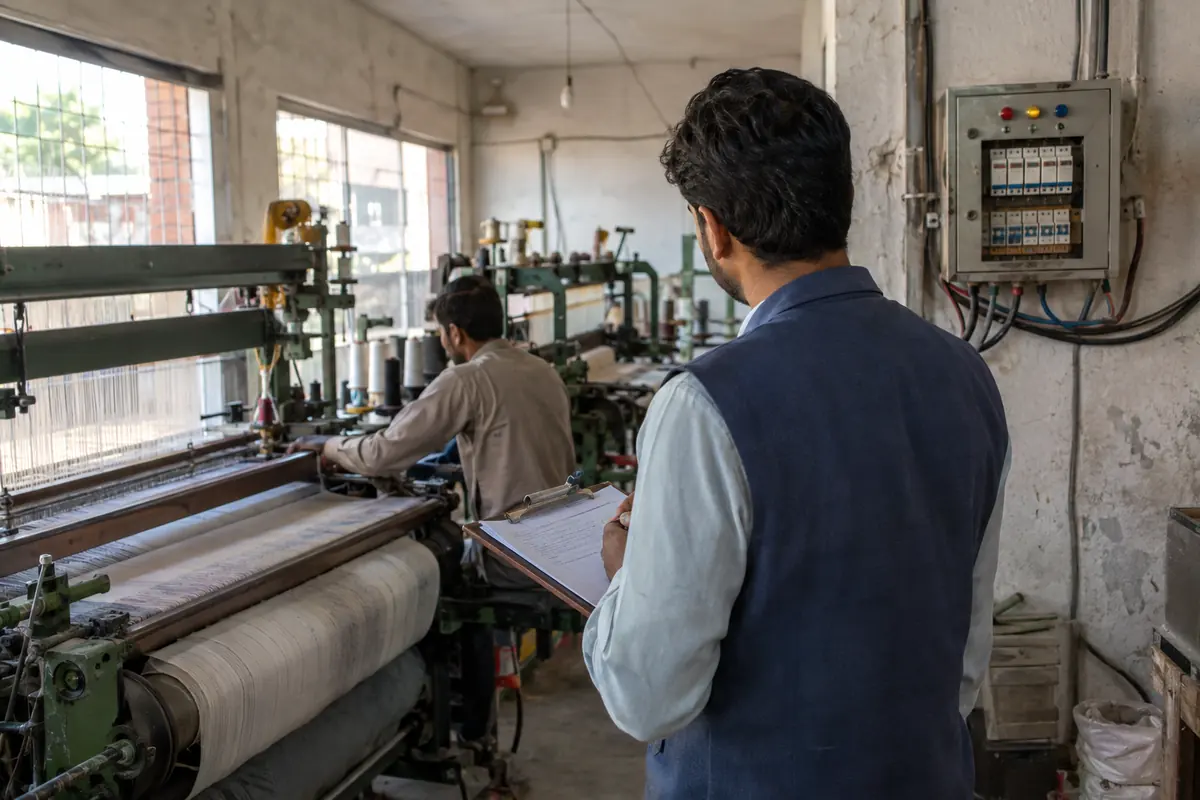
Power looms and small textile machines run through the working day, which lines up well with solar output. A few points specific to industrial users:
- Start with a load survey. Note the running load of each machine and how many hours a day it runs.
- Size the solar to the daytime base load, not the peak. Motors draw heavy starting current that the grid or a large inverter must handle.
- Use a three-phase inverter, and keep the panel array balanced across strings.
- Plan for dust and lint. Cotton fibre and road dust settle on panels near mills, so allow for frequent cleaning.
- Remember the sanctioned load rule: under NEPRA’s rules your solar capacity cannot exceed your sanctioned load, so check your bill before sizing.
Roof types in Faisalabad
- Concrete house roofs: standard galvanised frame, raised if there are water tanks.
- Tin or steel sheet sheds: rail clamps fixed to the purlins, not just the sheet.
- Old brick roofs on workshops: check for cracks before loading them with a frame and plates.
Our solar panel installation cost guide breaks down the fitting charges line by line.
Net metering in Faisalabad: step by step with FESCO
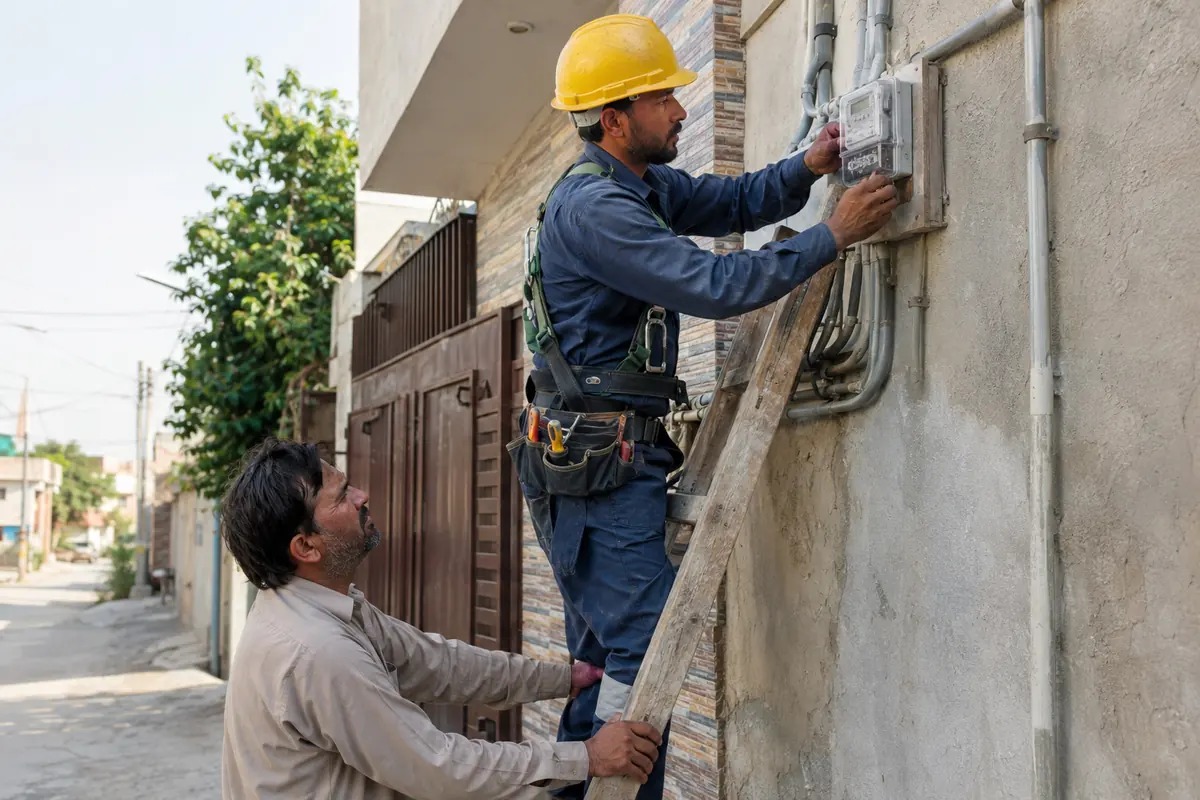
Faisalabad’s distribution company is FESCO, which also serves Sargodha, Mianwali, Khushab, Jhang, Bhakkar, Toba Tek Singh and Chiniot. Since 9 February 2026, new solar applications are handled under NEPRA’s Prosumer Regulations 2026 and are on net billing. Units you export are credited at the national average energy purchase price set by NEPRA, while units you import are billed at your normal FESCO tariff, whether domestic, commercial or industrial. Older net metering agreements keep their terms until they expire.
| Step | What happens | Time limit in the rules |
|---|---|---|
| 1. Eligibility | Three-phase 400 V or 11 kV connection; solar no bigger than sanctioned load | Before you apply |
| 2. Application | Installer submits the standard form, single-line diagram, equipment details, bill, CNIC and ownership papers to FESCO | Day 1 |
| 3. Acknowledgement | FESCO confirms receipt and lists anything missing | 5 working days |
| 4. Technical review | FESCO checks the feeder and transformer; can refuse if solar on the transformer has reached 80% of its capacity | 15 working days |
| 5. Agreement | Interconnection agreement signed | 7 working days |
| 6. Estimate and payment | FESCO issues the meter and connection estimate; you pay it | 7 working days each |
| 7. Meter | Bidirectional meter installed and system commissioned | 15 working days after payment |
| 8. NEPRA concurrence | FESCO forwards the file; NEPRA grants concurrence after the Rs 1,000 per kW fee | After forwarding |
Public NEPRA concurrence letters for FESCO consumers in 2026 show the regulator issuing approval a few weeks after FESCO forwards a file. As of October 2026, also budget Rs 15,000 to 50,000 for the meter and connection work, depending on size.
If your home or workshop already has a net metering agreement from before 9 February 2026, your old terms continue until the agreement expires. Be careful about expanding: NEPRA treats a change that raises the system’s maximum output as a material modification, which needs fresh concurrence and ends the old benefits for that system. If you need more capacity, work out whether the extra savings outweigh losing the old one-for-one terms, and ask FESCO in writing how the change would be treated before you buy extra plates. Sometimes cutting daytime waste or shifting loads gives the same saving without touching the agreement.
Net billing for a home vs a workshop
| Faisalabad user | Daytime use | Best approach under net billing |
|---|---|---|
| Family home, empty during the day | Low | Smaller system, or add a battery to use solar in the evening |
| Family home with someone in all day | Medium | Size to daytime AC and pump load |
| Shop open 10 am to 9 pm | Medium to high | Cover the daytime load, accept some evening grid use |
| Power-loom unit on day shifts | High | Size to the base load; very little is exported |
Shops on commercial meters usually pay some of the highest per-unit rates on the bill, so every solar unit they use directly is worth more than it is to a low-slab home.
Sun hours and solar output in Faisalabad
Faisalabad sits in the middle of Punjab’s plains with a planning average of about 5.3 peak sun hours a day, a little better than Lahore and below Multan. Winter fog and summer haze both play a part. The table below uses the European Commission’s PVGIS tool (ERA5 data) for south-facing panels at 31 degrees with 14% system losses.
| Month | Units per kW in the month | 5 kW home | 20 kW workshop |
|---|---|---|---|
| January | 136 | 680 | 2,720 |
| February | 131 | 655 | 2,620 |
| March | 150 | 750 | 3,000 |
| April | 150 | 750 | 3,000 |
| May | 147 | 735 | 2,940 |
| June | 131 | 655 | 2,620 |
| July | 122 | 610 | 2,440 |
| August | 122 | 610 | 2,440 |
| September | 129 | 645 | 2,580 |
| October | 146 | 730 | 2,920 |
| November | 137 | 685 | 2,740 |
| December | 140 | 700 | 2,800 |
Over a year that is about 1,640 units per kW, or roughly 8,200 units from a 5 kW home system. Plug in your own bill with our solar panel calculator.
The pattern is steady through most of the year, which suits workshops that run every day. March, April and October are the strongest months, the monsoon trims July and August, and winter output holds up better than many people expect because cool panels work more efficiently.
Fog, haze and lint
- December and January fog can keep panels dim until late morning, so winter output on foggy days falls short of the table.
- Crop-burning haze in October and November and summer dust both reduce output a little.
- Near mills and busy roads, lint and dust build up quickly. Wash panels every one to two weeks, early in the morning, with plain water and a soft brush. Our solar panel cleaning guide explains the safe way.
- Summer heat trims output on the hottest days, so N-type plates with a better temperature coefficient pay off here too.
How to choose a solar installer in Faisalabad
A good Faisalabad installer should be as comfortable with a three-phase workshop as with a house roof. Run through this list before you sign:
- Is the firm on PPIB’s certified installer list? AEDB’s certification work now sits with PPIB, and FESCO files and bank financing often ask for it.
- For industrial jobs, will they do a proper load survey and provide a single-line diagram?
- Does the quote name plate brand, model and wattage, inverter model, cable size and structure type?
- Is earthing and surge protection included, with the earthing pit shown?
- Who files the FESCO application, and is the NEPRA fee and meter cost listed separately?
- What workmanship warranty do they give, and who services the inverter locally?
- Can they show two Faisalabad jobs at least a year old, ideally one home and one workshop?
For a broader shortlist, start with our guide to solar panel companies in Pakistan.
Quotes to be careful with
- A full system priced far below the market with no model numbers.
- “Net metering, one for one” promised on a new connection. That ended for new applicants on 9 February 2026.
- Large industrial systems quoted without asking for your sanctioned load or a recent bill.
Faisalabad vs other cities: price difference
The solar panel price Faisalabad buyers pay for the plates themselves is close to the national rate. The real differences are in the type of buyer and the site.
| Factor | Faisalabad | Lahore | Multan | Gujranwala |
|---|---|---|---|---|
| Plate price | National rate plus freight | Close to national rate | National rate plus freight | National rate plus freight |
| Utility | FESCO | LESCO | MEPCO | GEPCO |
| Yearly units per kW | About 1,640 | About 1,610 | About 1,680 | About 1,600 |
| Typical buyer mix | Homes, shops, power looms | Homes and shops | Homes and farms | Homes and small industry |
| Main local issue | Lint, dust and winter fog | Smog | Heat and dust storms | Winter fog |
If you are comparing with a nearby city, see our Multan page, or return to the solar panel price in Pakistan home page for national rates.
Frequently asked questions
What is the solar panel price in Faisalabad today?
The cheapest A-grade 585 W plate is currently around Rs 20,520, and the table on this page lists other brands and sizes. Faisalabad prices follow the national market with a small freight margin.
Which company handles solar net billing in Faisalabad?
FESCO handles applications for Faisalabad and its other districts, including Jhang, Sargodha, Toba Tek Singh and Chiniot. New files follow NEPRA's Prosumer Regulations 2026, so they are on net billing.
Is solar worth it for a power-loom unit in Faisalabad?
Usually yes, because looms run through the day when panels produce most, so nearly every solar unit is used on the spot. Size the system to the daytime base load and use a three-phase inverter suited to motor loads.
How many units does a 5 kW system make in Faisalabad?
About 8,200 units a year, or close to 700 a month on average. March, April and October are the best months, and July, August and foggy winter days are the weakest.
How often should I clean panels in Faisalabad?
Every one to two weeks near mills and busy roads, where lint and dust settle fast, and every two to three weeks elsewhere. Wash early in the morning with plain water and a soft brush.
Can I expand my old net-metered system in Faisalabad?
You can, but raising the system's maximum output counts as a material modification. It needs fresh NEPRA concurrence and ends the old net metering benefits for that system, so get FESCO's view in writing first.
Do I need a three-phase connection for solar in Faisalabad?
For net billing, yes. NEPRA's rules cover three-phase 400 V or 11 kV connections, and the solar capacity cannot exceed your sanctioned load.
Should a Faisalabad home buy a battery with solar?
Only if your feeder has regular outages or most of your use is in the evening. A hybrid inverter lets you start without a battery and add one later if load-shedding gets worse.