Estimate assumes 80% system efficiency and planning-average sun hours. Inverter, batteries, structure and installation are extra.
On this page7 min read
This solar panel calculator sizes a home system from the units on your electricity bill, the panel you choose and your city’s sun. It tells you the system size in kW, how many panels you need, what those panels cost at today’s rates and how much roof space they take. Below is the method in plain words, worked examples for 300, 500 and 1,000 units, and the checks that make the answer accurate for your house.
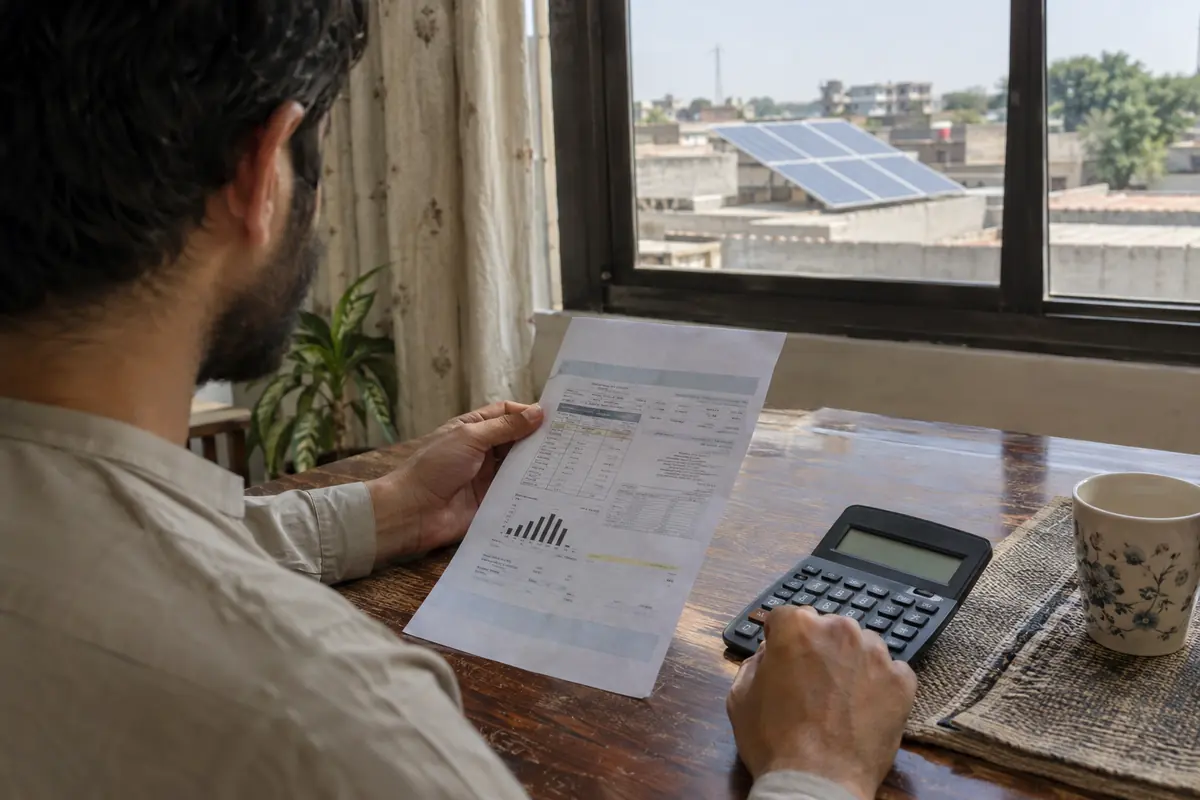
How the calculation works
The calculator answers one question: how many kW of panels produce the units you use in a month? It does it in four steps.
- Daily units. Your monthly units divided by 30. A 450 unit bill means about 15 units (kWh) a day.
- Sun hours. Each city has a planning average of “peak sun hours”, the number of hours a day the sun gives the equivalent of full strength. We use the figures in the table below.
- Losses. Real systems lose roughly 20% to heat, dust, inverter conversion and wiring, so we multiply by 0.8.
- System size. Daily units divided by (sun hours × 0.8). Then panels = system watts ÷ panel watts, rounded up, and roof space is about 28 square feet per large panel.
| City | Planning sun hours we use | DISCO |
|---|---|---|
| Karachi | 5.6 | K-Electric |
| Multan | 5.5 | MEPCO |
| Faisalabad | 5.3 | FESCO |
| Lahore | 5.2 | LESCO |
| Gujranwala | 5.1 | GEPCO |
| Peshawar | 5.1 | PESCO |
| Islamabad | 5.0 | IESCO |
| Rawalpindi | 5.0 | IESCO |
Why peak sun hours, not daylight hours
Lahore gets 10 to 14 hours of daylight depending on the season, so people often expect far more output than they get. Early morning and late afternoon light hits the panels at a low angle and through more haze, so it produces only a fraction of the midday output. Peak sun hours squeeze a whole day’s sunshine into the equivalent hours of full-strength sun. Over a year, Pakistani cities sit around 5 to 5.6, with summer days higher and foggy December and January days in Punjab much lower. That is why a 1 kW system here makes roughly 4 to 4.5 units on an average day, not 10.
| Month type | What to expect from 1 kW in Lahore |
|---|---|
| Clear summer day | 5 units or a little more |
| Average day across the year | about 4.2 units |
| Foggy winter day | 2 units or less |
One example in plain words
A Lahore home uses 450 units a month. That is 15 units a day. Lahore’s 5.2 sun hours times 0.8 gives 4.16 useful units per kW per day. 15 divided by 4.16 is 3.6 kW. With 585 watt panels, 3,600 ÷ 585 is 6.2, so the calculator says 7 panels, needing about 196 square feet of roof.
The cost line uses the cheapest current price for the panel wattage you pick, from the same price sheet as our 585 watt solar panel price page. It covers panels only. The inverter, structure, wiring and fitting are added separately, which is why the calculator note says so.
Worked examples: 300, 500 and 1,000 units
These three bills cover most Pakistani homes, from a small family with fans and a fridge to a large house running three ACs. Figures are for Lahore with 585 W panels; the panel cost updates daily.
| Monthly units | System size | Panels (585 W) | Panels cost today | Roof space | Inverter usually fitted |
|---|---|---|---|---|---|
| 300 | 2.4 kW | 5 | Rs 117,000 | about 140 sq ft | 3 kW |
| 500 | 4.0 kW | 7 | Rs 163,800 | about 196 sq ft | 5 kW |
| 1,000 | 8.0 kW | 14 | Rs 327,600 | about 392 sq ft | 8 to 10 kW |
The same bills in other cities
Sun hours change the answer more than people expect. Karachi homes need fewer panels than Islamabad homes for the same bill:
| Monthly units | Karachi (5.6 h) | Lahore (5.2 h) | Islamabad (5.0 h) |
|---|---|---|---|
| 300 | 2.2 kW, 4 panels | 2.4 kW, 5 panels | 2.5 kW, 5 panels |
| 500 | 3.7 kW, 7 panels | 4.0 kW, 7 panels | 4.2 kW, 8 panels |
| 1,000 | 7.4 kW, 13 panels | 8.0 kW, 14 panels | 8.3 kW, 15 panels |
Changing the panel size
The solar panel wattage calculator part of the tool lets you pick from 540 to 620 W. Bigger plates mean fewer panels and fewer mounting points, but each plate is heavier and longer. For the 500 unit Lahore home, 550 W plates need 8 panels and 620 W plates need 7. Compare the cost of each option in the calculator before you decide. For full system budgets with inverter and batteries, see the solar system price in Pakistan guide or the 5kW solar system price page.
What the result does not include
The system size and panel cost are the starting point of a quote, not the final bill. Keep these separate when you compare installers:
- The inverter, which is usually the second biggest cost after panels
- Mounting structure, either a standard L2 frame or an elevated structure if you want shade or parking underneath
- DC and AC cable, breakers, surge protection and earthing
- Labour, transport and, for grid-tied systems, the net metering or net billing application
- Batteries, if you want backup at night or during load-shedding
Solar panels needed for common appliances
If you do not have a bill to go by, for example in a new house or a shop, build up your units from appliances. This works as a solar panels kWh calculator in reverse: estimate daily kWh, multiply by 30, then put that number into the calculator.

| Appliance | Typical daily use | Daily units (kWh) | Monthly units |
|---|---|---|---|
| 1.5 ton DC inverter AC | 8 hours in summer | 8 to 9 | 240 to 270 |
| 1 ton DC inverter AC | 8 hours in summer | 5 to 6 | 150 to 180 |
| Refrigerator | all day | 1.2 to 1.8 | 35 to 55 |
| Ceiling fan (AC type, 80 W) | 12 hours | about 1 | about 30 each |
| Water motor (1 hp) | 1 hour | about 0.75 | about 22 |
| LED TV | 5 hours | about 0.5 | about 15 |
| Iron (1,000 W) | 30 minutes | about 0.5 | about 15 |
| Washing machine | one load | about 0.5 | about 15 |
| LED lights (10 bulbs) | 6 hours | about 0.6 | about 18 |
A worked case: a summer house with one 1.5 ton inverter AC, a fridge, five fans, a motor, TV, lights and an iron uses about 8.5 + 1.5 + 5 + 0.75 + 0.5 + 0.6 + 0.5 = 17 units a day, or about 520 a month. In Lahore that is roughly a 4.2 kW system. For AC-only sizing, the solar panel for AC calculator converts tonnage straight into panels.
Daytime vs night units
The calculator assumes your panels make your monthly units over the month. It does not mean the panels run your night load directly. What happens to the units you use after sunset depends on your setup:
- On-grid with net billing: daytime surplus goes to the grid and you draw from it at night. Since NEPRA’s February 2026 rules, exported units for new users are paid at a lower rate than imported units, so a larger share of daytime self-use saves more.
- Hybrid with battery: daytime surplus charges the battery for the evening. You need battery capacity on top of the panels.
- Off-grid: everything at night comes from batteries, so size both panels and battery generously.
Shops and small offices
Shops are often a better fit for solar than homes, because most of their load is in daylight. A typical small shop runs lights, two or three fans, a fridge or chiller, a computer and sometimes one inverter AC from 10 am to 9 pm. Because the commercial tariff is usually higher than domestic, every unit made on the roof saves more. When you use the calculator for a shop, take your units only from the commercial meter, and remember that the hours after sunset still come from the grid or a battery.
Tips for an accurate result
A solar panel cost calculator is only as good as the number you type in. These checks make the result match your roof:
- Use a 12-month average. Add the units from your last 12 bills (most DISCO bills print the history) and divide by 12. A June bill alone oversizes the system; a January bill undersizes it.
- Size for the season you care about. If you want summer bills near zero, use the average of May to August. Under net billing, it is often better to size for your daytime use than for your whole year.
- Check shade at 9 am and 3 pm. Water tanks, a neighbour’s top floor or a tree can cut one string’s output. Count only the shade-free roof.
- Face south and tilt correctly. Panels facing south at a tilt near your latitude give the output the calculator assumes. East-west roofs produce less. Use the solar panel tilt angle calculator for your city.
- Leave room to grow. If an extra AC or an electric car is likely, choose an inverter that can take two or three more panels. See the solar inverter price guide for sizes.
- Allow for heat. Summer roofs in Multan and Karachi are very hot, and panels lose output as they heat up. N-type panels lose less than older mono PERC panels.
Reading your bill for the calculator
On LESCO, FESCO, IESCO and most other DISCO bills, the units for the current month are printed on the front, and the bill also shows a month-by-month history for the past year. If your house has two meters, add both. If you already have a small solar system, use the “import” units shown on a net-metering bill plus the solar units your inverter app shows as self-used.
| If your result looks… | Likely reason | What to check |
|---|---|---|
| Too large for the roof | Bill includes very high summer AC use | Size for daytime use; move some loads |
| Too small to matter | Winter bill used | Use the 12-month average |
| Different from an installer’s quote | Different sun hours or losses | Ask which figures they used |
| More panels than expected | Smaller panel picked | Try 585 or 620 W in the panel box |
For a quick look at today’s rates across all wattages before you choose, the home page lists the cheapest panels in the market.
Frequently asked questions
How does the solar panel calculator work out my system size?
It divides your daily units by your city's peak sun hours and an 80% efficiency factor. For example, 450 units a month in Lahore works out to about a 3.6 kW system, or seven 585 watt panels.
How many solar panels do I need for 300 units a month?
In Lahore, about a 2.4 kW system, which is five 585 watt panels. Karachi homes need slightly less because of more sun, and Islamabad homes slightly more.
How many solar panels do I need for 500 units a month?
Roughly a 4 kW system in Lahore, or seven 585 watt panels, with a 5 kW inverter. Check your 12-month average units first, because one summer bill gives too large an answer.
Does the solar panel cost calculator include the inverter and installation?
No. The cost shown is for panels only at today's cheapest listed rate. Inverter, batteries, structure, wiring and installation are extra and are covered in our system price guides.
Which bill should I use, summer or winter?
Use the average of your last 12 months for a year-round answer. If you mainly want to cut summer bills, average the May to August units instead.
How much roof space do I need for solar panels?
Plan on about 28 square feet per large 540 to 590 watt panel, plus walking space between rows. A 5 kW system needs around 250 square feet of shade-free roof.
Are the sun hours in the calculator accurate for my city?
They are planning averages across a full year for each city. Real output is higher on clear summer days and lower in fog, dust or monsoon cloud, which the 80% factor partly allows for.
Can I use this solar panel calculator for a shop?
Yes. Enter the units from the commercial meter only. Shops use most of their power in daylight, so solar often pays back faster than at home.