On this page
Which are the best solar panels in Pakistan? For most homes, it is an N-type panel from a Tier 1 maker such as Jinko, Longi, Trina, JA, Canadian or Astronergy, bought as genuine A-grade stock from a dealer who will put the serial numbers on your invoice. This guide ranks the top 10 solar panels in Pakistan with price, explains how we judged them, and gives you a checklist so you do not pay Tier 1 money for a relabelled plate.
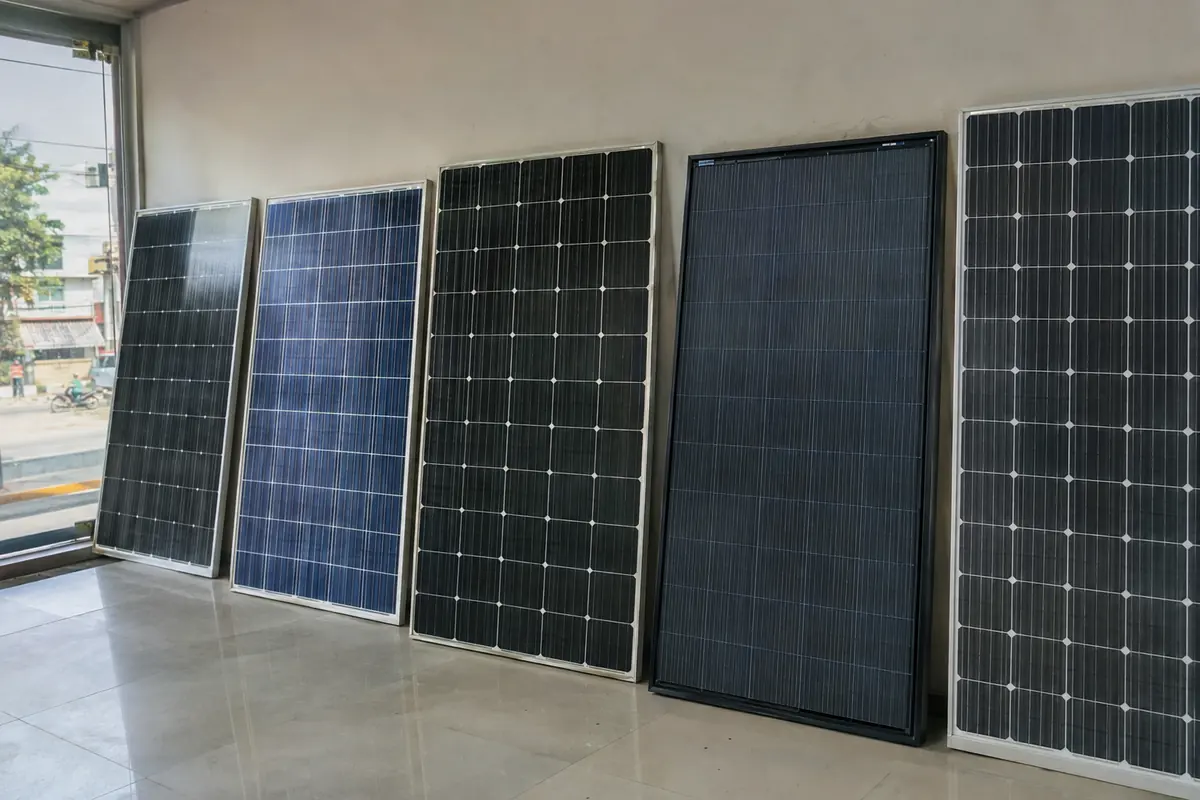
Quick answer: the best solar panels in Pakistan
There is no single best panel for every roof, but the shortlist is clear:
| If you want | Best pick | Why |
|---|---|---|
| The safest all-round choice | Jinko Tiger Neo or Longi Hi-MO X7, 585 W class | Tier 1, N-type, easiest to buy, service and resell |
| The best value Tier 1 panel | Astronergy ASTRO N5 585 W | Usually the lowest Tier 1 price per watt, 15-year product warranty |
| The most power from a small roof | Aiko ABC panels | Highest efficiency we track, no front busbars |
| A big roof or tubewell | Risen Hyper-ion HJT or Trina Vertex N Ultra 740 W | Fewer, bigger panels, strong heat performance |
| The lowest budget | Inverex Mustang or Crown N-type, 585 W class | Pakistani brands with local helplines, lower price |
If you only remember one rule, make it this: a genuine panel from a good brand beats a doubtful panel from a famous one. Most problems Pakistani buyers face are not with the brand they chose but with fake, B-grade or relabelled stock.
The other big shift is technology. A few years ago the standard answer was a mono PERC panel around 540 W. Today the top solar panels in Pakistan are almost all N-type: TOPCon, heterojunction (HJT) or back-contact cells. They lose less power in heat and age more slowly, and the price gap with PERC has shrunk to the point where PERC only makes sense on the tightest budgets.
How we checked this
We did not lab-test panels. Instead, we compared every brand we track on the same points, using makers’ datasheets, official product pages and our own live price sheet. Here is what we looked at and why.
| What we checked | Source | Why it matters in Pakistan |
|---|---|---|
| Tier 1 status | BloombergNEF Tier 1 list, makers’ announcements | Tells you the factory is large, financed and likely to be around for warranty |
| Cell technology | Makers’ datasheets | N-type TOPCon, HJT and back-contact age slower and handle heat better than PERC |
| Temperature coefficient | Datasheets | Roofs here reach 60 °C plus in summer; lower is better |
| Product and power warranty | Datasheets and brand pages | Longer product cover matters with heat and dust |
| Yearly degradation promise | Datasheets | Decides how many units the panel still makes in year 20 |
| Price per watt | Our live price sheet | The fair way to compare different wattages |
| Availability and resale | Pakistani market | A panel you cannot service or resell is a risk |
Two things we deliberately did not reward. First, marketing wattage: a 720 W panel is not “better” than a 585 W one, just bigger. Second, the biggest rear-side gains quoted for bifacial panels, because most Pakistani rooftops do not get them.
The prices in this guide are pulled live from our sheet, so the ranking stays honest even as rates change. You can see every listing on the solar panel price list.
Top 10 solar panels in Pakistan with price
Here are the top ten solar panels we would short-list for a Pakistani home or business, with the live price of the panel we track for each.
| Rank | Panel | Cell technology | Live price | Price per watt | Best for |
|---|---|---|---|---|---|
| 1 | Jinko Tiger Neo 585 W | N-type TOPCon | Rs 25,420 | Rs 43.5 | Most homes, easiest resale |
| 2 | Longi Hi-MO X7 585 W | N-type bifacial | Rs 25,010 | Rs 42.8 | Most homes, wide dealer network |
| 3 | Astronergy ASTRO N5 585 W | N-type TOPCon, dual glass | Rs 23,985 | Rs 41 | Best Tier 1 value |
| 4 | JA Solar DeepBlue 4.0 585 W | N-type TOPCon | Rs 23,545 | Rs 40.2 | Homes, a solid alternative to Jinko |
| 5 | Trina Vertex N 620 W | N-type TOPCon, 210R cells | Rs 25,110 | Rs 40.5 | More watts on standard rails |
| 6 | Canadian TOPBiHiKu6 590 W | N-type TOPCon bifacial | Rs 25,370 | Rs 43 | Elevated or ground mounts |
| 7 | Aiko Stellar 1N ABC 620 W | N-type back contact | Rs 25,110 | Rs 40.5 | Small or partly shaded roofs |
| 8 | Risen Hyper-ion 700 W | N-type HJT | Rs 29,400 | Rs 42 | Hot districts, big arrays |
| 9 | Trina Vertex N Ultra 740 W | N-type TOPCon, 210 mm cells | Rs 30,340 | Rs 41 | Factories and ground mounts |
| 10 | Inverex Mustang 585 W | N-type bifacial | Rs 24,280 | Rs 41.5 | Tight budgets, local warranty |
The market average across all tracked panels is currently Rs 41.3 per watt.
1 and 2: Jinko Tiger Neo and Longi Hi-MO X7
These two are the default answer to “which solar panel is best in Pakistan” for a reason. Both come from two of the largest module makers in the world, both are N-type, and both are stocked by almost every solar shop from Karachi to Peshawar. The Jinko Tiger Neo 585 W datasheet lists 22.65% efficiency, a −0.29% per °C temperature coefficient, a 12-year product warranty and 87.4% guaranteed power at 30 years. Longi has replaced its Hi-MO 6 with the Hi-MO X7 (585 to 590 W) and the Hi-MO X9 (600 to 610 W); the older Hi-MO 6 Explorer 585 W listed 22.6% efficiency, −0.29% per °C, a 12-year product warranty and 88.9% guaranteed power at 25 years, so check the X7 datasheet for its exact figures. On a real roof, the output difference between them is small. Choose on price and on the dealer you trust. See the Jinko and Longi pages for their full ranges.
The catch: because they are the most popular, they are also the most faked. Jinko and Longi are the brands where serial checks matter most.
3: Astronergy ASTRO N5
Astronergy, the solar arm of China’s Chint Group, is a Tier 1 maker that usually sells a little below Jinko and Longi. Its ASTRO N5 585 W is dual glass, has the same 2278 × 1134 mm footprint as older 540 to 550 W panels, and carries a 15-year product warranty on the datasheet, three years more than the mainstream Jinko and Longi panels above. It is the best value Tier 1 panel on our list. More on the Astronergy price page.
4: JA Solar DeepBlue 4.0
JA Solar is another long-standing Tier 1 maker, and its DeepBlue 4.0 is an N-type TOPCon panel in the same size class as Jinko and Longi. It is a sensible alternative when your dealer has fresher JA stock or a better rate. Check the datasheet of the exact model for warranty details.
5 and 9: Trina Vertex N
Trina’s Vertex N panels use larger 210R and 210 mm cells. The 620 W 210R panel keeps the standard 1134 mm width but gives more watts per plate, which makes it a strong choice when you want to fit more on existing rails. The Vertex N Ultra 740 W panel is best kept for big roofs and ground mounts. Details on the Trina price page.
6: Canadian TOPBiHiKu6
Canadian Solar is headquartered in Canada with most manufacturing in Asia, and has long been on the Tier 1 list. Its TOPBiHiKu6 is a bifacial TOPCon panel that makes most sense when mounted high over a light surface, where its rear side can earn extra units.
7: Aiko ABC
Aiko makes All Back Contact panels with no busbars on the front. In Pakistan it now sells the Stellar 1N (620 to 635 W) and Stellar 1N+ (645 to 655 W) ranges. Its earlier Comet 2N datasheet listed up to 23.9% efficiency, a −0.26% per °C temperature coefficient and not more than 0.35% yearly degradation. It costs the most per watt on our sheet, so it pays off mainly on small, hot or partly shaded roofs. If you are asking about the best solar panels in the world by efficiency, back-contact panels from makers like Aiko and Longi lead the mass-produced field today.
8: Risen Hyper-ion HJT
Risen’s heterojunction panel has the best datasheet temperature coefficient on our list at −0.24% per °C, a 15-year product warranty and about 90% guaranteed power at 30 years. At about 2384 × 1303 mm and 40.5 kg, it is a panel for big systems, not small roofs.
10: Inverex and Crown
Inverex and Crown are Pakistani brands rather than listed module manufacturers, so they are not on the Tier 1 list, and neither publishes which factory makes its panels. They are usually cheaper and come with a local helpline and warranty desk. Inverex now sells Mustang N-type bifacial panels from 585 W, Jolywood dual-glass panels and Mustang double-glass panels up to 620 W, with HJT models coming soon; Crown sells N-type TOPCon bifacial panels at 585 W and 620 W. For a tight budget they are reasonable, as long as you get the warranty terms in writing.
Best solar panel company in Pakistan
People also ask which is the best solar panel company in Pakistan. Panel brands and solar companies are two different things. The brand makes the panel; the company you hire designs the system, supplies the inverter and structure, and installs it. The best result comes from a Tier 1 panel installed by a company that:
- Gives a written quote listing panel model, inverter model, structure type and cable sizes.
- Puts every panel serial number on the invoice.
- Shows you the string design and earthing plan before work starts.
- Handles net-metering paperwork with your DISCO if you need it.
- Offers after-sales service in your city, not just a phone number.
Best solar panels by climate
Pakistan’s climate changes a lot from Karachi to Gilgit, and that changes which panel features matter most.
| Region | What stresses panels | Features to favour |
|---|---|---|
| Sindh, south Punjab, Balochistan plains | Extreme summer heat, dust storms | Low temperature coefficient (HJT, back contact), dual glass |
| Karachi and the coast | Salty humid air, sea winds | Dual glass, corrosion-resistant frames, strong structure |
| Central Punjab (Lahore, Faisalabad, Gujranwala) | Summer heat plus winter smog and fog | N-type TOPCon or back contact, regular cleaning |
| Islamabad, Rawalpindi, Peshawar | Hot summers, cooler winters | Any good N-type panel |
| Northern areas | Cold winters, snow load | Check that winter string voltage stays within inverter limits |
In cold places, panel voltage rises on clear winter mornings. That is not a reason to avoid a brand, but your installer must allow for it when deciding how many panels go in each string.
Best panel size by system size
| System | Sensible panel size | Panels needed |
|---|---|---|
| 5 kW home | 585 W class | 9 |
| 10 kW home | 620 W class | 17 |
| 20 kW commercial | 700 W class | 29 |
Bigger panels mean fewer clamps and connectors, but only if your roof and structure can take them.
Best solar panels for tubewells and farms
A solar tubewell is a different job from a house roof. Space is rarely the limit, the panels sit on a ground structure in open fields, and dust from tractors and dirt roads is constant. Here the best panels are large bifacial dual-glass plates in the 700 W class, such as the Risen Hyper-ion and Trina Vertex N Ultra, raised well off the ground so their rear side can work. If the budget is tight, more PERC panels on a cheaper structure can also do the job, because extra plates cost less than the land they stand on. Whatever you choose, plan for weekly cleaning in dry months and for a structure that can take strong summer winds.
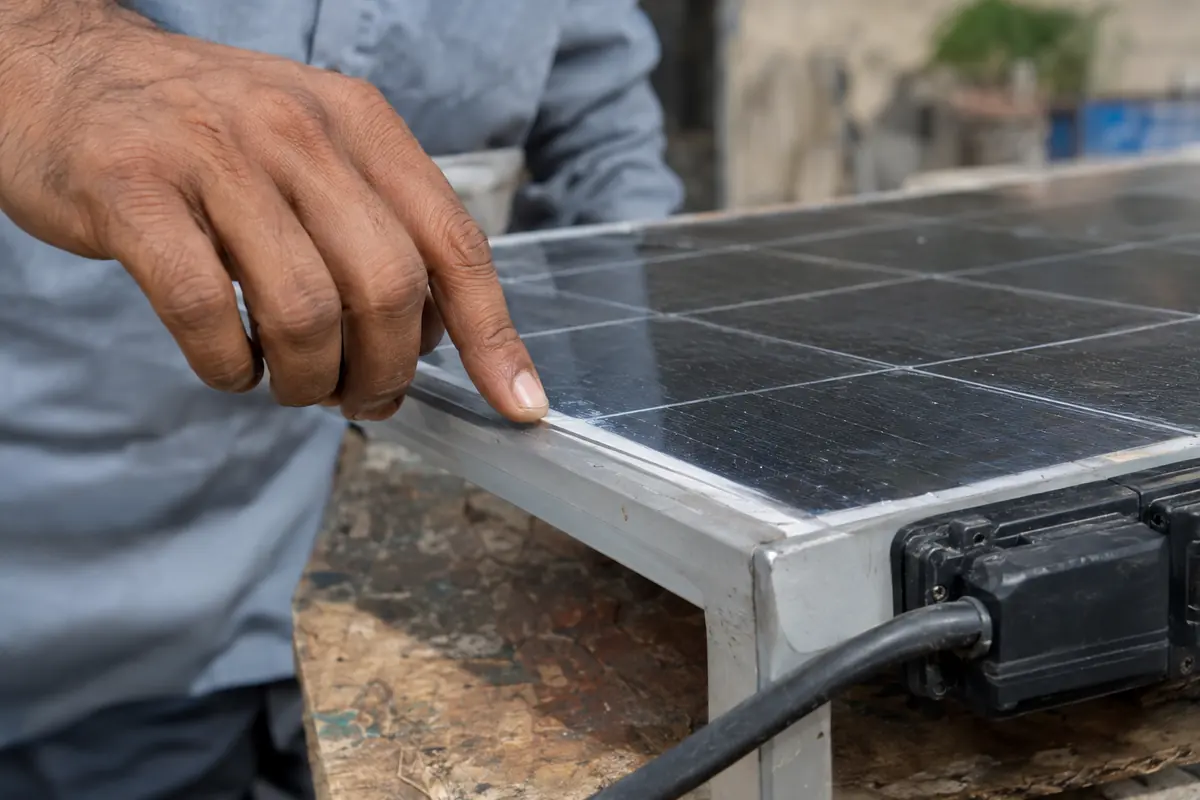
Comparison table
This table puts the datasheet numbers side by side for the panels where we checked the maker’s own figures.
| Panel | Efficiency (datasheet) | Temperature coefficient | Product warranty | Guaranteed power at end of warranty |
|---|---|---|---|---|
| Jinko Tiger Neo 585 W | 22.65% | −0.29% per °C | 12 years | 87.4% at 30 years |
| Longi Hi-MO 6 Explorer 585 W (now replaced by Hi-MO X7) | 22.6% | −0.29% per °C | 12 years | 88.9% at 25 years |
| Astronergy ASTRO N5 585 W | About 22.6% | −0.29% per °C | 15 years | 87% at 30 years |
| Trina Vertex N 615 W (210R) | About 23% | −0.29% per °C | 12 years | About 87% at 30 years |
| Aiko Comet 2N 630 W (now replaced by Stellar) | 23.9% | −0.26% per °C | 15 years | 88.85% at 30 years |
| Risen Hyper-ion 700–725 W | 23.3% | −0.24% per °C | 15 years | About 90% at 30 years |
Three takeaways. The mainstream Tier 1 TOPCon panels are very close to each other on paper, so price and genuine stock decide. Aiko and Risen lead on heat and ageing, at a higher price. And product warranties range from 12 to 15 years among Tier 1 makers, which is worth checking before you assume they are all the same.
Tier 1 solar panels: what the label really means
BloombergNEF’s Tier 1 list ranks module makers by bankability: whether banks have financed large projects using their panels. It is useful because it filters out small, short-lived factories. It is not a quality certificate for any single panel, and it changes every quarter.
| Brand | On BloombergNEF Tier 1 list | Notes |
|---|---|---|
| Jinko, Longi, Trina, JA Solar, Canadian | Yes, long-standing | The biggest names in Pakistan |
| Astronergy (Chint), Risen | Yes | Strong value and specialist options |
| Aiko | Yes, since 2024 | Back-contact specialist |
| Inverex, Crown | No | Pakistani brands, factory source not disclosed |
Buying checklist
Use these steps before you pay a single rupee of the balance. They take an hour and save years of trouble.
- Size the system first. Work out your monthly units and roof space with the solar panel calculator, then choose the panel size.
- Compare by price per watt, not price per panel. A cheaper 550 W panel can cost more per watt than a 585 W one.
- Get two or three written quotes for the same model code, not just the brand name.
- Ask who imported the stock and who handles warranty claims in Pakistan.
- Check the label on delivery: brand, full model code, Pmax, Voc, Isc and a serial number.
- Match serials on the label, under the front glass and on the box. Every panel must have a different serial.
- Measure one panel. Its size must match the datasheet for the claimed wattage.
- Check the back. Panels sold as bifacial must have glass on the back, not a plastic sheet.
- Test Voc in sun with a multimeter. It should be close to the label value, a little lower on a hot roof.
- Use the maker’s verification tools where they exist; Jinko buyers can follow our Jinko panel verification guide.
- Get every serial number, the model code and the warranty periods written on the invoice.
- Pay the balance only after checks are done and the panels are on the roof unbroken.
| Document | Why you need it |
|---|---|
| Invoice with serials | Proof of purchase for any warranty claim |
| Datasheet of the exact model | What power claims are measured against |
| Importer or brand warranty card | Shows who handles the claim |
| Installer’s string and earthing plan | Needed for safety and for net metering |
PERC or N-type: is an older panel still worth buying?
Most mono PERC panels around 540 to 550 W are now discontinued, and what is left is old stock, usually a little cheaper per watt than N-type panels.
| Point | Mono PERC 540–550 W | N-type 585 W class |
|---|---|---|
| Heat loss | Higher | Lower |
| First-year and yearly ageing | Faster | Slower |
| Price per watt | Usually a little lower | Usually a little higher |
| Best use | Tight budgets, tubewells with spare space | Most homes, net-metered systems |
Compare the live per-watt figures for both on the day you buy. If the gap is small, N-type is the better long-term buy because it keeps more of its output in the hot months and in later years.
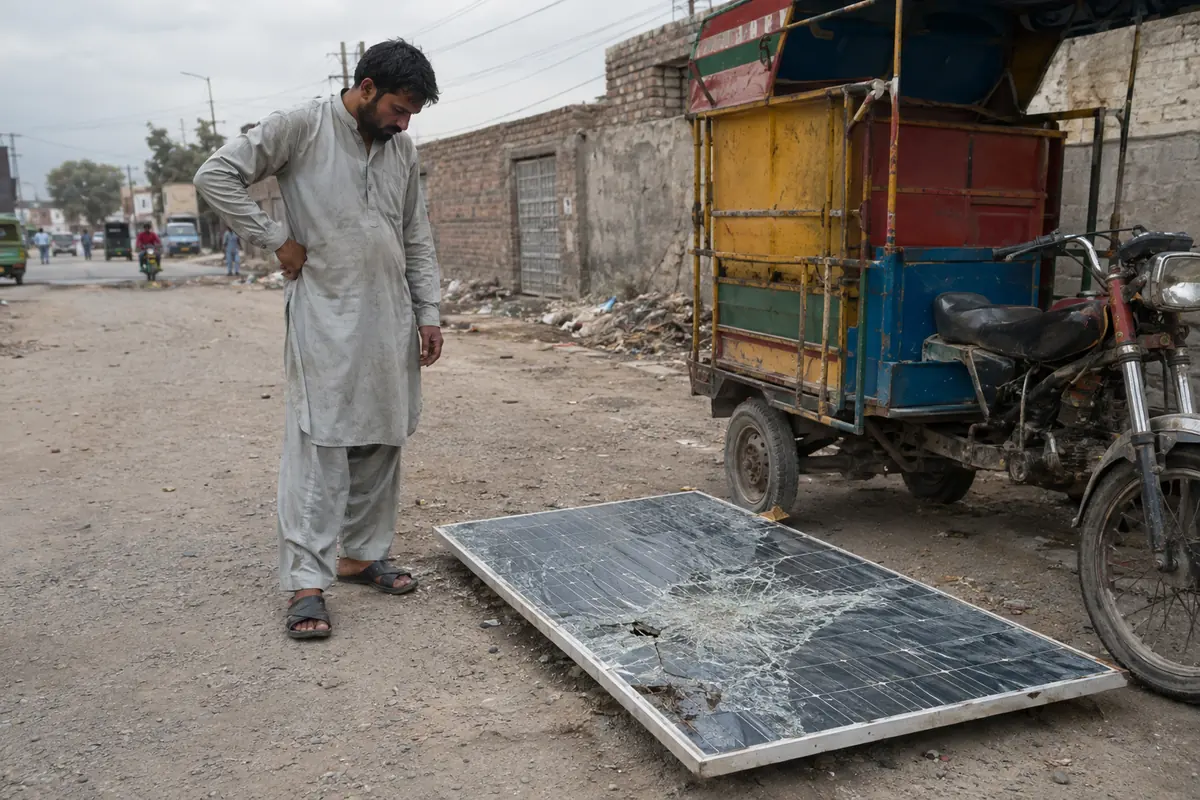
Common mistakes to avoid
Most bad solar experiences in Pakistan come from the same handful of mistakes.
| Mistake | What happens | What to do instead |
|---|---|---|
| Buying on brand name alone | You pay for Jinko and get a relabelled panel | Check serials, size and back glass on delivery |
| Chasing the cheapest quote | B-grade or old stock, no real warranty | Compare quotes for the same model code |
| Choosing the biggest wattage | 700 W panels that do not fit or need new structure | Pick the size that fits your roof and rails |
| Mixing panel models on one string | The whole string drops to the weakest panel | Keep one model per MPPT input |
| Believing best-case bifacial gains | Bill savings lower than promised | Plan on front-side output only |
| Skipping earthing and proper clamps | Safety risk and voided warranty | Ask for the earthing plan and clamp specs |
| No serials on the invoice | Claims rejected later | Refuse to pay until serials are listed |
Red flags that should make you walk away from a deal:
- A price far below the live market rate for the same panel.
- A dealer who cannot name the importer or the warranty handler.
- Stickers pasted over other labels, or wattage written by hand.
- Pressure to pay in full before delivery and checks.
- “Same as A-grade” claims for panels sold as B-grade or cut pieces.
One more mistake deserves its own line: spending everything on panels and buying the cheapest inverter. The inverter decides how much of the panels’ output actually reaches your appliances, and it is the part most likely to fail. A Tier 1 panel on a poor inverter, a thin cable run or a rusty structure is not a good system. Budget for the whole package, not just the plates.
The best solar panels price in Pakistan is the one where you got exactly the panel you paid for. Start with the live table on our home page, short-list two or three brands from this guide, and buy only after the checks above.
Frequently asked questions
Which solar panel is best in Pakistan?
For most homes, a genuine N-type panel from a Tier 1 maker such as Jinko, Longi, Trina, JA, Canadian or Astronergy is the best choice. On a small or very hot roof, back-contact panels from Aiko or HJT panels from Risen give more output, at a higher price per watt.
What are the top 10 solar panels in Pakistan?
Our top 10 are Jinko Tiger Neo, Longi Hi-MO X7, Astronergy ASTRO N5, JA Solar DeepBlue 4.0, Trina Vertex N 620 W, Canadian TOPBiHiKu6, Aiko Stellar ABC, Risen Hyper-ion, Trina Vertex N Ultra 740 W and Inverex Mustang for tight budgets. The live price of each is in the table on this page.
What are Tier 1 solar panels?
Tier 1 refers to BloombergNEF's list of module manufacturers whose panels banks have financed in large projects. It shows a maker is large and financially stable, but it is not a quality test of each panel, and the list is updated every quarter.
Which is the best solar panel company in Pakistan?
Separate the panel brand from the installer. Choose a Tier 1 panel brand, then hire a company that gives a written quote with model codes, lists every serial on the invoice, shows you the string and earthing plan and offers after-sales service in your city.
What are the best solar panels in the world?
By efficiency, the leading mass-produced panels today are back-contact designs from makers such as Aiko and Longi, followed closely by N-type TOPCon and HJT panels. The best panel for you still depends on your roof, climate and budget.
Is Jinko or Longi better?
On paper they are very close: both sell N-type panels in the 585 W class (Jinko Tiger Neo and Longi Hi-MO X7) with very similar datasheet figures. Buy whichever your trusted dealer can supply as genuine stock at the better price per watt.
Are Pakistani brands like Inverex and Crown good?
They can be a sensible budget choice with the advantage of a local helpline and warranty desk. They are not Tier 1 manufacturers and do not publish which factory makes their panels, so get the warranty terms and serials in writing.
How do I avoid fake solar panels?
Check that the label shows a full model code and serial, that serials match on the label, under the glass and on the box, that the size matches the datasheet, and that bifacial panels have glass on the back. Never pay the full amount before these checks.