Angles from latitude. Face panels due south.
On this page7 min read
This solar panel tilt angle calculator gives the best angle for solar panels in your city: one fixed angle for the whole year, plus summer and winter angles if your stand can be adjusted. Pick your city above and it shows the result instantly. Below we explain how the angle is worked out from latitude, which direction panels should face in Pakistan, and how to check the angle on your own roof.
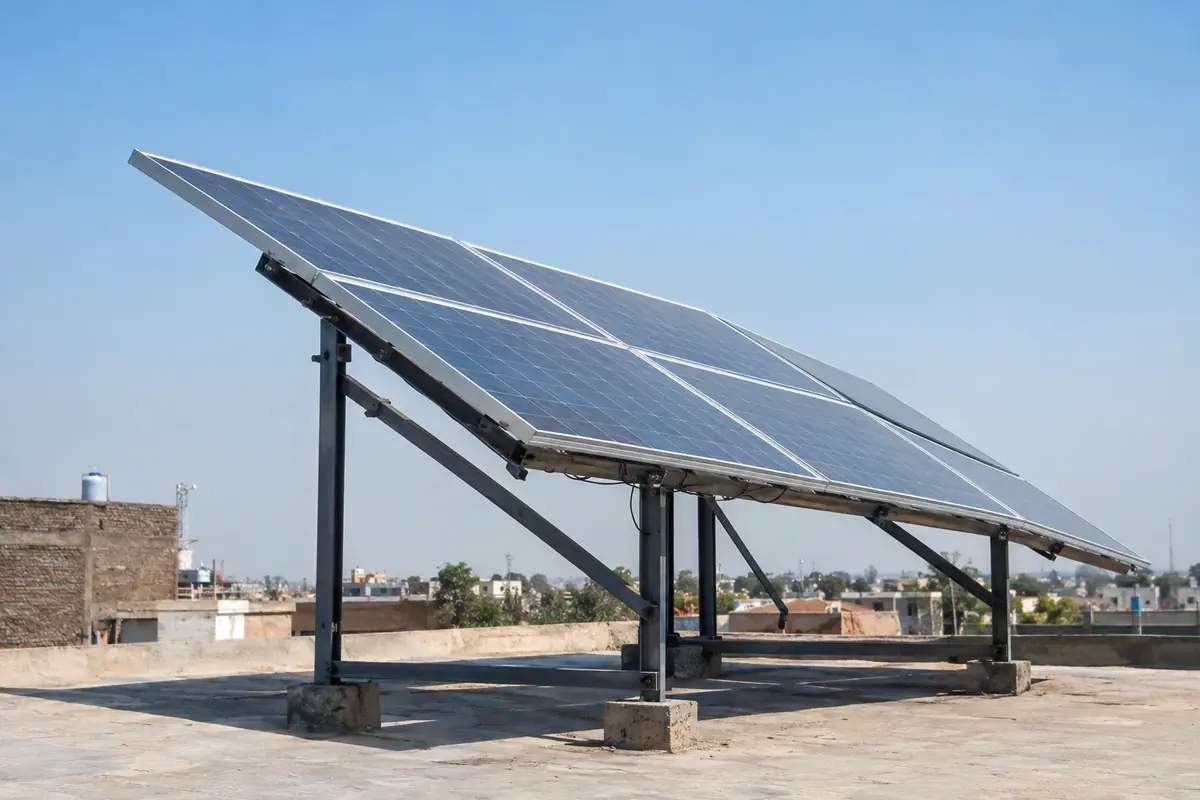
How the calculation works
The sun is lower in the sky in winter and higher in summer, and it is always to the south of us in Pakistan. A panel collects the most energy when it faces the sun squarely, so the tilt depends on how far north of the equator you are, which is your latitude.
The calculator uses three simple rules:
- Year-round angle = your latitude. Lahore is at about 31.5° north, so a fixed panel works best at about 32° from flat.
- Summer angle (April to September) = latitude minus 15°. The sun is high, so the panel lies flatter.
- Winter angle (October to March) = latitude plus 15°. The sun is low, so the panel stands steeper.
And one rule for direction: face the panels due south. Not towards the street, not towards the gate, but true south.
| Setting | Formula | Lahore example |
|---|---|---|
| Fixed, all year | Latitude | 32° |
| Summer (Apr to Sep) | Latitude − 15° | 17° |
| Winter (Oct to Mar) | Latitude + 15° | 47° |
| Direction | Due south | South (180° on a compass) |
What “tilt angle” means
Tilt is measured from flat. A panel lying on the roof is at 0°, a panel standing straight up like a wall is at 90°. When an installer says “32 degrees”, the front edge of the panel is low and the back edge is raised so the face points up and towards the southern sky. The other angle you will hear about is azimuth, the compass direction the panel faces. In Pakistan the target azimuth is south, written as 180°.
Why latitude, and how precise it needs to be
The latitude rule is the standard starting point used by installers around the world for a fixed system. Many simulation tools put the very best fixed angle a few degrees below latitude in places with hazy or cloudy summers, because more of the year’s energy then comes from a high summer sun. In practice the difference is small: anywhere within about 5° of the calculator’s figure loses only a percent or two over a year. So do not worry if your stand comes in at 28° or 30° instead of 32°. Worry if it is flat, or facing east.
Worked examples: Lahore, Karachi and Islamabad
Three cities show how much latitude changes the solar panel angle across Pakistan.
| City | Latitude | Fixed angle | Summer | Winter | What it means on the roof |
|---|---|---|---|---|---|
| Karachi | 24.9° N | 25° | 10° | 40° | Fairly flat panels; low wind load |
| Lahore | 31.5° N | 32° | 17° | 47° | Check a ready-made stand’s angle before buying |
| Islamabad | 33.7° N | 34° | 19° | 49° | Steeper; needs firm anchoring for wind |
Karachi
At 25°, Karachi’s panels sit flatter than anywhere else in the main cities. That helps in two ways: the structure catches less of the strong sea breeze, and rows can sit closer together because they cast shorter shadows. The trade-off is dust and salt settling more easily on a flatter panel, so wash more often.
Lahore
Lahore’s fixed angle is about 32°. If you are buying a ready-made stand, ask for the tilt in degrees, because ready-made frames are not all built to the same angle. During the December and January fog, output falls whatever the angle, so a steeper winter setting helps only on clear days.
Islamabad
Islamabad and Rawalpindi at about 34° need the steepest fixed angle among the big cities, along with Peshawar. A steeper panel stands taller and catches more wind, so the structure needs firm anchoring, especially on open, exposed top floors. Because the winter sun is lowest here, rows also need the widest gaps.
Tilt on different roof types
The best angle for solar panels is the same whatever the roof, but how you reach it changes:
- Flat RCC roof (most Pakistani houses). A steel stand sets the angle. You have full control, so build to the calculator’s figure and face south even if the house itself is turned.
- Elevated structure. Popular where people want parking or shade under the panels. The angle is the same, but height adds wind load, so the frame and base need to be stronger.
- Sloped roofs, sheds and godowns. Panels often go flush on the existing slope. If the slope faces south and is within about 10° of your latitude, flush mounting is fine. If it faces north, use a tilted frame or another roof.
- Shop and plaza roofs with limited space. A flatter angle, around 15° to 20°, lets you fit more rows with less shading, which often wins on total units.
Solar panel tilt angle for every major city
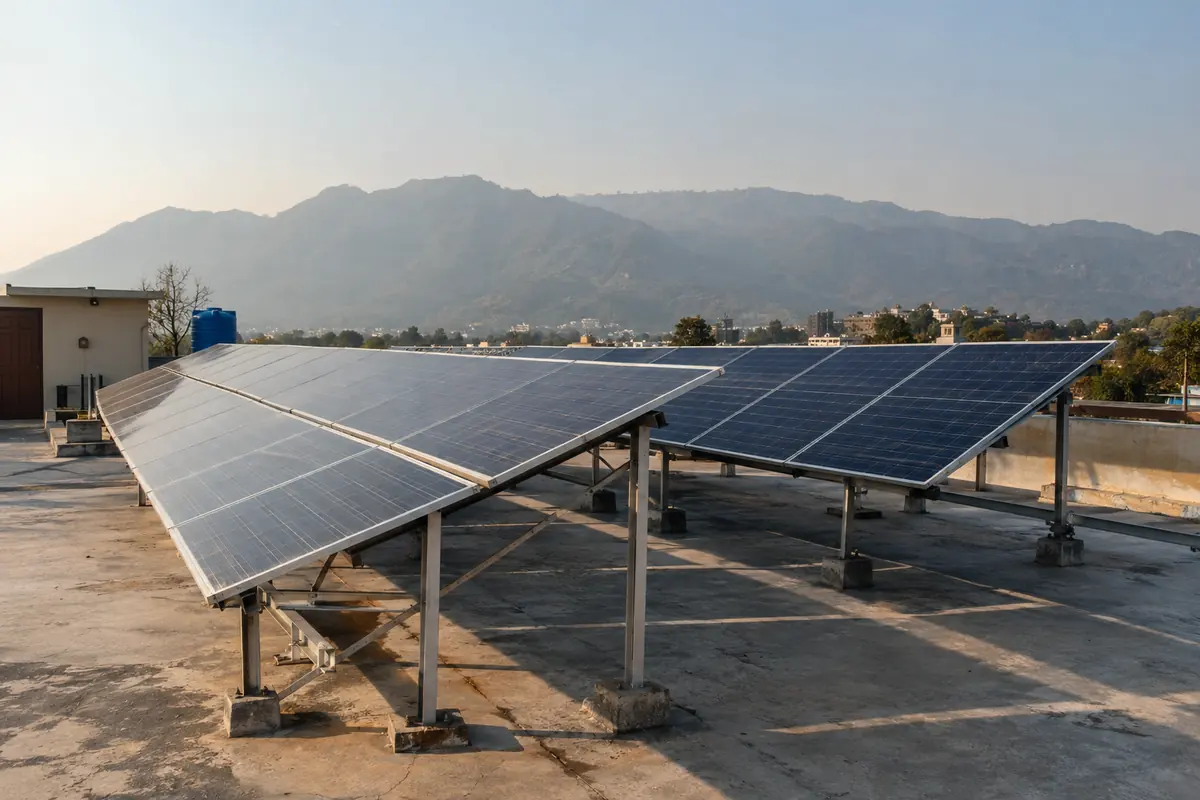
Here are the results for all the cities in the calculator. The row gap is the minimum clear space between one row’s back edge and the next row’s front edge, so the front row does not shade the back row at noon on the shortest winter day. It assumes one large 540 to 590 W panel (about 2.28 m long) mounted portrait at the fixed angle.
| City | Fixed angle | Summer | Winter | Winter noon sun height | Minimum row gap |
|---|---|---|---|---|---|
| Karachi | 25° | 10° | 40° | about 42° | about 1.1 m |
| Multan | 30° | 15° | 45° | about 36° | about 1.6 m |
| Faisalabad | 31° | 16° | 46° | about 35° | about 1.7 m |
| Lahore | 32° | 17° | 47° | about 35° | about 1.7 m |
| Gujranwala | 32° | 17° | 47° | about 34° | about 1.8 m |
| Islamabad | 34° | 19° | 49° | about 33° | about 2.0 m |
| Rawalpindi | 34° | 19° | 49° | about 33° | about 2.0 m |
| Peshawar | 34° | 19° | 49° | about 33° | about 2.0 m |
That gap is the noon minimum. To keep the back row clear from about 9 am to 3 pm in December, leave more, roughly one and a half times the figure. If roof space is tight, a slightly flatter angle with closer rows usually produces more in total than a perfect angle with fewer panels.
Solar panel direction
Direction matters more than a few degrees of tilt. Expected output for a fixed panel at the right tilt, compared with facing due south:
| Panels face | Output compared with south |
|---|---|
| South | Best |
| South-east or south-west | Slightly less, often a few percent |
| East or west | Noticeably less, often 10 to 20% |
| North | Poor; avoid in Pakistan |
Facing a little west is not always a loss. If your house uses most power in the afternoon, for example ACs from 2 pm, a south-west facing array shifts output later in the day, which matters more under net billing, where daytime self-use is worth more than exported units.
Is seasonal adjustment worth it?
Moving panels twice a year, to the summer angle in April and the winter angle in October, adds a few percent of output over a fixed setting. On a small home system that is worth doing only if the stand is built to adjust safely. On a large or high structure, the risk of loosened bolts and someone working on the roof usually outweighs the gain. Most homes are best served by fixing the year-round angle and spending the effort on regular cleaning instead.
Tips for an accurate result
The solar panel installation angle calculator above gives the target. Getting it right on the roof takes a few simple checks.
- Find true south. A phone compass works, but stand away from steel water tanks and the structure itself. Compass apps point to magnetic south, which in Pakistan is only a few degrees from true south, so that is close enough for solar.
- Measure the tilt. Lay a phone with a level or angle app flat on the panel frame. Or measure the rise and the run of the stand and use the angle: a 2.28 m panel at 32° rises about 1.2 m from front to back.
- Check shade at three times. Look at 9 am, noon and 3 pm, ideally in December when shadows are longest. Water tanks, stair rooms and parapets are the usual problems.
- Allow for wind. Steeper panels catch more wind. Use proper anchoring and a structure designed for the angle; our solar panel stand price page covers common options.
- Keep cleaning easy. Panels below about 10° stay dusty because rain does not wash them. Even in Karachi, many installers avoid going flatter than 10° to 15°.
- Size first, angle second. The angle fine-tunes output; the number of panels sets it. Use the solar panel calculator to size from your bill, or the solar panel for AC calculator for AC loads.
When to choose the winter angle instead
If your system has batteries, or you mainly want to beat winter load-shedding and gas-heater bills, lean towards a steeper setting, about 5° to 10° above the year-round figure. You give up a little summer output, when there is usually surplus anyway, and gain on short winter days when every unit counts. Homes on net billing that mainly run summer ACs can do the opposite and go a few degrees flatter.
| Your priority | Suggested fixed angle |
|---|---|
| Balanced, all-year output | Latitude (the calculator’s figure) |
| Winter output, battery backup | Latitude + 5° to 10° |
| Summer AC load, tight roof | Latitude − 5° to 10° |
| Common mistake | Effect | Fix |
|---|---|---|
| Panels laid flat on the roof | Dust builds up, lower winter output | Tilt at least 10° to 15° |
| Facing the street instead of south | Can lose a large share of output | Re-orient the structure to south |
| Rows too close | Back row shaded in winter | Use the row gaps above |
| Steep angle on a weak frame | Structure damage in storms | Match the frame to the angle |
Once the angle and direction are right, the remaining choices are panels and price. Compare today’s rates on the 585 watt solar panel price page, see full budgets in solar system price in Pakistan, and check what fitters charge on the solar panel installation cost guide.
Frequently asked questions
What is the best angle for solar panels in Pakistan?
For a fixed system, tilt the panels at about your city's latitude and face them due south. That works out to about 25 degrees in Karachi, 32 degrees in Lahore and 34 degrees in Islamabad, Rawalpindi and Peshawar.
What is the optimum angle for solar panels in Lahore?
About 32 degrees for a fixed year-round setting. If your stand can be adjusted, use about 17 degrees from April to September and about 47 degrees from October to March.
Which direction should solar panels face in Pakistan?
Due south. South-east or south-west costs only a little output, but east or west facing panels can lose 10 to 20 percent, and north facing panels should be avoided.
Is it worth changing the solar panel angle every season?
It adds a few percent of output over a fixed angle, so it is worth it only if your stand is designed to adjust safely. For most homes, fixing the year-round angle and cleaning the panels regularly gives a better return.
Can I install solar panels flat on the roof?
It is better not to. Flat panels collect dust and rainwater does not wash them, and winter output drops. Keep at least 10 to 15 degrees of tilt even in Karachi.
How much gap should I leave between rows of solar panels?
At least the minimum shown in our city table, about 1.1 metres in Karachi and 1.7 metres in Lahore for one portrait panel, and roughly one and a half times that to stay shade-free from morning to afternoon in December.
How do I measure the angle of my solar panel stand?
Use a level or angle app on your phone laid flat on the panel frame. You can also measure how high the back edge rises above the front edge and compare it with the panel's length.
Does the tilt angle matter more than the number of panels?
No. The number of panels sets how many units you get, and the angle fine-tunes it by a few percent. Size the system first, then get the angle and direction right.