| Model | Watt | Price per panel | Per watt | This week | Trend |
|---|---|---|---|---|---|
| Jinko Tiger Pro P-type (old stock)Mono PERC | 550 W | Rs 20,900 | Rs 38.0 | No change | |
| Jinko Tiger Pro P-type (old stock)Mono PERC | 540 W | Rs 20,520 | Rs 38.0 | No change | |
| Longi Hi-MO 5 (old stock)Mono PERC | 545 W | Rs 21,255 | Rs 39.0 | No change | |
| Crown N-type bifacial 20BBN-type TOPCon | 620 W | Rs 24,800 | Rs 40.0 | No change | |
| Trina Vertex N bifacialN-type i-TOPCon | 590 W | Rs 23,600 | Rs 40.0 | No change | |
| Crown N-type bifacial 16BBN-type | 585 W | Rs 23,400 | Rs 40.0 | No change | |
| JA Solar DeepBlue 4.0 N-type bifacialN-type | 585 W | Rs 23,545 | Rs 40.2 | No change | |
| Trina Vertex N bifacialN-type i-TOPCon | 620 W | Rs 25,110 | Rs 40.5 | No change | |
| Aiko Stellar 1N ABCN-type ABC | 620 W | Rs 25,110 | Rs 40.5 | No change | |
| Trina Vertex N UltraN-type i-TOPCon | 740 W | Rs 30,340 | Rs 41.0 | No change | |
| Risen Hyper-ion Pro HJTN-type HJT | 720 W | Rs 29,520 | Rs 41.0 | No change | |
| Astronergy ASTRO N5 bifacialN-type TOPCon | 585 W | Rs 23,985 | Rs 41.0 | No change | |
| Inverex Mustang bifacialN-type TOPCon | 585 W | Rs 24,280 | Rs 41.5 | No change | |
| Risen Hyper-ion HJTN-type HJT | 700 W | Rs 29,400 | Rs 42.0 | No change | |
| Jinko Tiger Neo N-typeN-type TOPCon | 580 W | Rs 24,505 | Rs 42.3 | No change | |
| Inverex Mustang double glassN-type | 620 W | Rs 26,350 | Rs 42.5 | No change | |
| Inverex Jolywood dual glassN-type | 600 W | Rs 25,500 | Rs 42.5 | No change | |
| Longi Hi-MO X7 bifacialN-type | 585 W | Rs 25,010 | Rs 42.8 | No change | |
| Aiko Stellar 1N+ ABCN-type ABC | 650 W | Rs 27,950 | Rs 43.0 | No change | |
| Jinko Tiger Neo 3.0 bifacialN-type TOPCon | 620 W | Rs 26,660 | Rs 43.0 | No change | |
| Canadian TOPHiKu6 bifacialN-type TOPCon | 590 W | Rs 25,370 | Rs 43.0 | No change | |
| Canadian TOPHiKu6 bifacialN-type TOPCon | 585 W | Rs 25,155 | Rs 43.0 | No change | |
| Jinko Tiger Neo N-type bifacialN-type TOPCon | 585 W | Rs 25,420 | Rs 43.5 | No change | |
| Longi Hi-MO X9N-type HPBC 2.0 | 600 W | Rs 26,400 | Rs 44.0 | No change |
On this page9 min read
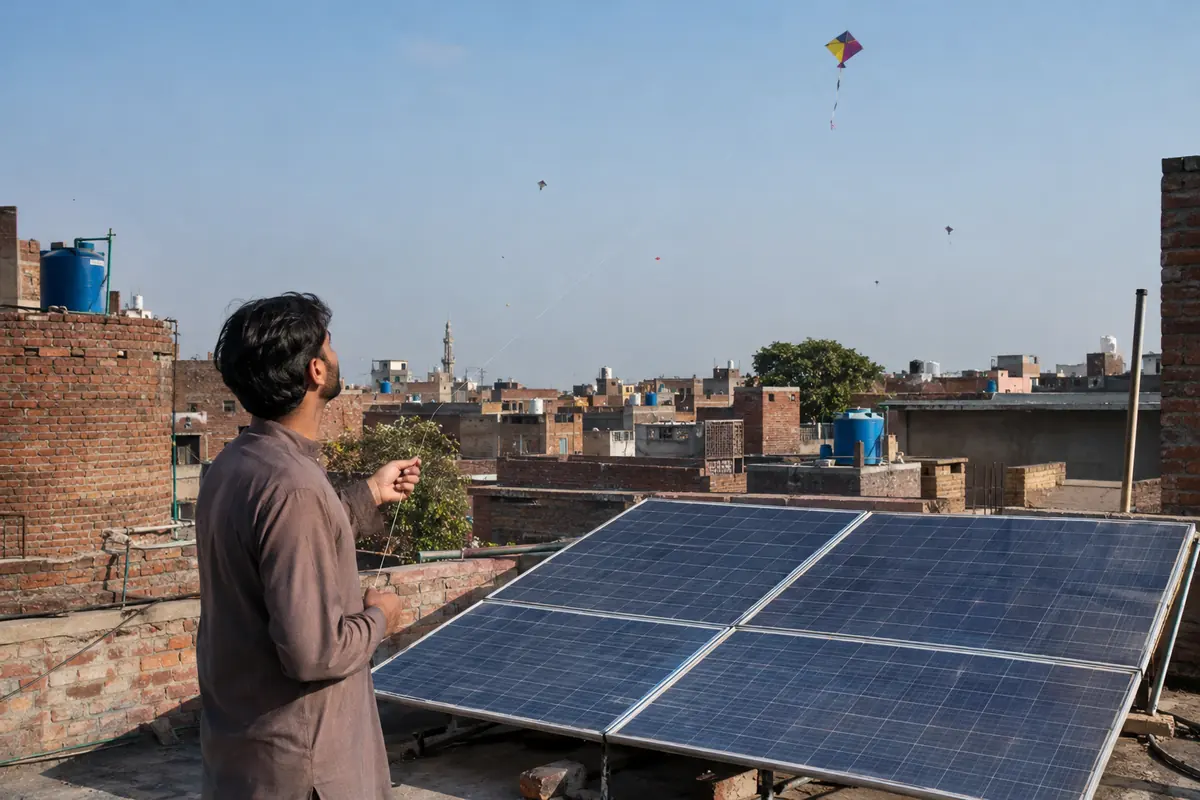
The solar panel price in Gujranwala is the same national rate you see in the table above, give or take a little freight, because the city sits on the GT Road close enough to Lahore that buyers can easily compare prices with the big wholesale traders there. What makes Gujranwala different is the buyer: busy family homes, small factories and workshops, and a winter that brings dense fog to the city and the GT Road. This guide covers where people buy, what a full system costs, how GEPCO’s net billing works, and what a Gujranwala roof really produces.
Solar panel markets in Gujranwala
Gujranwala does not have a well-known solar street of its own that we could confirm, and some buyers drive to Lahore’s Hall Road for a wider choice. Inside the city, you will buy a solar panel in Gujranwala through one of these routes:
- Electrical and electronics traders in the city’s main bazaars, who sell plates, inverters and batteries by the piece.
- Local installers who quote a full system and file the GEPCO paperwork.
- Contractors who work mostly with factories and workshops along the GT Road and in industrial areas.
- Distributors covering the GEPCO region, including Sialkot, Gujrat, Wazirabad and Hafizabad.
Is the Lahore trip worth it? Sometimes. On a full set of plates, a Lahore wholesale rate can beat a local quote, but you then pay for transport, carry the risk of breakage, and lose the convenience of a local seller who can swap a faulty plate. For one or two plates, buy locally. For a full 10 kW set, compare the delivered price from both.
Today the cheapest A-grade 585 W plate is listed at Rs 23,400, and the average across the market is Rs 41.3 per watt.
| Model | Watt | Price per panel | Per watt | This week | Trend |
|---|---|---|---|---|---|
| Trina Vertex N bifacialN-type i-TOPCon | 590 W | Rs 23,600 | Rs 40.0 | No change | |
| Canadian TOPHiKu6 bifacialN-type TOPCon | 590 W | Rs 25,370 | Rs 43.0 | No change | |
| Crown N-type bifacial 16BBN-type | 585 W | Rs 23,400 | Rs 40.0 | No change | |
| JA Solar DeepBlue 4.0 N-type bifacialN-type | 585 W | Rs 23,545 | Rs 40.2 | No change | |
| Astronergy ASTRO N5 bifacialN-type TOPCon | 585 W | Rs 23,985 | Rs 41.0 | No change | |
| Inverex Mustang bifacialN-type TOPCon | 585 W | Rs 24,280 | Rs 41.5 | No change | |
| Longi Hi-MO X7 bifacialN-type | 585 W | Rs 25,010 | Rs 42.8 | No change | |
| Canadian TOPHiKu6 bifacialN-type TOPCon | 585 W | Rs 25,155 | Rs 43.0 | No change | |
| Jinko Tiger Neo N-type bifacialN-type TOPCon | 585 W | Rs 25,420 | Rs 43.5 | No change | |
| Jinko Tiger Neo N-typeN-type TOPCon | 580 W | Rs 24,505 | Rs 42.3 | No change | |
| Jinko Tiger Pro P-type (old stock)Mono PERC | 550 W | Rs 20,900 | Rs 38.0 | No change | |
| Longi Hi-MO 5 (old stock)Mono PERC | 545 W | Rs 21,255 | Rs 39.0 | No change |
What Gujranwala buyers ask about most
Shopkeepers here tend to get the same questions again and again. The short answers:
- Which brand is best? Any tier-1 A-grade plate with a proper local warranty. Spend your effort checking the model and serials, not arguing about brand names.
- Mono PERC or N-type? N-type TOPCon costs a little more per plate but makes more units per watt in heat, and most new stock is now N-type.
- Bigger plates or more plates? Larger plates mean fewer clamps and connectors, but they must fit your roof and suit your inverter’s string limits.
- Can I mix brands? Avoid mixing different models in the same string. If you expand later, put the new plates on their own string or inverter input.
For brand-level rates, see our 585 watt solar panel price page.
Solar system installation cost in Gujranwala
Most homes in Gujranwala go for 3 to 5 kW, while workshops and larger houses move to 10 kW and beyond. The panel cost below updates with the market. Other costs are ranges checked as of October 2026 and cover the inverter, frame, cables, protection and labour.
| System | Plates at 585 W | Panel cost today | Rest of the system |
|---|---|---|---|
| 3 kW | 6 | Rs 140,400 | Rs 1,05,000 to 2,25,000 |
| 5 kW | 9 | Rs 210,600 | Rs 1,58,000 to 3,75,000 |
| 10 kW | 18 | Rs 421,200 | Rs 3,25,000 to 5,90,000 |
The gap between the low and high end is mostly the inverter. A locally branded hybrid sits at the bottom of each range and a premium international brand at the top. Batteries are on top of these figures and can cost as much as the inverter.
Budgeting for a Gujranwala home
A typical family home here has one or two inverter ACs, a water motor, a fridge, fans and lights, and often a home business or a shop below. That makes daytime use fairly high, which is good news under net billing. A sensible way to plan:
- Read twelve months of GEPCO bills and note your highest summer units.
- Estimate how much of that is used in daylight. For a family with someone at home all day, that is often more than half.
- Size the system to cover the daytime share, then decide whether a battery is worth it for evenings and outages.
- Leave roof space for two or three more plates if you expect to add an AC later, but remember any expansion of a net-billed system needs fresh approval.
Backup during GEPCO outages
Outage patterns in the GEPCO area depend heavily on your feeder. Urban feeders with low losses see fewer scheduled cuts, while high-loss feeders on the city’s edges and in nearby villages can face several hours a day. A plain on-grid inverter switches off whenever GEPCO supply drops, even at noon, so it does nothing for you during a cut. If outages are part of your routine, choose a hybrid inverter and at least a small lithium battery to keep fans, lights, the router and the fridge running. If they are rare, start with a hybrid inverter and no battery, and add one later if things change.
Workshops and small factories
Gujranwala’s workshops run motors, compressors and machines through the day. Solar can carry a big share of that load if it is designed properly. Ask your contractor for a load survey, use a three-phase inverter sized for motor starting, and keep the array on a strong frame that can be cleaned easily, because workshop roofs collect metal dust and soot. Our solar panel installation cost guide has a line-by-line breakdown of fitting charges.
Net metering in Gujranwala: step by step with GEPCO
Gujranwala is served by GEPCO, the Gujranwala Electric Power Company, which also covers Sialkot, Narowal, Gujrat, Hafizabad, Wazirabad and Mandi Bahauddin. Like every other DISCO, GEPCO now handles new solar applications under NEPRA’s Prosumer Regulations 2026, in force since 9 February 2026. Net metering has been replaced by net billing for new connections: exported units are credited at the national average energy purchase price that NEPRA sets, while every unit you import is billed at the normal GEPCO tariff. If you signed a net metering agreement before that date, it continues on its old terms until it expires.

The process for a Gujranwala home looks like this:
- Make sure you have a three-phase connection and that the system you want is no larger than your sanctioned load. If not, apply to GEPCO for a three-phase connection or a load extension first.
- Your installer prepares the standard application form with a single-line diagram, the panel and inverter details (the inverter must meet UL 1741), a copy of your bill, your CNIC and proof of ownership or the owner’s consent.
- GEPCO acknowledges the application and checks it is complete within 5 working days. If something is missing, you get 3 working days to provide it.
- GEPCO completes a technical review within 15 working days. It may refuse if solar on your transformer has already reached 80% of the transformer’s capacity.
- You sign the interconnection agreement within 7 working days. GEPCO then issues a cost estimate for the meter and connection within 7 working days, and you pay within 7 working days.
- GEPCO installs the bidirectional meter and commissions the link within 15 working days of payment.
- GEPCO forwards your file to NEPRA, which grants its concurrence once the Rs 1,000 per kW fee is paid. You then have six months to start generating, or you must reapply.
| Cost item (as of October 2026) | Amount |
|---|---|
| NEPRA concurrence fee | Rs 1,000 per kW |
| Meter and connection work | Rs 15,000 to 50,000, depending on size |
| Agreement term | 5 years, renewable by mutual consent |
Living with net billing in Gujranwala
Because exported units earn far less than imported units cost, the goal is to use as much solar as possible while it is being made. In practice that means running the water motor, washing machine, iron and AC during the day, and thinking twice before adding extra plates purely to export. Any credit left after a billing cycle carries forward to the next bill or is settled quarterly.
Sun hours and solar output in Gujranwala
Gujranwala has a planning average of about 5.1 peak sun hours a day. Summer is strong, the monsoon is heavier than in southern Punjab, and winter brings dense fog that can sit over the city and the GT Road until late morning. The table below shows modelled output from the European Commission’s PVGIS tool (ERA5 data), for panels facing south at 32 degrees with 14% system losses.
| Month | Units per kW per day | 4 kW system, units in the month |
|---|---|---|
| January | 4.2 | 524 |
| February | 4.5 | 508 |
| March | 4.8 | 592 |
| April | 4.9 | 588 |
| May | 4.7 | 580 |
| June | 4.3 | 512 |
| July | 3.7 | 456 |
| August | 3.7 | 460 |
| September | 4.3 | 512 |
| October | 4.7 | 584 |
| November | 4.5 | 544 |
| December | 4.4 | 544 |
That is about 1,600 units per kW a year, or roughly 6,400 units from a 4 kW system. Satellite-based models smooth out the worst fog days, so expect real December and January output to fall short on foggy weeks and to catch up on clear ones. Try your own numbers in our solar panel calculator.
Fog, monsoon and dust
- Fog: on foggy mornings panels produce very little until the sun breaks through. Do not judge a new system by a week in January.
- Monsoon: July and August are the weakest months. Heavy rain also tests the roof, so check the frame anchors and seals before the season.
- Dust and soot: roads, brick kilns in the wider region and workshop roofs all add grime. Clean every two to three weeks in dry months, and after any dust storm.
- Lightning: a proper earthing pit and surge protection are not optional in a district with heavy monsoon storms.
For the right technique, see our solar panel cleaning guide.
How to choose a solar installer in Gujranwala
Gujranwala’s installers range from long-standing electrical contractors to newer teams. The good ones are easy to recognise once you know what to ask:
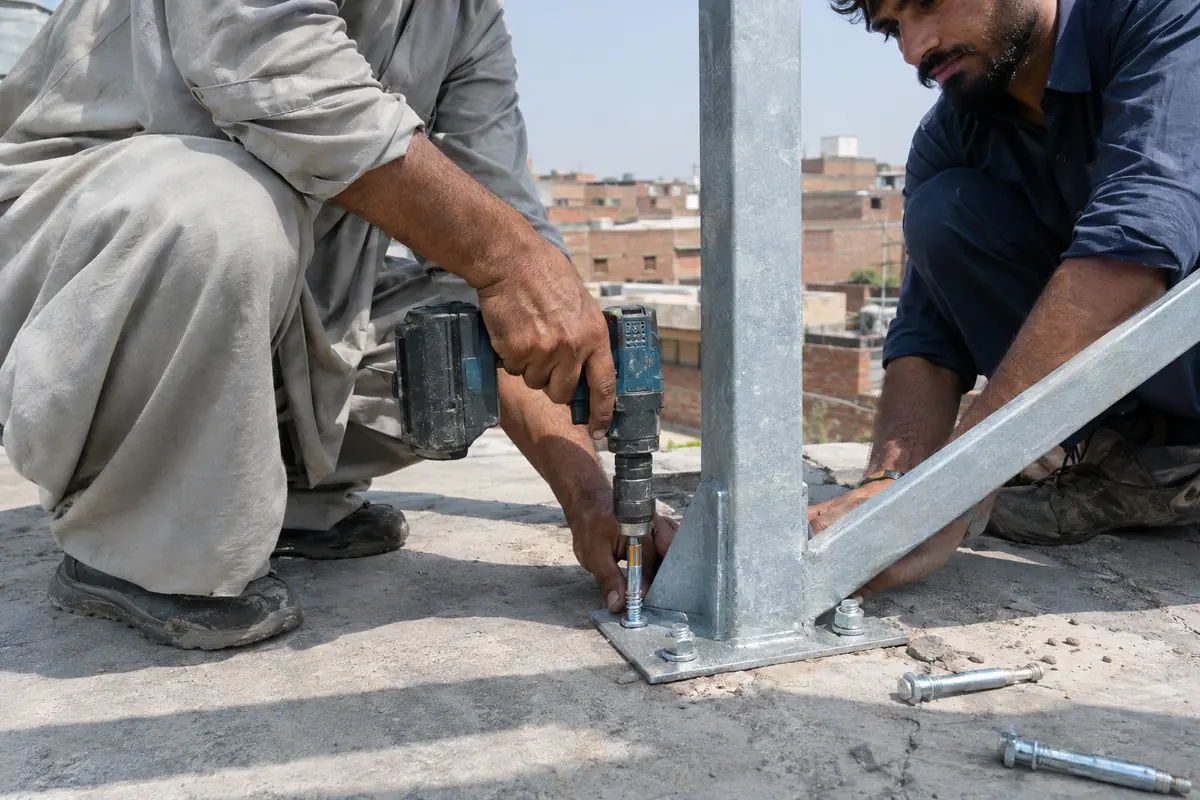
- Are they on PPIB’s certified installer list? AEDB’s certification now sits with PPIB, and GEPCO files and bank financing often expect it.
- Will they put plate brand, model, wattage and serial numbers, inverter model, cable size and structure details in writing?
- Have they filed net billing applications with GEPCO under the 2026 rules, and how long did those take?
- Do they include an earthing pit, DC and AC surge protection and proper breakers in the quote?
- Who handles warranty claims for the plates and the inverter, and is there a local service contact?
- Can they show you two jobs in Gujranwala that are at least a year old?
- Will they give a workmanship warranty that covers roof leaks and loose clamps?
A quote that skips earthing or names only “A-grade plates” with no model is not a cheaper quote; it is an incomplete one. Start your shortlist with our page on solar panel companies in Pakistan.
Gujranwala vs other cities: price difference
For an identical plate, the solar panel Gujranwala buyers get costs about what it costs in Lahore, plus a small freight margin. The differences between cities come from the site, the utility and the weather.
| Factor | Gujranwala | Lahore | Faisalabad | Peshawar |
|---|---|---|---|---|
| Utility | GEPCO | LESCO | FESCO | PESCO |
| Plate price | Lahore rate plus freight | Close to national rate | National rate plus freight | National rate plus freight |
| Yearly units per kW | About 1,600 | About 1,610 | About 1,640 | About 1,580 |
| Main local issue | Winter fog, monsoon | Smog | Lint and dust | Load-shedding, dust |
If you are willing to travel for plates, our Lahore page explains how Hall Road buying works. For national rates, go back to the solar panel price in Pakistan home page.
Frequently asked questions
What is the solar panel price in Gujranwala today?
The cheapest A-grade 585 W plate is currently around Rs 20,520, and the live table on this page shows other brands and sizes. Gujranwala prices are close to Lahore's, usually with a small freight margin.
Should I buy solar panels in Lahore instead of Gujranwala?
For a full set of plates, a Lahore wholesale rate can be slightly cheaper, but you pay for transport and take the breakage risk. For a few plates, or if you want easy warranty swaps, buying from a local Gujranwala seller is usually simpler.
Which company handles solar net billing in Gujranwala?
GEPCO handles applications for Gujranwala, Sialkot, Narowal, Gujrat, Hafizabad, Wazirabad and Mandi Bahauddin. New files follow NEPRA's Prosumer Regulations 2026 and are on net billing.
How much electricity does a 4 kW solar system make in Gujranwala?
About 6,400 units a year, or roughly 530 a month on average. March, April and October are the strongest months, while July, August and foggy winter weeks are the weakest.
Does winter fog stop solar panels working in Gujranwala?
Fog cuts output sharply while it lasts, and panels may produce very little until it lifts. Clear winter days make up for much of it, so judge your system on a whole season rather than one foggy week.
Do I need a battery with solar in Gujranwala?
Only if your feeder has regular outages or you use a lot of power at night. A hybrid inverter lets you start without a battery and add one later, while a plain on-grid inverter shuts down during every cut.
How long does GEPCO take to approve net billing?
The deadlines in NEPRA's regulations for acknowledgement, technical review, agreement, payment and meter installation add up to roughly three months of working days. Missing documents are the most common cause of delay.
Can I add more panels to my net-billed system later?
Yes, but changing the system's maximum output is a material modification that needs GEPCO's approval and fresh NEPRA concurrence before you install. Plan roof space and inverter capacity with future additions in mind.