On this page
Solar panel cleaning is the cheapest way to get more units out of a system you already own. In Pakistan’s dust, smog and long dry spells, a dirty plate can quietly lose a big share of its output within a few weeks. This guide shows how to clean solar panels safely, how often to do it in different cities, and when a cleaning service, a brush kit or an automatic system makes sense.
Quick answer on solar panel cleaning
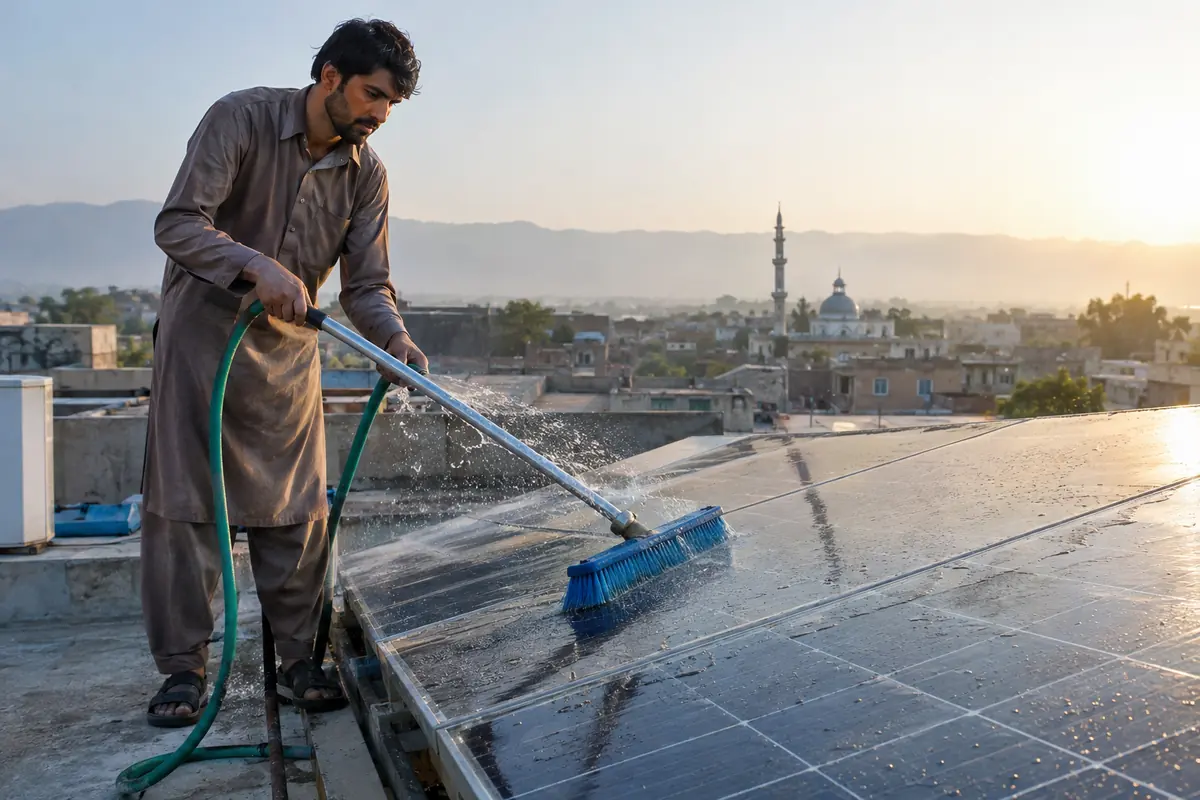
Clean your panels with plain, soft water and a soft brush or sponge, early in the morning or after sunset, while the panels are cool. Never use soap powder, a hard scrubber, a pressure washer close up, or cold water on hot glass. In most Pakistani cities, cleaning every one to three weeks in the dry season and less often in the monsoon keeps losses small.
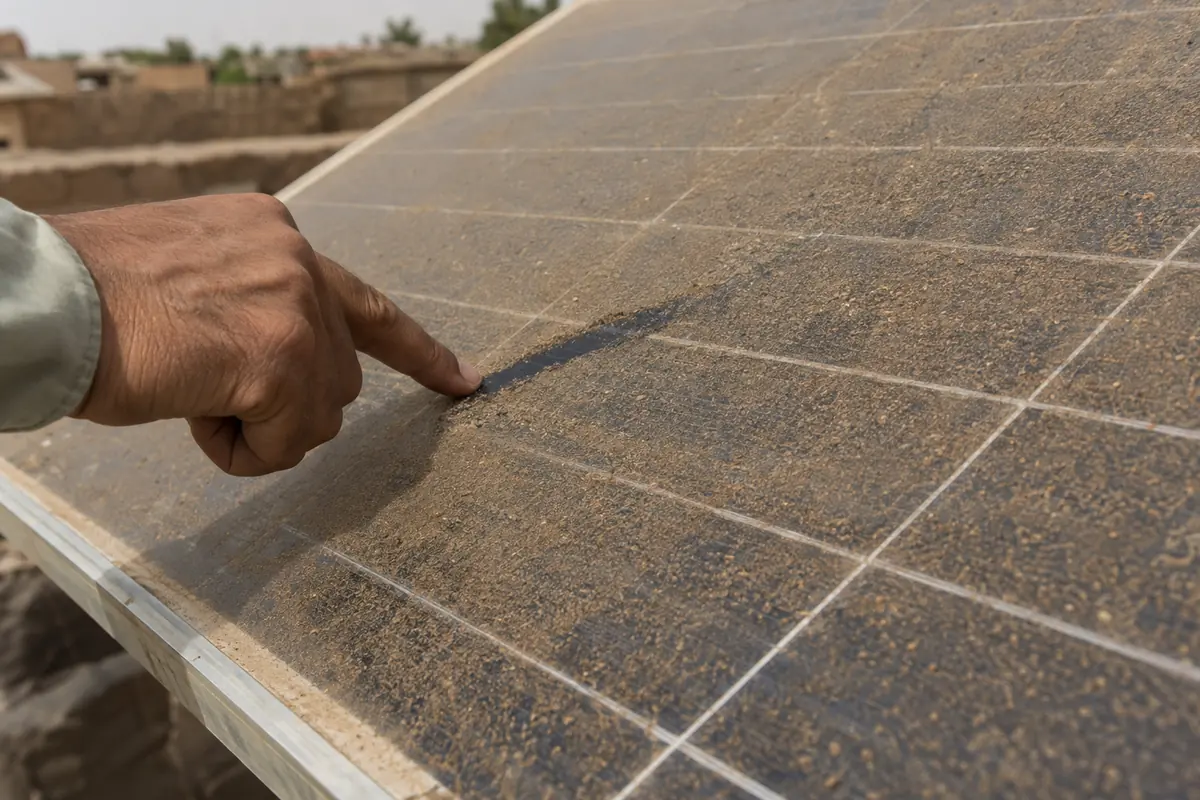
How big are the losses? A rooftop study in Lahore by researchers at LUMS measured soiling losses of about 0.8% per day on panels tilted at 30° during October to January, one of the highest rates reported for an urban site in the region. At that rate, a panel left uncleaned for two weeks of smoggy winter weather can lose more than a tenth of its output. The same study recommended cleaning roughly once a week at that tilt.
- Best tools: soft nylon brush on a pole, soft sponge, microfibre or non-woven cloth, clean water
- Best time: early morning, evening, or a cloudy day
- Best frequency: weekly to fortnightly in dry, dusty months; after dust storms; less in the rains
How we checked this
We did not want generic advice copied from countries with clean air and frequent rain. The guidance on this page comes from three kinds of sources:
| Source | What it gave us |
|---|---|
| Panel maker cleaning and maintenance manuals (for example LONGi’s O&M manual) | Water quality limits, pressure limits, allowed tools, banned chemicals, time of day |
| Published soiling research from Pakistan (LUMS rooftop study in Lahore) | Real daily loss rates and a tested cleaning schedule |
| Installer and owner experience across Punjab, Sindh and KP | What actually goes wrong on Pakistani roofs: hard water marks, cracked glass, broken connectors |
Where we give a number, it comes from one of these. Where conditions vary too much for one number, such as cleaning-service charges that differ by city, roof access and number of plates, we explain how pricing works instead of quoting a figure that would be out of date in a month.
How to clean solar panels safely
Step by step: how to wash solar panels at home
- Pick the time. Early morning before about 8 am, or after sunset. The glass should be cool to the touch.
- Turn the system off. Switch off the inverter, then the DC isolator or breaker if you have one. The panels still make voltage in daylight, so keep water away from cables and connectors.
- Check for damage first. Do not clean a panel with cracked glass, burnt marks or exposed wires. Call your installer.
- Dry-brush loose dust. On a dusty day, a soft brush removes most of the loose layer before you add water, which stops it turning to mud.
- Rinse with low-pressure water. Use a hose with a gentle spray, not a jet. Start at the top edge and let the water run down.
- Brush gently. Use a soft nylon-bristle brush or sponge on a pole. Work top to bottom in straight lines.
- Rinse again. Wash off the loosened dirt before it dries.
- Squeegee or let it drain. On hard-water roofs, a rubber squeegee prevents spots drying on the glass.
- Switch on and check the app. Compare the output with the day before cleaning. This is the easiest way to see whether your schedule is right.
What maker manuals allow and ban
Big panel makers publish cleaning rules because the wrong method can void the warranty. The LONGi maintenance manual is a good example and matches what most top brands say.
| Allowed | Not allowed |
|---|---|
| Soft foam, soft sponges, soft brushes, non-woven cloth | Blades, steel wool, metal scrapers, the hard side of a kitchen sponge |
| Soft nylon bristles (around 0.06–0.1 mm thick) | Abrasive powders, polishing agents, washing powder, caustic soda, acids, thinner |
| Ordinary municipal water | Very hard or salty water, unless treated |
| Glass cleaner or alcohol for stubborn stains, then rinse | Steam cleaning |
| Water pressure at the surface below 0.7 MPa (about 100 psi) | Close-range pressure washing |
| Water within about 10 °C of the panel temperature | Cold water on hot glass at midday |
| Cleaning at low sun (around 200 W/m² or less) | Cleaning in strong wind or a dust storm |
| Gloves on, standing beside the array | Standing or walking on the panels |
The same manual suggests cleaning at least every 20–30 days in dry, low-rainfall areas and every 40–50 days in rainy areas, and immediately whenever dirt hides the cell colour. In Pakistan’s smoggy winter months, the Lahore research shows you may need to clean more often than that.
Water quality: the problem nobody mentions
Much of Pakistan’s groundwater is hard, and in parts of Karachi, southern Punjab and Sindh it can also be brackish. When hard water dries on hot glass it leaves white mineral spots that block light and are hard to remove. Maker manuals set limits such as total dissolved solids below about 1,000 mg/L and hardness below about 450 mg/L.
- If your tap water leaves white marks on a car or a steel sink, it will mark your panels too.
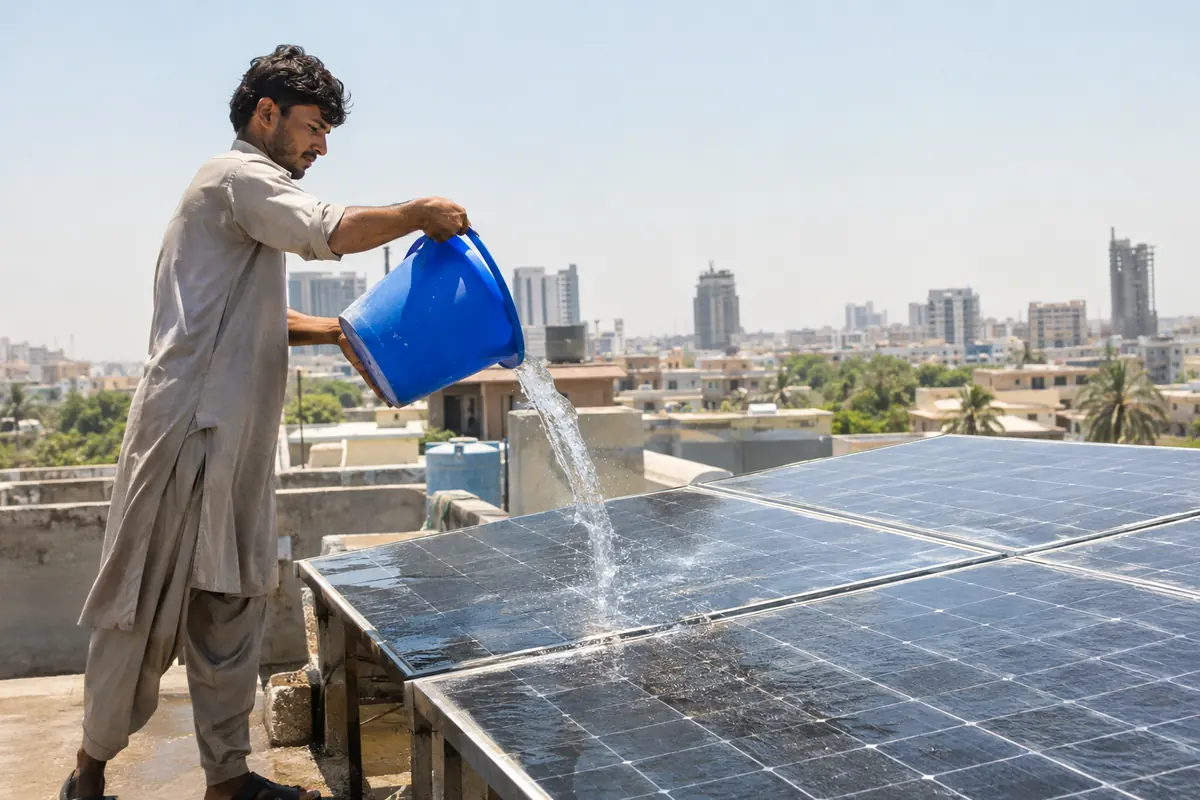
- Use water from an RO plant or a filter for the final rinse, even if you use tap water for the first wash.
- Never leave water to dry in the sun. Squeegee or wipe with a clean microfibre cloth.
How often to clean in different parts of Pakistan
| Area and conditions | Suggested cleaning | Why |
|---|---|---|
| Lahore, Faisalabad, Gujranwala in smog season (roughly Oct–Jan) | Weekly | Oily soot plus dust sticks to the glass; high measured daily losses |
| Karachi and coastal Sindh | Every 1–2 weeks | Sea salt, humidity and dust form a sticky film |
| Multan, Bahawalpur, interior Sindh in dry months | Weekly, and after every dust storm | Fine desert dust and long periods without rain |
| Islamabad, Rawalpindi, Peshawar | Every 2–3 weeks; more near construction | Less dust overall, but pollen in spring and construction dust |
| Any city during the monsoon | After heavy rain, check; often a light rinse is enough | Rain helps but leaves mud streaks at the bottom edge |
| Near factories, brick kilns, roads or flour mills | Weekly or more | Heavy local soot or flour dust |
These are starting points. The right schedule for your roof is the one your inverter app tells you: if output jumps noticeably after a clean, you waited too long.
How many units does cleaning win back?
It helps to put the loss in units, because that is what shows up on your bill. A 5 kW system in Punjab typically produces somewhere around 18–22 units a day in good weather.
| Soiling loss | Units lost per day (5 kW system) | Units lost per month |
|---|---|---|
| 5% (light dust, cleaned recently) | About 1 | About 30 |
| 10% (two weeks without cleaning in dry weather) | About 2 | About 60 |
| 20% (a month of smog and dust, no rain) | About 4 | About 120 |
Multiply the monthly figure by your own tariff per unit and you can see what a missed month of cleaning costs. On a net-metered or net-billed system, those are units you would otherwise have exported. A brush and pole usually pays for itself within the first dusty season. If you are still sizing a system, the solar panel calculator estimates daily units for your city.
Bifacial panels: the back side too
Many newer N-type panels are bifacial, meaning they also collect light reflected onto the back. On a high, open frame over a light-coloured roof, the rear side adds useful output, but it also collects dust and bird droppings. Maker guidance is to clean the back of bifacial panels far less often, around every six months, and only with the system switched off, keeping water away from the junction box. Do not clean the back of an ordinary mono-facial panel at all; its back sheet is not designed for scrubbing.
Tilt makes a big difference
Panels laid nearly flat collect far more dust and let rainwater pool at the bottom edge, leaving a muddy line across the lowest cells. A steeper tilt sheds dust and rain better. The Lahore study found that panels at a steep tilt needed cleaning far less often than panels at 30°. You do not need to mount panels vertically, but avoid very low angles. Our solar panel tilt angle calculator helps you choose an angle that balances output and cleaning.
Staying safe on the roof
Cleaning is riskier than it looks, because it is done often, in a hurry and on wet surfaces.
- Never stand or kneel on a panel, and never lean a ladder against one.
- Wet glass and wet roof tiles are slippery; wear shoes with grip.
- Do not touch connectors or cables with wet hands, even with the inverter off. Panels still produce voltage in daylight.
- On a roof without a parapet, use a harness or leave it to a professional team.
- Keep children off the roof while you work and do not leave the hose across walkways.
Comparison table: cleaning methods, tools and systems
| Method | What it is | Good for | Watch out for |
|---|---|---|---|
| Hand cleaning with bucket and sponge | Soft sponge or cloth and clean water | Small systems you can reach safely | Do not climb on the panels; use a ladder and pole |
| Solar panel cleaning brush on a pole | Soft nylon brush on an extendable pole, often with a water feed | Most home rooftops (3–10 kW) | Cheap brushes with hard bristles scratch the anti-reflective coating |
| Solar panel washer / pressure washer | Motor pump with a spray gun | Large arrays, heavy grime | Keep the nozzle well away and pressure low; never aim at connectors or the junction box |
| Rotating brush machine | Motorised roller brush, battery or water powered | Big commercial roofs and plants | Heavy and needs training; must be approved for your panels |
| Sprinkler or fixed-pipe system | Pipes and nozzles along the top edge of each row | Homes with easy water supply and hard-to-reach roofs | Uses a lot of water; hard water leaves marks unless treated |
| Automatic robot cleaning system | Waterless or low-water robot that travels along the row | Utility plants and large factories | High cost; built for long, uniform rows |
| Professional cleaning service | A team with brushes, pumps and treated water | Owners who cannot reach the roof safely | Check their method and tools before they start |
Brushes and washers: what to buy
A good solar panel brush has soft, fine nylon bristles, a wide head and a pole long enough to reach the top row from the roof parapet or a ladder. Many come with a hose connection so water flows through the brush head. For a typical home system, this is the best value tool you can own.
A solar panel washing machine or pressure washer is useful only for larger roofs and only when used gently. Set it to a wide fan spray, keep the nozzle at least an arm’s length from the glass, and stay under the maker’s pressure limit. A car-wash pressure jet held close to the glass can damage seals and push water into the frame.
Automatic solar panel cleaning systems
An automated solar panel cleaning system makes sense when panels are hard to reach, when there are hundreds of them, or when labour is the biggest cost. There are two main types:
- Water-based sprinkler or pipe systems. Simple and fairly cheap to install on a home roof. They work best with filtered or soft water and still need an occasional brush clean, because spraying alone does not remove sticky smog residue.
- Robotic cleaners. Brushes or microfibre rollers that move along each row, often at night, with little or no water. These are common on large solar farms in desert regions and are usually overkill for a house.
If you install any automatic system, confirm with the panel maker or installer that it will not void your warranty.
Buying checklist: hiring a solar panel cleaning service
Searches for “solar panel cleaning near me” and “solar panel washing service” are common, and the quality of these services varies widely. Before you let anyone on your roof, go through this list.
- Ask what they will use. Soft brushes, sponges and clean or treated water are fine. Scrapers, washing powder, kitchen scourers and acid cleaners are not.
- Ask about water. Do they bring RO or filtered water, or use your tank? Hard tank water leaves spots.
- Ask how they reach the panels. A good team works from ladders, walkways or the roof edge, not by walking on the panels.
- Ask about switching off. They should switch off the inverter and keep water away from connectors and the junction box.
- Check how they charge. Most services charge per panel, per kilowatt or per visit, and many offer monthly packages. Compare like with like, and ask what is included (water, travel, inspection).
- Ask for a before-and-after reading. A serious service will note your inverter output before and after, or show you photos.
- Ask about damage. Who pays if a panel is cracked or a connector is broken during cleaning?
- Start with one visit. Watch the first clean before signing a monthly contract.
Cleaning yourself or hiring a service
| Point | Doing it yourself | Hiring a service |
|---|---|---|
| Cost | A one-time brush and pole; water | A charge every visit or a monthly package |
| Safety | Risky on high or sloping roofs | Better if the team has proper ladders and harnesses |
| Quality | As good as your tools and patience | Varies; check their method |
| Frequency | Easy to do weekly | Usually every 2–4 weeks on a package |
| Best for | Single-storey homes with safe roof access | Tall buildings, shops, factories, owners abroad |
Common mistakes to avoid
| Mistake | What happens | Do this instead |
|---|---|---|
| Cleaning at noon with cold water | Thermal shock can crack hot glass; water dries into spots | Clean early morning or evening |
| Using washing powder or dish soap | Leaves a film that attracts more dust; can harm coatings and seals | Plain water; glass cleaner only for stubborn stains, then rinse |
| Scrubbing with a hard brush or scourer | Scratches the anti-reflective coating, permanently reducing output | Soft nylon brush or sponge only |
| Walking on the panels | Micro-cracks in cells, hot spots, possible warranty loss | Work from the side with a pole |
| Spraying the junction box and connectors | Water gets into the electrics; risk of faults and shocks | Keep spray on the glass; leave the back of the panel alone |
| Using hard or salty tank water and leaving it to dry | White mineral marks that block light | Use RO or filtered water for the final rinse and squeegee dry |
| Ignoring bird droppings | A single dropping shades a cell and can create a hot spot | Remove droppings promptly with a damp soft cloth |
| Not checking output after cleaning | You never learn whether your schedule is right | Compare inverter readings before and after |
Removing stubborn stains
Some marks do not come off with water and a soft brush: dried bird droppings, sticky smog film, tree sap and old hard-water spots. Soak the spot with clean water for a few minutes first to soften it, then wipe with a soft cloth. If that fails, a little ordinary glass cleaner or isopropyl alcohol on a microfibre cloth is what maker manuals allow, followed by a full rinse with clean water. Never scrape with a blade or a coin, and never use acid descalers sold for bathroom tiles, as they can attack the coating, the frame seal and the aluminium.
Cleaning and your warranty
Panel warranties usually exclude damage caused by improper cleaning. Scratched glass from abrasive tools, cracked cells from walking on panels and water damage to the junction box are all hard to claim. Keeping to the maker’s cleaning rules protects both your output and your warranty. Our solar panel lifespan guide explains what the power warranty actually covers.
If you are planning a new system and want panels that cope well with dust and heat, check today’s prices on the home page, see the best solar panels in Pakistan and the live solar panel price list. For Lahore buyers in particular, our solar panel price in Lahore page covers local conditions, including the winter smog that makes regular cleaning so important.
Frequently asked questions
How often should I clean my solar panels in Pakistan?
In dusty, dry months most rooftops in Punjab and Sindh benefit from cleaning every one to two weeks, and weekly during the Lahore smog season. In the monsoon you can usually clean less often. Check your inverter app: if output jumps after cleaning, you waited too long.
How do I clean solar panels at home?
Switch off the inverter, then rinse the panels with low-pressure clean water early in the morning or after sunset. Brush gently with a soft nylon brush or sponge from top to bottom, rinse again and wipe or squeegee dry. Never stand on the panels.
Can I use soap or detergent on solar panels?
Avoid washing powder and dish soap because they leave a film that attracts dust and can harm coatings. Plain water is enough most of the time; for stubborn stains, a little glass cleaner or alcohol on a soft cloth, followed by a rinse, is what panel makers allow.
What kind of solar panel cleaning brush should I buy?
Choose a brush with soft, fine nylon bristles and a wide head on an extendable pole, ideally with a hose connection. Hard bristles and kitchen scourers scratch the anti-reflective coating and permanently reduce output.
Is it safe to use a pressure washer on solar panels?
Only gently. Keep the nozzle well back, use a wide fan spray, stay within the maker's pressure limit and never aim at the junction box or connectors. A close-range jet can damage seals and force water into the panel.
Why should I not clean solar panels at noon?
At midday the glass is very hot, and cold water can cause thermal shock that may crack it. Water also dries instantly and leaves mineral spots. Early morning or evening cleaning is safer and gives a better result.
Are automatic solar panel cleaning systems worth it for a house?
For most homes, no. A good brush and pole costs far less and does a better job on sticky smog film. Sprinkler or robotic systems make more sense for large roofs, factories and solar farms, or where the panels are very hard to reach.
How much output do dirty solar panels lose?
It depends on the location and season. A rooftop study in Lahore measured losses of about 0.8% per day during the winter months on panels tilted at 30 degrees, which adds up to more than a tenth of output within two weeks.
What should I ask a solar panel cleaning service?
Ask what tools and water they use, how they reach the panels without walking on them, whether they switch off the system, how they charge and who pays for any damage. Watch the first visit before signing a monthly package.