On this page12 min read
The Aiko solar panel price in Pakistan is higher per watt than almost every other brand on our sheet, and that is deliberate. Aiko sells only back-contact (ABC) panels, the most efficient mass-produced panels you can buy in Pakistan right now, and it prices them as a premium product. This page explains what ABC actually means on a Pakistani roof, which Aiko series you are likely to be offered, the warranty on the datasheet and when the extra rupees are worth paying.
About Aiko solar
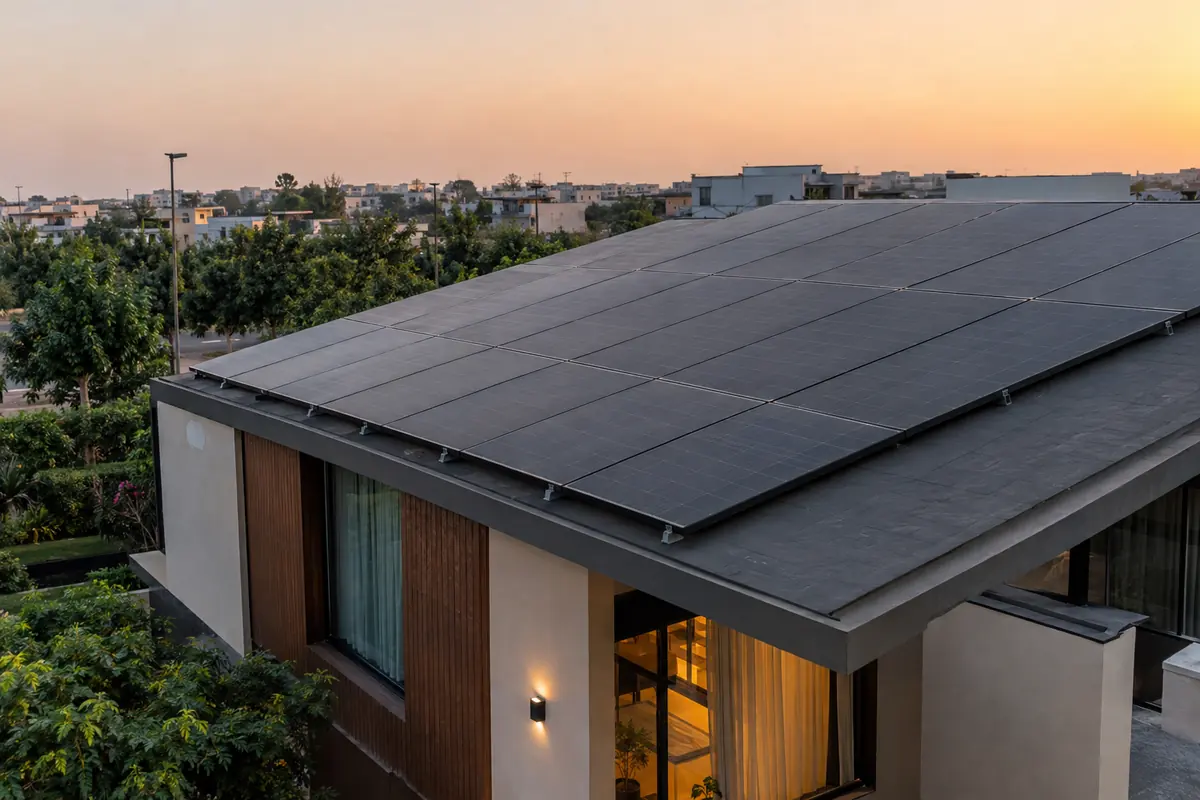
Aiko is a Chinese solar manufacturer that grew into one of the world’s largest solar cell makers before launching its own modules. Its big bet is All Back Contact (ABC) technology: every electrical contact on the cell is moved to the back, so the front of the panel has no silver busbar lines at all. That gives more glass area for sunlight and a clean, all-black look.
Aiko was added to BloombergNEF’s Tier 1 list of bankable module makers in 2024, which put it alongside the long-established Chinese majors such as Jinko, Longi and Trina.
| Fact | Aiko |
|---|---|
| Country | China |
| Background | Large solar cell maker, now selling its own modules |
| Core technology | ABC (All Back Contact), N-type |
| BloombergNEF Tier 1 | Yes, since 2024 |
| Module families | Neostar (homes), Stellar (the range now sold in Pakistan), Comet (older range, no longer sold here) |
| Position in Pakistan | Premium, highest price per watt on our sheet |
In Pakistan, Aiko is a newer name than Jinko or Longi. You will mostly find it with installers who sell high-end home systems and with buyers who have a small roof and want the most power from it.
Back contact is no longer a niche idea. Longi’s Hi-MO panels, which are among the most common in Pakistan, also use back-contact cells (Longi calls its version HPBC). Aiko and Longi are the two big makers betting on this design, while Jinko, Trina, JA, Astronergy and Canadian mostly sell TOPCon. For a buyer, that means back contact is a proven mass-production technology now, not an experiment.
Aiko solar panel models explained
Aiko splits its ABC panels into three families by use. Power ranges below come from Aiko’s own product listing and datasheets.
| Family | Aimed at | Example versions | Power range |
|---|---|---|---|
| Neostar | Homes | 54-cell and 60-cell, mono-glass and dual-glass | About 460 W to 555 W |
| Comet | Commercial and industrial roofs (older range, no longer sold in Pakistan) | 72-cell (Comet 2N and the newer 3N72) | About 605 W to 630 W (2N), 655 W to 690 W (3N72) |
| Stellar | Homes, commercial roofs and ground mounts; the range sold in Pakistan now | Stellar 1N and Stellar 1N+ | About 620 W to 635 W (1N), 645 W to 655 W (1N+) |
Our sheet tracks two Aiko panels:
| Size on our sheet | Live price | Price per watt |
|---|---|---|
| 620 W (Stellar 1N) | Rs 25,110 | Rs 40.5 |
| 650 W (Stellar 1N+) | Rs 27,950 | Rs 43 |
Aiko’s own site lists its Neostar home panels only up to about 555 W, with the 600 W plus panels sold here under the Stellar name; the older Comet 600 W panels are no longer sold in Pakistan. So when a dealer offers a “600 W Neostar”, read the full model code on the label before you pay.
Neostar for small home roofs
Neostar is Aiko’s home range, built in 54-cell and 60-cell sizes that are shorter and lighter than the 72-cell panels most Pakistani installers use. Aiko’s listing includes these versions:
| Neostar version | Glass | Power range |
|---|---|---|
| 3P54 | Mono-glass | 470 W to 500 W |
| 3P+54 | Dual-glass | 465 W to 495 W |
| 3P60 | Mono-glass | 530 W to 555 W |
| 3P+60 | Dual-glass | 530 W to 550 W |
These smaller panels are useful on oddly shaped roofs, mumty tops and narrow verandas where a 2.3 metre panel will not fit. They are less common in Pakistani stock than Stellar panels, so you may need to order them.
Comet 2N, the older 600 W class panel
The Comet 2N (AIKO-A-MAH72Mw) was the Aiko panel most often seen on Pakistani rooftops in the 600 W class. It is no longer sold new here, and the Stellar 1N 620 W has taken its place, but its datasheet is a useful guide to what ABC panels offer:
| Spec | Comet 2N datasheet |
|---|---|
| Power range | 605 W to 630 W |
| Maximum efficiency | 23.9% (630 W version) |
| Cells | 144 N-type ABC cells |
| Size | 2323 × 1134 × 33 mm |
| Weight | 27.7 kg |
| Temperature coefficient of Pmax | −0.26% per °C |
That 23.9% efficiency is higher than the roughly 22.5% to 23% you get from the mainstream TOPCon panels around it on our sheet. On the same roof area, that means a little more power. The −0.26% per °C temperature coefficient is also better than typical TOPCon (around −0.29% to −0.30%), so the Aiko panel loses slightly less output on a 45 °C June afternoon in Multan or Jacobabad.
Note the weight: at 27.7 kg, the Comet 2N is lighter than many dual-glass panels of the same size, which helps on older roofs and makes handling easier.
What ABC means in plain words
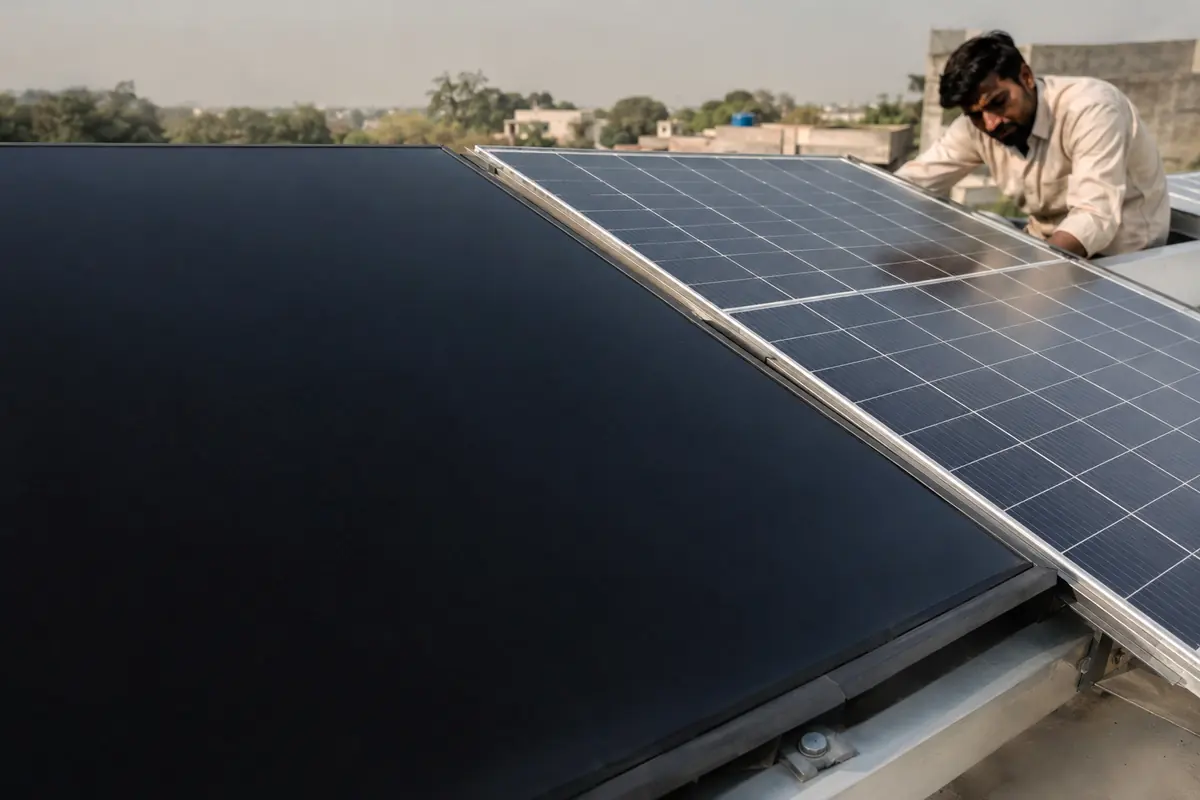
- No front busbars. On a normal panel, thin silver lines on the front block a small part of the light. ABC cells move all of that to the back.
- Better looks. Aiko panels look plain black from the street, which some home owners in DHA and Bahria Town prefer.
- Shading behaviour. Aiko says its ABC panels handle partial shading better than standard panels. In Pakistan that is useful where a water tank, parapet or neighbour’s wall throws a shadow across the array for part of the day.
Panel count for common systems
| System | At 620 W | At 650 W |
|---|---|---|
| 5 kW | 9 panels | 8 panels |
| 10 kW | 17 panels | 16 panels |
See every brand at these sizes on the 600 watt panel price page and the 650 watt panel price page.
Worked example: how much fits on a small roof
Say you have about 40 square metres of usable, unshaded roof after leaving space for the water tank and walkways. A rough rule is that panel area times efficiency gives kilowatts under standard test light, before you lose some space to gaps between panels and rows.
| Panel | Efficiency (datasheet) | Roughly what fits on 40 m² |
|---|---|---|
| Aiko Comet 2N 630 W | 23.9% | About 9.5 kW |
| Typical TOPCon 585 W | About 22.6% | About 9 kW |
Half a kilowatt does not sound like much, but on a roof that cannot fit one more row, it is the difference between covering your summer bill and not quite covering it. On a roof with spare space, you would get the same result more cheaply by adding one ordinary panel.
Aiko solar panel warranty in Pakistan
Aiko’s datasheets give one of the stronger warranty and degradation packages in the market. Using the Comet 2N as the example:

| Warranty item | Comet 2N datasheet |
|---|---|
| Product warranty | 15 years |
| Power warranty | 30 years |
| First-year degradation | Not more than 1% |
| Yearly degradation, years 2 to 30 | Not more than 0.35% |
| Guaranteed power at year 30 | 88.85% of nameplate |
The yearly figure is the one to look at. A typical TOPCon panel promises not more than 0.4% per year. Aiko promises not more than 0.35%. Over thirty years that small difference adds up, and on a net-metered home system it means slightly more units in the later years.
| Year | Aiko Comet 2N (0.35% a year) | Typical TOPCon (0.4% a year) |
|---|---|---|
| 1 | 99% | 99% |
| 10 | About 95.9% | About 95.4% |
| 20 | About 92.4% | About 91.4% |
| 30 | 88.85% | About 87.4% |
These are the guaranteed minimums from the warranty curves, not predictions. Real panels usually do better than the guarantee if they are kept clean and well ventilated.
In Pakistan the warranty is honoured through the importer or distributor that brought your Aiko stock in, not through a local Aiko office in every city. Before buying:
- Ask the dealer to name the importer or distributor.
- Ask who inspects a faulty panel and who pays for removal and transport.
- Get the full model code, quantity and every serial number on the invoice.
- Keep the datasheet for your exact model, since its degradation curve is what a power claim is tested against.
| You can claim for | You usually cannot claim for |
|---|---|
| Junction box failure, hot spots from manufacturing faults | Cracks from impact or being walked on |
| Delamination, bubbles or moisture inside the laminate | Storm damage from a weak structure |
| Power well below the warranty curve, proven by test | Burnt MC4 joints from poor installation |
Is Aiko worth it on a grid-connected home?
On a grid-tied or hybrid home system, every extra unit your roof makes either replaces a unit you would buy from your DISCO or reduces what you draw at night. The value of Aiko’s higher efficiency and slower ageing therefore depends on your electricity rate and on the export terms you get under the current NEPRA rules. Run the numbers both ways with our solar panel calculator: once with Aiko at its live price, and once with a cheaper TOPCon panel plus one or two extra plates. If both fit on your roof, the cheaper option usually wins. If only the Aiko layout fits, the premium is the price of the roof space you do not have.
How to check an original Aiko panel
Aiko panels are expensive, which makes them worth faking, but ABC cells are also hard to fake. A quick look at the front of the panel tells you a lot.
- Look at the front. A genuine Aiko ABC panel has no visible busbar lines across the cells. If you see the usual thin silver lines, it is not an Aiko ABC panel.
- Read the model code. Aiko model codes start with AIKO-A, for example AIKO-A615-MAH72Mw for a Comet 2N. A label without a full code is a warning sign.
- Check the size. A Comet 2N is about 2323 × 1134 mm. A “650 W Aiko” that is the size of a 550 W panel is not genuine.
- Weigh it if you can. The Comet 2N datasheet weight is 27.7 kg. A much heavier or much lighter panel of the same size is suspect.
- Match the serials on the rear label, under the front glass and on the box.
- Ask for the flash test list for your pallet from the importer, and find your serials on it.
| What you see | What it means |
|---|---|
| Silver busbar lines on the front | Not an ABC panel |
| “Aiko” sticker but no AIKO-A model code | Relabelled panel |
| Price close to ordinary TOPCon panels | Too good to be true for genuine ABC stock |
| Seller cannot name the importer | No traceable warranty |
Installing Aiko panels
ABC panels do not need a special inverter. They connect with standard MC4 connectors and work with the hybrid and on-grid inverters sold in Pakistan, as long as the string voltage and current fit the inverter’s limits. Two points matter more than usual:
- Do not mix Aiko panels with other brands on the same MPPT input; you lose the efficiency you paid for.
- Use the clamping zones in Aiko’s installation manual. The lighter Comet 2N frame is strong, but clamping in the wrong place can void the warranty.
Aiko vs other Tier 1 brands
The fair comparison for Aiko is at 600 to 650 W, where our sheet has rival panels from Longi and Trina.
| Panel | Live price | Price per watt | Cell technology |
|---|---|---|---|
| Aiko Stellar 1N 620 W | Rs 25,110 | Rs 40.5 | N-type ABC back contact |
| Longi 600 W | Rs 26,400 | Rs 44 | N-type HPBC back contact |
| Aiko Stellar 1N+ 650 W | Rs 27,950 | Rs 43 | N-type ABC back contact |
| Trina Vertex N 620 W | Rs 25,110 | Rs 40.5 | N-type TOPCon |
| Market average | Rs 41.3 | All tracked panels |
Aiko is usually the most expensive per watt in this group. What do you get for that?
| Factor | Aiko ABC | Longi HPBC | Mainstream TOPCon |
|---|---|---|---|
| Front busbars | None | None | Yes |
| Typical efficiency | Highest on our sheet | High | Good |
| Temperature coefficient | About −0.26% per °C (Comet 2N) | Check model datasheet | About −0.29% to −0.30% per °C |
| Yearly degradation promise | 0.35% (Comet 2N) | Check model datasheet | Often 0.4% |
| Price per watt | Highest | High | Lowest |
| Ease of finding in Pakistan | Limited | Very easy | Very easy |
Longi is Aiko’s closest rival, because Longi’s Hi-MO panels also use back-contact cells. The Longi price page covers that range. For most home owners with a big, unshaded roof, a mainstream N-type TOPCon panel gives more units per rupee. Aiko makes the most sense when roof space is the real limit. See the full ranking in our best solar panels in Pakistan guide.
When the Aiko premium pays off
- A small roof where you cannot fit enough ordinary panels to cover your bill.
- A roof with partial shade from tanks, walls or trees for part of the day.
- Very hot cities, where a better temperature coefficient adds up over the summer.
- A house where looks matter and an all-black array is part of the design.
When it does not: a big open roof or a ground-mounted tubewell array, where you can simply add one more cheaper panel to get the same output.
Aiko vs Longi: choosing a back-contact panel
If you have already decided you want back contact, the choice is mostly between Aiko and Longi. Longi wins on availability: its panels are in almost every solar market in Pakistan, from big-city markets to small-town dealers, and used Longi panels are easy to resell. Aiko usually wins on datasheet efficiency and on the yearly degradation promise of the Comet 2N. On price, compare the Aiko 620 W and Longi 600 W rows in the table above on the day you buy, because both brands move with each shipment. A practical rule: if your installer can get genuine Aiko stock through a named importer, it is the stronger panel on paper. If they cannot, a genuine Longi beats a doubtful Aiko every time.
What moves the Aiko solar panel price
- Family and size. Stellar 1N and Stellar 1N+ panels are the mass sellers; Neostar home panels are rarer here and can cost more per watt.
- Mono-glass or dual-glass. Dual-glass versions usually cost a little more.
- Supply. Fewer importers bring Aiko in, so a gap between shipments can push prices up quickly.
- Rupee and taxes. As with every imported panel, exchange rate moves and budget changes reach the shop price.
Aiko solar panels: pros and cons
| Pros | Cons |
|---|---|
| Highest efficiency panels we track, no front busbars | Highest price per watt on our sheet |
| Better temperature coefficient than most TOPCon | Limited stock outside big cities |
| Strong degradation promise, 0.35% a year on Comet 2N | Newer brand in Pakistan, less local track record |
| 15-year product warranty on Comet 2N | Model names on dealer quotes are sometimes confused |
| All-black look, lighter Comet 2N panel | Resale market for used Aiko panels is small |
| Tier 1 listed since 2024 | Warranty runs through importers only |
Our view: Aiko is the right panel for a specific buyer, not for everyone. If your roof is small, shaded or very hot, Aiko earns its premium. If you have space, put the money into an extra panel or a better inverter instead.
Who should buy Aiko
- Home owners with a small or awkward roof who need the most kilowatts from limited space.
- Houses with partial shading from tanks, walls or trees at some hours of the day.
- Buyers in the hottest districts who want the lowest heat losses.
- Anyone planning to keep the system for 25 years or more, who values the lower degradation promise.
Who should skip it: buyers with plenty of open roof, ground-mount farmers and anyone on a tight budget, where a Tier 1 TOPCon panel gives more units per rupee.
Where to buy Aiko solar panels
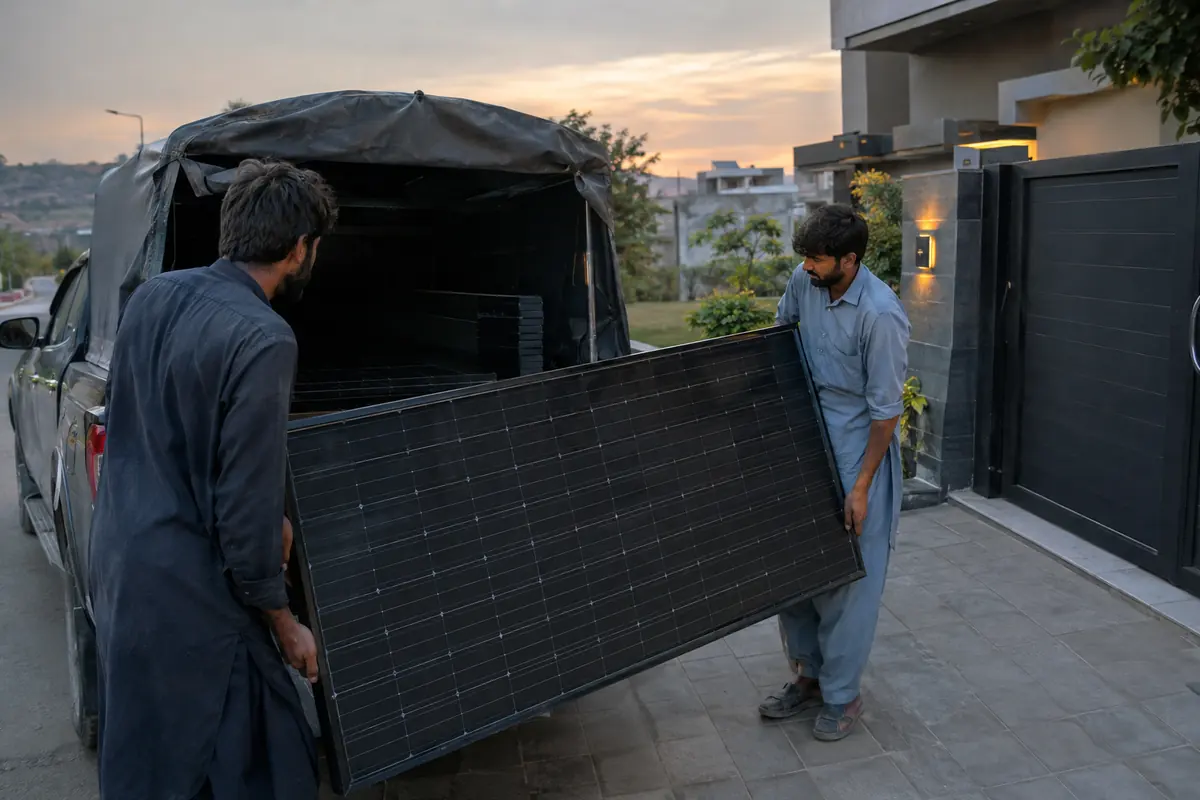
Aiko panels are sold through a smaller number of importers and premium installers than the mass-market brands, mostly in Lahore, Karachi and Islamabad. We do not name dealers because authorisations change. Instead:
- Ask installers who do high-end residential work whether they supply Aiko and through which importer.
- Get a written quote with the full AIKO-A model code, family name (for example Stellar 1N or Stellar 1N+), wattage and quantity.
- Compare the quote with the live 620 W and 650 W prices on this page.
- Check the front of every panel for busbars and match the serials on delivery.
- Keep the datasheet and invoice for warranty claims.
| Buying route | Good for | Watch out for |
|---|---|---|
| Premium installer, supply and fit | Correct design for shading and heat | Ask for the importer invoice |
| Importer or distributor direct | Best price on larger quantities | Delivery and breakage terms |
| Online listing | Price check | Hard to verify ABC stock remotely |
Compare Aiko with every brand we track on the solar panel brands in Pakistan page, or check today’s full price table on the home page.
Questions to ask before you pay for Aiko
- Which family is this, Neostar, Comet or Stellar, and what is the full AIKO-A model code?
- Is it mono-glass or dual-glass?
- Which importer supplied it, and will they handle a claim directly?
- Can I see the flash test results for my serials?
- Is the quoted price per panel or per watt, and does it include delivery to the roof?
Frequently asked questions
What is the Aiko solar panel price in Pakistan?
The cheapest Aiko panel on our sheet is Rs 25,110, checked on 2 Nov 2026. Aiko is a premium brand, so expect a higher price per watt than Jinko, Longi or Astronergy for panels of the same size.
Why are Aiko solar panels more expensive?
Aiko makes only All Back Contact (ABC) panels, which move all the wiring to the back of each cell. That gives higher efficiency, a better temperature coefficient and a slower yearly degradation promise than mainstream TOPCon panels, and Aiko prices that as a premium.
Is Aiko a Tier 1 solar panel brand?
Yes. Aiko was added to BloombergNEF's Tier 1 list of bankable module manufacturers in 2024, joining the large Chinese makers such as Jinko, Longi and Trina.
Is Aiko better than Longi?
Both make back-contact panels. Aiko's Comet 2N datasheet shows higher efficiency and a lower yearly degradation promise, while Longi is far easier to find and resell in Pakistan, so availability and trusted stock often decide.
Which Aiko panel is sold in Pakistan?
You will mostly see Stellar panels: the Stellar 1N at about 620 to 635 W and the Stellar 1N+ at about 645 to 655 W. The older Comet 600 W panels are no longer sold here. Aiko's Neostar home panels are smaller, about 460 to 555 W, and are less common here.
What warranty does Aiko give?
The Comet 2N datasheet gives a 15-year product warranty and a 30-year power warranty, with not more than 1% loss in the first year and 0.35% a year after that. Claims in Pakistan go through the importer named on your invoice.
How can I tell if an Aiko panel is genuine?
A genuine Aiko ABC panel has no silver busbar lines on the front, a full model code starting with AIKO-A, and serials that match on the label, under the glass and on the box. If you can see busbars, it is not an Aiko ABC panel.
Is an Aiko panel worth it for a small roof?
Usually yes. When roof space is the limit, Aiko's higher efficiency lets you fit more kilowatts in the same area. On a large open roof, a cheaper TOPCon panel plus one extra plate normally gives more units per rupee.