On this page
Before you look at the flexible solar panel price in Pakistan, decide whether you actually need a panel that bends. Flexible and foldable panels are lighter and easier to carry than normal glass plates, but they cost more per watt, run hotter and usually last fewer years. This guide explains the different types, where they make sense and how to buy one without regret.
Quick answer on the flexible solar panel price in Pakistan
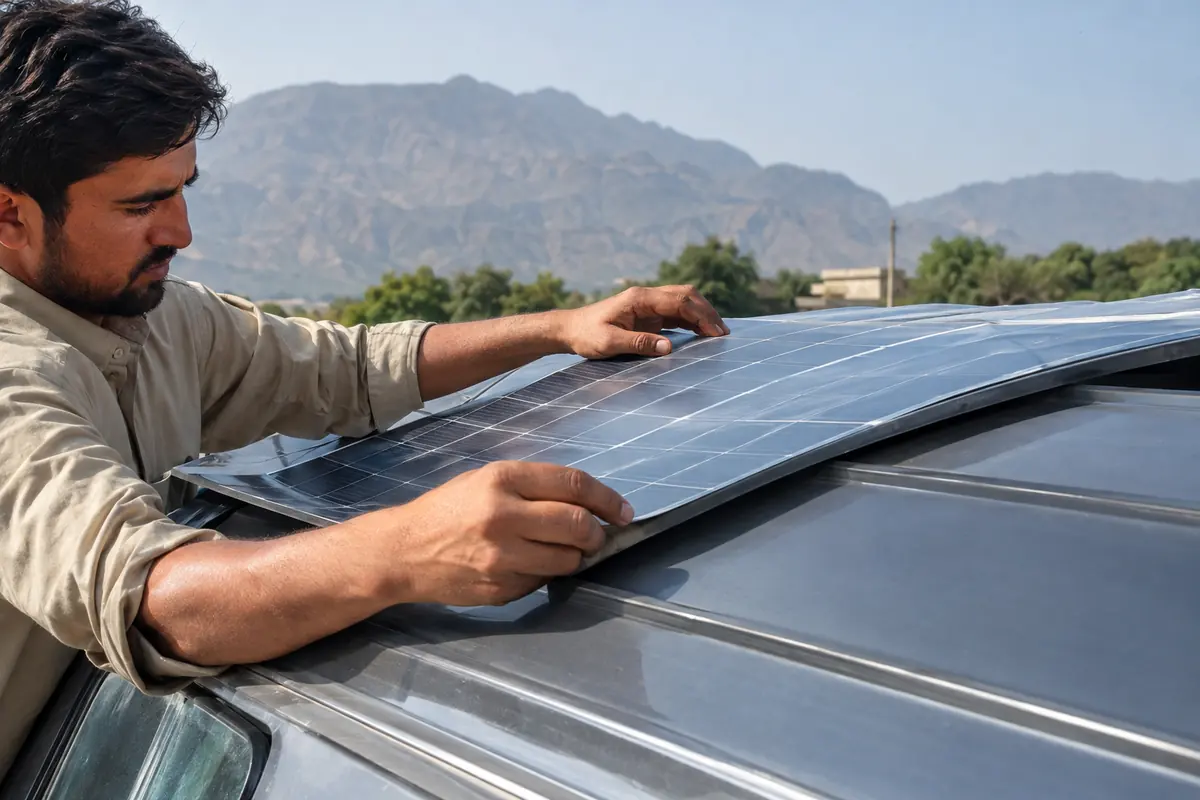
Flexible solar panels are thin (about 2–3 mm), light panels with no glass and no aluminium frame. Most use the same monocrystalline cells as rigid panels, laminated between plastic layers. Foldable solar panels are a related product: several small cells sewn into a fabric case that folds like a book, usually with a USB port or a 12V output.
On price, flexible and foldable panels nearly always cost more per watt than a normal framed plate of the same size. For comparison, a rigid A-grade 180 W panel (Inverex mono PERC) currently costs Rs 10,000 (about Rs 55.6 per watt), and large rooftop panels average Rs 41.3 per watt. Expect a flexible panel to sit well above both, with foldable kits higher again because of the case, the electronics and the brand.
- Buy flexible if: weight matters, the surface is curved, or you need to carry the panel.
- Buy rigid if: it is going on a roof or a frame and will stay there for years.
The foldable solar panel price in Pakistan also depends heavily on what comes in the box. A bare folding panel with a USB port is one product; a folding panel bundled with a portable power station, cables and adapters is a very different one. When you compare listings, compare the panel’s own watt rating and outputs, then add the value of the extras separately. Otherwise a cheap-looking bundle can hide a small, weak panel, and an expensive one can look worse value than it is.
How we checked this
Flexible panels are mostly sold online in Pakistan, often under many different shop names, so prices and quality vary hugely. We did not try to list shop prices, which change too often. Instead we compared published datasheets and product sheets from established flexible panel makers, and set them against a standard rigid panel datasheet.
| What we compared | Why it matters |
|---|---|
| Weight and thickness | The main reason anyone buys a flexible panel |
| Surface material (ETFE or PET) | Decides how well the panel survives strong sun and heat |
| Cell type (mono, back-contact, thin-film) | Sets efficiency and how much it can bend |
| Bend limit in the datasheet | Bending past it cracks cells |
| Product and power warranty | A good guide to how long the maker expects it to last |
| Operating temperature range | Important on hot Pakistani roofs and vehicle tops |
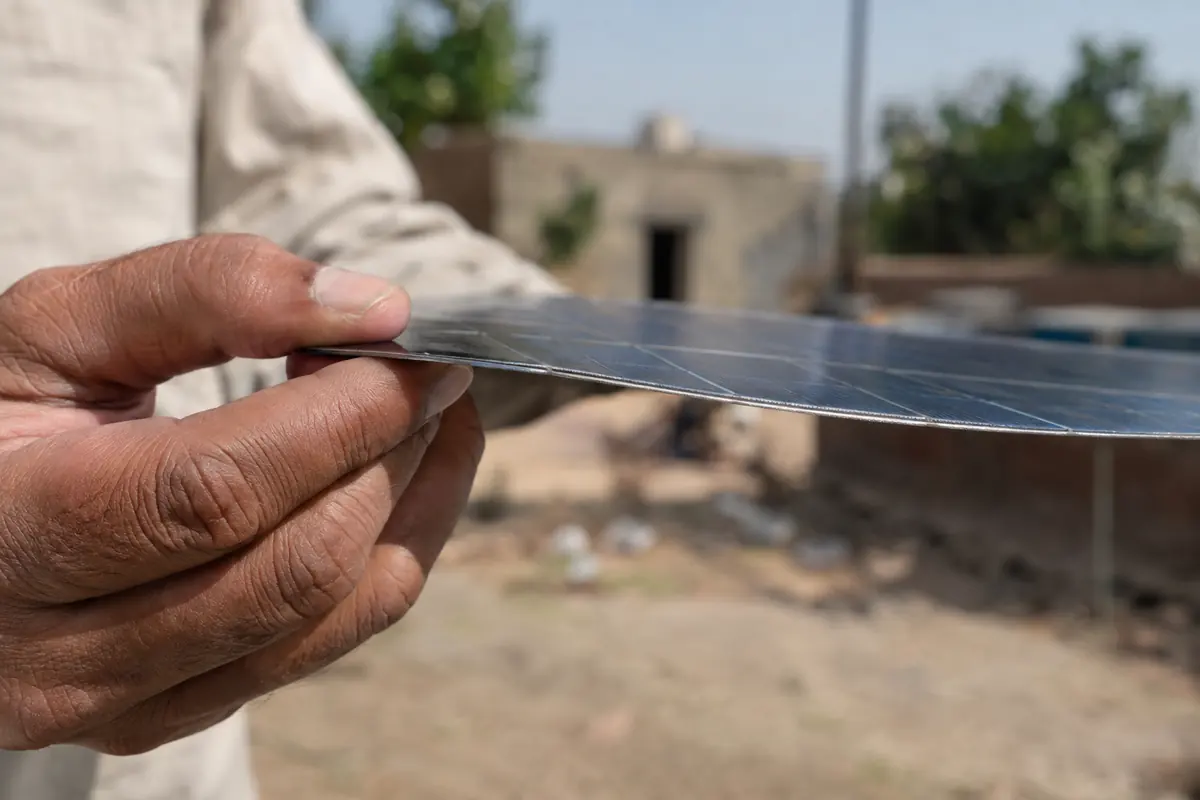
As a reference, one 100 W semi-flexible panel from a known maker weighs about 2.2 kg and is 2.2 mm thick, while a comparable rigid 100 W framed panel weighs about 6.5 kg and is 35 mm deep. That weight difference is the whole story of why flexible panels exist.
Flexible, portable and foldable solar panels explained
The four types you will see
| Type | How it is built | Typical efficiency | Bend | Best use |
|---|---|---|---|---|
| Semi-flexible, ETFE surface | Mono or back-contact cells between a tough ETFE top film and a polymer back | Around 19–22% for good mono cells | Gentle curve only | Vans, boats, curved roofs, carts |
| Semi-flexible, PET surface | Same cells, cheaper PET plastic top layer | Similar at first | Gentle curve only | Short-term or budget use |
| Thin-film flexible (CIGS or amorphous) | Very thin film on a flexible sheet | Lower, often well below mono | Can curve more | Tents, specialist uses |
| Foldable / portable kit | Small panels sewn into a fabric case with handles and outputs | Depends on cells inside | Folds at seams, panels stay flat | Camping, travel, field work, emergency phone charging |
The words get mixed up in shops. “Flexible solar panels” usually means the semi-flexible laminated type. “Portable solar panels” and “folding solar panels” usually mean the fabric kits, sometimes sold with a portable power station.
Newer cells in flexible panels
Flexible panels have improved. Many now use back-contact cells, where all the metal contacts sit on the back of the cell instead of as silver lines on the front. That leaves the whole front face open to light, which lifts efficiency and gives the panel a plain, all-black look. Back-contact cells are also said to cope a little better with partial shading. These panels cost more, but on a small vehicle roof where every square centimetre counts, the extra output per area can be worth it.
ETFE or PET: the detail that decides lifespan
The top layer is what takes the sun, dust and heat, so it matters more on a flexible panel than anything else.
- ETFE is a tough fluoropolymer film. It resists UV light well, sheds dust and holds up to heat. Makers that use it generally claim around 10–15 years of service.
- PET is a cheaper plastic. It can yellow, crack or peel after a few summers of strong sun. Some makers estimate around 5 years of useful life for PET-faced panels.
In Pakistan, where roof and vehicle-top temperatures can go far above 60 °C in summer, ETFE is worth the extra cost. A PET panel that looks fine in the shop can be cloudy within two or three summers.
How much can they really bend?
“Flexible” does not mean you can roll it up. The silicon cells inside are still crystal and can crack. Datasheets give a bend limit, often described as a maximum arc or radius. Treat it as an installation limit: you curve the panel once to fit a surface and leave it there. Bending it back and forth, folding it, or standing on it creates micro-cracks that you cannot see but that cut the output.
Why flexible panels run hot and age faster
A rigid panel sits on a frame with air moving behind it. A flexible panel is usually glued or screwed flat onto a roof or vehicle, so the heat has nowhere to go. Hot cells produce less power: a typical mono panel loses roughly 0.3–0.4% of its output for each degree above 25 °C. Heat also speeds up the ageing of the plastics and adhesives. That is why flexible panels usually carry shorter warranties than glass panels; one well-known semi-flexible panel comes with a 5-year product warranty and a 15-year performance warranty, against the 12-year product and 25–30 year power warranties typical of big rigid panels. Our solar panel lifespan guide explains how rigid panels age by comparison.
A hot-day example
Here is what heat does in numbers. Take two 100 W mono panels on a June afternoon in Multan with the air at 42 °C.
| Panel | Likely cell temperature | Loss vs label (at about −0.35% per °C) | Output in full sun |
|---|---|---|---|
| Rigid panel on a raised frame | About 60–65 °C | Roughly 12–14% | Roughly 86–88 W |
| Flexible panel glued flat on a metal roof | About 70–80 °C or more | Roughly 16–19% | Roughly 81–84 W |
These are estimates, not test results, but the pattern is real. The flexible panel loses several more watts every hot afternoon, and the extra heat also ages its plastic layers faster. A small spacer or a raised rail that lets air pass behind the panel narrows the gap.
Where flexible panels make sense in Pakistan
- Loader rickshaws, vans and food trucks: a curved roof, a weight limit and vibration all favour a light panel.
- Boats and fishing launches: no heavy frame and less wind load on deck.
- Tin sheds and light structures: where a steel frame and glass panels would be too heavy for the roof sheets.
- Camping, hiking and survey teams: foldable kits charge phones, lights and power banks in the field.
- Caravans and campers: fixed on a curved roof with a small 12V battery inside.
- Emergency kits: a folding panel with a small battery for floods and long outages.
For a normal house roof, flexible panels are a poor deal. Rigid panels on a frame cost less per watt, last longer and are easier to clean. If you are planning a home system, start with the solar panel calculator and the live prices on the home page.
Sizing a flexible panel for a vehicle or boat
Size a flexible panel the same way as any off-grid panel: from watt-hours.
- List the loads. For example, a food truck with two LED tubes (2 × 18 W) for four hours and a 30 W DC fan for four hours needs about 264 Wh a night.
- Add about 25% for losses: roughly 330 Wh.
- Divide by usable sun hours. A flexible panel on a vehicle roof is often parked in partial shade, so plan on 4 hours rather than 5 or 6: about 82 W.
- Allow for heat loss on a flat-mounted panel (another 15% or so) and you land at a 100 W flexible panel, ideally a little more.
- Pick a battery that stores at least one night’s need with margin: a 12V battery of around 50 Ah for lead-acid, or smaller for lithium.
This is also where the price comparison becomes fair. If the truck roof could take a small rigid frame, a rigid 180 W plate at Rs 10,000 might be the cheaper way to get the same energy. Our small solar panel price guide compares small rigid sizes in more detail.
Foldable panels and portable power stations
Many foldable solar panel kits are sold to pair with a portable power station: a box with a lithium battery, an inverter and USB ports. The pairing works well for camping, short outages and field work, as long as you check three things.
| Check | What to look for |
|---|---|
| Voltage window | The panel’s Voc must sit inside the power station’s solar input range |
| Input connector | Many power stations use a specific DC plug; you may need an adapter cable |
| Input watt limit | A power station that accepts only 100 W will not charge faster from a 200 W panel |
A foldable panel is a convenience item. It is good at what it does, but it is not a cheaper route to home solar.
Wiring a flexible panel
Most semi-flexible panels are 12V class, with a Vmp around 18 V, and come with short MC4 leads. Some larger ones are 24V class, with a Vmp around 34 V. Treat them exactly like a rigid panel of the same voltage: through a charge controller to a battery, never straight to the battery. Our 12 volt solar panel guide explains how to match the panel, controller and battery.
Foldable kits often have a USB output (for phones) and a DC output (for a power station or a controller). The USB port is only good for small devices; do not expect it to charge a battery bank quickly.
Comparison table: flexible against rigid panels
| Point | Flexible (ETFE, mono) | Foldable fabric kit | Rigid framed panel |
|---|---|---|---|
| Weight per 100 W | About 2 kg | About 2–4 kg with case | About 6–7 kg |
| Thickness | 2–3 mm | Thin panels in a padded case | About 30–35 mm with frame |
| Mounting | Glue, screws or tape on the surface | Prop up or hang | Bolted to a frame |
| Heat handling | Poor when stuck flat | Fair, air reaches the back | Good, air behind the panel |
| Typical warranty | Short product warranty, about 10–15 year power warranty at best | Usually 1–2 years | About 12 year product, 25–30 year power for big brands |
| Service life | Around 10–15 years if ETFE and well installed | Several years with careful use | 25 years and more |
| Price per watt | Higher than rigid | Highest | Lowest; live 180 W rate Rs 55.6 |
The table makes the trade-off plain. You pay more and get fewer years in return for weight, shape and portability. If you do not need those three things, a rigid panel is the better buy. The full solar panel price list shows rigid panel prices across every size.
Buying checklist for flexible and foldable panels
- Be clear why you need flexible. Write down the weight limit, the surface shape or the need to carry it. If none applies, buy rigid.
- Ask for the surface material. Choose ETFE over PET for any panel that will live outside in Pakistani summers.
- Check the cell type. Mono or back-contact cells give the best output per area. Thin-film is fine for specialist uses but needs more space.
- Read the label. Pmax, Vmp, Imp, Voc and Isc should be printed on the back. Multiply Vmp by Imp; it should come close to the rated watts.
- Check the bend limit and warranty. Get both in writing or as a datasheet. A seller with no datasheet is a seller with no warranty.
- For foldable kits, check the outputs. USB-A, USB-C, DC barrel or MC4. Make sure at least one suits your battery or power station.
- Test it in the sun. Measure Voc with a multimeter before you accept delivery, especially from online sellers.
- Plan the mounting. For vehicles and boats, use a proper adhesive or mounting kit, leave a small air gap where possible, and keep the cable entry sealed.
- Buy a controller. Like every panel, a flexible panel needs a charge controller between it and the battery.
- Keep the invoice and photos. Short warranties are only useful if you can prove the date of purchase.
Questions to ask the seller
- Is the top layer ETFE or PET?
- What is the maximum bend radius or angle?
- What are the product warranty and the power warranty, in years?
- Is it 12V class or 24V class, and what is the Vmp?
- Can I see a sun test before paying, or return it if it under-performs?
Mounting rules for vehicles and boats
- Clean and degrease the surface before using adhesive; most failures start with dust under the glue line.
- Use a sealant or adhesive meant for outdoor solar or marine use, not ordinary silicone or double-sided tape alone.
- Keep the leading edge (the edge facing forward on a vehicle) fully bonded or clamped so wind cannot lift it at speed.
- Run the cable through a proper cable gland so rainwater cannot follow it inside.
- Fit an inline fuse near the battery and keep the controller in a shaded, ventilated spot.
- Check the edges and the cable entry after the first month, then every few months.
Common mistakes to avoid
| Mistake | What goes wrong | Fix |
|---|---|---|
| Fitting a flexible panel on a house roof to “save on the frame” | Higher cost per watt, hotter running, shorter life | Use rigid panels and a proper stand on homes |
| Gluing it flat on a hot metal roof with no gap | Overheating, lower output, faster ageing | Leave an air gap or use a raised mount where possible |
| Walking or kneeling on it | Invisible cell cracks and hot spots | Treat it like glass; never step on it |
| Folding or rolling a semi-flexible panel | Cracked cells and broken connections | Curve it once to fit, then leave it |
| Buying a PET panel for permanent outdoor use | Yellowing and peeling within a few summers | Pay extra for ETFE |
| Drilling holes through the panel to mount it | Water gets into the laminate | Use only the factory mounting holes or edge clamps |
| Expecting a foldable kit to run a fan or fridge | Small output, long charging times | Size it from watt-hours; use rigid panels for real loads |
Used and “refurbished” flexible panels
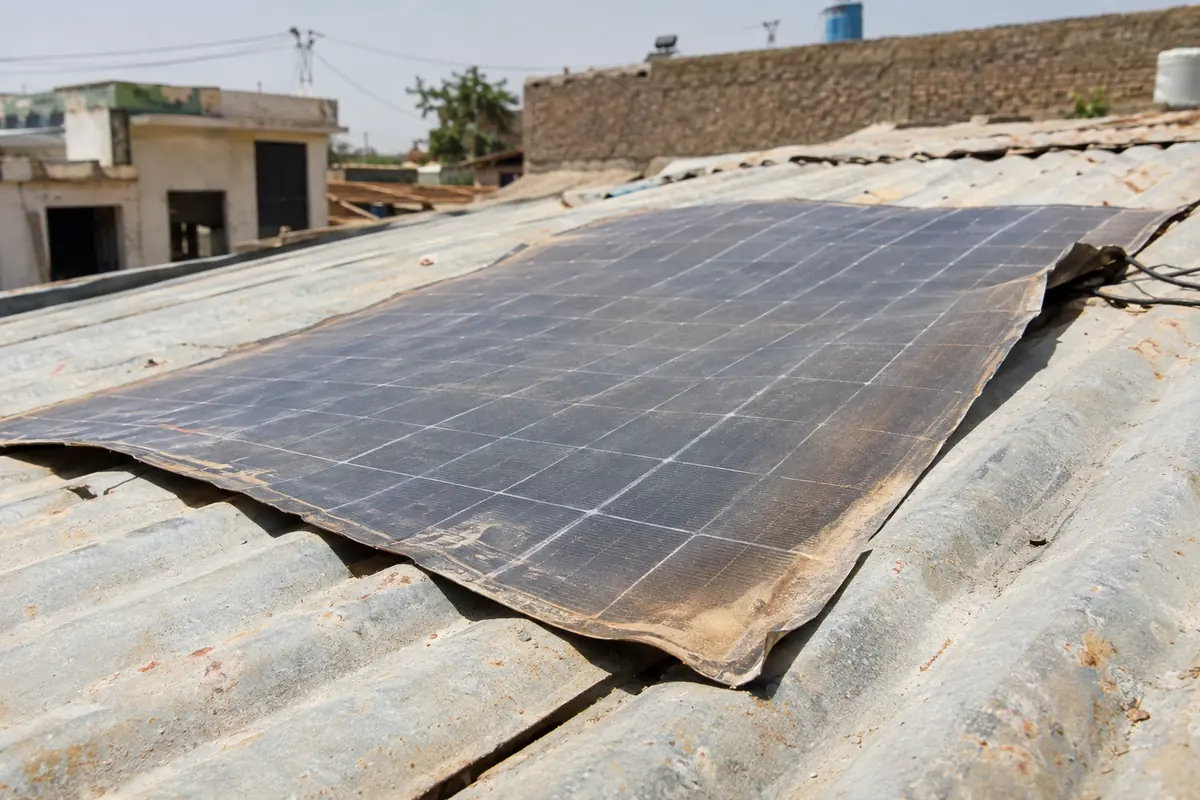
Flexible panels show damage less clearly than glass ones. A used panel can look clean while hiding cracked cells, a lifted top film or a corroded junction. If you are offered a second-hand or “refurbished” flexible panel, insist on a sun test with a multimeter, look along the surface for bubbles and cloudy patches, and pay much less than for new. The same checks apply to used framed panels, but cracks are easier to spot through glass.
Cleaning flexible panels
Flexible panels scratch more easily than glass. Clean them with plain water and a soft cloth or sponge, never with a hard brush, sand-filled water or strong detergent. Our solar panel cleaning guide covers safe methods in more detail, and if you are comparing panels for a bigger setup, the list of the best solar panels in Pakistan is a good place to start.
Frequently asked questions
What is the flexible solar panel price in Pakistan?
Flexible panels usually cost more per watt than normal framed panels of the same size, because of the special films, adhesives and lower production volumes. Compare any quote against the live rigid panel prices on this page by working out the price per watt before you decide.
Are flexible solar panels good for a house roof?
Usually not. On a house roof a rigid panel on a proper frame costs less per watt, runs cooler, lasts longer and is easier to clean. Flexible panels make sense where weight or a curved surface rules out a rigid panel.
How long do flexible solar panels last?
A well-made ETFE-faced flexible panel installed with some airflow can be expected to last around 10-15 years, while cheaper PET-faced panels may degrade within about 5 years. Rigid glass panels from major brands usually carry 25-30 year power warranties.
What is the difference between flexible and foldable solar panels?
A flexible panel is one thin laminated sheet that can be curved once to fit a surface. A foldable solar panel is a set of small panels sewn into a fabric case that folds for carrying, usually with USB or DC outputs.
Can I walk on a flexible solar panel?
No. Even though it bends, the silicon cells inside can crack under a person's weight, and the damage is often invisible until output drops. Treat a flexible panel like a glass panel.
Do flexible solar panels work on a rickshaw or van roof?
Yes, that is one of their best uses, since they are light and follow a curved roof. Bond them properly with an outdoor-rated adhesive, seal the cable entry and use a charge controller with a battery.
Which is better, ETFE or PET flexible panels?
ETFE is better for permanent outdoor use in Pakistan because it resists UV, heat and dust much better. PET panels are cheaper but can yellow, crack or peel after a few hot summers.
Can a foldable solar panel charge a portable power station?
Yes, if the panel's open-circuit voltage falls inside the power station's solar input range and the connector matches. Charging speed is limited by both the panel's output and the power station's input watt limit.