On this page
Solar panel installation cost in Pakistan is the part of a solar quote that people check least and argue about most. It covers the fitting labour, the mounting structure, cables, breakers, earthing and, for grid-tied homes, the net billing paperwork. This guide breaks those costs down per kW and by system size as of October 2026, explains what a proper solar panel installation includes, and shows how to judge an installer before you hand over the roof.
Quick answer
For a typical home system, installation and fitting (labour, structure, wiring and protection, but not panels or inverter) usually costs about Rs 12,000 to Rs 21,000 per kW as of October 2026. On a 5kW system that is roughly Rs 63,000 to Rs 1 lakh. Grid paperwork and the bidirectional meter add about Rs 20,000 to Rs 40,000 if you want net billing.
| System | Labour | Structure | Cable and protection | Net billing file and meter |
|---|---|---|---|---|
| 3kW | Rs 15,000 to 25,000 | Rs 15,000 to 20,000 | Rs 10,000 to 15,000 | Rs 15,000 to 25,000 |
| 5kW | Rs 20,000 to 35,000 | Rs 25,000 to 40,000 | Rs 18,000 to 28,000 | Rs 20,000 to 40,000 |
| 10kW | Rs 40,000 to 60,000 | Rs 50,000 to 75,000 | Rs 35,000 to 50,000 | Rs 30,000 to 50,000 |
These figures assume a normal single or double-storey house in a big city, a standard galvanised frame and a short cable run. They do not include the panels, the inverter or batteries, which together make up most of a system’s cost.
Panels are priced separately and change daily. See the solar panel price list for today’s rates, or use the solar panel calculator to work out your system size first.
How we checked this
Installation prices are not published in one place, so we built the ranges from several sources and kept only what they agreed on.
- We compared installation cost breakdowns published by Pakistani solar installers and price sites between June and October 2026, for 3kW, 5kW and 10kW systems.
- We converted each to a per-kW figure to see where they overlapped, and used the overlapping band.
- We checked rules that affect cost against official decisions reported in national newspapers: NEPRA’s 2026 net billing regulations, and the April 2026 decision that systems of 25 kW or less no longer need a NEPRA licence or the Rs 1,000 per kW fee.
- We did not include panels, inverters or batteries in the installation figures. Those are covered on their own pages because they move faster.
| Cost item | Source basis | How fast it changes |
|---|---|---|
| Labour per kW | Installer breakdowns, 2026 | Slowly; city and season matter |
| Structure | Installer breakdowns, steel rates | With steel prices |
| Cable and protection | Installer breakdowns, copper rates | With copper prices |
| Net billing costs | DISCO process, installer fees | When rules change |
What we did not price: elevated structures (they vary too much with height and design), roof repair or waterproofing, long cable runs to a basement or far DB, and civil work. Ask for these as separate lines in any quote.
What solar panel installation includes and costs
The work, step by step
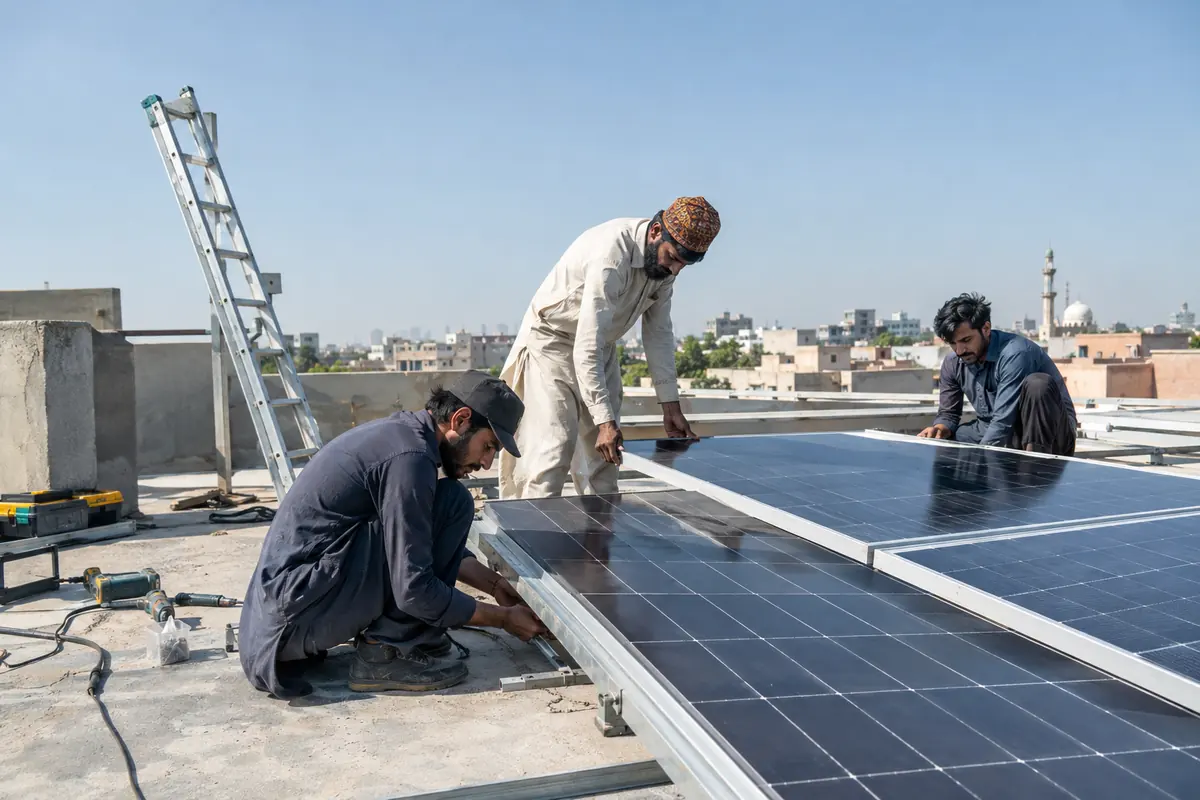
A proper solar panel installation in Pakistan follows the same order whatever the size. Knowing the steps helps you see what you are paying for.
- Site survey. The installer checks roof space, shade at different times of day, roof condition, where the inverter will sit and how far the cable has to run to your DB.
- Design. Panel layout, tilt and direction, string plan (how many panels in series), inverter choice, cable sizes and breaker ratings.
- Structure. The steel frame is assembled and bolted to the roof slab, then sealed at every bolt to stop leaks.
- Panel mounting. Panels are clamped to the rails, facing south at the planned tilt.
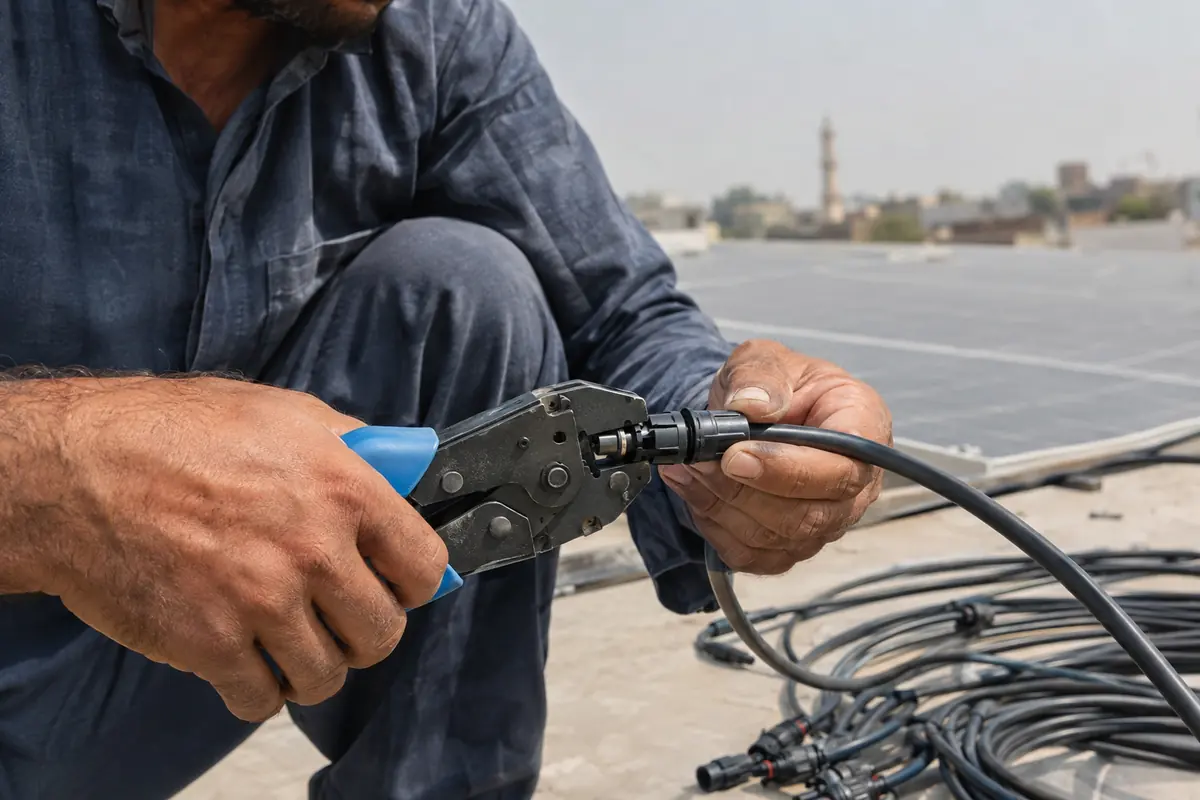
- DC wiring. Panels are connected with solar cable and MC4 connectors, routed through conduit to a DC breaker or isolator and DC surge protector.
- Inverter and AC side. The inverter is mounted in a shaded, ventilated spot and connected to the house DB through an AC breaker and AC surge protector.
- Earthing. The frame, panels and inverter are earthed through a dedicated earthing rod, not the house water pipe.
- Commissioning. The installer tests voltages, switches on, sets up the inverter app and shows you how to read it.
- Grid paperwork. For net billing, the file goes to your DISCO and the bidirectional meter is installed after approval.
On a typical 5kW home job, steps 3 to 8 usually take one to two working days. The DISCO stage can take weeks and depends on your distribution company, not the installer.
Labour
Labour for solar panel fitting is usually quoted per kW or as a lump sum. Across 2026 breakdowns it sits around Rs 4,000 to Rs 8,000 per kW, with the higher end on small jobs, where minimum charges apply, and on tall or awkward roofs. Some installers quote per panel; divide by the panel wattage to compare it per kW.
Timing also matters. Demand for solar panel installation services tends to rise in spring, when the first hot weeks push families to install before the AC season, and good crews get booked up. Booking in autumn or winter usually means faster scheduling and more time for the crew to do a careful job, and the system is ready before summer.
| What raises labour cost | Why |
|---|---|
| Roof above the second floor | Lifting panels takes more people and time |
| Long cable route | More conduit, more drilling, more hours |
| Elevated structure | More fabrication and welding on site |
| Small system | Fixed travel and setup time spread over fewer kW |
| Upgrading an old system | Removing and re-fixing panels, rewiring |
Structure
The mounting structure is often the item where quotes differ most. A standard galvanised frame for a 5kW home system is around Rs 25,000 to Rs 40,000. What to look for:
- Galvanised or properly painted steel, not bare mild steel that rusts in two monsoons
- Steel gauge stated in the quote
- Rails and clamps sized for the panel you are buying, since 585 W and 620 W panels are long and heavy
- Bolts anchored into the slab, with every hole sealed
- Tilt close to your city’s latitude; the tilt angle calculator gives the angle
For frame types and prices, see the solar panel stand price guide.
Cable, protection and earthing
This bundle is small in cost and large in importance. On a 5kW system it typically runs Rs 18,000 to Rs 28,000 and should include:
| Item | What it does | What to check |
|---|---|---|
| DC solar cable (4 to 6 mm²) | Carries panel power to the inverter | Proper solar cable, not house wire |
| MC4 connectors | Join panels and cables | Branded, crimped with the right tool |
| DC breaker or isolator | Cuts panel power for safety | Rated for DC voltage |
| DC and AC surge protection | Protects the inverter from lightning and grid spikes | Installed on both sides |
| AC breaker | Connects the inverter to the DB safely | Correct rating for inverter output |
| Earthing rod and cable | Safely carries fault and lightning current | A separate rod, tested |
Net billing paperwork and meter
If you want to export surplus units, your DISCO has to approve the system and fit a bidirectional meter. Installers usually handle the file for a fee. Expect about Rs 20,000 to Rs 40,000 for a 5kW home, including the meter, as of October 2026. Since April 2026, systems of 25 kW or less do not pay the Rs 1,000 per kW NEPRA fee and do not need a licence, which reduced the cost for homes.
Two things to know before paying for it:
- Under NEPRA’s 2026 rules, new solar users are on net billing, and exported units are paid much less than imported units cost. The value of exporting is lower than it was for older net-metering users.
- Your sanctioned load must support the system size. If it does not, apply for a load extension first.
Solar panel installation in Karachi
Karachi jobs have three differences from Punjab:
- Utility. Net billing applications go to K-Electric, not a WAPDA DISCO, so the process and timing follow KE’s system.
- Salt air. Near the coast, galvanised or aluminium frames and stainless steel bolts last much longer. Expect the structure to cost a little more.
- Wind and tilt. Karachi’s lower latitude means a flatter tilt, around 25°, which helps with sea breeze, but frames still need firm anchoring.
City prices for panels are on the solar panel price in Karachi page.
Solar panel installation on different roofs
The roof decides how the frame is fixed, and that changes the installation cost:
| Roof | How panels are fixed | Cost effect |
|---|---|---|
| Flat RCC slab (most houses) | Steel frame bolted into the slab, holes sealed | The standard price |
| Old or cracked slab | Frame on weighted bases or after repair | Repair or ballast adds cost |
| Tin or girder shed | Rails clamped or bolted to purlins | Often cheaper frame, but check the shed’s strength |
| Plaza or shop roof | Frame bolted to slab, longer cable runs to the meter room | More cable and labour |
| Elevated parking or shade structure | Tall welded frame with strong bases | Much higher; quote separately |
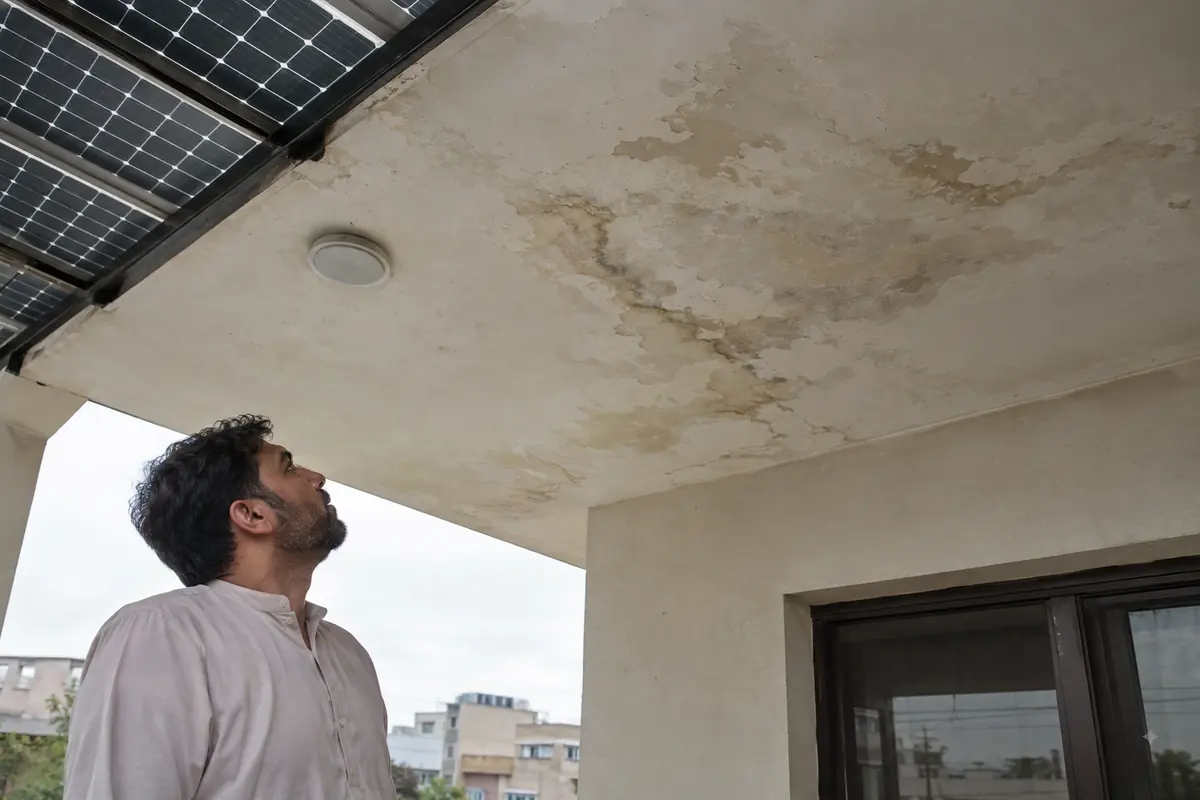
Each large panel weighs roughly 25 to 35 kg, and a 5kW array with its frame adds a few hundred kilograms spread over the roof. A sound RCC slab handles this easily. If your roof is old, has visible cracks or already leaks, fix it before installation, because removing panels later to repair the roof costs labour twice.
Comparison table
How the installation cost changes with the type of job. Ranges as of October 2026.
| Job | Labour | Structure | Cable and protection | Typical time on site |
|---|---|---|---|---|
| New 3kW home system | Rs 15,000 to 25,000 | Rs 15,000 to 20,000 | Rs 10,000 to 15,000 | 1 day |
| New 5kW home system | Rs 20,000 to 35,000 | Rs 25,000 to 40,000 | Rs 18,000 to 28,000 | 1 to 2 days |
| New 10kW home system | Rs 40,000 to 60,000 | Rs 50,000 to 75,000 | Rs 35,000 to 50,000 | 2 to 3 days |
| Elevated structure (any size) | Higher | Get a separate quote | Similar | Longer |
| Adding panels to an existing system | Per panel or per kW | For the new panels only | New strings only | Half a day to 1 day |
Per kW at a glance
| Item | Per kW (October 2026) |
|---|---|
| Labour | about Rs 4,000 to Rs 8,000 |
| Standard structure | about Rs 5,000 to Rs 7,500 |
| Cable and protection | about Rs 3,500 to Rs 5,500 |
| Total installation, excluding paperwork | about Rs 12,000 to Rs 21,000 |
Costs that show up later
Some costs are not in the first quote but appear during or after the job. As of October 2026, installer breakdowns list these as common extras:
- DB box upgrade: about Rs 8,000 to Rs 20,000 if your house distribution board is old or full
- Extra DC cable for long runs: about Rs 5,000 to Rs 15,000 when the inverter sits far from the roof
- Load extension: a DISCO fee and paperwork if your sanctioned load is lower than the system size
- Roof waterproofing: if the roof needs it, do it before the frame goes on
Ask the installer at the survey whether any of these apply to your house, so the quote is complete from the start.
Buying checklist
Choosing solar panel installers near you matters as much as choosing panels. A great panel badly installed gives poor output and can leak or burn. Before you pay:
- Get three itemised quotes. Each should list labour, structure, cable, protection, earthing and paperwork separately.
- Ask to see a finished job. A good installer will show you a recent installation nearby or photos with the inverter app running.
- Check experience with your DISCO. For net billing, ask how many files they have completed with LESCO, K-Electric, IESCO or your company, and how long approval took.
- Confirm the design. Ask for the panel layout, tilt, string plan and cable sizes in writing.
- Confirm protection. DC and AC surge protection, breakers and a separate earthing rod must be included.
- Ask about the roof. Who seals the bolt holes, and what happens if the roof leaks after installation?
- Get a workmanship warranty. Separate from the panel and inverter warranties, it covers the installer’s own work, such as loose connections and structure faults.
- Agree payment stages. Pay a deposit on order, most on installation, and the last part after commissioning.
- Check commissioning. Before the crew leaves, make sure the inverter shows each string’s voltage and that the app is set up on your phone.
| Question for the installer | What a good answer looks like |
|---|---|
| Who will do the work? | Their own trained crew, named supervisor |
| What cable do you use? | Branded solar DC cable, size stated |
| How do you earth the system? | Separate earthing rod, tested |
| Who handles the DISCO file? | They do, with a clear fee and timeline |
| What if something fails? | Written workmanship warranty, phone support |
For help choosing the panel itself, see best solar panels in Pakistan.
Solar panel repair and after-sales service
Good installation services do not end on commissioning day. Ask what support you get after the job, because many solar panel repair calls are about the installation, not the panel itself:
- Loose or burnt MC4 connectors, often from poor crimping
- Water entering the junction box or conduit
- Tripped or wrongly rated breakers
- Inverter errors after a surge, where surge protection was missing
- Structure bolts loosening in storms
A reliable installer checks these on a yearly visit. Regular washing also matters; our solar panel cleaning guide covers safe methods.
Can you install solar panels yourself?
Plenty of handy homeowners in Pakistan fit small panel sets themselves, and for a single panel on a UPS that can be fine. For a grid-tied system of 3kW and above, it is a poor saving. DC strings from nine or ten large panels carry several hundred volts, which can cause serious injury and fires if connections are wrong. DISCOs also expect a proper installation for net billing, and panel and inverter warranties can be refused if damage comes from incorrect fitting. Labour is one of the smaller lines in the total system cost, so paying a qualified crew is usually money well spent.
Moving or reinstalling panels
If you rent or plan to move, ask what it costs to take the system down and refit it. Removal and refitting is roughly a fresh labour charge, plus any new structure if the old frame does not fit the new roof. Keep the original string plan and invoice, because they make the second installation faster and keep warranties traceable.
Common mistakes to avoid
- Choosing on labour price alone. The cheapest fitting crew often saves money by skipping earthing, surge protection or proper sealing.
- Using house wire for DC. Ordinary PVC house cable is not made for sun exposure and DC voltage. It cracks and becomes a fire risk.
- Unsealed bolt holes. A leaking roof after the first rain is a frequent complaint. Insist on sealing.
- Flat or wrongly faced panels. Laying panels flat to save structure cost loses output every day and keeps them dusty.
- No shade check. A water tank or neighbour’s wall shading one panel in the afternoon drags down a whole string.
- Inverter in the sun or a closed room. Heat derates inverters and shortens their life. Mount them in a shaded, ventilated place.
- Mixing panels in one string. Different wattages or brands in series perform like the weakest panel.
- Paying the full amount upfront. Keep the last part until the system is commissioned and working.
- No written warranty. Verbal promises do not help when a connector burns six months later.
| Warning sign during installation | What to do |
|---|---|
| Crew drilling the roof without sealant on hand | Stop work until sealing is arranged |
| Panels connected with twisted wire instead of MC4 | Ask for proper connectors |
| No earthing rod being installed | Ask where the earth is going |
| Inverter mounted on a sunny outside wall | Ask to move it to shade |
Panels, inverter and installation together make up the full system price. To compare panel rates before you sign, check the live prices on the home page.
Frequently asked questions
How much does solar panel installation cost per kW in Pakistan?
As of October 2026, labour, a standard structure, cabling and protection together usually cost about Rs 12,000 to Rs 21,000 per kW for a home system. Panels, inverter, batteries and net billing paperwork are extra.
What is the installation cost of a 5kW solar system?
For a 5kW home, labour, structure, cable and protection come to roughly Rs 63,000 to Rs 1 lakh as of October 2026. Net billing paperwork and the bidirectional meter add about Rs 20,000 to Rs 40,000.
Does the installation cost include panels and the inverter?
No. Installation covers fitting labour, the mounting structure, wiring, breakers, surge protection and earthing. Panels and the inverter are priced separately because their rates change much faster.
How long does a solar installation take?
A typical 3kW job takes about a day and a 5kW job one to two days on site. Net billing approval from your DISCO can take several weeks after that and depends on the distribution company.
Is solar installation different in Karachi?
The work is the same, but net billing files go to K-Electric instead of a WAPDA DISCO. Karachi panels sit flatter, around 25 degrees, and salt and dust mean more frequent cleaning.
Can I install solar panels myself?
A single panel on a UPS is a manageable DIY job. For grid-tied systems of 3kW and above, DC strings carry several hundred volts, net billing needs a proper installation, and poor fitting can void warranties, so a qualified installer is the safer choice.
Do I still need to pay the NEPRA licence fee for net billing?
Since April 2026, home systems of 25 kW or less no longer need a NEPRA licence or the Rs 1,000 per kW fee. You still need DISCO approval and a bidirectional meter.
What should a good installer include in the quote?
A site survey, a galvanised structure set at the right tilt, proper solar cable with MC4 connectors, DC and AC breakers, surge protection on both sides, a separate earthing rod, sealed roof fixings and a written workmanship warranty.