On this page
- Quick answer: solar panel stand price in Pakistan
- How we checked this
- Solar panel stand, frame and structure: the main types
- Comparison table: standard stand vs elevated structure vs aluminium rails
- Buying checklist: before you pay for a solar panel stand
- Common mistakes to avoid with solar stands
- Frequently asked questions
The solar panel stand price in Pakistan depends far more on the type of structure than on the brand of panel it holds. A simple low iron stand on a flat roof costs a fraction of a raised girder structure that lets you use the roof underneath. This guide gives researched price ranges for stands, structures, clamps and clips as of October 2026, explains the common stand designs and frame designs, and shows what to check before you pay a fabricator.
Quick answer: solar panel stand price in Pakistan
As of October 2026, these are the typical asking prices we found in Pakistani seller listings:
| Item | Typical asking price (as of October 2026) | How it is usually quoted |
|---|---|---|
| Standard low stand (sellers call these L2, L3, L4 and similar) | About Rs 3,000 to Rs 3,350 per panel | Per plate, iron frame, made to order |
| 4-panel L2 stand, 14-gauge galvanised | About Rs 12,800 for the set (about Rs 3,200 per panel) | Per set |
| Elevated girder structure, custom made | About Rs 10 to Rs 12 per watt | Per watt of panels it holds |
| Galvanised iron frame, 60 inch, 18 gauge (retail) | About Rs 8,500 | Per piece |
| Mid or end clamp with U-bolt | About Rs 240 to Rs 350 each | Per piece |
| Small mid or end clamps, 25 to 30 mm | About Rs 480 to Rs 750 per pack of 12 | Per pack |
In simple terms, a standard stand for a 5 kW home system with large plates usually lands in the tens of thousands of rupees, while an elevated structure for the same system can cost about twice as much. Prices change with the steel rate, so always get a written quote. For the full system cost, see our solar system price guide.
How we checked this
Stand and structure prices are not on our live panel price sheet, so we researched them separately.
| What we checked | Where | What we used it for |
|---|---|---|
| Solar stand and structure listings | OLX Pakistan, Lahore, Rawalpindi, Karachi and smaller cities, October 2026 | Asking prices per panel, per set and per watt |
| Retail frame listing | W11 Stop online store, October 2026 | A fixed retail price for a galvanised frame |
| Clamp and clip listings | OLX Pakistan, October 2026 | Prices of mid clamps, end clamps and clips |
| Panel sizes | Maker datasheets | Stand length must match modern panel sizes |
What you should know about these figures:
- They are asking prices, not final prices. Fabricators quote after a roof visit. Steel thickness, height and the number of panels change the price.
- Units vary. Some sellers quote per panel, some per set, some per watt. Several listings showed placeholder prices such as Rs 100, which are not real prices. We ignored those.
- Ranges are rounded. We give ranges, not single figures, because rates move with the steel market.
We did not include brand names of fabricators, phone numbers or addresses. Use the checklist below to compare any quote you receive.
Solar panel stand, frame and structure: the main types
What is a solar panel stand, frame or structure?
The words are used loosely in Pakistan, but they usually mean:
- Solar panel stand: the steel frame that holds panels at an angle on a roof. Most home installers use this word.
- Solar panel frame: either the aluminium edge around each panel, or the welded base that the panels sit on. In listings, “frame” usually means the stand.
- Solar panel structure: the full mounting system, often used for larger or raised designs such as elevated girder structures.
- Clamps and clips: the small aluminium or steel parts that hold each panel to the rails of the stand.
Solar panel stand design options
| Stand design | What it looks like | Good for | Watch out for |
|---|---|---|---|
| Low tilted stand (L-type) | Iron angle or channel legs, panels tilted south at a fixed angle | Most flat concrete roofs | Must be anchored well against wind |
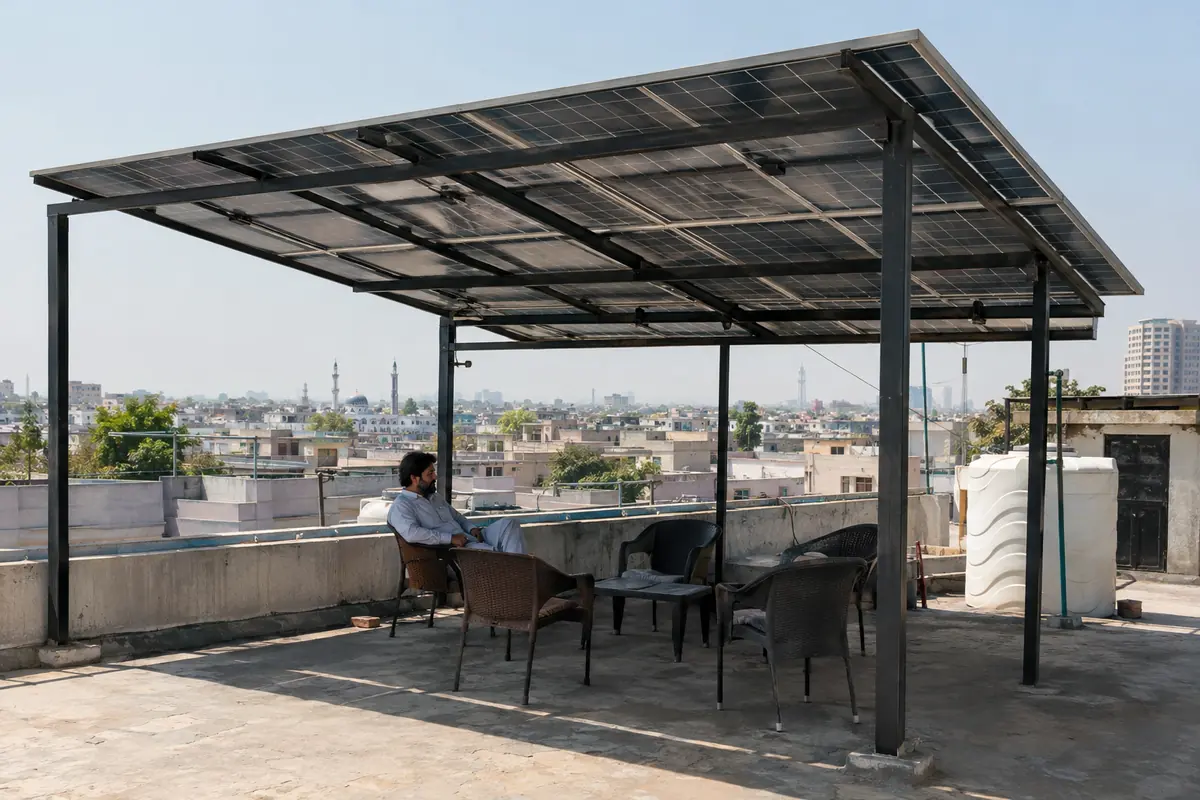
| Elevated structure | Tall columns and girders, panels raised high enough to walk under | Using the roof below for drying clothes, parking or water tanks | Costs much more, needs strong anchoring and a proper design |
| Flat or low-tilt rails | Panels close to the roof on short rails | Sloped or sheet roofs | Less cooling, lower output in heat |
| Ground-mounted frame | Frame on concrete footings on the ground | Farms, tube-wells, large plots | Needs fencing and footings |
| Pole or single-post mount | One or a few panels on a pipe | Street lights, small pumps, kiosks | Only for small systems |
Seller labels such as L2, L3, L4 and L5 are stand model names. They differ between fabricators, usually by height and size. Ask the seller for a drawing or the actual height and number of panels per stand, rather than relying on the label.
Solar panel frame design and materials
The material decides how long the stand lasts.
| Material | Typical use | Life in Pakistani weather | Notes |
|---|---|---|---|
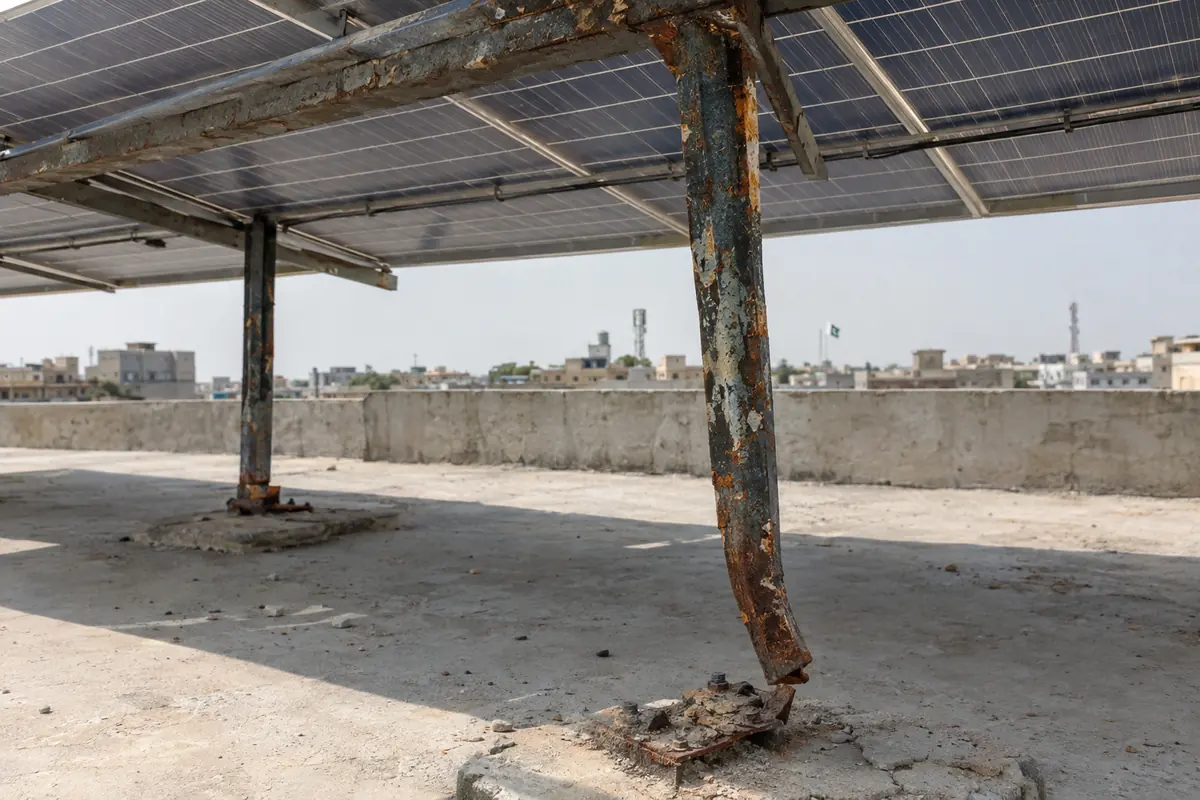
| Painted mild-steel angle or channel | Cheapest home stands | Shortest, rusts unless repainted | Check paint quality and welding |
| Galvanised iron (GI) | Most good home stands | Long, resists rust | Ask for the gauge; lower gauge numbers are thicker |
| Hot-dip galvanised steel | Elevated and commercial structures | Longest of the steel options | Costs more, best near the coast |
| Aluminium rails and clamps | Sloped roofs, light designs | Long, does not rust | Lighter; check rail thickness |
Gauge matters. In sheet steel, a smaller gauge number means thicker metal. A 14-gauge stand is thicker and stronger than a 16 or 18-gauge stand. On windy rooftops and with heavy modern panels, thicker steel is worth paying for.
Solar panel structure design for an elevated system
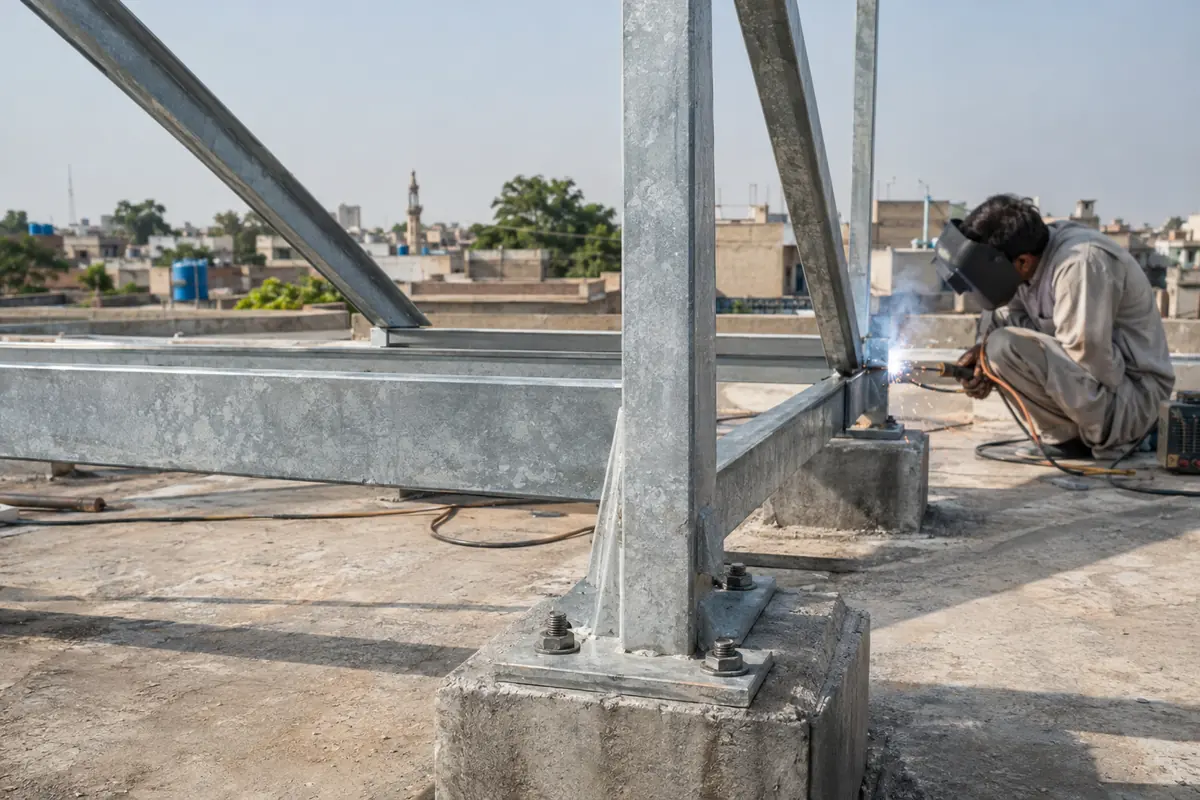
An elevated structure is a small building frame on your roof. A good design should include:
- Column positions over beams or walls. Columns should sit where the slab is strongest, not in the middle of a weak span.
- Proper base plates and anchor bolts. Each column needs a steel base plate fixed into the slab with anchor bolts, plus waterproofing around it.
- Bracing. Diagonal bracing stops the structure from swaying in wind.
- Girders sized for the span. Longer spans need deeper girders.
- Panel rails at the right tilt. Rails are set at the chosen angle, usually facing south.
- Access for cleaning. You need a safe way to reach the panels for washing.
Ask the fabricator for a drawing with column positions, girder size and steel thickness, and keep it with your warranty papers.
Solar panel clamps and clips
Clamps hold each panel to the rails without drilling the panel frame.
| Part | Where it goes | Typical asking price (as of October 2026) |
|---|---|---|
| Mid clamp | Between two panels, holds both | About Rs 40 to Rs 65 each in packs of 12, or Rs 245 to Rs 350 with a U-bolt |
| End clamp | At the end of a row | About Rs 50 to Rs 60 each in packs of 12, or Rs 240 to Rs 300 with a U-bolt |
| U-bolt clamp | Fixes a clamp onto a round or square pipe | Included in the U-bolt prices above |
| Plastic drainage clips | Lower edge of the panel, lets rain and dust slide off | About Rs 1,300 per pack of 10 |
| Nuts, bolts and washers | Throughout the stand | Use stainless or galvanised; usually included in the stand quote |
Match the clamp to the panel frame thickness. Modern panels have frames of about 30 to 35 mm. A clamp made for 25 mm frames will not hold a 35 mm frame properly. Check the frame depth on your panel’s datasheet.
Stand size must match modern panels
Many large panels sold today are about 2.28 m long and 1.13 m wide, roughly 7 ft 6 in by 3 ft 9 in, and some of the biggest panels are larger still. A stand built for older, shorter panels will not hold them safely. See our solar panel size in feet guide for exact sizes before ordering a stand.
Tilt angle and direction
Most stands in Pakistan face south and are tilted at roughly the same angle as the city’s latitude for good year-round output. Lahore and Islamabad are further north than Karachi, so their best tilt is steeper. Use our solar panel tilt angle calculator to find the angle for your city, and tell the fabricator before welding starts.
Why stand quotes differ so much
Two quotes for the same roof can be very different. The main reasons:
| Factor | Effect on price |
|---|---|
| Steel thickness (gauge) | Thicker steel weighs more and costs more, but lasts longer |
| Galvanised or painted | Galvanising adds cost but greatly reduces rust |
| Height | Every extra foot of leg adds steel; elevated structures add girders and bracing |
| Number of panels per set | Larger sets can lower the cost per panel |
| Steel market rate | Iron prices move, so quotes from different months can differ |
| What is included | Clamps, anchor bolts, transport and fitting may or may not be in the price |
| City and access | Upper-floor roofs with narrow stairs take more labour |
Ask each fabricator for the same details, then compare like with like.
Choosing a stand for your roof type
Pakistani homes have a mix of roof types, and each needs a different fixing method:
| Roof type | Recommended stand | Fixing method | Extra care |
|---|---|---|---|
| Flat RCC concrete slab | Low tilted galvanised stand, or elevated structure | Anchor bolts into the slab, or concrete ballast blocks | Seal every bolt hole against leaks |
| Old or weak slab | Light low stand, fewer panels per frame | Spread the load over beams and walls | Ask an engineer before adding an elevated structure |
| Steel sheet or shed roof | Aluminium rails or low-tilt rails on the purlins | Bolted to the purlins, not just the sheet | Check the purlins can carry the weight |
| Mud or tiled roof | Usually not suitable for a direct fix | Ground-mounted frame nearby | Avoid loading the roof |
| Ground or open plot | Ground-mounted frame | Concrete footings | Fencing against theft and animals |
If your roof has water tanks, stair rooms or a high parapet wall, plan the stand position around their shadows. A stand that is too low behind a parapet can lose output for hours each winter morning.
Panels per stand and row spacing
Fabricators often build stands in sets that hold two, three, four or more panels each. Points to plan:
- Panels per stand. Larger sets need fewer legs per panel, which can lower the cost, but they catch more wind. On exposed roofs, ask for extra legs or bracing on long sets.
- Portrait or landscape. Most home stands hold large panels in portrait, with the long side running up the tilt. This keeps the stand shorter from front to back.
- Row spacing. The gap between rows should be enough that the front row’s shadow does not reach the back row at midday in December, when the sun is lowest.
- Walkway. Leave at least one clear path to reach every row for cleaning and checks.
Stands for tube-wells and farms
Agricultural systems are usually ground-mounted and larger than home systems:
- Use concrete footings for every leg, set deep enough for the local soil.
- Raise the lowest edge of the panels above the ground so dust, water and animals do not reach the glass.
- Choose hot-dip galvanised steel in fields where irrigation water and humidity cause rust.
- Add fencing around the array to prevent theft and damage.
- Consider a manual tilt option if the fabricator offers one, so you can change the angle between summer and winter.
Looking after your stand
A stand needs very little care, but a quick check twice a year adds years to its life:
- Tighten loose nuts and clamps, especially after storms.
- Touch up rust spots and scratches with zinc-rich or anti-rust paint.
- Check that roof sealing around anchor bolts has not cracked.
- Make sure no clamp is pressing on the panel glass.
- Clear bird nests and debris from under the panels.
Questions to ask the fabricator
- What steel will you use, and what gauge or thickness?
- Is it galvanised, painted or both?
- Is the price per panel, per set, per watt or for the whole job?
- Are clamps, anchor bolts and transport included?
- How will the stand be fixed to my roof, and how will you seal the holes?
- Can you show a stand you built at least a year ago?
- What warranty do you give on welding and rust?
How the stand cost fits into the whole system
The stand is a small part of the total, but it carries all the panels for 25 years. Worked examples with typical asking prices as of October 2026:
| System | Panels (about 585 W each) | Standard stand at Rs 3,000 to Rs 3,350 per panel | Elevated structure at Rs 10 to Rs 12 per watt |
|---|---|---|---|
| 3 kW | 6 | About Rs 18,000 to Rs 20,000 | About Rs 35,000 to Rs 42,000 |
| 5 kW | 9 | About Rs 27,000 to Rs 30,000 | About Rs 53,000 to Rs 63,000 |
| 10 kW | 18 | About Rs 54,000 to Rs 60,000 | About Rs 105,000 to Rs 126,000 |
The elevated figures use the panel watts (for example, 9 panels of 585 W is 5,265 W). Fabrication, transport and fitting may be included or charged separately, so ask. Our solar panel installation cost guide covers labour and wiring.
Comparison table: standard stand vs elevated structure vs aluminium rails
| Point | Standard low stand | Elevated structure | Aluminium rail system |
|---|---|---|---|
| Typical price (as of October 2026) | About Rs 3,000 to Rs 3,350 per panel | About Rs 10 to Rs 12 per watt | Varies by rail length and brand |
| Height above roof | Low, a few feet | High enough to walk under | Close to the roof |
| Roof space below | Mostly blocked | Free to use | Blocked |
| Wind exposure | Moderate | High, needs strong anchoring | Low |
| Cleaning access | Easy | Needs a ladder or walkway | Depends on roof slope |
| Best for | Most homes with a free roof | Small roofs that are also used daily | Sloped or sheet roofs |
| Rust risk | Depends on paint or galvanising | Low if hot-dip galvanised | Very low |
For most families, a well-built galvanised low stand is the best value. Choose an elevated structure only if you really need the roof space underneath.
Buying checklist: before you pay for a solar panel stand
- Measure your panels first. Give the fabricator the exact length, width and frame depth from the datasheet.
- Ask for the material and gauge in writing. For example, “galvanised iron, 14 gauge” rather than just “strong iron”.
- Ask how the price is quoted. Per panel, per set, per watt or per kW. Convert every quote to the same unit to compare.
- Check what is included. Clamps, nuts and bolts, anchor bolts, painting, transport and fitting.
- Confirm the tilt and direction. South-facing at the angle from the tilt calculator.
- Ask how it is fixed to the roof. Anchor bolts into the slab with waterproofing, or ballast blocks. Avoid stands that are just placed on the roof.
- Check welding and finish. Welds should be full and clean. Cut ends and welds on galvanised steel should be painted with zinc-rich paint.
- Plan for cleaning. Leave space to walk between rows and reach every panel.
- Check row spacing. Rows should be far enough apart that the front row does not shade the back row in winter.
- Get a warranty. Ask the installer for a written workmanship warranty on the structure.
Once the stand is planned, compare panels on our best solar panels in Pakistan page and use the solar panel calculator to confirm how many plates you need.
Common mistakes to avoid with solar stands
- Choosing the cheapest thin steel. Thin, painted stands can rust and bend within a few years, and every panel on top depends on them.
- Not anchoring the stand. Strong summer storms can lift loose stands and throw panels off the roof.
- Buying a stand before the panels. A stand made for older, shorter panels may not fit the large plates you buy later.
- Wrong clamp size. Clamps that do not match the panel frame depth can let panels slide or crack.
- Drilling the panel frame. Drilling extra holes in the panel’s aluminium frame can void the warranty. Use clamps.
- Facing panels to the street for looks. Panels that face east, west or north lose output every day.
- Ignoring roof waterproofing. Anchor bolts without sealing can cause leaks into the room below.
- Elevated structures without a design. Tall structures carry heavy wind loads. They need proper columns, bracing and base plates.
A good stand costs a little more but protects panels worth far more. Compare panel rates on our home page and the solar panel price list before you finalise the system.
Frequently asked questions
What is the solar panel stand price in Pakistan?
As of October 2026, standard low stands were advertised at about Rs 3,000 to Rs 3,350 per panel, and custom elevated girder structures at about Rs 10 to Rs 12 per watt. Final prices depend on steel thickness, height and what is included, so get a written quote.
What is the difference between a solar panel stand, frame and structure?
In Pakistan the words overlap. A stand usually means the tilted steel frame on a roof, a frame can mean either that stand or the aluminium edge of the panel, and a structure usually means a full or raised mounting system such as an elevated girder design.
Is an elevated solar structure worth the extra cost?
Only if you need the roof space underneath, for example for water tanks, drying clothes or parking. It costs roughly twice as much as a standard stand and needs a proper design with columns, bracing and strong anchoring.
Which material is best for a solar panel stand?
Galvanised iron is the usual choice for home stands because it resists rust. Hot-dip galvanised steel lasts longest and suits coastal areas and elevated structures, while aluminium rails suit sloped or sheet roofs. Plain painted iron is cheapest but rusts sooner.
What do solar panel clamps and clips do?
Mid clamps hold two neighbouring panels to the rail and end clamps hold the last panel in a row, so the panel frame never needs drilling. Clamps must match the panel's frame depth, which is about 30 to 35 mm on most modern panels.
What does L2 or L3 mean for a solar stand?
These are model names that fabricators use for their stand designs, and they differ from seller to seller, usually by height and size. Ask for a drawing or the actual height and number of panels per stand rather than relying on the label.
What angle should a solar panel stand be in Pakistan?
Most stands face south and are tilted at roughly the latitude of the city, so northern cities like Lahore and Islamabad need a steeper tilt than Karachi. Use a tilt angle calculator for your city and give the angle to the fabricator before welding.
How do I fix a solar stand to my roof safely?
On a concrete roof, use anchor bolts into the slab with proper waterproofing, or heavy concrete ballast blocks. A stand that is just placed on the roof can be lifted by strong storms. On weak or old slabs, ask an engineer first.