On this page
Solar panel series vs parallel is the first wiring decision on any system, and it decides whether your inverter sees the right voltage, whether your cables run cool and whether one shaded plate drags the rest down. This guide explains both methods with real datasheet numbers, shows how to work out a safe string for a Pakistani inverter, and lists the wiring mistakes that cause most burnt connectors and tripped inverters.
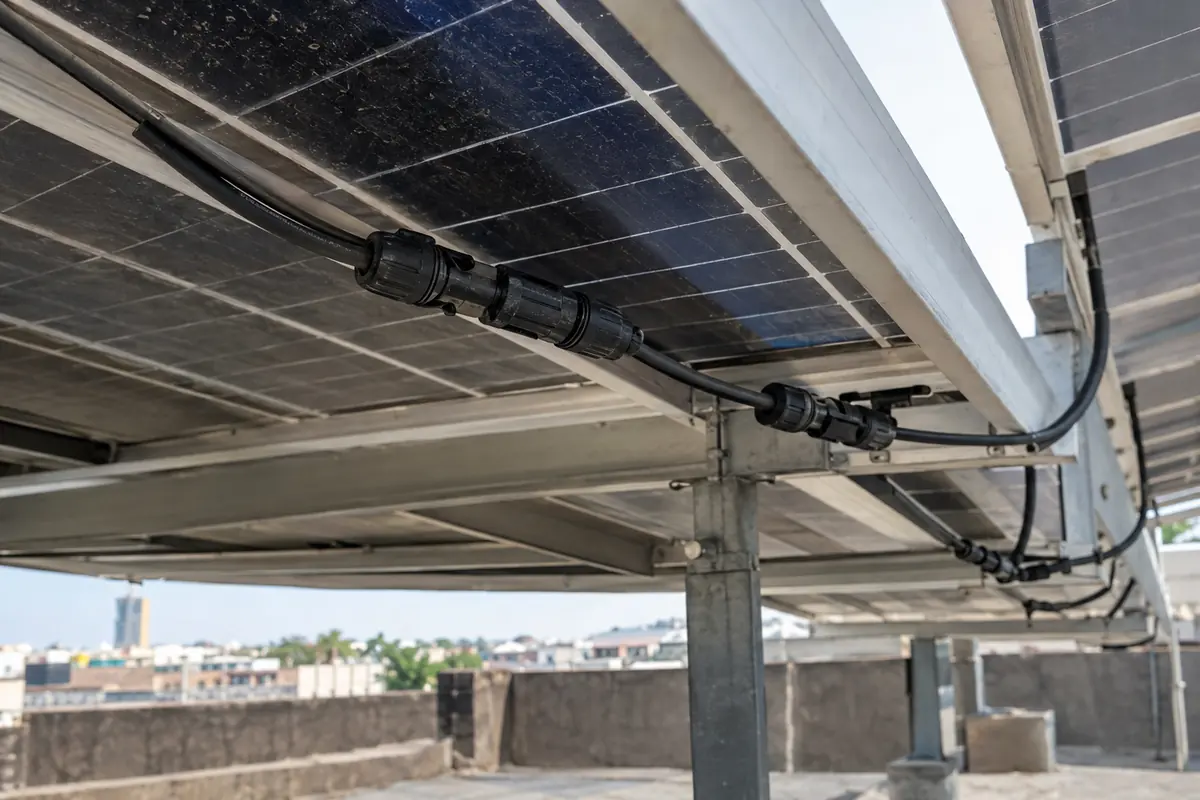
Quick answer: solar panel series vs parallel
- Series means the positive of one panel goes to the negative of the next. Voltages add up; current stays the same as one panel.
- Parallel means all positives join together and all negatives join together. Currents add up; voltage stays the same as one panel.
- Series-parallel means you build two or more equal series strings and then join the strings in parallel.
For most grid-tied and hybrid inverters in Pakistan, panels are wired in series into strings, because the inverter needs a few hundred volts to work efficiently and higher voltage means lower current and thinner cable. Parallel wiring is used mainly for small 12V or 24V battery systems with PWM controllers, or to join two equal strings on one inverter input. The right answer always comes from two documents: your panel’s datasheet and your inverter’s datasheet.
How we checked this
Wiring advice is only as good as the numbers behind it, so every example on this page uses published values rather than rules of thumb.
| Source | What we took from it |
|---|---|
| Datasheet of a common 585 W N-type panel (Jinko Tiger Neo 72HL4 series) | Vmp, Imp, Voc, Isc and the temperature coefficient of Voc |
| Jinko Tiger Neo datasheet (575 W version) | Maximum series fuse rating, used for the parallel fusing example |
| Typical hybrid and on-grid inverter datasheets | How MPPT voltage range, maximum DC voltage and maximum input current are specified |
| IEC wiring practice for PV arrays | When string fuses are needed in parallel, why strings must match |
| Installer experience in Pakistan | Common faults: cold-morning overvoltage, mixed panels, loose MC4 joints |
The reference panel values used below are: Vmp 42.52 V, Imp 13.76 A, Voc 51.16 V, Isc 14.55 A, Voc temperature coefficient −0.25% per °C. Other panels differ, so swap in the numbers from your own label before you wire anything.
Connecting solar panels in series and in parallel
What happens in series
When you start connecting solar panels in series, each panel’s voltage stacks on top of the last. The current through the string is the same as through one panel.
| Panels in series | String Vmp | String Voc (25 °C) | String current (Imp) | Power at STC |
|---|---|---|---|---|
| 1 | 42.5 V | 51.2 V | 13.8 A | 585 W |
| 2 | 85.0 V | 102.3 V | 13.8 A | 1,170 W |
| 4 | 170.1 V | 204.6 V | 13.8 A | 2,340 W |
| 6 | 255.1 V | 307.0 V | 13.8 A | 3,510 W |
| 8 | 340.2 V | 409.3 V | 13.8 A | 4,680 W |
| 9 | 382.7 V | 460.4 V | 13.8 A | 5,265 W |
The big advantage is current. Nine panels make over 5 kW at under 14 A, so a standard 4 mm² or 6 mm² solar cable handles it easily with low loss.
The weakness is that everything in a series string carries the same current. If one panel is shaded or weaker, it limits the string. Modern panels reduce the damage with bypass diodes (usually three per panel), which let current skip a shaded section, but you still lose that section’s output.
What happens in parallel
When you join solar panels in parallel, voltage stays at one panel’s value and the currents add.
| Panels in parallel | Array Vmp | Array Voc | Array current (Imp) | Array Isc |
|---|---|---|---|---|
| 1 | 42.5 V | 51.2 V | 13.8 A | 14.6 A |
| 2 | 42.5 V | 51.2 V | 27.5 A | 29.1 A |
| 3 | 42.5 V | 51.2 V | 41.3 A | 43.7 A |
| 4 | 42.5 V | 51.2 V | 55.0 A | 58.2 A |
You can see the problem straight away. Four large panels in parallel push about 55 A at only 42 V. That needs very thick cable, heavy connectors and a controller rated for the current. This is why big panels are almost never wired fully in parallel.
Parallel wiring has one real strength: each panel works more independently. Shade on one panel lowers only that panel’s current, not the whole array’s. That is why small off-grid kits with 12V panels and a 12V battery are often wired in parallel.
Shading: which wiring copes better?
Shade is the one situation where the choice really changes output, so it is worth understanding properly.
A typical large panel has three bypass diodes, each covering one third of the cells. If a water tank’s shadow falls across the bottom of one panel in a series string, the diode for that section switches on and current flows around it. The string loses roughly that third of a panel, plus a little voltage, and the rest keeps working. Modern half-cut panels also split each panel into an upper and lower half, which helps when shade falls across the bottom edge.
| Shading situation | Series string | Parallel array |
|---|---|---|
| Small shadow on part of one panel | Bypass diode skips that section; small loss | Only that panel drops; small loss |
| One panel fully shaded for hours | Bypass diodes skip it; string voltage drops by one panel’s worth, which may push it below the MPPT range if the string is short | Only that panel drops |
| Morning shade across a whole row | Large loss; consider a separate string or MPPT for that row | Large loss, but no worse per panel |
| Dust or bird droppings on one cell | Can create a hot spot; clean it | Can create a hot spot; clean it |
The practical answer is not to pick parallel because of shade, but to design around it: keep shaded panels in their own string on a separate MPPT input, make strings long enough that losing one panel does not drop them out of the MPPT range, and remove the cause of shade where you can. Where shade is unavoidable, module-level optimisers or microinverters are another option, at extra cost.
Connecting 2 solar panels: three ways compared
| Wiring | Voltage (Vmp) | Current (Imp) | Best for |
|---|---|---|---|
| Two 12V panels (18 V, 8 A each) in series | About 36 V | About 8 A | Charging a 24V battery, or an MPPT controller on 12V |
| Two 12V panels in parallel | About 18 V | About 16 A | A 12V battery with a PWM controller |
| Two 585 W panels in series | About 85 V | About 13.8 A | An MPPT controller with a 24V or 48V battery |
Two large rooftop panels in parallel (42 V, about 27.5 A) are rarely a good idea; series gives the same power at half the current.
Series vs parallel side by side
| Point | Series | Parallel |
|---|---|---|
| Voltage | Adds up | Stays the same |
| Current | Stays the same | Adds up |
| Cable size needed | Small | Large |
| Effect of shading one panel | Limits the whole string (bypass diodes reduce the loss) | Only that panel drops |
| Suits | Grid-tied, hybrid and MPPT systems | Small 12V/24V systems with PWM controllers |
| Main risk | Exceeding inverter maximum voltage on cold days | High current, overheating, reverse current without fuses |
| Extra parts | Usually none | Branch (Y) connectors or a combiner box; fuses for 3+ strings |
The cold-morning voltage rule
This is the step most often skipped. Panel voltage rises as temperature falls. The datasheet Voc is measured at 25 °C. On a cold January morning in Lahore, Peshawar or Quetta, panels can be far colder than that before the sun warms them, and the string voltage climbs.
Work it out like this:
- Find the lowest temperature your site sees. For most of Punjab, a few degrees above zero is realistic; for Quetta and the north, plan for well below zero.
- Work out the temperature difference from 25 °C. At 0 °C, that is 25 degrees.
- Multiply by the Voc coefficient. 25 × 0.25% = 6.25% higher Voc.
- Apply it: 51.16 V × 1.0625 = about 54.4 V per panel at 0 °C.
- Multiply by the panels in the string and compare with the inverter’s maximum DC input voltage.
| Panels in series | Voc at 25 °C | Voc at 0 °C | Voc at −10 °C |
|---|---|---|---|
| 8 | 409 V | 435 V | 445 V |
| 9 | 460 V | 489 V | 501 V |
| 10 | 512 V | 544 V | 556 V |
| 11 | 563 V | 598 V | 612 V |
On an inverter with a 500 V maximum input, nine of these panels stays under the limit down to about 0 °C. That is tight for the coldest mornings in Lahore and too many for a site that drops to −10 °C, so many installers would use eight. Ten panels exceed 500 V even at 25 °C. Overvoltage can permanently damage an inverter, and it is usually not covered by warranty.
The MPPT window and current limit
The inverter also has an MPPT voltage range, the band in which it tracks maximum power, and a maximum input current per MPPT. Your string’s Vmp should sit comfortably inside the MPPT range on hot summer afternoons too, when voltage drops. A Vmp temperature coefficient of around −0.3% per °C or a little more means a string can lose 10–12% of its voltage when cells reach 60–65 °C. If the hot-day Vmp falls below the MPPT window, the inverter loses output exactly when the sun is strongest.
Here is a worked example with an illustrative 6 kW hybrid inverter (check your own model’s numbers):
| Inverter spec (example) | Value | What it means for the string |
|---|---|---|
| Maximum DC input voltage | 500 V | Cold-morning Voc must stay below this |
| MPPT voltage range | 120–450 V | Hot-afternoon Vmp must stay above 120 V and below 450 V |
| Maximum input current per MPPT | 27 A | Two parallel strings of 13.8 A fit; three do not |
| Number of MPPTs | 2 | Strings on different roofs or angles can go on separate MPPTs |
With these numbers, a string of 9 panels gives about 383 V Vmp at 25 °C and roughly 340 V on a hot afternoon: safely inside the window. Cold-morning Voc at 0 °C is about 489 V: just under the 500 V limit. Two such strings in parallel on one MPPT give about 27.5 A, at or slightly above a 27 A limit, so split them across the two MPPTs instead. Some inverters allow a connected current above their working limit and simply cap what they draw, but always check the manual before relying on that.
Series-parallel: when you have more panels
When one string would be too long, build two or more strings and join them in parallel. Rules:
- Every string in parallel must have the same number of panels, the same model and the same orientation.
- If strings face different directions (east and west roofs), put them on separate MPPT inputs, not in parallel.
- With two strings in parallel, string fuses are usually not needed, because the reverse current into a faulty string can only come from one other string, about one panel’s Isc.
- With three or more strings in parallel, a fault in one string can receive current from all the others. In our example, two strings feeding a faulty one push about 29 A backwards, above a typical maximum series fuse rating of 25 A for this type of panel. That is when string fuses in a combiner box become necessary, sized to the panel’s rated maximum series fuse.
Solar panel connectors and branch joints
Most panels come with MC4-type connectors. For parallel joins you use Y-branch connectors or a DC combiner box.
| Part | Purpose | Tip |
|---|---|---|
| MC4-type connector | Joins panel leads and extension cables | Crimp with the proper tool; never use pliers or twist joints |
| Y-branch connector | Joins two panels or strings in parallel | Check its current rating against the combined current |
| DC combiner box | Joins several strings with fuses and a surge protector | Needed for three or more strings |
| DC isolator | Lets you disconnect the array from the inverter | Required for safe servicing |
| Solar DC cable (4 or 6 mm²) | Carries string current | UV-resistant, double-insulated, red and black for polarity |
One important warning: do not mix connector brands. Different makers’ connectors may look identical but have slightly different dimensions, which leads to poor contact, heating and melted joints. Use the same brand on both halves of every joint.
Voltage drop: why series also saves on cable
Power lost in a cable rises with the square of the current. Double the current and, on the same cable, you lose four times as much. That is the hidden cost of parallel wiring. A 9-panel series string at about 14 A loses very little on a 20-metre run of 6 mm² solar cable, because the voltage is high and the current low. The same panels in parallel at over 120 A would need cable far thicker than anything sold for home solar. A common target is to keep DC voltage drop under about 1–2% from the roof to the inverter; at series voltages that is easy, at parallel currents it is expensive.
Comparison table: wiring options for common systems
| System | Typical panels | Common wiring | Why |
|---|---|---|---|
| 12V battery with PWM controller | One or two 12V panels | Parallel | Keeps voltage near 18 V for the PWM controller |
| 24V battery with PWM controller | Two 12V panels or one 24V panel | Series (two 12V) | Gives about 36 V Vmp for a 24V battery |
| 12V/24V battery with MPPT controller | Two to four large panels | Series or 2S2P, within controller input voltage | MPPT converts higher voltage to battery voltage |
| 3–5 kW hybrid inverter | 6–9 large panels | One series string | Voltage within MPPT range, low current |
| 6–10 kW hybrid or on-grid inverter | 10–18 large panels | Two strings, one per MPPT | Stays under voltage and current limits |
| 10 kW+ three-phase on-grid | 18 or more panels | Several long strings | Higher voltage inverters allow longer strings |
For panel counts, the solar panel calculator estimates how many plates your load needs, and a 5 kW system with 585 W panels needs 9 panels, costing about Rs 210,600 for the panels alone at today’s rates. For full system pricing see the 5kW solar system price page.
How to connect solar panels: a basic solar panel wiring diagram in words
For a single string of six panels into one inverter input:
- Lay out the panels and check every label is the same model and wattage.
- Connect panel 1 positive (+) to panel 2 negative (−). Repeat along the row until panel 6.
- You now have one free negative lead (panel 1) and one free positive lead (panel 6). These are the string ends.
- Run red and black DC cable from the string ends to a DC isolator, then a surge protection device, then the inverter’s PV input for one MPPT.
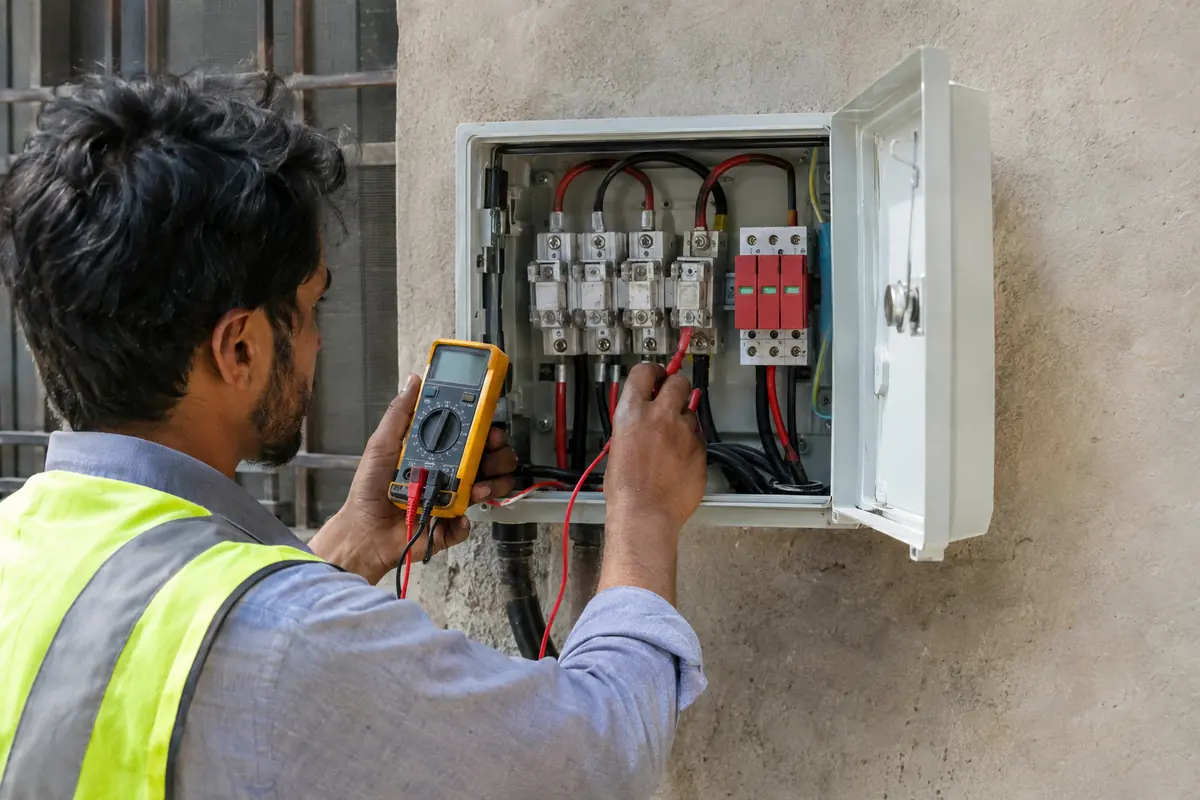
- Before connecting the inverter, measure the open-circuit voltage at the isolator. It should be close to 6 × the panel Voc, adjusted for temperature, with the right polarity.
- Earth the panel frames and mounting structure.
For connecting 2 solar panels in parallel on a small battery system, join both positives with a Y-branch connector, join both negatives with the matching Y-branch, and run one positive and one negative to the charge controller.
Buying checklist before you wire
- Get both datasheets. Panel: Vmp, Imp, Voc, Isc, temperature coefficients, maximum series fuse. Inverter or controller: maximum DC voltage, MPPT range, maximum input current, number of MPPTs.
- Find your coldest and hottest temperatures. Use the coldest for Voc, the hottest for Vmp.
- Calculate the longest safe string. Cold Voc × panels must stay below the inverter maximum, with a margin.
- Calculate the shortest useful string. Hot Vmp × panels must stay above the bottom of the MPPT range.
- Check current. Strings in parallel must stay within the MPPT current limit.
- Match panels in every string. Same model, same wattage, same orientation.
- Buy proper parts. Same-brand connectors, solar DC cable, a DC isolator and surge protection; a fused combiner for three or more strings.
- Plan cable sizes. Keep voltage drop low, especially on long runs from roof to inverter.
- Test before switching on. Measure each string’s Voc and polarity at the isolator.
When you are choosing the panels themselves, the best solar panels in Pakistan guide and the live solar panel price list help you compare models with similar electrical values.
Common mistakes to avoid
| Mistake | Result | Fix |
|---|---|---|
| Ignoring cold-morning Voc | Inverter overvoltage alarm or permanent damage | Calculate Voc at your coldest temperature |
| Mixing old and new panels, or different wattages, in one string | The weakest panel limits the string | Keep each string to one model; put different panels on a separate MPPT |
| Putting east and west roof panels in one string | Mismatched current through the day | Use separate MPPT inputs |
| Paralleling three or more strings without fuses | Reverse current can overheat a faulty string | Use a fused combiner box |
| Mixing connector brands | Loose contact, heating, melted connectors | Same brand on both halves |
| Joints crimped with pliers, or wires twisted together | Arcing and fire risk | Use the correct MC4 crimp tool |
| Wiring big panels in parallel to a small PWM controller | Huge current, wasted power, overheated controller | Use MPPT and wire in series within its limits |
| Unequal string lengths in parallel | Lower output from both strings | Equal number of panels per parallel string |
If you are working with small 12V plates and batteries rather than a rooftop inverter, our 12 volt solar panel guide covers PWM and MPPT controllers in more detail, and the home page shows today’s panel prices for every size in the sheet.
Frequently asked questions
Should I connect my solar panels in series or parallel?
For grid-tied and hybrid inverters, series is almost always right, because the inverter needs a high DC voltage and series keeps the current and cable size low. Parallel suits small 12V or 24V battery systems with PWM controllers, or joining two equal strings within the inverter's current limit.
What happens when you connect solar panels in series?
The voltages add up while the current stays the same as one panel. Two panels with a Vmp of about 42 V each give about 85 V at the same current, which is why long series strings can feed an inverter on thin cable.
What happens when you connect solar panels in parallel?
The currents add up while the voltage stays the same as one panel. Four large panels in parallel can push more than 50 A at around 42 V, which needs thick cable and a controller rated for that current.
How many solar panels can I connect in series?
Divide your inverter's maximum DC input voltage by the panel's open-circuit voltage at your coldest expected temperature, then round down and keep a margin. Also check that the string's voltage on a hot afternoon stays above the bottom of the inverter's MPPT range.
How do I connect 2 solar panels?
In series, join the positive of one panel to the negative of the other and use the two free leads. In parallel, join both positives and both negatives with Y-branch connectors, then run one positive and one negative to the controller.
What are solar panel connectors?
Most panels use MC4-type connectors, which lock together and seal against water. Use the same brand on both halves of every joint, crimp them with the proper tool, and use Y-branch connectors or a combiner box for parallel joins.
Do I need fuses when connecting solar panels in parallel?
With two strings in parallel, string fuses are usually not needed. With three or more, a fault in one string can receive reverse current from all the others, so string fuses sized to the panel's maximum series fuse rating are normally required.
Can I mix different solar panels in one string?
It is best not to. In a series string the lowest-current panel limits the whole string, so mixed wattages or old and new panels waste power. Put different panels on a separate MPPT input instead.
Why does my inverter show a high voltage alarm on winter mornings?
Panel voltage rises as temperature falls, so a string that is fine in summer can exceed the inverter's maximum DC voltage on a cold morning. The fix is to shorten the string so the cold-weather open-circuit voltage stays under the limit.