On this page
The 5kW solar panel price in Pakistan is the number most families ask about, because 5kW is the size that can run an inverter AC through the day and cut a 500 to 700 unit bill hard. This guide shows the live cost of the panels, realistic October 2026 ranges for the inverter, battery and fitting, and how to tell a good 5kW quote from a weak one.
Quick answer
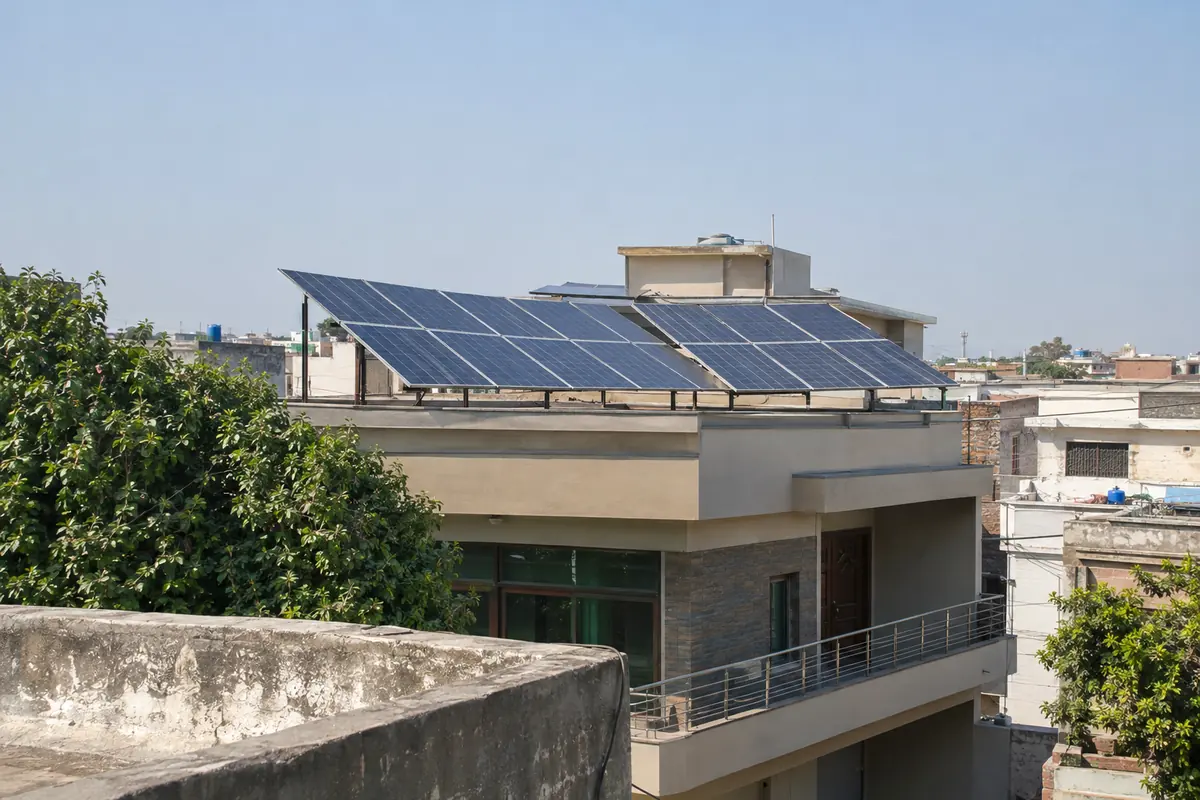
A 5kW system is nine 585 W panels or ten 550 W panels, plus a 5 to 6 kW inverter. At today’s cheapest listed rates, the panels for 5kW cost about Rs 210,600 using 585 W plates.
On a complete system the panels are usually well under half of the total. A full 5kW system without batteries typically costs the panels plus about Rs 1.7 lakh to Rs 4.7 lakh for the inverter, stand, wiring, fitting and grid paperwork, depending on brands. A 5 kWh lithium battery adds roughly Rs 1.85 lakh to Rs 2.3 lakh on top.
| Item | What you get | Cost basis |
|---|---|---|
| Panels | 9 × 585 W (5.27 kW) | Live, Rs 210,600 today |
| Inverter | 5 to 6 kW hybrid or on-grid | Range, October 2026 |
| Battery (optional) | 48V lithium, about 5 kWh | Range, October 2026 |
| Stand, cable, fitting | Full rooftop installation | Range, October 2026 |
A 5kW system in Lahore makes about 20 to 21 units a day on average, around 600 to 650 units a month.
“5kV” or “5kW”?
Many people search for a 5kv solar panel price in Pakistan. Solar panels and systems are rated in kW (kilowatts), which is the power they produce. “kV” means kilovolts and is not used for home solar. Inverters are sometimes labelled in kVA, which is close to kW for home use: a “6 kVA” inverter is roughly a 5 to 6 kW unit. When a seller says “5kv system”, they mean 5kW.
How we checked this
We treat panel prices and everything else differently, because they behave differently.
- Panels: live from our price sheet, updated from dealer rates. Each shortcode on this page recalculates when the sheet changes.
- Inverters: listed prices of 4 to 6.5 kW hybrid inverters at major Pakistani online retailers in October 2026, from budget units around Rs 90,000 to premium IP65 models above Rs 3 lakh.
- Batteries: listed prices of 48V/51.2V 100Ah lithium packs (about 5 kWh) from several brands in October 2026.
- Installation items: 5kW cost breakdowns published by Pakistani installers between June and October 2026, cross-checked against each other.
- Rules: NEPRA’s 2026 prosumer regulations and the April 2026 relief for systems up to 25 kW, as reported in national newspapers; the 10% sales tax on imported panels from the 2025-26 budget, unchanged in 2026-27 according to the FBR.
| Figure | Where it comes from | Update speed |
|---|---|---|
| Panel cost | Live price sheet | Daily |
| Inverter and battery ranges | Retail listings, October 2026 | Monthly |
| Stand, wiring, labour | Installer breakdowns, 2026 | Quarterly |
| Net billing | NEPRA rules via national news | When revised |
We do not include brand-specific inverter prices in the text, because they change faster than this page. For model-level comparisons, see the solar inverter price guide.
What a 5kW solar system costs and what it runs
Panel options for 5kW
Bigger plates mean fewer panels, fewer clamps and less stand, but each one is heavier to lift onto the roof.
| Panel | Panels for 5kW | Actual size | Panels cost today |
|---|---|---|---|
| 540 W | 10 | 5.4 kW | Rs 205,200 |
| 550 W | 10 | 5.5 kW | Rs 209,000 |
| 585 W | 9 | 5.27 kW | Rs 210,600 |
| 620 W | 9 | 5.58 kW | Rs 223,200 |
| 650 W | 8 | 5.2 kW | Rs 223,600 |
| 720 W | 7 | 5.04 kW | Rs 206,640 |
The 585 W N-type panel is a popular choice for 5kW, because nine of them make just over 5 kW and fit in a compact block on most house roofs. Live rates for the main sizes:
| Model | Watt | Price per panel | Per watt | This week | Trend |
|---|---|---|---|---|---|
| Crown N-type bifacial 20BBN-type TOPCon | 620 W | Rs 24,800 | Rs 40.0 | No change | |
| Trina Vertex N bifacialN-type i-TOPCon | 620 W | Rs 25,110 | Rs 40.5 | No change | |
| Aiko Stellar 1N ABCN-type ABC | 620 W | Rs 25,110 | Rs 40.5 | No change | |
| Inverex Mustang double glassN-type | 620 W | Rs 26,350 | Rs 42.5 | No change | |
| Jinko Tiger Neo 3.0 bifacialN-type TOPCon | 620 W | Rs 26,660 | Rs 43.0 | No change | |
| Inverex Jolywood dual glassN-type | 600 W | Rs 25,500 | Rs 42.5 | No change | |
| Longi Hi-MO X9N-type HPBC 2.0 | 600 W | Rs 26,400 | Rs 44.0 | No change | |
| Trina Vertex N bifacialN-type i-TOPCon | 590 W | Rs 23,600 | Rs 40.0 | No change | |
| Canadian TOPHiKu6 bifacialN-type TOPCon | 590 W | Rs 25,370 | Rs 43.0 | No change | |
| Crown N-type bifacial 16BBN-type | 585 W | Rs 23,400 | Rs 40.0 | No change | |
| JA Solar DeepBlue 4.0 N-type bifacialN-type | 585 W | Rs 23,545 | Rs 40.2 | No change | |
| Astronergy ASTRO N5 bifacialN-type TOPCon | 585 W | Rs 23,985 | Rs 41.0 | No change | |
| Inverex Mustang bifacialN-type TOPCon | 585 W | Rs 24,280 | Rs 41.5 | No change | |
| Longi Hi-MO X7 bifacialN-type | 585 W | Rs 25,010 | Rs 42.8 | No change | |
| Canadian TOPHiKu6 bifacialN-type TOPCon | 585 W | Rs 25,155 | Rs 43.0 | No change | |
| Jinko Tiger Neo N-type bifacialN-type TOPCon | 585 W | Rs 25,420 | Rs 43.5 | No change | |
| Jinko Tiger Neo N-typeN-type TOPCon | 580 W | Rs 24,505 | Rs 42.3 | No change | |
| Jinko Tiger Pro P-type (old stock)Mono PERC | 550 W | Rs 20,900 | Rs 38.0 | No change | |
| Longi Hi-MO 5 (old stock)Mono PERC | 545 W | Rs 21,255 | Rs 39.0 | No change | |
| Jinko Tiger Pro P-type (old stock)Mono PERC | 540 W | Rs 20,520 | Rs 38.0 | No change |
Compare brands on our 585 watt solar panel price page.
The rest of a 5kW system, as of October 2026
| Part | Typical range (October 2026) | What changes the price |
|---|---|---|
| Hybrid inverter, 5 to 6 kW | about Rs 90,000 to Rs 3.3 lakh | Brand, IP65 outdoor rating, max PV input, warranty |
| Lithium battery, 48V about 5 kWh | about Rs 1.85 lakh to Rs 2.3 lakh each | Cell brand, warranty, cycle rating |
| Mounting structure | about Rs 25,000 to Rs 40,000 | Standard vs elevated, steel gauge, galvanising |
| DC/AC cable, breakers, surge protection, earthing | about Rs 18,000 to Rs 28,000 | Cable length and quality |
| Installation labour | about Rs 20,000 to Rs 35,000 | City, roof height, crew experience |
| Net metering / net billing application and meter | about Rs 20,000 to Rs 40,000 | DISCO, paperwork help |
Adding the low ends gives the panels plus about Rs 1.7 lakh; adding the high ends gives the panels plus about Rs 4.7 lakh, both without a battery. Most good quotes in big cities sit in the middle, with a mid-range hybrid inverter. Full fitting details are on the solar panel installation cost page, and battery options on the solar battery price page.
What 5kW runs
A 5kW system produces about 4 to 4.5 units per kW per day in most Pakistani cities, so roughly 20 to 22 units a day. The daytime peak, around noon in good sun, is about 4 kW after losses.
| Daytime load | Running watts | On 5kW? |
|---|---|---|
| One 1.5 ton DC inverter AC | about 1,450 W | Yes, comfortably |
| Two 1.5 ton DC inverter ACs | about 2,900 W | Yes around midday in good sun; not in the morning or evening |
| One 1.5 ton non-inverter AC | 1,700 to 2,000 W | Yes, but a high start-up surge |
| Fridge, 6 fans, lights, TV | about 900 W | Yes, alongside one AC |
| 1 hp water motor | about 750 W | Yes, but time it when the AC is off or the sun is strong |
| Washing machine, iron | 500 to 1,000 W | Yes, in the middle of the day |
| Electric oven or geyser element | 2,000 W and up | Only alone and briefly |
A common real-world use: one 1.5 ton inverter AC from 11 am to 5 pm, plus fridge, fans and lights, with the rest going to the grid under net billing or to a battery.
Savings and payback
Around 600 to 650 units a month is enough to wipe out most of the daytime part of a typical family bill. What you actually save depends on three things:
- How much you use yourself. Under NEPRA’s 2026 rules, new solar users are on net billing. Units you export are paid at a much lower rate than units you import, so every unit you use directly from the panels is worth far more than one you send to the grid.
- Your tariff slab. Higher slabs save more per unit. Commercial users save more again.
- Your setup. A battery stores daytime surplus for the evening, raising self-use, but adds a large cost and wears out over time.
The practical way to judge payback is to compare the system’s price with what you paid in electricity bills over the last year, then ask how much of that was daytime use. Homes that run their ACs mainly in the daytime usually see the fastest payback, especially if they also shift the motor, washing and ironing to midday.
A June day on a 5kW system
To picture what 5kW does, follow a clear June day in Lahore. By 8 am the panels are already making more than the fridge, fans and lights need, and the surplus starts charging a battery or flowing to the grid. Around 11 am the family turns on the 1.5 ton inverter AC in the main bedroom. Between noon and 2 pm the system is near its peak, so this is the time to run the water motor, the washing machine and the iron. By 4 pm output is falling, and by 6 pm the AC is mostly running from the grid or the battery again. In a day like this, a 5kW system covers almost the entire daytime load and still has some units left over. On a foggy January day, the same system might make less than half of that, which is why the yearly average matters more than one good day.
A useful habit is to note your monthly units for the year before and after installation. Most families see the biggest drop from April to September, when ACs run and the sun is strongest, and a smaller drop in winter. If the summer drop is smaller than expected, the usual causes are shade, dirty panels, or most of the AC use falling after sunset.
On-grid, hybrid or with battery
| Setup | Load-shedding in the day | At night | Who it suits |
|---|---|---|---|
| On-grid inverter | Shuts down | Grid | City homes with little load-shedding, focused on the bill |
| Hybrid, no battery | Runs from panels | Grid | Most 5kW homes; battery can be added later |
| Hybrid with 1 battery | Runs from panels | A few hours of fans, lights, fridge | Areas with evening outages |
| Hybrid with 2 or more batteries | Runs from panels | Longer backup, even an AC for a short while | Long outages, higher budget |
The most popular choice for 5kW is a hybrid inverter without a battery at first, with space and wiring left to add one later. For comparisons of every system size, see solar system price in Pakistan.
Single-phase or three-phase?
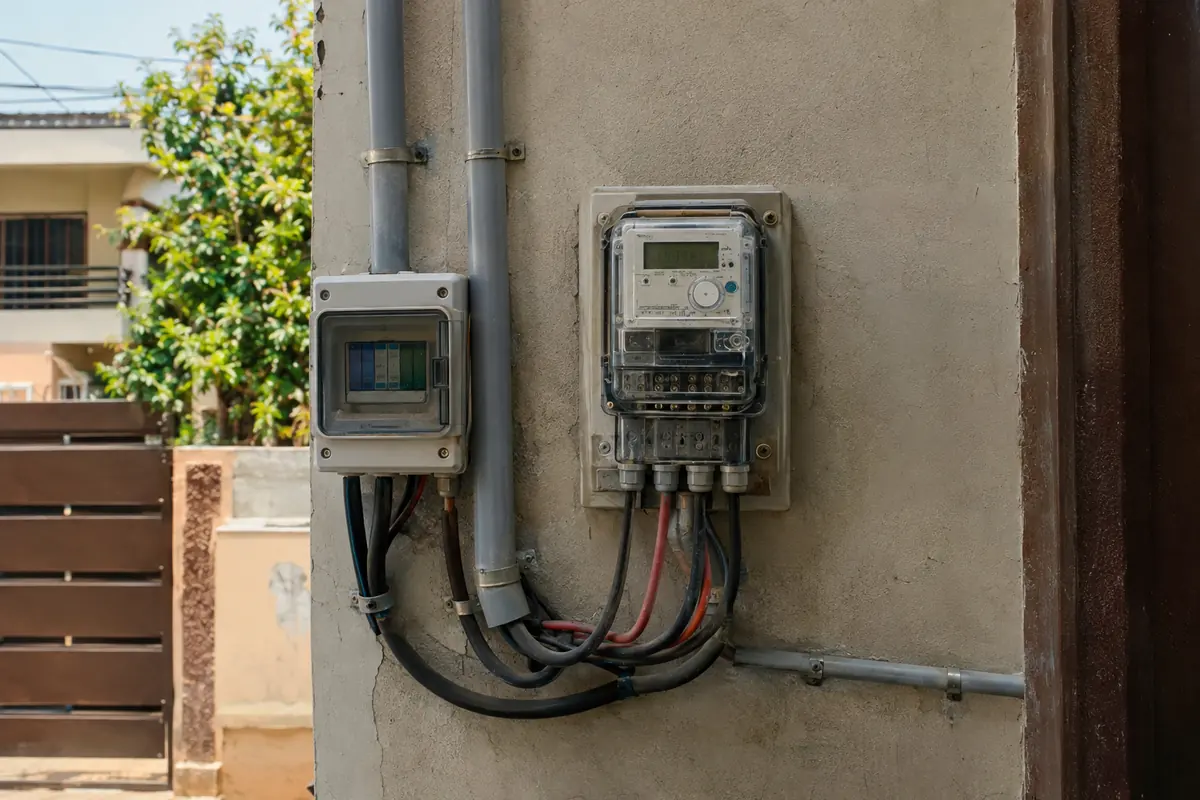
Most 5kW home systems in Pakistan use a single-phase inverter, because most houses up to 10 marla have single-phase connections. If your house has a three-phase meter, you can either use a single-phase inverter on one phase, which is cheaper, or a three-phase inverter, which spreads the solar output across all phases and suits homes with ACs on different phases. Your DISCO also compares the system size with the sanctioned load on your bill when you apply for net billing. If your sanctioned load is lower than the system you want, apply for a load extension first, or the application can be held up.
Comparison table
Three typical 5kW builds side by side. Panels are live; other parts are October 2026 ranges.
| Budget 5kW | Mid-range 5kW | Premium 5kW with battery | |
|---|---|---|---|
| Panels | 10 × 550 W, about Rs 209,000 | 9 × 585 W N-type, about Rs 210,600 | 9 × 620 W N-type, about Rs 223,200 |
| Inverter | Budget hybrid, about Rs 90,000 to Rs 1.35 lakh | Known-brand hybrid, about Rs 1.5 lakh to Rs 2.2 lakh | IP65 hybrid with strong warranty, about Rs 2.2 lakh to Rs 3.3 lakh |
| Battery | None | None, wiring ready | 1 × 5 kWh lithium, about Rs 1.85 lakh to Rs 2.3 lakh |
| Structure | Standard frame | Standard galvanised frame | Elevated or heavy-gauge frame |
| Protection | Basic breakers | DC and AC breakers, surge protection, earthing | Full protection plus monitoring |
| Best for | Tight budgets, low outage areas | Most families | Areas with long evening outages |
5kW vs 3kW vs 10kW
| 3kW | 5kW | 10kW | |
|---|---|---|---|
| Panels (585 W) | 6 | 9 | 18 |
| Panels cost today | Rs 140,400 | Rs 210,600 | Rs 421,200 |
| Monthly units (approx.) | 370 to 390 | 600 to 650 | 1,250 to 1,300 |
| Daytime AC capacity | One 1 ton inverter AC | One 1.5 ton, two at midday | Two to three ACs |
| Roof needed (approx.) | 170 sq ft | 250 sq ft | 500 sq ft |
If you are unsure which size fits your bill, put your 12-month average units into the solar panel calculator.
Buying checklist
- Size from your bill, not your neighbour’s system. Average the last 12 months of units and check that 5kW actually matches.
- Check roof space and shade. Nine large panels need about 250 square feet of clear, south-facing roof. Water tanks and stair rooms often take more space than people think.
- Choose the panel by model, not just brand. Ask for the exact model, wattage and cell type (N-type TOPCon or mono PERC) in writing.
- Match the inverter to the panels. Confirm the inverter’s maximum PV input wattage and voltage handle nine or ten large panels in the string layout proposed. Ask for the string plan.
- Decide on battery readiness. Even if you skip the battery now, buy a hybrid inverter that supports 48V lithium and ask for the battery cable route to be planned.
- Insist on protection. DC breakers or isolator, AC breaker, surge protection on both sides, and proper earthing with a separate rod.
- Check the structure. Galvanised or properly painted steel, bolted to the roof slab, at a tilt close to your city’s latitude, facing south.
- Ask who handles the grid paperwork. For net billing, the installer should prepare the DISCO application and arrange the bidirectional meter. Ask what is included in their fee.
- Get warranties in writing. Panel product and performance warranties from the maker, inverter warranty with a local service centre, and an installer workmanship warranty.
- Pay in stages. A deposit on order, the main payment on delivery and fitting, and the final part when the system is commissioned and working.
If the full amount is a stretch, our solar panels on installments page compares bank and company plans for systems of this size.
| Paper to keep | Why |
|---|---|
| Invoice with panel serial numbers | Panel warranty claims |
| Inverter warranty card | Repairs and replacement |
| String and wiring plan | Future expansion and repairs |
| DISCO application and meter papers | Net billing disputes |
Reading a 5kW quote line by line
A clear quote for a 5kW system should read something like this, with brands and models filled in:
- 9 × 585 W N-type panels, brand and model named, with serial numbers on the invoice
- 1 × 6 kW hybrid inverter, brand and model named, warranty period stated
- Galvanised mounting structure for 9 panels, tilt angle stated
- DC cable (size in mm²), MC4 connectors, DC breaker or isolator, DC surge protection
- AC breaker, AC surge protection, earthing rod and cable
- Installation, testing and commissioning
- Net billing file and meter, if included, with what the fee covers
If a line is missing, ask about it before you compare prices. A quote that is cheaper because it leaves out earthing or surge protection is not cheaper.
Common mistakes to avoid
- Comparing only the total price. Two “5kW” quotes can differ by a lakh or more because of the inverter, the stand or missing protection. Always compare line by line.
- Undersized or overloaded inverter. A 5kW array on a cheap inverter with a low PV input limit wastes output at midday. Check the PV input rating, not just the kW label.
- Mixing panel models. Putting different wattages or brands in the same string drags the whole string down.
- Flat or wrongly facing panels. To save on stand cost, some installers lay panels flat or face them towards the street. You lose output every day for 25 years.
- Skipping surge protection and earthing. Lightning and grid surges are a common reason inverters fail early.
- Sizing for export under net billing. Since February 2026, new users earn much less for exported units than they pay for imported ones. Size for what you use in the daytime, not for the biggest possible export.
- Buying a battery you do not need. If your area has little evening load-shedding, a battery adds cost with limited payback. Start without one and add it later if needed.
- Ignoring roof strength and water. Old roofs need checking before a 5kW frame and nine panels go on top, and stand bolts must be sealed to stop leaks.
| Quote red flag | Ask this |
|---|---|
| “5kW complete” with no brands | Which panel model, which inverter model? |
| No mention of earthing | Is a separate earthing rod included? |
| Very cheap labour | Who is on the crew, and is there a workmanship warranty? |
| Net metering “guaranteed in a week” | What exactly will you submit to the DISCO, and when? |
Looking after a 5kW system
A well-installed 5kW system needs little care, but a few habits keep it producing:

- Wash the panels with plain water every one to three weeks in dusty months, early in the morning or late in the afternoon when the glass is cool.
- Check the inverter app or screen once a week. A sudden drop on a sunny day usually means shade, dirt, a loose connector or a tripped breaker.
- Keep the inverter in a shaded, ventilated spot. Inverters in hot, closed rooms derate and fail sooner.
- Have the installer check bolts, cables and earthing once a year, ideally before the summer.
Before you sign, check today’s panel prices on the home page to make sure the panel line in your quote is fair.
Frequently asked questions
How many panels are in a 5kW solar system?
Usually nine 585 watt panels or ten 550 watt panels. With larger 650 to 720 watt plates you need seven or eight, but each one is heavier and longer.
What is the 5kW solar panel price in Pakistan today?
The panel cost changes with daily market rates, so the live figures on this page are recalculated from our price sheet. The inverter, structure, wiring and fitting are extra and usually cost more than the panels.
Is 5kV the same as 5kW?
Yes, in practice. Home solar systems are rated in kW, and "5kv" is a common way of writing 5kW. Inverters are sometimes labelled in kVA, which is close to kW for home use.
Can a 5kW solar system run an AC?
Yes. It runs one 1.5 ton DC inverter AC comfortably through the day along with the fridge, fans and lights, and two inverter ACs around midday in good sun.
How many units does a 5kW solar system make per month?
Roughly 600 to 650 units a month on average in most Pakistani cities. Output is higher in summer and lower in foggy or cloudy winter weeks.
Should I buy a battery with a 5kW system?
Only if you have regular evening load-shedding or want backup. Many families start with a hybrid inverter and no battery, then add a 5 kWh lithium battery later.
How much roof space does a 5kW system need?
About 250 square feet of shade-free, south-facing roof for nine large panels, plus some walking space for cleaning and maintenance.
Is net metering still worth it for 5kW in 2026?
It can still help, but under NEPRA's 2026 net billing rules exported units earn far less than imported units cost. Size the system for your daytime use rather than for maximum export.