On this page
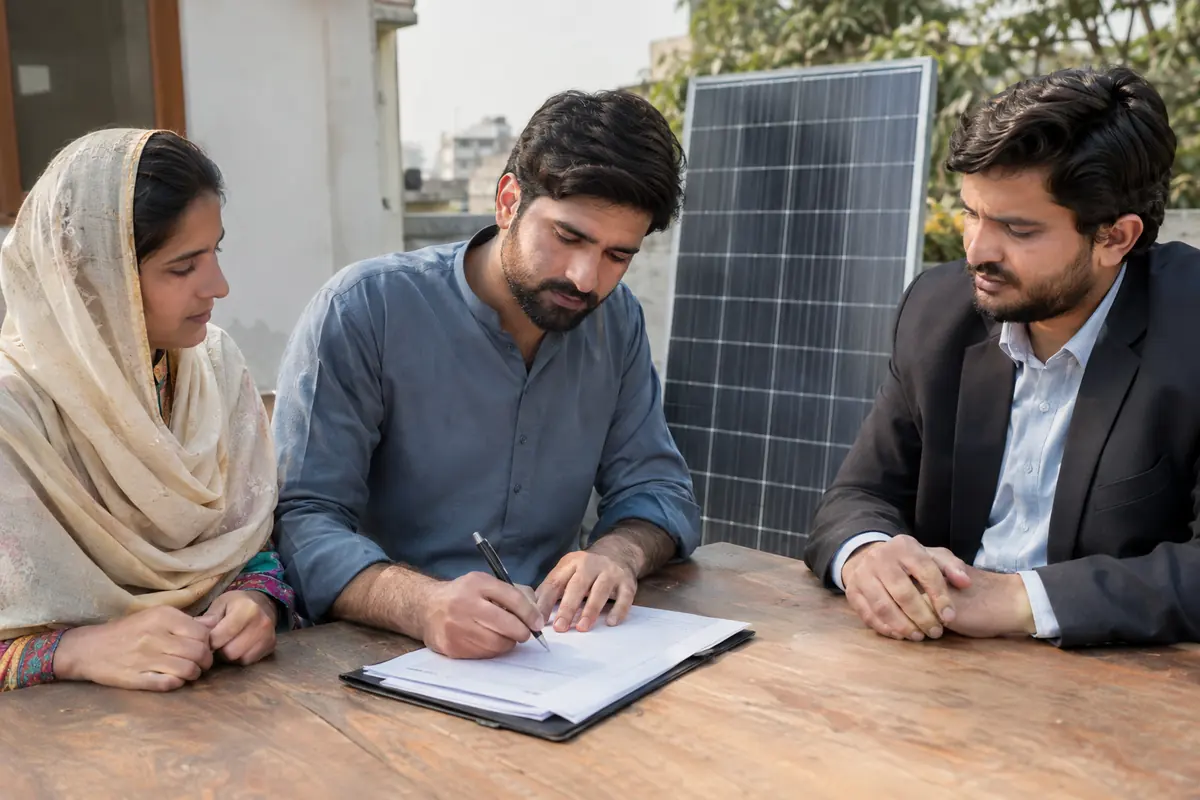
A solar panel installment plan lets you start saving on your bill now and pay for the system over three to ten years instead of upfront. In Pakistan you can do this through a bank loan, an Islamic bank’s financing, an installer’s own plan or, for some households, a government scheme. This guide explains each route, names the bank products we could confirm on the banks’ own websites, shows what the monthly payment really looks like, and tells you what to check before you sign.
Quick answer: how to get solar panels on installments in Pakistan
There are four main ways to buy solar on installments:
- Conventional bank solar loan. For example, Bank Alfalah’s Home Solar Finance lists financing up to Rs 5 million over 3 to 10 years, priced at KIBOR plus 3% for salaried customers and KIBOR plus 4% for self-employed customers, through bank-approved vendors.
- Islamic (Shariah-compliant) solar financing. For example, Meezan Bank’s Meezan Solar programme describes itself as interest-free financing for complete home systems, currently offered in Karachi, Lahore and Rawalpindi/Islamabad.
- Installer or dealer installment plans. Some installers offer their own plans or arrange bank financing for you. Terms vary widely and must be read carefully.
- Government schemes. Provincial programmes, such as those run by the Punjab government, have offered subsidised or interest-free solar for eligible households. See our solar panel scheme page for what is open.
For most salaried homeowners in big cities, a bank or Islamic bank plan through an approved vendor is the most transparent option. For a household with high summer bills, the monthly installment can end up in the same range as the bill it replaces, which is why financing has become popular.
How we checked this
Financing terms are easy to get wrong, and many websites copy outdated figures. So we only name a bank product where we read its terms on the bank’s own website in October 2026, and we say exactly what each page states.
| Product | Where we checked | What we confirmed |
|---|---|---|
| Bank Alfalah Home Solar Finance | Bank Alfalah personal banking website | Limit, tenure range, KIBOR-based pricing, income and age criteria, approved vendors |
| Bank Alfalah Green Energy | Bank Alfalah business banking website | 4 to 1,000 kW systems with net metering, up to 5 years, residential caps |
| Meezan Solar | Meezan Bank website | Interest-free (Islamic) positioning, cities, charges, limit for Premium customers |
| HBL solar tubewell financing | HBL news release, 31 January 2024 | Over Rs 2 billion financed for solar tubewells for more than 850 farmers |
What we did not do: we did not quote a KIBOR figure, because it changes with the State Bank’s policy rate and would make this page wrong within weeks. We did not invent installer plans, and we have not listed any bank whose solar product we could not find on its own site. Banks change terms often, so confirm the current offer with the bank before applying.
Solar panel financing options explained
Conventional bank solar loans
A bank solar loan works like a car loan. The bank pays an approved vendor for the system, and you repay the bank in fixed or variable monthly installments.
Bank Alfalah Home Solar Finance, as listed on the bank’s website:
- Financing up to Rs 5 million
- Tenure of 3 to 10 years
- Variable pricing at 1-year KIBOR plus 3% for local salaried customers, and KIBOR plus 4% for self-employed professionals and businesspeople, with a 6-month KIBOR option and a hybrid fixed-then-variable option
- Minimum net monthly income of Rs 50,000 for salaried applicants and Rs 100,000 for self-employed applicants
- Age 25 to retirement for salaried, 25 to 70 for self-employed
- The property must be residential and owned by you, your spouse or a blood relative (with an NOC)
- Equipment must come from a Bank Alfalah-approved vendor; insurance is required, with the first year paid upfront
- Partial and balloon prepayments allowed; early settlement carries charges
Bank Alfalah Green Energy, the bank’s broader solar facility, covers systems from 4 kW to 1,000 kW with net metering, for individuals, SMEs, commercial and agricultural customers. It runs up to 5 years including a 3-month grace period. For residential use, the bank caps it at Rs 2.5 million for rented premises and Rs 4 million for owned premises, with KIBOR-plus-spread pricing.
Islamic solar financing
Islamic banks structure solar financing without interest, usually through a rental or shared-ownership arrangement, so the monthly payment includes the bank’s profit instead of interest. For many Pakistani families this is the deciding factor.
Meezan Solar (Meezan Bank’s Solar Panel Financing Program), as listed on the bank’s website:
- Positioned as interest-free financing for complete home solar systems
- Available only in Karachi, Lahore and Rawalpindi/Islamabad
- Up to Rs 3 million for Meezan Premium Banking customers
- Processing charges of Rs 5,000 plus FED, documentation at actual, no late payment charges listed
- Can be terminated at any time by paying the remaining installments
- Applicants near retirement can qualify if at least 75% of installments fall within their working years
This makes Meezan one of the few clearly documented options for a solar panel on installment in Karachi, alongside banks that serve all cities.
Installer and dealer installment plans
Many installers advertise “solar on easy installments”. In practice these fall into three types:
| Type | How it works | What to check |
|---|---|---|
| Bank-backed plan | Installer is an approved vendor; the bank finances you | The bank’s terms apply. Ask which bank and get its paperwork. |
| Installer’s own credit | Installer collects monthly payments directly | Total price vs cash price, ownership until paid, what happens if you miss a payment |
| Rent-to-own or PPA | You pay for power or rent the system; it becomes yours later | Contract length, buy-out price, who maintains it |
The installer’s own credit plans are the least regulated. Always compare the total of all installments with the cash price of the same system.
Solar financing for farmers and tube-wells
Agricultural solar financing is a separate category. HBL reported in January 2024 that it had financed more than Rs 2 billion of solar-powered tube-wells for over 850 farmers. Bank Alfalah’s Green Energy facility also lists agricultural customers. If you are a farmer, ask your bank’s agriculture desk rather than the consumer loan desk.
Farm solar financing works a little differently from a home solar loan:
- Security: banks often take the land record or a lien on the pump and panels instead of a salary slip.
- Repayment timing: some lenders match installments to harvest seasons, so ask whether half-yearly payments are possible.
- System size: tube-well systems are usually larger than home systems, often 10 kW to 30 kW or more, so the panel count and the cost of the stand matter more.
- Pump compatibility: the solar pump drive must match the motor size and the depth of the water table. Get this written into the quotation.
- Diesel savings: compare the monthly installment with what you spend on diesel or on the electricity bill for the tube-well today. If the installment is lower, the plan pays for itself from the first month.
Government schemes
Provincial governments have run solar programmes with subsidies or interest-free installments for eligible households, with conditions such as monthly units consumed and a clean bill history. These schemes open and close in phases, so their terms change. Our CM Punjab solar panel scheme page covers the current Punjab programme in detail.
Before you count on a government scheme, check three things: whether applications are open right now, whether your monthly units and bill history meet the conditions, and how long the waiting list is. If the wait is many months, a bank or installer plan may cost less overall than the units you keep paying for while you wait. You can also apply for a scheme and keep a bank quote ready as a backup.
Step by step: applying for a bank solar loan
The process is similar across banks, though the order can vary:
- Check eligibility on the bank’s website: income, age, job or business length and property ownership.
- Choose an approved vendor. The bank keeps a list. Get a site survey and a written quotation from that vendor.
- Submit the application with documents and the vendor quotation at a branch or online.
- Bank verification: income checks, a credit report (eCIB) and sometimes a visit to the property.
- Approval and signing: you sign the financing agreement, pay the processing fee, insurance and any upfront contribution.
- Disbursement to the vendor: the bank pays the vendor directly, often in stages.
- Installation and commissioning: the vendor installs the system and, if included, applies for net metering.
- Installments start, usually from the month after disbursement.
Documents you will usually be asked for
- CNIC of the applicant and any co-borrower
- Recent salary slips and a bank statement (salaried), or business proof, tax returns and bank statements (self-employed)
- Latest electricity bill for the property
- Property ownership papers, or an NOC from the owner if it is a spouse or relative
- Vendor quotation and site survey report
- NTN, if you are self-employed or a business
Ask the bank for its exact list before you start, because missing papers are the most common reason for delay.
Is an installment plan worth it?
The honest answer depends on three numbers: how many units the system saves, what each unit costs you on your bill, and the monthly installment.
| Step | Example (5 marla house, 6 kW system) |
|---|---|
| Expected solar output | A 6 kW system in most of Punjab and Sindh produces roughly 700 to 850 units a month on average across the year |
| Units you no longer buy or that you export | Most of that output, depending on daytime use and net-metering terms |
| Value of those units | Units saved multiplied by the per-unit rate on your own bill |
| Monthly installment | From the bank’s offer for your amount and tenure |
| Result | If the value of units saved is close to or above the installment, the plan pays for itself as you go |
Do this calculation with your own bill. If your monthly usage is low, a long installment on a large system rarely makes sense. If you pay heavy summer bills, financing can work well, especially with a tenure of three to five years.
Cash, installments or wait and save?
| Option | Upside | Downside | Best for |
|---|---|---|---|
| Pay cash now | Lowest total cost, best bargaining power | Large upfront amount | Those with savings |
| Bank or Islamic installments | Start saving now, documented terms | Total cost higher, eligibility rules | Salaried families in big cities |
| Installer credit | Easy approval | Often the highest markup, weak paperwork | Only with a written contract and a cash-price comparison |
| Wait and save | No debt | Keep paying full bills meanwhile | Low-usage homes |
Installments and net metering
Net metering is what makes most financed systems pay off, because daytime surplus is credited against your night-time use. Three things to get clear before signing:
- Who applies: many approved vendors include the DISCO application in the package; some charge extra.
- When installments start: if the meter change takes several weeks, you could be paying installments before the system can export. Ask whether the first installment can be timed after commissioning.
- Policy changes: net-metering rules are set by NEPRA and the government and can change during a long financing term. A shorter tenure reduces that risk.
Questions to ask the bank
- What is the total annual rate today, and how often does it reset?
- Is there a fixed-rate or hybrid option, and for how long is it fixed?
- What is the minimum contribution I must pay upfront?
- What are the processing, documentation, survey and insurance charges in rupees?
- What are the early settlement and partial prepayment charges?
- Which vendors in my city are approved, and can I choose the equipment brands?
- Does the financing cover batteries, or only panels and inverter?
- What happens if the property is sold before the loan is repaid?
Missed payments, selling the house and other what-ifs
Financing is a contract, so plan for the unexpected before you sign:
- Missed payments are reported to the credit bureau and can affect future loans. Meezan’s page notes that negative history stays on eCIB reports for two years after settlement.
- Selling the house usually means settling the remaining balance first, since the system is fixed to the property. Ask whether the buyer can take over the financing.
- Job change or retirement can matter if the bank linked approval to employment. Meezan, for example, sets a rule for applicants retiring during the term.
- System failure does not pause the installments. Keep warranty cards, the vendor’s contact and the inverter app login safe.

Comparison table: what your monthly installment looks like
The monthly amount depends on the amount financed, the tenure and the total annual rate (KIBOR plus the bank’s spread, or the Islamic bank’s profit rate). The table below uses two illustrative annual rates, 15% and 20%, only to show how tenure changes the payment. It is not a quote from any bank.
| Amount financed | Tenure | Monthly at 15% (illustrative) | Total paid at 15% | Monthly at 20% (illustrative) | Total paid at 20% |
|---|---|---|---|---|---|
| Rs 500,000 | 3 years | about Rs 17,300 | about Rs 624,000 | about Rs 18,600 | about Rs 669,000 |
| Rs 500,000 | 5 years | about Rs 11,900 | about Rs 714,000 | about Rs 13,200 | about Rs 795,000 |
| Rs 1,000,000 | 3 years | about Rs 34,700 | about Rs 1,248,000 | about Rs 37,200 | about Rs 1,338,000 |
| Rs 1,000,000 | 5 years | about Rs 23,800 | about Rs 1,427,000 | about Rs 26,500 | about Rs 1,590,000 |
| Rs 1,000,000 | 7 years | about Rs 19,300 | about Rs 1,621,000 | about Rs 22,200 | about Rs 1,865,000 |
Longer tenure means a smaller monthly payment but a much bigger total. On Rs 1 million at 20%, going from 3 to 7 years lowers the installment by about Rs 15,000 a month but adds over Rs 500,000 to the total.
To see what you would be financing, start with the panel cost. On our live sheet, the panels alone for a 5 kW system with 585 W plates cost Rs 210,600, and for 10 kW Rs 421,200. Add the inverter, structure, wiring and installation from our solar system price guide.
| Model | Watt | Price per panel | Per watt | This week | Trend |
|---|---|---|---|---|---|
| Inverex Jolywood dual glassN-type | 600 W | Rs 25,500 | Rs 42.5 | No change | |
| Longi Hi-MO X9N-type HPBC 2.0 | 600 W | Rs 26,400 | Rs 44.0 | No change | |
| Trina Vertex N bifacialN-type i-TOPCon | 590 W | Rs 23,600 | Rs 40.0 | No change | |
| Canadian TOPHiKu6 bifacialN-type TOPCon | 590 W | Rs 25,370 | Rs 43.0 | No change | |
| Crown N-type bifacial 16BBN-type | 585 W | Rs 23,400 | Rs 40.0 | No change | |
| JA Solar DeepBlue 4.0 N-type bifacialN-type | 585 W | Rs 23,545 | Rs 40.2 | No change | |
| Astronergy ASTRO N5 bifacialN-type TOPCon | 585 W | Rs 23,985 | Rs 41.0 | No change | |
| Inverex Mustang bifacialN-type TOPCon | 585 W | Rs 24,280 | Rs 41.5 | No change | |
| Longi Hi-MO X7 bifacialN-type | 585 W | Rs 25,010 | Rs 42.8 | No change | |
| Canadian TOPHiKu6 bifacialN-type TOPCon | 585 W | Rs 25,155 | Rs 43.0 | No change | |
| Jinko Tiger Neo N-type bifacialN-type TOPCon | 585 W | Rs 25,420 | Rs 43.5 | No change | |
| Jinko Tiger Neo N-typeN-type TOPCon | 580 W | Rs 24,505 | Rs 42.3 | No change |
Buying checklist: before you sign an installment plan
- Size the system first. Use the solar panel calculator so you do not finance more panels than you need.
- Get the cash price. Ask the same vendor for a cash price for the exact same system, then compare it with the total of all installments.
- Ask for the full cost schedule. Processing fee, documentation, insurance, survey charges, late payment charges and early settlement charges.
- Check fixed or variable. A KIBOR-linked loan can go up or down. A fixed or Islamic plan gives a steadier payment.
- Confirm the vendor is approved. Banks only pay approved vendors. Ask the bank, not just the installer.
- Read the equipment list. The brand, model and wattage of panels, inverter model and battery should be written in the financing papers. Check panel rates on the solar panel price list.
- Ask who owns the system until the last payment. And what happens if you sell or rent out the house.
- Check the warranty link. If the system fails, you still owe the installments. Make sure warranty and service are documented.
- Plan net metering. Ask who handles the DISCO application and whether the installment starts before or after the meter is changed.
- Keep a buffer. Do not commit to an installment that only works if every summer bill drops to zero.
Common mistakes to avoid
- Comparing only the monthly amount. A low installment over a long tenure can cost far more in total. Always compare totals.
- Ignoring KIBOR risk. On a variable loan, the payment can rise if rates go up during the term.
- Financing a cheap system. The bank does not check quality for you. Poor panels or a weak inverter mean paying installments on a system that underperforms.
- Paying an installer “booking money” for a bank plan. With a bank-backed plan, the bank pays the approved vendor. Be careful of large advances.
- Assuming the bill disappears. Fixed charges, night use and winter months mean you will usually still get a bill. Plan the installment against realistic savings.
- Missing the fine print on insurance. Some plans require yearly insurance renewals that add to your cost.
- Not checking eligibility first. Income, age, job length and property ownership rules decide approval. Check them before you pay for a survey.
Installments make solar affordable for many more families, but only if the system and the terms are both sound. Compare panel brands on our best solar panels in Pakistan page and current rates on the home page before you choose.
Frequently asked questions
Can I buy solar panels on installments in Pakistan?
Yes. You can use a conventional bank solar loan, an Islamic bank's solar financing, an installer's own installment plan or, if eligible, a government scheme. Bank plans through approved vendors usually have the clearest terms.
Which banks offer solar financing in Pakistan?
Bank Alfalah lists Home Solar Finance and a Green Energy facility on its website, Meezan Bank offers Meezan Solar as Islamic financing, and HBL has financed solar tube-wells for farmers. Check each bank's site for its current terms.
Is there an interest-free solar installment plan?
Islamic banks structure solar financing without interest. Meezan Solar, for example, is offered as interest-free financing in Karachi, Lahore and Rawalpindi/Islamabad. The payment still includes the bank's profit.
How long can a solar loan run?
Terms differ by bank. Bank Alfalah's Home Solar Finance lists 3 to 10 years and its Green Energy facility up to 5 years. A shorter tenure means a higher monthly payment but a much lower total cost.
Where can I get solar panels on installments in Karachi?
Meezan Solar is available in Karachi, and banks with nationwide solar loans also serve the city through approved vendors. Ask the bank for its list of approved installers in Karachi.
Who is eligible for a solar loan?
Banks set income, age and property rules. Bank Alfalah, for example, asks for a minimum net monthly income of Rs 50,000 for salaried and Rs 100,000 for self-employed applicants, and the house must be residential and owned by you or a close relative.
What documents do I need for solar financing?
Usually your CNIC, salary slips or business proof, bank statements, the latest electricity bill, property papers or an owner's NOC, and the approved vendor's quotation. Ask the bank for its exact list.
How much will my monthly solar installment be?
It depends on the amount financed, the tenure and the rate. As an illustration, Rs 1 million over 5 years at 20% a year is about Rs 26,500 a month. Get the exact figure from the bank's offer.