On this page
- Quick answer: how do solar panels work?
- How we checked this
- How solar panels work, step by step
- How a home solar system works in Pakistan
- Comparison table: advantages and disadvantages of solar panels
- Buying checklist: turning the theory into a good purchase
- Common mistakes to avoid
- Frequently asked questions
Knowing how solar panels work makes you a much harder customer to fool. Once you understand what happens inside a cell, why heat and shade matter and what the inverter is for, a seller’s claims become easy to check. This guide explains the science in plain language, follows the electricity from the roof to your fan, and sets out the real advantages and disadvantages of solar for a Pakistani home.
Quick answer: how do solar panels work?
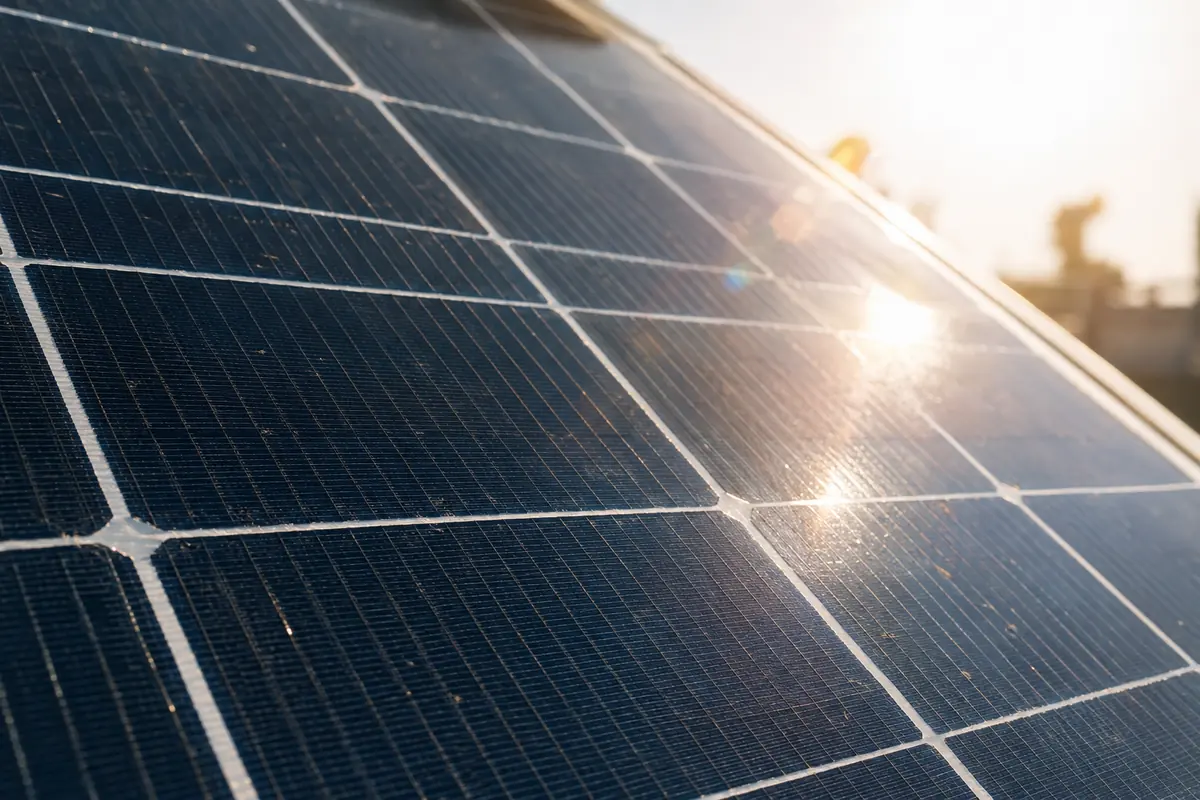
A solar panel is a set of silicon cells that turn sunlight directly into electricity, with no moving parts and no fuel. When light hits a cell, its energy frees electrons in the silicon. A built-in electric field inside the cell pushes those electrons in one direction, and metal contacts collect them as a direct current (DC). The cells are wired together so their small voltages add up, and the panel sends this DC power to an inverter, which converts it into the 220–230 V alternating current (AC) used by your home appliances.
In Urdu, a solar panel is usually just called سولر پینل (solar panel), or شمسی پینل (shamsi panel), from shams, meaning sun. Solar energy is شمسی توانائی (shamsi tawanai).
- Input: sunlight (photons)
- Inside the panel: silicon cells with a p-n junction create DC electricity
- Inverter: turns DC into AC for the house, and manages batteries and the grid
- Output: units (kWh) that cut your electricity bill or keep you running during load-shedding
That is the whole idea in one paragraph. The rest of this page goes one level deeper, because the details explain the things buyers actually notice: why a panel makes less than its sticker on a hot afternoon, why a small shadow matters, why the inverter is so important, and why panels slowly lose a little power every year.
How we checked this
This page explains established physics, so our job was to keep it correct and practical rather than new.
| Topic | Where the facts come from |
|---|---|
| The photovoltaic effect and p-n junctions | Standard semiconductor physics, as explained by national laboratories such as NREL |
| Cell voltage, efficiency and temperature effects | Maker datasheets for current N-type panels (for example Jinko Tiger Neo) |
| Test conditions (STC and NOCT) | The definitions printed on every panel datasheet |
| Inverters, batteries and grid connection | Inverter manuals and NEPRA’s prosumer regulations |
| Output in Pakistan | Typical sun hours and real system output across Punjab, Sindh and KP |
Where we simplify, we say so. Where a number depends on the model, we give a typical range and tell you where to find the real value on your own panel.
How solar panels work, step by step
Step 1: Light carries energy
Sunlight arrives as tiny packets of energy called photons. At the ground on a clear day, sunlight delivers roughly 1,000 watts per square metre at midday. Panel ratings are measured at exactly this level, which is why it is called “standard test conditions”.
Step 2: Silicon frees an electron
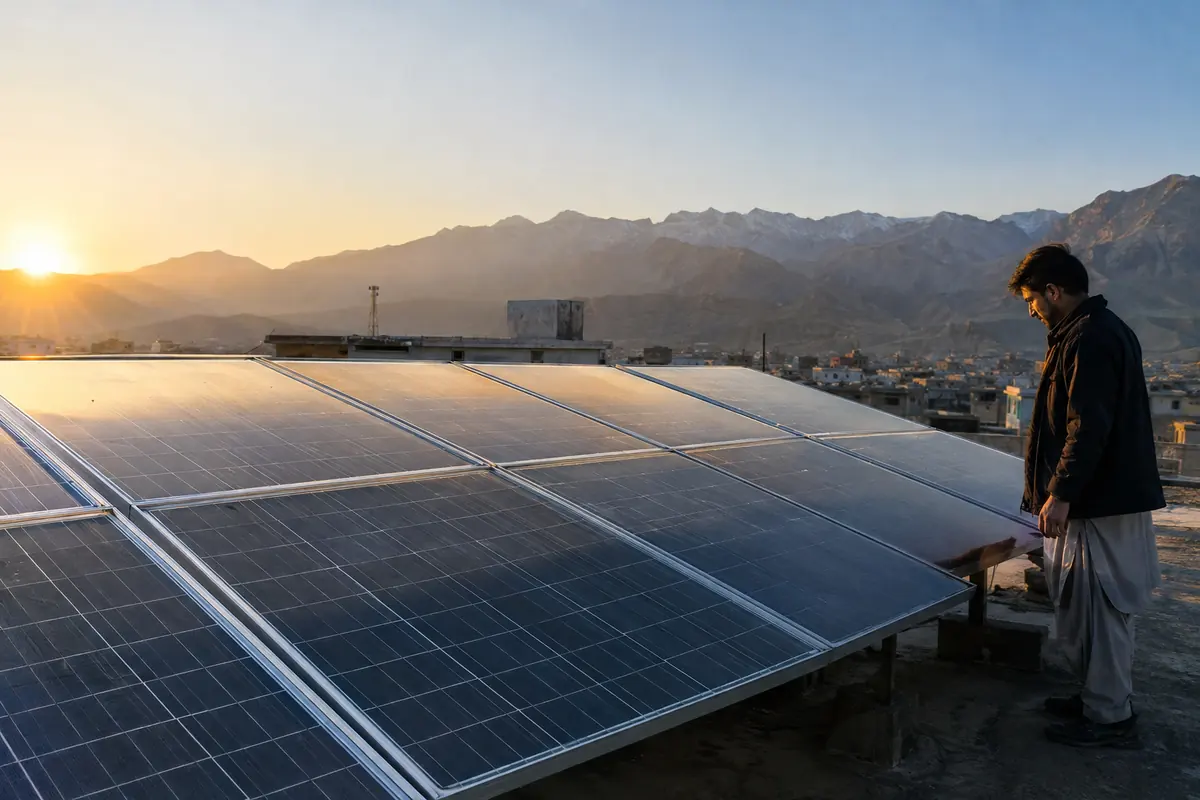
Silicon is a semiconductor. Its electrons are normally held in place, but a photon with enough energy can knock one loose. For silicon, the energy needed (called the band gap) is about 1.1 electron-volts. Visible and near-infrared light is strong enough; much of the deep infrared is not. Light with more energy than needed frees an electron, but the extra energy turns into heat. This is the main reason a single silicon cell can never turn all sunlight into electricity.
Step 3: The p-n junction pushes electrons one way
A loose electron would simply fall back into place unless something moves it. Each cell is made from two layers of silicon treated with small amounts of other elements. One side has extra electrons (n-type) and the other has a shortage (p-type). Where they meet, the p-n junction, a permanent electric field forms. That field sweeps freed electrons towards one side and the “holes” they left behind towards the other. This one-way push is what creates voltage.
Step 4: Metal contacts collect the current
Thin silver lines on the front of the cell (or contacts on the back, in back-contact cells) collect the electrons. Connect the front and back through a load, such as a fan, and current flows. One cell makes only about 0.6–0.7 volts, whatever its size. A bigger cell makes more current, not more voltage.
Step 5: Cells are wired into a panel
To get a useful voltage, cells are wired in series. A modern 144 half-cell panel arranges them so that around 72 cells’ worth of voltage is in series, giving a working voltage of roughly 40–45 V. The reference datasheet we used, for a 585 W N-type panel, lists a Vmp of about 42.5 V and an Imp of about 13.8 A. Multiply them and you get the rated power.
Step 6: The inverter makes it usable
Panels produce DC. Your home runs on AC. The inverter converts one to the other and, in a hybrid system, also charges batteries and talks to the grid. It also runs maximum power point tracking (MPPT), constantly adjusting the load on the panels so they work at the voltage that gives the most power as sunlight and temperature change.
Where the rest of the sunlight goes
If a panel is 22% efficient, where does the other 78% go? Roughly, in these ways:
- Too little energy: some infrared photons cannot free an electron at all and pass through or warm the panel.
- Too much energy: blue and ultraviolet photons free an electron but waste their extra energy as heat.
- Reflection: a small share bounces off the glass and cell surface, even with anti-reflective coatings.
- Recombination: some freed electrons fall back into place before they reach a contact.
- Resistance: a little power is lost as heat in the metal lines, solder ribbons and cables.
- Shading by the contacts: front silver lines block a little light, which is why back-contact cells move them to the back.
Each new cell design, from PERC to TOPCon, HJT and back-contact, attacks one or more of these losses.
What is inside a solar panel?
| Layer | What it does |
|---|---|
| Tempered glass (front) | Protects the cells, lets light through, carries an anti-reflective coating |
| Encapsulant (EVA or POE) | Glues the layers together and seals out moisture |
| Solar cells | Convert light to electricity |
| Backsheet or rear glass | Protects the back; dual-glass and bifacial panels use glass on both sides |
| Aluminium frame | Gives strength and a way to clamp the panel |
| Junction box with bypass diodes | Joins the cables and lets current skip shaded sections |
| Cables and connectors | Carry DC power to the next panel or the inverter |
Reading the numbers: STC and NOCT
Every datasheet shows two sets of figures. They describe the same panel under different conditions.
| Condition | Sunlight | Temperature | 575 W reference panel output |
|---|---|---|---|
| STC (standard test conditions) | 1,000 W/m² | Cells at 25 °C | 575 W |
| NOCT (nominal operating cell temperature) | 800 W/m² | Air at 20 °C, light wind; cells near 45 °C | About 432 W |
STC is the lab rating used to sell the panel. NOCT is closer to a normal sunny day on a roof, and on a Pakistani summer afternoon real conditions are hotter still. Neither number is wrong; they simply answer different questions. When you estimate your own output, the NOCT figure is the more realistic starting point.
Do solar panels need direct sunlight?
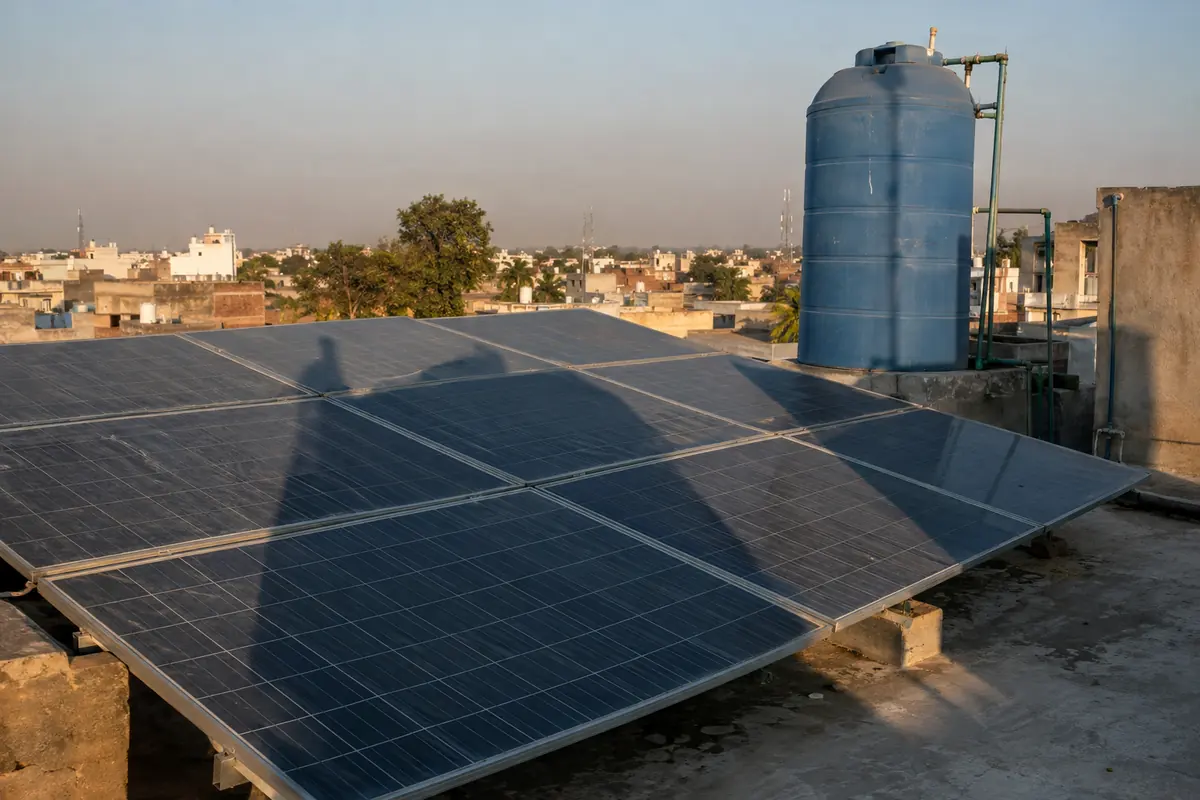
No, but they work best in it. Panels also produce power from diffuse light on cloudy or hazy days, at a much lower level. Direct sun on a clean panel, facing roughly south at a sensible tilt, gives the most units. That is why the angle and direction of your structure matter, and why a panel tucked behind a water tank or stair room can lose a large share of its yearly output.
Mono, poly and thin-film: same principle, different cells
Every type of panel uses the photovoltaic effect. What changes is the material and how the cells are made.
| Type | Material | Typical module efficiency | Where you see it in Pakistan |
|---|---|---|---|
| Monocrystalline (PERC, TOPCon, HJT, back-contact) | Single-crystal silicon | Roughly 20–24% | Almost all new rooftop panels |
| Polycrystalline | Multi-crystal silicon | Lower, often 15–18% | Older systems and some cheap small panels |
| Thin-film (CdTe, CIGS, amorphous) | Very thin layers on glass or foil | Varies widely | Some flexible panels and utility plants abroad |
Why heat, shade and dust matter
Once you know how a cell works, three everyday problems make sense:
- Heat: hot silicon produces less voltage. A typical panel loses about 0.3–0.4% of its power for every degree its cells run above 25 °C. On a June roof in Multan the cells can reach 60–70 °C, so a few hundred watts of a big system disappear in the afternoon heat.
- Shade: cells in series share one current. A shaded cell restricts the current of its group. Bypass diodes limit the damage by letting current go around the shaded section, but that section’s output is lost.
- Dust and soot: anything that blocks light reduces the photons reaching the silicon. Pakistani cities lose noticeable output within days in smoggy, dry weather, which is why our solar panel cleaning guide matters as much as the panel itself.
How efficient are solar panels?
A good modern panel converts about 21–23% of the sunlight that hits it into electricity; the reference 575 W panel datasheet we used lists 22.07%. That sounds low, but sunlight is free and plentiful. The theoretical ceiling for a single-junction silicon cell is around 29%, and the best laboratory silicon cells are now within a couple of points of it. Higher figures come from stacking a second material on top of silicon, which our latest solar panel technology guide explains.
Bifacial panels: light from both sides
A bifacial panel has a transparent back (usually glass) and cells that can accept light from the rear as well. Sunlight reflected from a light-coloured roof, white gravel or a bright floor reaches the back of the cells and adds output. The gain depends heavily on how high the panel is mounted and how reflective the surface below is: on a raised structure over a white roof it can be worthwhile, while on a low frame over dark concrete it is small. The physics is the same; the cell simply has two windows instead of one.
Why panels slowly lose power
Nothing inside a panel wears out the way an engine does, but the materials age. Sunlight, heat and moisture slowly affect the encapsulant, the cell surfaces and the solder joints, and a panel’s output falls a little each year. On good modern N-type panels, makers guarantee only about 1% loss in the first year and around 0.4% per year after that. That slow, steady decline is why a panel bought today should still be producing most of its rated power decades from now. Our solar panel lifespan guide covers this in detail.
How a home solar system works in Pakistan
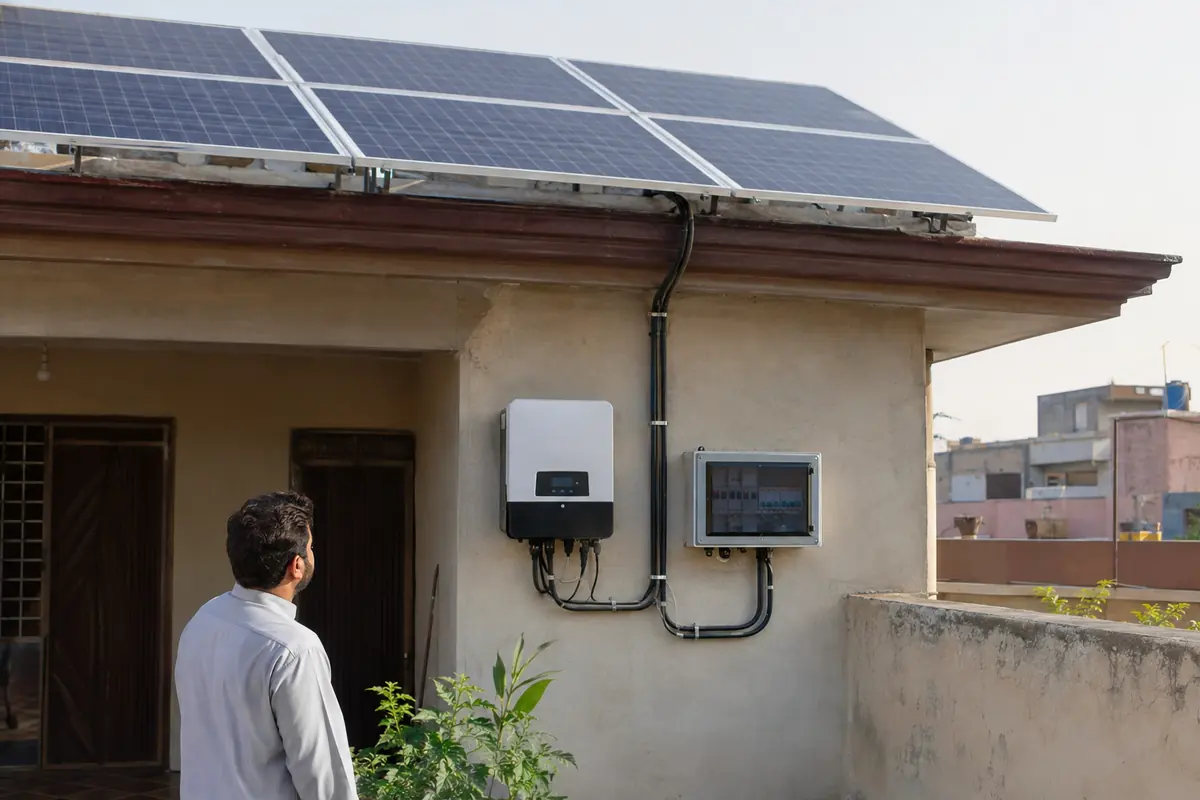
The panel is only one part. Here is the path electricity takes in a typical home:
- Panels on the roof turn sunlight into DC.
- DC cables, isolator and surge protection carry it safely to the inverter.
- The inverter converts DC to AC and tracks maximum power.
- The house uses the AC power first: fans, lights, fridge, pump, AC.
- Batteries (in hybrid systems) store surplus for the evening and for load-shedding.
- The grid (with an approved DISCO connection) takes any remaining surplus and supplies you when solar is not enough.
On-grid, off-grid and hybrid
| System type | How it works | Works in load-shedding? | Best for |
|---|---|---|---|
| On-grid | Panels and inverter tied to the grid; no battery | No, it switches off for safety | Cutting the bill where supply is reliable |
| Off-grid | Panels charge batteries; no grid connection | Yes | Villages, farms, places with no grid |
| Hybrid | Panels, batteries and grid together | Yes, from the battery | Most Pakistani homes |
Since February 2026, new grid-connected systems fall under NEPRA’s Prosumer Regulations 2026, which use net billing: exported units are credited at a lower rate than you pay for imported units. That makes it more valuable than before to use your solar power directly during the day. Check the current rules with your DISCO before you apply.
How many units does a solar panel make?
As a rule of thumb, 1 kW of well-installed panels in most of Pakistan produces roughly 4–5 units (kWh) on an average day across the year, more in spring and less in foggy winter weeks. A single 585 W panel therefore makes roughly 2.5–3 units on a good day. A 5 kW system, which needs about 9 panels of 585 W, makes roughly 20–25 units on a clear day. The solar panel calculator turns your monthly bill into a system size using this kind of figure.
Comparison table: advantages and disadvantages of solar panels
| Advantages of solar panels | Disadvantages of solar panels |
|---|---|
| Cuts monthly electricity bills, often sharply | Upfront cost of panels, inverter, structure and wiring |
| Keeps fans and lights on during load-shedding (with a battery) | Batteries add significant cost and need replacing |
| No fuel, no noise, almost no moving parts | No output at night and much less in fog or heavy cloud |
| Panels last 25 years or more with slow, predictable ageing | Needs roof space with little shade |
| Low maintenance: mainly cleaning and occasional checks | Output drops with heat and dust; regular cleaning needed |
| Protects against future tariff increases | Grid export rules can change, as the 2026 move to net billing showed |
| Cleaner air: no diesel generator smoke | Quality varies; poor installation and fake panels are common |
The benefits of solar panels for a Pakistani household
- Lower bills: every unit you make and use yourself is a unit you do not buy at the full slab rate.
- Fewer generator hours: a hybrid system can replace most daytime generator use.
- Predictable costs: panel output falls slowly and predictably, so savings are easy to estimate.
- Higher property appeal: a working solar system is a selling point for many buyers.
For current prices of the main part, see the solar panel price list. A good 585 W panel currently costs Rs 23,400, and the market average is Rs 41.3 per watt.
Buying checklist: turning the theory into a good purchase
- Check the label values. Pmax, Vmp, Imp, Voc and Isc should match the datasheet; Vmp × Imp should be close to Pmax.
- Look at the temperature coefficient. A smaller number (for example −0.29% per °C rather than −0.40%) means less loss on hot days.
- Check the efficiency. Higher efficiency means more watts from the same roof space.
- Ask about cell type. N-type (TOPCon, HJT, back-contact) panels generally age more slowly than older P-type PERC panels; see types of solar panels.
- Match panels and inverter. String voltage must suit the inverter’s input range; our guide to series and parallel wiring explains how.
- Plan for shade. Keep panels away from water tanks, walls and stair rooms, or put shaded panels on a separate input.
- Read the warranties. Separate product and power warranties, in writing.
- Decide on batteries. If load-shedding is your main problem, budget for a hybrid inverter and a battery.
Common mistakes to avoid
| Mistake | Why it happens | Better approach |
|---|---|---|
| Expecting rated watts all day | The rating is at 1,000 W/m² and 25 °C, which rarely happen together | Expect real output to be lower, especially in summer heat |
| Thinking an on-grid system helps in load-shedding | On-grid inverters switch off when the grid fails | Choose a hybrid inverter with a battery |
| Ignoring shade from a water tank | One shaded group of cells drags its section down | Move the panel or the tank, or use a separate string |
| Buying on wattage alone | Two “585 W” panels can differ in efficiency, heat loss and ageing | Compare datasheets, not just stickers |
| Never cleaning the panels | Dust and soot cut light reaching the cells | Clean regularly with soft water and a soft brush |
| Believing panels work at night | Cells need light | Store energy in a battery or use the grid |
If you are comparing brands next, our list of the best solar panels in Pakistan is the natural next step, and today’s prices for every size are on the home page.
Frequently asked questions
How do solar panels work?
Sunlight frees electrons in the silicon cells, and an electric field built into each cell pushes them in one direction, creating a DC current. The cells are wired together to raise the voltage, and an inverter converts the DC into AC for your home.
What is the meaning of solar panel in Urdu?
A solar panel is usually called سولر پینل in Urdu, and sometimes شمسی پینل (shamsi panel), from shams meaning sun. Solar energy is called شمسی توانائی (shamsi tawanai).
What is a solar panel?
A solar panel is a weatherproof frame of silicon cells, glass and encapsulant that turns sunlight directly into electricity. It has no moving parts and uses no fuel.
What are the advantages of solar panels?
They cut electricity bills, can keep fans and lights running during load-shedding with a battery, need little maintenance and last 25 years or more. They also reduce reliance on noisy, polluting generators.
What are the disadvantages of solar panels?
The upfront cost is significant, batteries add more, and panels produce nothing at night and much less in fog or heavy cloud. Output also falls in strong heat and with dust, and grid export rules can change.
Do solar panels work on cloudy days?
Yes, but at a much lower level. Panels use diffuse light on cloudy or foggy days, so output drops sharply but does not stop until the sun sets.
Why do solar panels produce less power in summer heat?
Silicon cells lose voltage as they get hotter. A typical panel loses about 0.3-0.4% of its power for every degree above 25 °C, so on a hot Pakistani roof the afternoon output is noticeably below the label.
Why do I need an inverter with solar panels?
Panels produce DC electricity, while household appliances run on AC. The inverter converts DC to AC, tracks the panels' best operating point and, in hybrid systems, manages batteries and the grid.
How many units does a solar panel produce per day in Pakistan?
A rough rule is 4-5 units per day for each kilowatt of panels, averaged over the year. One 585 W panel therefore makes around 2.5-3 units on a good day, depending on the season, tilt, heat and cleaning.