On this page
The latest solar panel technology falls into two groups: designs you can already buy in Pakistan, and laboratory breakthroughs that make headlines but are years from a local shop. This guide separates the two. It explains TOPCon, HJT and back-contact panels in plain terms, shows what each means for your roof and your bill, and sets out where perovskite tandems and “hydrogen solar panels” really stand.
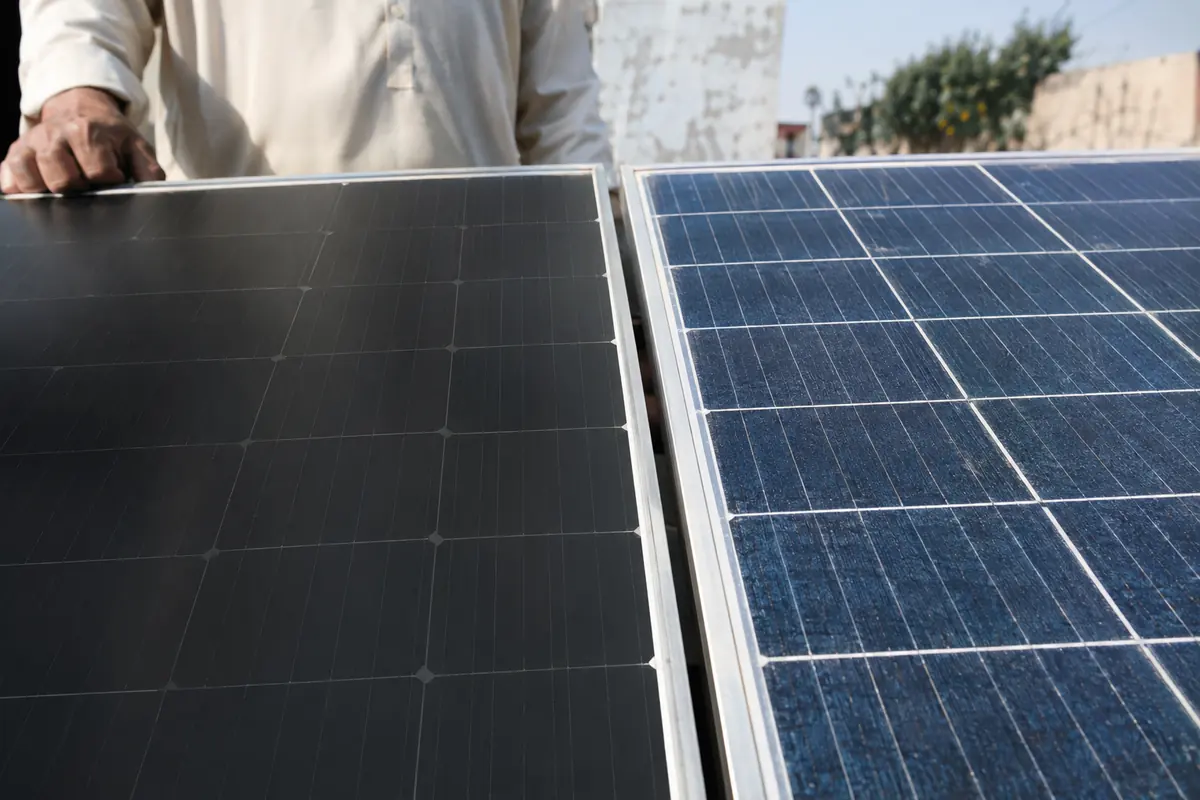
Quick answer on the latest solar panel technology
On sale in Pakistan now, the newest mainstream panels are N-type designs that have replaced the older P-type PERC panels:
- TOPCon (for example Jinko Tiger Neo, JA Solar DeepBlue 4.0, Trina Vertex N): the most common new panel in the market, with good efficiency and lower heat loss than PERC.
- Back-contact (BC) (for example Longi Hi-MO X9 and Aiko Stellar ABC): all the metal contacts are on the back, so the front catches more light; usually the highest efficiency you can buy.
- HJT, heterojunction (for example Risen Hyper-ion): the lowest heat loss of the three, well suited to hot climates.
Still in the lab or in small pilot production:
- Perovskite-silicon tandem cells, which have passed 35% efficiency in certified tests, against a practical ceiling of about 29% for silicon alone.
- Hydrogen solar panels, which produce hydrogen gas from humid air instead of electricity, now in demonstration projects in Europe.
For a Pakistani home buyer, the practical choice today is between TOPCon, back-contact and HJT. Perovskite and hydrogen panels are worth following, not waiting for. A good N-type panel bought today will still be producing most of its rated power long after tandem panels finally reach the Pakistani market, so delaying a purchase for them usually costs more in lost units than it could ever save.
How we checked this
Panel technology moves quickly and is surrounded by marketing. We used primary sources wherever possible.
| Claim type | Source used |
|---|---|
| Cell and module records | Announcements from the companies that set them, with the certifying lab named (for example ESTI and ISFH) |
| Commercial tandem modules | Statements from Oxford PV, the first company to sell perovskite-silicon tandem modules |
| Hydrogen panels | Reporting on Solhyd, the KU Leuven spin-off, and its demonstration park in Belgium |
| Panel types on sale in Pakistan | The models in our live price sheet and their maker datasheets |
| Heat and ageing behaviour | Temperature coefficients and degradation warranties printed on datasheets |
Records in this field are broken several times a year. The figures below were correct when we checked them in October 2026; treat them as the state of play, not the final word.
New solar panel technology explained
From PERC to N-type: why the change matters
For most of the last decade, the standard panel in Pakistan was a P-type mono PERC panel. PERC added a reflective layer to the back of the cell to bounce unused light back through it. It was a big step at the time, and a few PERC panels are still sold as old stock, such as the 540–550 W Jinko Tiger Pro and the 545 W Longi Hi-MO 5 in our sheet.
N-type panels use silicon doped differently, which suffers less from a light-induced loss that affects P-type cells in their first months. They also lose less power in heat and age more slowly. That is why makers can now offer power warranties with only about 0.4% loss per year after the first year.
TOPCon: the new standard
TOPCon stands for tunnel oxide passivated contact. A very thin oxide layer and a layer of doped silicon on the back of the cell reduce the energy lost where the metal contact meets the silicon. Because it can be made on upgraded PERC production lines, it became the volume leader quickly.
- Typical module efficiency: around 22–23%
- Typical power temperature coefficient: around −0.29% to −0.30% per °C
- Usually bifacial versions are available
- Examples in Pakistan: Jinko Tiger Neo, JA Solar DeepBlue 4.0, Trina Vertex N, Canadian TOPHiKu6, Astronergy ASTRO N5
Back-contact (BC): more light, cleaner look
In a back-contact cell, all the positive and negative contacts sit on the rear. With no silver lines on the front, the full surface collects light, and the panel looks plain black. Longi’s HPBC and HIBC lines and Aiko’s ABC panels are the best-known examples.
- Typical module efficiency: around 23–25% for commercial products; LONGi lists one commercial BC series at 25%
- Heat loss similar to or slightly better than TOPCon on most datasheets
- Often better in partial shade, according to makers, because of the way the cell is designed
- Usually priced above TOPCon
- Examples in Pakistan: Longi Hi-MO X9 (HPBC 2.0), Aiko Stellar 1N and 1N+ ABC
Back-contact also holds the current record for a single silicon cell. LONGi reported a certified 28.29% for its HIBC cell in September 2026, measured by Germany’s ISFH, and a certified 26.4% for an HIBC module.
HJT: best for heat
Heterojunction cells sandwich crystalline silicon between ultra-thin layers of amorphous silicon. The result is excellent voltage and the lowest heat loss of the mainstream technologies.
- Typical module efficiency: around 22–23%
- Typical power temperature coefficient: around −0.24% to −0.26% per °C
- Very low yearly degradation on good brands
- Examples in Pakistan: Risen Hyper-ion 700 W and 720 W panels
On a roof in Multan or Jacobabad, where cells can run at 65–70 °C, that lower temperature coefficient is worth a few extra percent of output on summer afternoons compared with PERC.
What “N-type” means on a Pakistani price list
In the market, “N-type” has become a selling word, and it is not always used honestly. On a genuine price list or quotation, N-type should come with a specific technology name (TOPCon, HJT, HPBC, ABC) and a specific model number, and the datasheet for that model should say N-type. In our own sheet, the N-type rows include the Jinko Tiger Neo, JA Solar DeepBlue 4.0, Trina Vertex N, Canadian TOPHiKu6, Astronergy ASTRO N5, Longi Hi-MO X7 and X9, Aiko Stellar ABC and Risen Hyper-ion ranges, while the only PERC rows left are old stock of the Jinko Tiger Pro and Longi Hi-MO 5. If a seller quotes “N-type” for a model that the maker lists as PERC, you are being misled.
How much extra energy does newer technology give?
Two things separate the technologies over the life of a system: heat loss each summer and ageing each year.
Heat. Take a cell temperature of 65 °C on a summer afternoon, 40 degrees above the 25 °C test point.
| Technology | Typical power coefficient | Loss at 65 °C cell temperature |
|---|---|---|
| PERC | About −0.35% per °C | About 14% |
| TOPCon | About −0.30% per °C | About 12% |
| HJT | About −0.25% per °C | About 10% |
On a 10 kW system at full sun, the gap between PERC and HJT at that moment is a few hundred watts. Over a long Pakistani summer it adds up to a noticeable number of units.
Ageing. Older PERC panels were typically warranted to lose up to about 2% in the first year and about 0.55% per year after that. Current N-type panels such as the Jinko Tiger Neo series are warranted at about 1% in the first year and 0.4% per year after that, with 87.4% guaranteed at 30 years. After 25 years, that difference is several percent of output, every year, for the rest of the system’s life. Our solar panel lifespan guide explains these warranties in detail.
Other improvements you will see on datasheets
| Feature | What it does | Why it matters to you |
|---|---|---|
| Half-cut cells | Cells cut in two, each half carrying half the current | Lower resistive losses and better shade tolerance |
| Multi-busbar and zero-busbar designs | More, thinner contact wires, or none on the front | Less shading by metal, lower losses |
| Larger wafers (182 mm, 210 mm and rectangular sizes) | Bigger cells in bigger panels | More watts per panel; check that your structure fits |
| Bifacial, dual-glass panels | Glass on both sides, cells that accept rear light | Extra output over light roofs; tougher against moisture |
| Better encapsulants (POE) | Stronger moisture barrier | Slower ageing in humid coastal climates like Karachi |
Perovskite-silicon tandems: the next big jump
A perovskite is a crystal structure that can be made from cheap materials and tuned to absorb blue and green light very efficiently. Stack a thin perovskite layer on top of a silicon cell and each layer handles the part of sunlight it is best at. That breaks through the efficiency ceiling of silicon alone.
- Record cells: LONGi announced a certified 35.5% crystalline silicon-perovskite tandem cell in July 2026, certified by the European Solar Test Installation (ESTI). The company has also reported certified tandem modules above 29%.
- Commercial modules: Oxford PV began selling perovskite-silicon tandem modules in 2024. In early 2026 its CEO said its modules were at about 25% efficiency, with a roadmap aiming for 27% and a 20-year lifetime by 2027.
- The catch: durability. Perovskites are sensitive to heat, moisture and light over the long term. Until outdoor data proves 25–30 year lifetimes, these panels will stay a premium niche product.
For Pakistani buyers, this is technology to watch over the next several years. It is not a reason to delay buying a good N-type panel now.
How fast does lab technology reach Pakistani roofs?
History gives a useful guide. PERC cells were demonstrated in laboratories in the late 1980s but only became the mass-market standard in the late 2010s. TOPCon was first described in 2013 and became the volume leader roughly a decade later. Back-contact cells have existed for decades in premium niche products and only recently reached mainstream rooftop prices.
The pattern is the same each time: a lab record, then pilot production, then a premium product, then a price fall as factories scale up. Pakistan, which imports almost all of its panels from large Chinese factories, usually sees a technology once it reaches mass production and its price falls. That is why our live sheet is now dominated by TOPCon, with back-contact and HJT as premium options, and why perovskite tandems are not on it yet.
| Technology | First shown | Mass market |
|---|---|---|
| PERC | Late 1980s | Late 2010s |
| TOPCon | 2013 | Early-to-mid 2020s |
| Back-contact for rooftops | Decades ago, as niche products | Mid 2020s |
| Perovskite-silicon tandem | Mid 2010s | Not yet; first small commercial sales from 2024 |
Hydrogen solar panels
“Hydrogen solar panels” are a different idea altogether. Instead of making electricity, they use sunlight to split water vapour, captured from the surrounding air, into hydrogen and oxygen. The best-known developer is Solhyd, a spin-off from KU Leuven in Belgium.
- In lab tests, a 1.5 m² panel produced about 250 litres of hydrogen gas a day, around 6 kg a year, at about 15% solar-to-hydrogen efficiency.
- A demonstration park near Namur in Belgium, with around 160–170 panels, was planned for construction in 2026.
- Production is still in small pilot batches, and the hydrogen costs several times more than hydrogen made from fossil fuels.
There is no hydrogen panel you can buy for a Pakistani roof, and even if there were, you would need a way to store and use hydrogen safely. Treat any local seller offering “hydrogen solar panels” with great suspicion.
Smarter systems around the panel
Some of the newest technology is not in the panel at all but around it:
- Module-level optimisers fitted behind each panel let every panel work at its own best point, which helps on roofs with shade from tanks, walls or trees.
- Microinverters convert DC to AC at each panel, removing high-voltage DC cables from the roof. They cost more per watt and are less common in Pakistan.
- Hybrid inverters with smart apps show each string’s output, battery state and grid import and export, which makes faults and dirty panels easy to spot.
For most rooftops with little shade, a good string or hybrid inverter is still the sensible choice. Optimisers make sense where shade cannot be avoided.
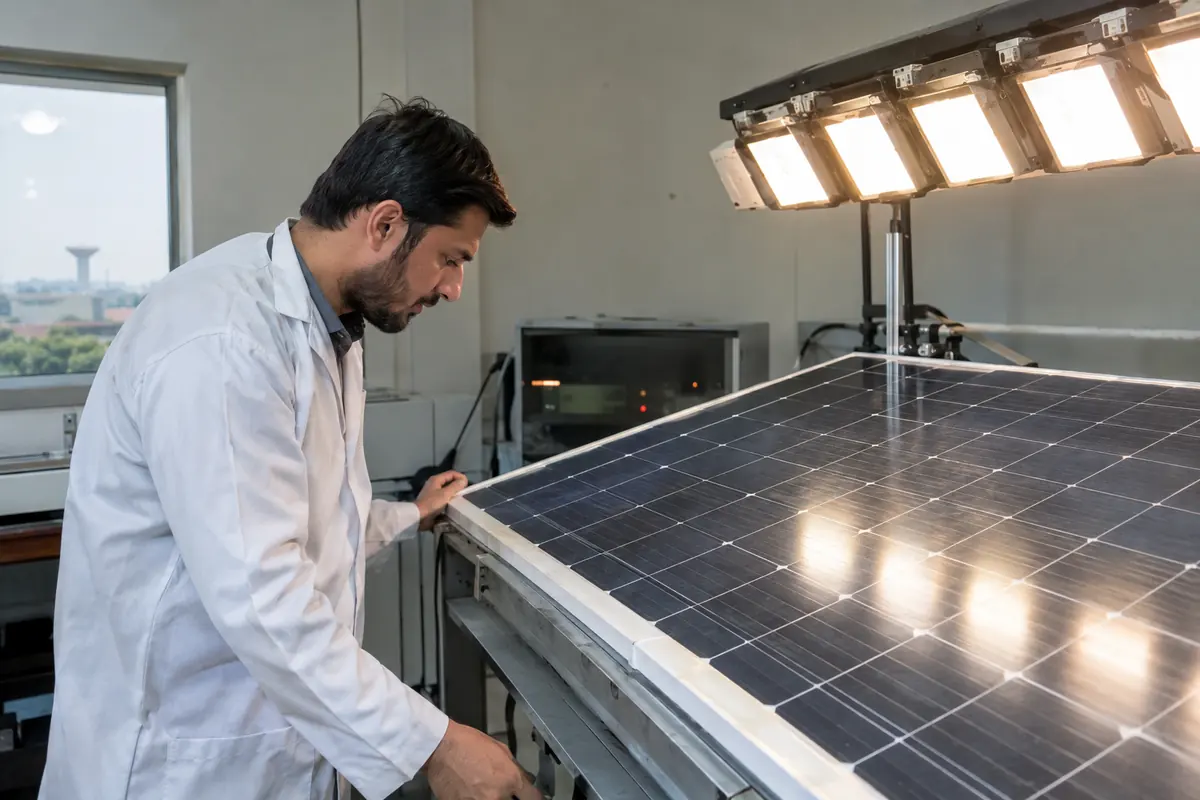
Comparison table: latest solar panels you can buy in Pakistan
Prices below come from the live sheet and update automatically; the technical columns show typical values for each cell type, so always confirm the exact figures on the datasheet of the model you are offered.
| Technology | Example in our sheet | Live price | Typical efficiency | Heat loss (power coefficient) |
|---|---|---|---|---|
| P-type mono PERC (older) | Jinko Tiger Pro 550 W (old stock) | Rs 20,900 | About 21% | About −0.34% to −0.35% per °C |
| N-type TOPCon | Jinko Tiger Neo 585 W | Rs 25,420 | About 22–23% | About −0.29% to −0.30% per °C |
| N-type back-contact (HPBC) | Longi Hi-MO X9 600 W | Rs 26,400 | About 23% or more | Similar to or slightly better than TOPCon |
| N-type back-contact (ABC) | Aiko Stellar 1N ABC 620 W | Rs 25,110 | Among the highest on sale, around 23–24% | Similar to or slightly better than TOPCon |
| HJT | Risen Hyper-ion 700 W | Rs 29,400 | About 22–23% | About −0.24% to −0.26% per °C |
| Perovskite-silicon tandem | Not sold in Pakistan | n/a | About 25% commercial, over 35% in the lab | Long-term data still limited |
For more on each maker, see the Longi solar panel price and Aiko solar panel price pages, or compare all brands on the solar panel price list.
Is newer technology worth the extra cost?
Work it out per unit of energy, not per panel. A back-contact or HJT panel that costs more per watt can still be the better buy if:
- Your roof is small, so more watts per square metre matters.
- You live in a very hot area, so lower heat loss adds real units.
- You plan to keep the system for 20 years or more, so slower ageing adds up.
If your roof is large and open, a good TOPCon panel at a lower price per watt is usually the best value. The market average is currently Rs 41.3 per watt.
Buying checklist for new solar panels
- Confirm the cell type on the datasheet. “N-type TOPCon”, “HJT” or “back-contact” should be printed, not just said by the seller.
- Compare the power temperature coefficient. Lower is better for Pakistani summers.
- Check efficiency and size. Higher efficiency means more watts from the same space; larger panels need a structure that fits them.
- Read the power warranty. Look for first-year and yearly degradation figures and the guaranteed output at 25 or 30 years.
- Check bifacial details. If the panel is bifacial, it only pays off on a raised, open structure over a light surface.
- Verify the panel is genuine. Use the maker’s serial number check where one exists, and buy from authorised distributors.
- Match the inverter. Newer high-current panels (often 13–18 A) need inverter inputs rated for that current.
- Ignore lab headlines when buying. A 35% lab record does not change what is available to you this year.
Our list of the best solar panels in Pakistan compares current models across these points, and the types of solar panels guide explains the older categories.
Questions to ask a seller about new technology
- Which exact model is this, and can I see its datasheet?
- Is it TOPCon, HJT or back-contact, and is it bifacial?
- What are the first-year and yearly degradation figures in the power warranty?
- What is the power temperature coefficient?
- Can the serial number be checked on the maker’s website?
Common mistakes to avoid
| Mistake | Why it is a problem | Better approach |
|---|---|---|
| Waiting for perovskite panels | They are not sold here and long-term durability is unproven | Buy a good N-type panel now |
| Paying for “hydrogen solar panels” | No such product is available for homes | Walk away |
| Assuming every “N-type” claim is true | Relabelled older stock is sometimes sold as new technology | Check the datasheet and serial number |
| Choosing the highest-efficiency panel for a big open roof | You pay more per watt for space you do not need | Compare price per unit of energy |
| Putting bifacial panels flat on dark concrete | The back side gains almost nothing | Raise the structure or use monofacial panels |
| Using an inverter that cannot take the panel’s current | Clipping, lost output, possible faults | Check the inverter’s maximum input current per MPPT |
New panels are also only as good as their installation and care. Our guide to how solar panels work explains why heat and shade matter for every technology, and today’s prices for all sizes are on the home page.

Frequently asked questions
What is the latest solar panel technology available in Pakistan?
The newest mainstream panels on sale are N-type designs: TOPCon, back-contact (such as Longi HPBC and Aiko ABC) and HJT (such as Risen Hyper-ion). They are more efficient, lose less power in heat and age more slowly than the older PERC panels.
What is new solar panel technology in simple words?
Most new panels change how the cell collects electricity, by cutting losses at the metal contacts, moving contacts to the back, or using thin layers that reduce heat loss. The result is more units from the same roof and slower ageing.
Which is better, TOPCon, HJT or back-contact panels?
TOPCon offers the best price per watt for most roofs, back-contact gives the highest efficiency for small roofs, and HJT has the lowest heat loss for very hot areas. Compare the datasheets and the live price per watt before deciding.
What are hydrogen solar panels?
They are panels that use sunlight to split water vapour from the air into hydrogen and oxygen instead of producing electricity. They are in pilot production and demonstration projects in Europe and are not available for homes in Pakistan.
Are perovskite solar panels available in Pakistan?
Not as a normal product. Perovskite-silicon tandem cells have passed 35% efficiency in certified lab tests, and a few tandem modules are sold abroad, but long-term durability is still being proven.
Should I wait for new solar panels before buying?
Usually not. Today's N-type panels are a large step up from older panels, and every year you wait is a year of units and savings lost. Lab breakthroughs typically take many years to reach mass-market prices.
How can I tell if a panel is really N-type?
Ask for the exact model number and its datasheet, which should state the cell type, such as N-type TOPCon, HJT or back-contact. Check the serial number with the maker where possible, and be wary of sellers who cannot name the model.
Do new technology panels need a different inverter?
Not a different type, but larger modern panels can carry 13-18 A or more, so the inverter's maximum input current per MPPT must suit them. String voltage must also stay inside the inverter's limits.