On this page
A Jinko solar panel serial number check takes about two minutes and is the single best protection against fake or relabelled plates in Pakistan. This guide shows exactly where to find the serial, how to use Jinko’s own verification tool, what each result means for your warranty, and which physical checks and tests back it up when you are standing in the shop.
Quick answer
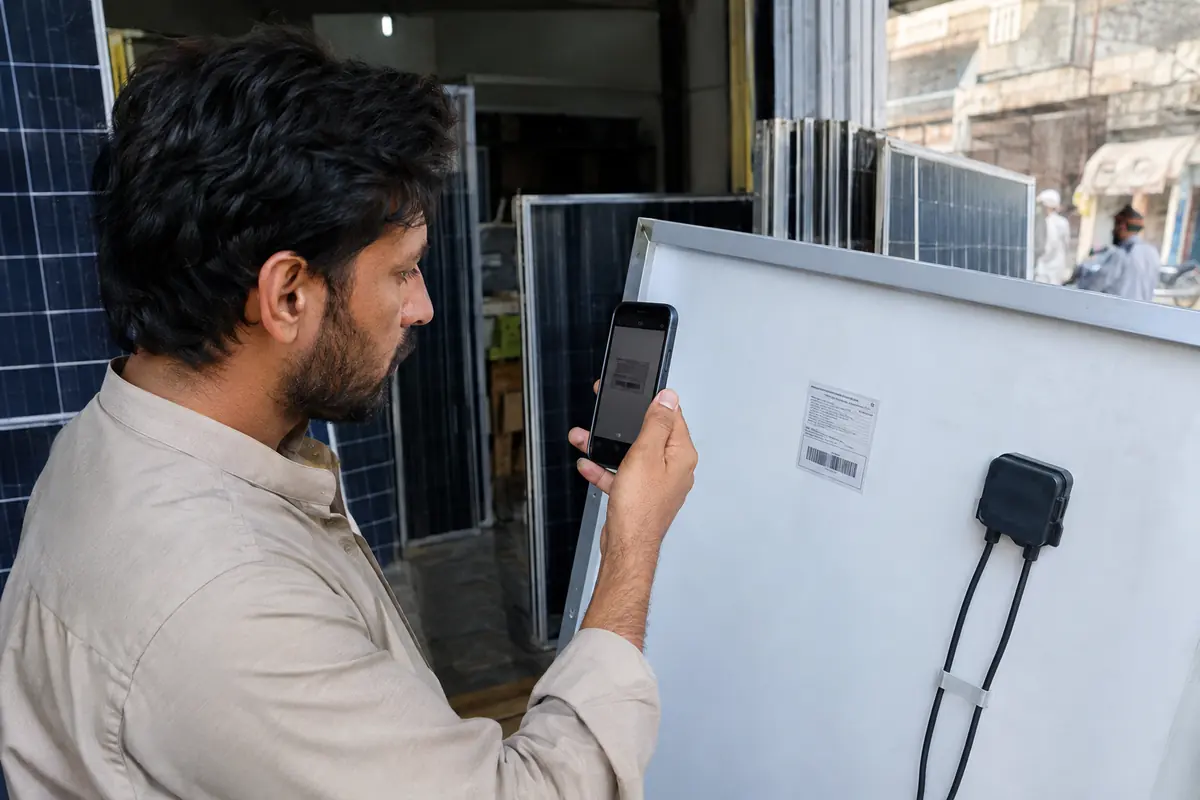
To verify a Jinko panel, find the 24-digit serial number (Jinko prints it in one corner on the front of the module and in the centre of the label on the back), then enter it on Jinko’s official serial number authentication page with your country selected. The tool tells you whether the panel is genuine and whether it was sold into your country’s sales region, which decides warranty support.
| Step | What you do | Time |
|---|---|---|
| 1 | Read the 24-digit serial on the front corner and back label | 30 seconds |
| 2 | Open Jinko’s official authentication page on a jinkosolar domain | 30 seconds |
| 3 | Select Pakistan, enter the serial and the on-screen code | 30 seconds |
| 4 | Read the result and screenshot it | 30 seconds |
Why bother? Jinko is the best-selling panel brand in Pakistan by the company’s own figures, which makes it the brand most worth copying. A fake or diverted plate can look identical on the roof for the first year and only show its problems later, when the dealer may be gone. Three moments matter most:
| When | What to verify |
|---|---|
| In the shop, before paying | Two or three random plates: serial check, label, weight |
| At home, before installation | Every plate’s serial, plus a look for transport damage |
| After installation | Installer’s voltage and current readings for each string |
Only use a page on Jinko’s own domain. Several look-alike “Jinko verification” websites exist that are not run by Jinko.
How we checked this
Plenty of pages online describe “Jinko verification” methods that nobody can trace back to Jinko. For this guide we only included steps we could confirm from Jinko itself or from Jinko’s published product documents. Here is what we used and what we left out:
| Source | What it confirms |
|---|---|
| JinkoSolar Europe’s Serial Number Verification Tool page | How the tool is reached, the inputs (country, 24-digit serial, verification code), where the serial is printed, and the three possible results |
| Jinko datasheets for Tiger Neo 72HL4 and Tiger Pro 72HC | Model codes, sizes, weights and electrical values you can match against the label |
| Jinko’s own news releases about Pakistan | That Jinko sells through partners and distributors in Pakistan |
What we deliberately did not include:
- SMS codes, scratch cards or mobile apps for Jinko verification. We could not find these described by Jinko, so we do not recommend relying on them.
- Third-party “verification portals” that are not on a Jinko domain.
- Claims about the percentage of fake panels in the market. We could not find a reliable source.
Information checked as of October 2026. Jinko can change the location or design of its tool, so if a step looks different, start from Jinko’s official website and follow its support or contact menu.
How to do a Jinko solar panel serial number check
This is the core of Jinko solar panel verification. Do it in the shop, before you pay, on two or three plates picked at random from the stack, and then on every plate at home before installation.
Step 1: Find the serial number
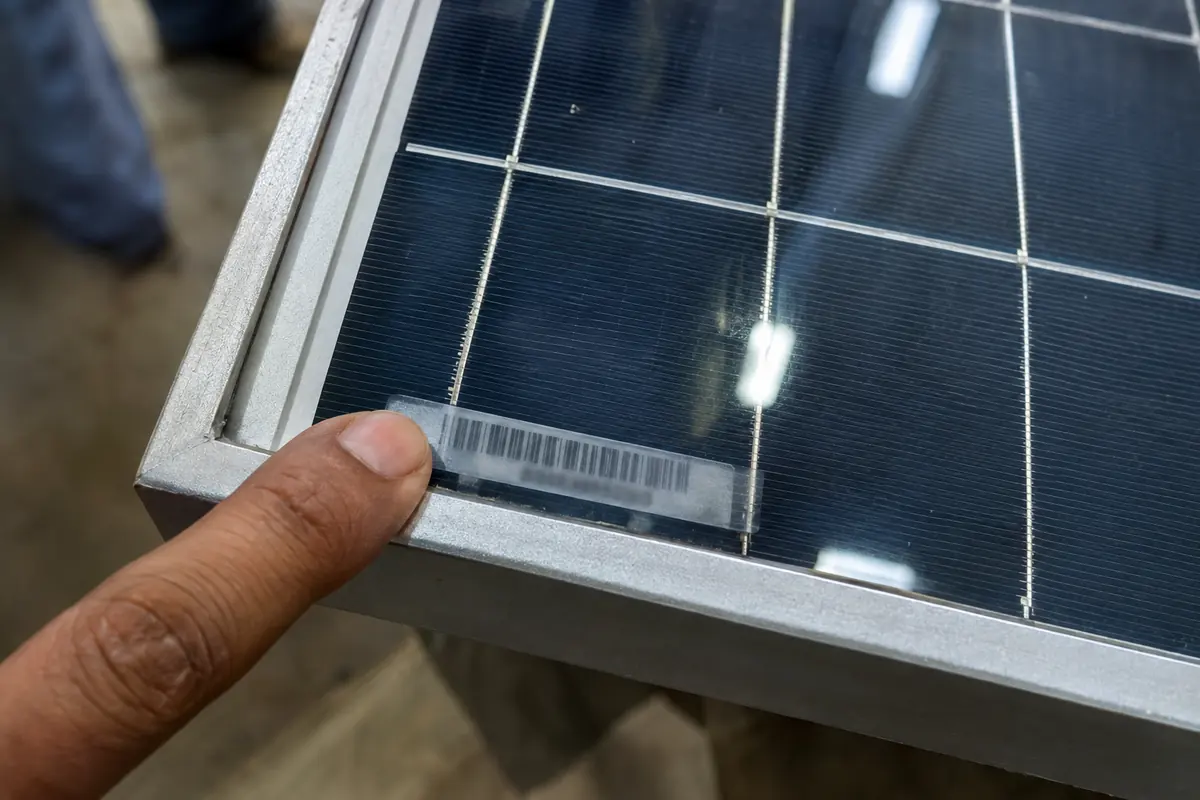
Jinko’s guidance says the serial number is printed in two places:
- On the front: in one corner of the module, visible through the glass, usually as a small barcode with digits.
- On the back: in the centre of the rear side, on or near the nameplate label.
Both numbers should be identical. The serial is 24 digits long. Write it down carefully, or take a clear photo so you can zoom in. Mixing up 0 and O or 1 and I is the most common reason a genuine panel shows as “not found”.
Step 2: Open Jinko’s official tool
Jinko’s European site explains the route: from the PV Support or Contact section, choose “PV After-Sales”, then “Serial Number Authentication”, then “Verify Serial Number”. That button sends you to Jinko’s global verification page, which is hosted on Jinko’s customer service domain, cs.jinkosolar.com. You can start from JinkoSolar’s serial number verification page.
Before typing anything, look at the address bar. The domain must end in jinkosolar.com or jinkosolar.eu (or another official Jinko regional site). If it is anything else, close it.
Step 3: Enter the details
The form asks for three things:
- Country: choose the country where the panel is located, in our case Pakistan.
- Serial number: the 24-digit number from the panel.
- Verification code: the short code shown on screen, to prove you are not a bot.
Then press verify.
Step 4: Read the result
Jinko’s tool returns one of three outcomes:
| Result | What it means | What to do |
|---|---|---|
| Genuine, and the country matches where it was sold | The panel is authentic and eligible for warranty and after-sales service in that country and its sales region | Buy, and keep a screenshot with your invoice |
| Genuine, but sold to a different country in the same sales region | Authentic and supported within that sales region, but not outside it | Ask the dealer why; confirm local warranty support in writing |
| Not genuine, or sold through an unofficial channel | Jinko says the product is not eligible for its limited warranty or support | Do not buy. Report the dealer and contact Jinko through its official consulting page |
The second and third results are why this check is about more than fakes. A genuine panel that was diverted from another market can leave you without warranty support in Pakistan, even though the plate itself is real.
If the result says “not found” or “not genuine”
Do not panic straight away. Run through these before deciding:
- Re-type the serial. Check every character against a zoomed photo. 0 and O, 1 and I, 5 and S are easy to confuse.
- Compare front and back. If the front and back serials differ, that is a warning sign in itself.
- Check the country. Make sure Pakistan is selected, then try once more.
- Try another plate from the same batch. If every plate fails, the batch is the problem. If only one fails, ask the dealer to replace it.
- Contact Jinko officially. Jinko’s tool directs failed checks to its online consulting platform on jinkosolar.com. Send the serial, photos of both labels and the dealer’s details.
If the result is still “not genuine”, do not install the panel. Jinko says such products are not eligible for its limited warranty.
Step 5: Match the label with the datasheet
A serial check proves the number exists in Jinko’s database. It does not prove that the panel in front of you is the one that number belongs to, because a label can be copied. So also compare the back label with Jinko’s datasheet for the model:
| Model on label | Pmax | Voc | Isc | Size | Weight |
|---|---|---|---|---|---|
| JKM585N-72HL4-V (Tiger Neo) | 585 W | 51.16 V | 14.55 A | 2278 x 1134 x 35 mm | about 28 kg |
| JKM580N-72HL4-V (Tiger Neo) | 580 W | 51.02 V | 14.47 A | 2278 x 1134 x 35 mm | about 28 kg |
| JKM580N-72HL4-BDV (Tiger Neo bifacial) | 580 W | 51.47 V | 14.37 A | 2278 x 1134 x 30 mm | about 32 kg |
If the label values, size or weight do not match the datasheet for that exact model code, treat the plate as suspect even if the serial check passed. You can find model-by-model details on our Jinko 585 watt and Jinko 580 watt pages.
Checking panels that are already on your roof
If your system is already installed and you never checked the serials, you can still do it. The front serial sits behind the glass in a corner, so on most rooftop layouts you can read or photograph it from the roof without lifting anything. Clean the corner first and use your phone’s zoom. If the front serial is hidden by a clamp or frame, ask your installer to read the back label during the next cleaning or maintenance visit, with the system switched off. Record each serial with its position on the roof, so if one plate fails later you know exactly which one to claim.
Step 6: Solar panel testing on the roof
A simple solar panel check with a multimeter, done by your installer on a sunny day, tells you whether each plate behaves like its label:
- Open-circuit voltage (Voc): measured across the panel’s connectors with nothing connected. A healthy plate reads close to the label Voc, a little lower when the panel is hot.
- Short-circuit current (Isc): measured by the installer with a DC clamp meter rated above the panel’s current, in strong sun. A Jinko 585 can push over 14 A, more than the 10 A range of most ordinary multimeters, so this is not a test to improvise. It should read close to the label Isc in bright midday light and lower in haze.
- Compare plates: the most useful test is relative. Ten genuine plates from one batch read within a few percent of each other. A plate that reads well below the rest needs a closer look.
For a deeper check, some installers and testing labs offer electroluminescence (EL) imaging, which shows micro-cracks invisible to the eye, and thermal imaging, which shows hot spots once a system is running. These are worth paying for on large commercial jobs or when a whole batch looks doubtful.
Genuine vs fake Jinko panel: comparison table
Use this as a quick solar panel check when you are standing in a dealer’s godown.
| What to check | Genuine Jinko | Common sign of a fake or relabelled plate |
|---|---|---|
| Serial number | 24 digits, same on front corner and back label | Missing on the front, different on the back, or a sticker stuck over another |
| Official check result | Genuine and sold into Pakistan’s region | “Not genuine”, or a result from a non-Jinko website |
| Model code | Full code such as JKM585N-72HL4-V | Only “Jinko 585” printed, or a code that does not exist in Jinko’s datasheets |
| Electrical values | Match the datasheet for that model | Round numbers, wrong Voc or Isc, values from another model |
| Label print | Sharp, aligned, no spelling mistakes | Blurry print, uneven fonts, misspelt words |
| Weight and size | Matches the datasheet | Noticeably lighter, or a different length or width |
| Frame and glass | Clean, straight anodised frame; uniform cell colour | Scratched or bent frame, uneven cell colour, visible cracks |
| Junction box and cables | Sealed box, branded connectors, standard cable lengths | Loose box, mismatched or taped connectors |
| Price | Close to the market rate, around Rs 25,420 for a Tiger Neo 585 W | Far below Rs 23,400 for a “Jinko 585” |
Tiger Neo or Tiger Pro? Read the letter
Many complaints in Pakistan are not about fakes at all, but about a buyer paying N-type rates for an older PERC panel. The model code settles it:
| Label shows | Family | Cell type | Power warranty |
|---|---|---|---|
| JKM5xxN-72HL4… | Tiger Neo | N-type TOPCon | 30 years |
| JKM5xxM-72HL4… | Tiger Pro | P-type mono PERC | 25 years |
| JKM6xxN-78HL4-BDV | Tiger Neo, 78-cell bifacial | N-type TOPCon | 30 years |
A single small issue, like a slightly crooked label, is not proof of a fake. Two or three issues together, or a failed serial check, are enough to walk away.
Buying checklist
Before you hand over any money for Jinko panels, go through these steps in order.
- Fix the model, not just the wattage. Ask for the full model code and write it down. “Jinko 585 N-type” should be JKM585N-72HL4-V or the BDV bifacial version.
- Compare the price with the live sheet. Check today’s rates on our Jinko solar panel price page. A deal far below the market is a warning, not a bargain.
- Pick random plates. Do not let the dealer choose which plates you check. Pull two or three from different parts of the stack.
- Run the serial check in the shop. Use your own phone, on Jinko’s official site, with Pakistan selected. Screenshot each result.
- Read the label against the datasheet. Model code, Voc, Isc, size and weight should all agree.
- Ask who handles warranty. Get the importer’s name and how a claim would work. Write it on the invoice.
- Get every serial on the invoice. One line per plate, or a printed list attached to the bill and stamped by the dealer.
- Inspect on delivery. Look for cracked glass, bent frames and damaged connectors before the installer lifts anything onto the roof.
- Check the remaining serials at home. Do this before installation, while you can still return a plate.
- Test after installation. Ask the installer to record Voc and Isc for each string and keep the readings with your invoice.
Buying second-hand Jinko panels
Used Jinko plates turn up from dismantled systems and upgrades. The serial check still works, but the warranty picture is harder: you will usually not have the original invoice, and the region result tells you where the panel was first sold, not who owns it now. If you are buying used, run the serial check, ask for the original invoice copy if the seller has it, test every plate’s Voc and current in sun, and inspect closely for cracks, browning or burn marks near the junction box. Our page on used solar panels for sale covers what to look for.
| Document | Why you need it |
|---|---|
| Invoice with model code and serials | Proof of purchase for any warranty claim |
| Screenshots of serial check results | Proof that the panels were genuine and sold into the region |
| Photos of back labels | Matches each serial to a plate if a label fades later |
| Installer’s test readings | Baseline to compare against if output drops |
Common mistakes to avoid
These are the errors we see most often from buyers who later find a problem with their panels.
- Trusting a link the dealer sends. If a seller sends you a “verification link” on WhatsApp, do not use it. Type Jinko’s site address yourself or start from the official Jinko site.
- Checking only one plate. A stack can mix genuine and relabelled panels. Check several at random, and all of them before installation.
- Ignoring the “different country” result. A genuine panel sold into another market may not be supported in Pakistan. That matters for a 12-year product warranty.
- Assuming a passed serial check means the plate is fine. The label can be copied. Always match the label values, size and weight with the datasheet.
- Not measuring anything. A five-minute Voc and current check by your installer catches panels that underperform their label.
- Losing the paperwork. Without the invoice and serial list, even a genuine panel is hard to claim on.
- Buying “Jinko” from someone who cannot name the importer. A dealer with a clear supply chain is far more likely to sell genuine stock and support a claim.
What to do if you were sold a fake
- Stop installation, or switch off the affected string if the plates are already connected.
- Collect your evidence: invoice, serial screenshots, label photos and any test readings.
- Message the dealer in writing and ask for replacement with verified genuine plates.
- If the dealer refuses, contact the importer named on the invoice, and report the serials to Jinko through its official consulting platform.
- Keep all messages. A written record makes any later complaint far stronger.
| Red flag | Risk level | Action |
|---|---|---|
| Serial check fails | High | Do not buy |
| Verification on a non-Jinko domain | High | Re-check on Jinko’s official site |
| Label values do not match datasheet | High | Do not buy that plate |
| Price far below market | Medium to high | Ask why; check every serial |
| Dealer refuses to let you check serials | High | Walk away |
| “Different country, same region” result | Medium | Get local warranty support confirmed in writing |
Jinko is the most popular brand in Pakistan and has a strong warranty, which is exactly why it is worth protecting. For other brands, see our solar panel brands in Pakistan overview and our guide to the best solar panels in Pakistan. If you are pricing a system, the 585 watt solar panel price page compares every brand at the most common size.
Frequently asked questions
How can I check a Jinko solar panel serial number?
Find the 24-digit serial in a front corner of the panel and on the back label, then enter it on Jinko's official serial number authentication page with Pakistan selected as the country. The tool shows whether the panel is genuine and whether it was sold into your sales region.
Where is the serial number on a Jinko panel?
Jinko prints it in two places: in one corner on the front of the module, visible through the glass, and in the centre of the rear side near the label. Both numbers should match.
Is there an official Jinko verification website?
Yes. Jinko's serial number authentication tool is reached from its official websites and is hosted on Jinko's own customer service domain. Avoid look-alike verification sites that use "jinko" in a different domain name.
What does it mean if a genuine Jinko panel was sold to another country?
Jinko ties warranty and after-sales support to the sales region a panel was officially shipped to. A genuine panel sold into another region may not be supported in Pakistan, so ask the dealer to confirm local warranty support in writing.
Can I verify Jinko panels by SMS or a mobile app?
We could not confirm any SMS code or app verification from Jinko itself, so we do not recommend relying on one. Use the serial number tool on Jinko's official website.
How do I test a solar panel to see if it works properly?
Ask your installer to measure open-circuit voltage and short-circuit current in full sun with proper DC meters and compare them with the label. Comparing several plates from the same batch is the most useful test; one plate reading well below the rest needs a closer look.
Does a passed serial check mean the panel is definitely original?
It confirms the serial is in Jinko's records, but labels can be copied. Also check that the model code, electrical values, size and weight match Jinko's datasheet for that model.
What should I do if my Jinko panel fails verification?
Re-type the serial carefully and try another plate. If it still fails, do not install it, ask the dealer for verified replacements in writing, and report the serial to Jinko through its official consulting page.