On this page
The inverter is the part of a solar system that most often fails, gets mis-sized or is quietly swapped for a cheaper model, so the solar panel inverter price in Pakistan deserves as much attention as the panels. This guide gives realistic price ranges by type and size as of October 2026, explains on-grid, hybrid and off-grid inverters in plain terms, and shows how to choose one that matches your panels, batteries and DISCO connection.
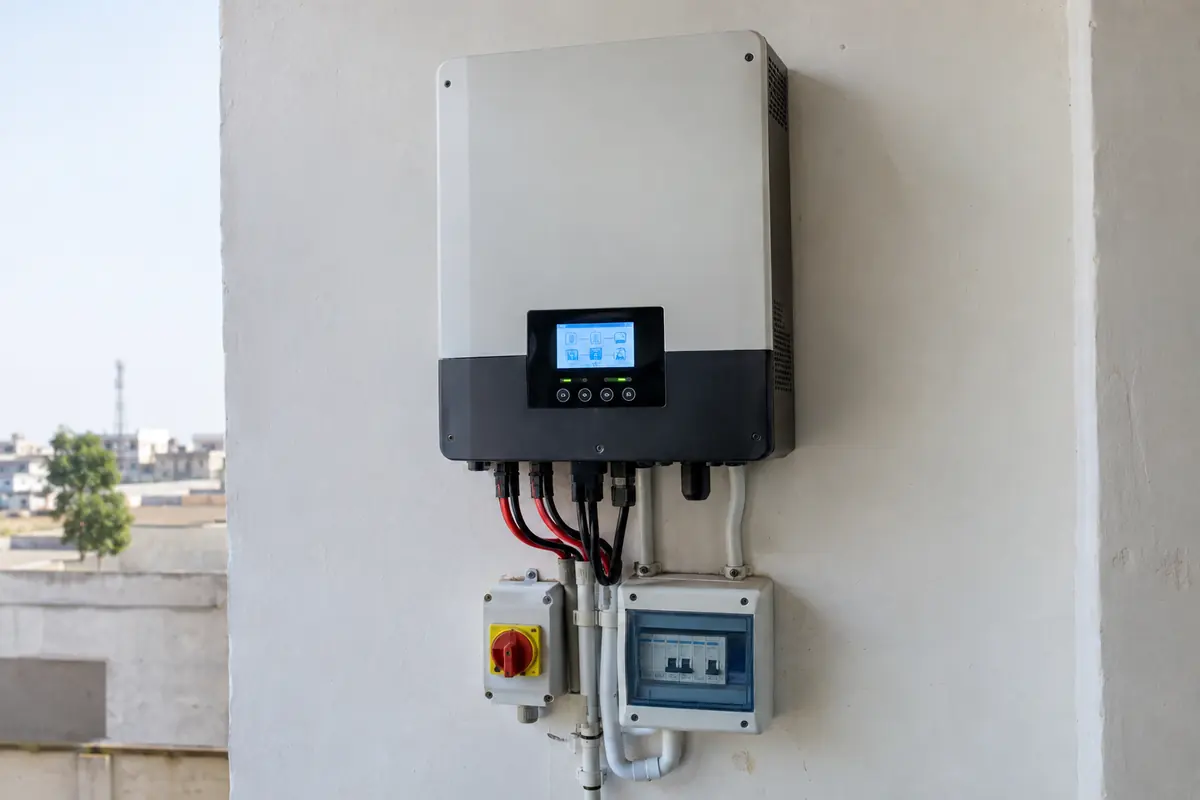
Quick answer: solar inverter price ranges
Inverter prices depend far more on type and brand tier than on kilowatts alone. These ranges are based on retail listings from Pakistani solar sellers that we checked in early October 2026, and they will move with the dollar rate.
| Inverter type and size | Typical price range (as of October 2026) |
|---|---|
| Basic hybrid / off-grid, 3 to 4.5 kW (Axpert-style, local brands) | Rs 68,000 to 125,000 |
| Basic hybrid, 6 to 6.5 kW | Rs 90,000 to 180,000 |
| Branded hybrid (Solis, Growatt, GoodWe, Fox), 5 to 6 kW | Rs 150,000 to 225,000 |
| Branded or premium hybrid, 8 kW | Rs 300,000 to 405,000 |
| Branded hybrid, 10 to 12 kW | Rs 365,000 to 525,000 |
| On-grid (grid-tie), 10 kW three-phase | Rs 188,000 to 336,000 |
| On-grid, 15 kW three-phase | Rs 200,000 to 335,000 |
| On-grid, 20 kW three-phase | Rs 300,000 to 320,000 |
| PWM charge controller, 10 to 60 A | Rs 1,600 to 8,500 |
| MPPT charge controller, 70 to 100 A | Rs 23,000 to 34,000 |
The cheapest end of each range is usually a local or import-brand unit with a short warranty. The top end is Huawei, Sungrow or a premium hybrid with high PV input and IP65/66 weather protection.
How we checked these prices
There is no shortcode for inverter prices on this site, because inverters do not change as often as panel rates and the models vary too much for one live sheet. Instead, we built the ranges by hand.
- Retail listings. We read current listings from large Pakistani online solar retailers and price-tracking sites in the first week of October 2026, covering more than 30 models from about 15 brands.
- Ranges, not single prices. Where a listing showed two prices (for example cash and card, or with and without Wi-Fi), we kept both ends.
- Matched specs. We grouped models by rated output, phase and type (on-grid, hybrid with battery, off-grid), because a 6 kW on-grid and a 6 kW hybrid are completely different products.
- Left out outliers. Listings with no price, bundled battery kits and second-hand units were excluded.
- Checked tax. Business Recorder reported in March 2026 that solar inverters carry 18% sales tax, higher than the 10% on panels. Retail prices already include it.
We do not name a “best” price, because a city market dealer may beat an online price for cash, and installers often get trade rates. Use these ranges to spot a quote that is far too high or suspiciously low.
Solar panel inverter types and prices explained
On-grid, hybrid and off-grid: what each one does
Every solar panel inverter converts the DC power from panels into AC power for your home. The difference is what it does with the grid and batteries.
| Type | Works with grid | Works with battery | Works during load-shedding | Best for |
|---|---|---|---|---|
| On-grid (grid-tie) | Yes, exports to grid | No | No, shuts off for safety | Net metering homes and factories with stable supply |
| Hybrid | Yes | Yes | Yes, from battery or panels | Homes with load-shedding that also want net metering |
| Off-grid | Uses grid only as a charger, no export | Yes, required | Yes | Areas with long outages or no connection |
| Solar charge controller | No | Yes | Only DC loads or with a separate UPS | Small DC systems, shops, tube lights, fans |
An on-grid inverter is the cheapest way to cut your bill per kilowatt, but it stops working when the grid goes down. That surprises many buyers in their first summer. If your area has regular load-shedding, a hybrid is usually worth the extra cost.
On-grid inverter price and when it makes sense
On-grid inverters are simple and efficient. For 10 kW and above, most are three-phase, which suits houses and businesses with a three-phase meter. Retail listings in October 2026 put a 10 kW three-phase on-grid unit between Rs 188,000 and Rs 336,000, with Growatt, Knox, CHINT and Hopewind towards the lower end and Huawei at the top. A 15 kW unit sits around Rs 200,000 to 335,000.
On-grid makes sense when:
- You have, or will apply for, a net-metering connection
- Your feeder has little or no load-shedding (many Islamabad sectors, DHA and cantonment areas)
- You want the fastest payback and do not need backup
- You run a factory or commercial building that uses most power in the daytime
Hybrid inverter price and the most common sizes
Hybrid inverters are the default choice for Pakistani homes, because they handle net metering and backup in one box. They split into two tiers that look similar on a quotation but behave very differently.
Basic hybrid (often called “infini” or Axpert-style). These are low-frequency or simple high-frequency units, usually 3 to 8.5 kW, from local brands and importers. They work, but they often lack proper grid export, have lower PV input limits and shorter warranties. Prices start around Rs 68,000 for 3 kW and go to about Rs 220,000 for some 8.5 kW models.
Branded hybrid. Solis, Growatt, GoodWe, Fox, Knox’s higher ranges and similar brands. These support proper net metering export, have two MPPT inputs, better efficiency and app monitoring. A 6 kW branded hybrid is listed between about Rs 150,000 and Rs 225,000, an 8 kW between Rs 300,000 and Rs 345,000, and 10 to 12 kW models from about Rs 365,000 to Rs 525,000.
| Size | Typical house | Panels (585 W) | Branded hybrid range (October 2026) |
|---|---|---|---|
| 3 kW | 3 to 5 marla, fans and lights, one small AC at night | 6 | Rs 75,000 to 125,000 (mostly basic hybrids) |
| 6 kW | 5 to 10 marla, one or two ACs | 11 | Rs 150,000 to 225,000 |
| 8 kW | 10 marla, two ACs | 14 | Rs 300,000 to 345,000 |
| 10 to 12 kW | 1 kanal, three ACs | 18 | Rs 365,000 to 525,000 |
Many hybrids accept more panels than their AC rating (for example a 6 kW unit with 8 to 9 kW of panels). Check the maximum PV input on the datasheet before you oversize.
Off-grid inverters
A pure off-grid inverter needs a battery and does not export to the grid. In Pakistan most “off-grid” units are actually basic hybrids used without net metering. They suit farms, remote houses and shops that want backup but have no plans for a net meter. Price ranges overlap with basic hybrids above.
Off-grid is the right call in a few specific cases:
- A farmhouse or dera where the nearest grid line is far away
- A tube-well or solar pump that runs only in daylight, where a dedicated pump inverter (VFD) is cheaper than a battery inverter
- Rental property where the owner will not allow a net meter
- A shop that only needs fans, lights and a fridge during outages
For a tube-well, ask specifically for a solar pump inverter matched to the motor’s horsepower. It is a different product from a home inverter and is sized by motor rating.
Solar panel controller and converter
A solar panel controller (charge controller) sits between small panels and a battery and stops the battery from over-charging. It does not make AC power by itself.
- PWM controllers are the cheapest, about Rs 1,600 to 8,500 for 10 to 60 A as of October 2026. They suit one or two small panels on a 12 V battery.
- MPPT controllers cost more, about Rs 23,000 to 34,000 for 70 to 100 A units from mid-range brands, with premium American-made units around Rs 80,000. They often harvest noticeably more energy from the same panels, especially in cold weather and with modern high-voltage panels.
The solar panel controller price in Pakistan only makes sense to pay for on small DC systems. Any hybrid inverter already has an MPPT controller built in.
A solar panel converter usually means either a DC-to-DC converter (for example 24 V to 12 V for a car or rickshaw) or, loosely, the inverter itself. If a seller quotes a “converter”, ask exactly what it converts.
How to size an inverter for your load
Size the inverter for the load you run at the same time, not for your monthly units. Add up what can be on together on a summer afternoon, then add a margin for motor start-up.
| Appliance (typical) | Running watts (approx.) | How many | Total |
|---|---|---|---|
| 1.5 ton inverter AC | 1,200 to 1,600 W | 2 | about 3,000 W |
| Refrigerator | 150 to 250 W | 1 | about 200 W |
| Ceiling fans | 60 to 80 W | 6 | about 450 W |
| LED lights | 10 to 20 W | 12 | about 200 W |
| Water pump (1 HP) | about 750 W | 1 | about 750 W |
| TV, router, chargers | about 250 W | ||
| Peak at once | about 4,850 W |
For this 10 marla example, a 6 kW inverter covers the running load with some headroom for the pump and AC compressors starting. If you plan a third AC, step up to 8 kW. Running two ACs at night on battery is a different calculation, covered in our battery guide.
Single-phase or three-phase
Most houses up to about 10 marla have a single-phase meter. Larger houses, shops and factories often have three-phase supply. A single-phase inverter connects to one phase only, so on a three-phase meter it can only export or back up that one phase. Three-phase hybrids such as 12 to 15 kW units cost more, but they balance the load across the house and suit net metering on a three-phase connection. Ask your installer to check your bill, which shows the connection type, before choosing.
How long an inverter lasts and what to budget
Panels can last 25 years or more, but inverters do not. Electronics, cooling fans and capacitors wear out faster, especially in a hot porch in Multan or Hyderabad.
| Inverter tier | Typical warranty offered | Realistic life with good installation |
|---|---|---|
| Basic hybrid / local brand | 1 to 2 years | about 4 to 8 years |
| Branded hybrid | 5 years, some extendable | about 8 to 12 years |
| Premium on-grid (Huawei, Sungrow) | 5 to 10 years | about 10 to 15 years |
Plan for at least one inverter replacement over the life of your panels. A cheaper unit that needs replacing twice can cost more than a branded one in the end. Keep it in shade, clean the fan vents every few months and protect it from voltage spikes with proper breakers and surge protection.
What the extra money buys you
Two 6 kW hybrids can be Rs 100,000 apart. Here is where that difference usually goes, so you can decide what you actually need:
- Conversion efficiency. Branded units typically convert 97% or more of the DC power at their best point. Some basic units are noticeably lower, and the loss repeats every sunny hour for years.
- Idle consumption. A cheap inverter can draw 50 to 100 W just to stay on at night, which drains a battery faster.
- Grid export quality. Branded hybrids meet the grid codes DISCOs look for, which makes net-metering approval smoother.
- Monitoring. A phone app that shows daily units, battery level and faults helps you spot a problem the same day instead of at bill time.
- Surge handling. Better units cope with AC compressor and pump start-up without tripping.
- After-sales service. The single biggest difference. A brand with a local service centre and stock of spare boards saves weeks of downtime.
If you are on net metering with a good feeder, spending more on the inverter and less on extras usually pays back. If you only need backup for fans and lights, a well-reviewed basic hybrid can be enough.
Inverter features that change the price
- PV input voltage and MPPT count. Higher voltage and two MPPTs let you use more modern 585 W panels in longer strings, on two roof faces.
- Battery voltage. 24 V, 48 V low-voltage or high-voltage battery support. Most new lithium packs are 48 V.
- Weather rating. IP65 or IP66 units can be mounted outdoors; IP20 units must stay indoors and away from dust.
- Parallel capability. Some units can be paired to make a larger system later.
- Warranty and service. Ask how long and who services it locally. A 5-year warranty with a real service centre in your city is worth more than a 10-year one on paper.
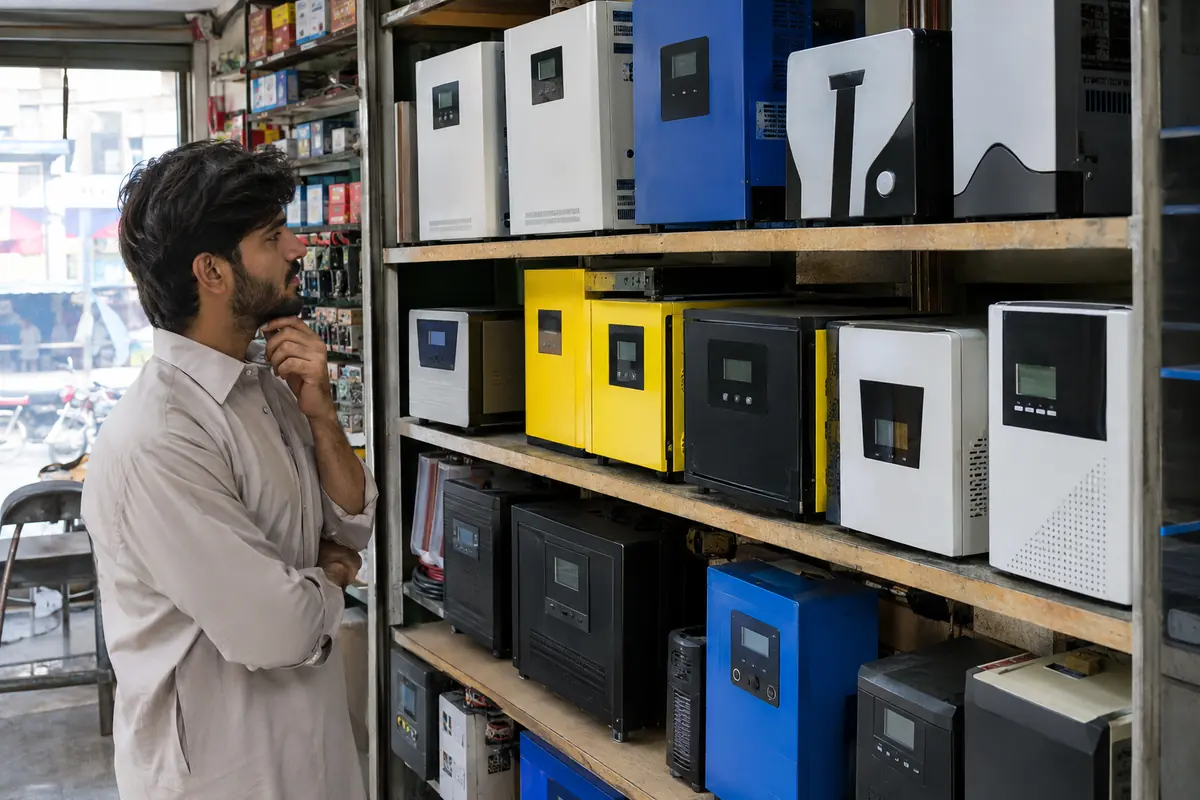
Comparison table: inverter brands in the Pakistani market
These are brands that appear widely in Pakistani retail listings. Price position is relative within the market as of October 2026.
| Brand | Main types sold | Price position | Notes for buyers |
|---|---|---|---|
| Huawei | On-grid, hybrid with battery | Premium | High efficiency, strong app; check genuine import |
| Sungrow | On-grid | Upper-mid | Common on commercial roofs |
| Solis | On-grid, hybrid | Mid | Wide range from 5 to 10 kW hybrids |
| Growatt | On-grid, hybrid | Mid | Popular for 10 to 20 kW on-grid |
| GoodWe | Hybrid, on-grid | Mid to upper | 12 kW single-phase hybrids common |
| Fox | Hybrid, three-phase hybrid | Mid to upper | 15 kW three-phase hybrids |
| Knox | Hybrid, on-grid | Budget to mid | Very wide local range |
| Inverex | Hybrid | Mid to upper | Local brand with large dealer network |
| Itel, Maxpower, Ziewnic, Crown, Luminey | Basic and mid hybrids | Budget | Check warranty terms carefully |
Pair the inverter with panels of the right size. Our solar panel calculator helps you work out the kilowatts, and the solar system price page shows full package costs.
| Model | Watt | Price per panel | Per watt | This week | Trend |
|---|---|---|---|---|---|
| Inverex Jolywood dual glassN-type | 600 W | Rs 25,500 | Rs 42.5 | No change | |
| Longi Hi-MO X9N-type HPBC 2.0 | 600 W | Rs 26,400 | Rs 44.0 | No change | |
| Trina Vertex N bifacialN-type i-TOPCon | 590 W | Rs 23,600 | Rs 40.0 | No change | |
| Canadian TOPHiKu6 bifacialN-type TOPCon | 590 W | Rs 25,370 | Rs 43.0 | No change | |
| Crown N-type bifacial 16BBN-type | 585 W | Rs 23,400 | Rs 40.0 | No change | |
| JA Solar DeepBlue 4.0 N-type bifacialN-type | 585 W | Rs 23,545 | Rs 40.2 | No change | |
| Astronergy ASTRO N5 bifacialN-type TOPCon | 585 W | Rs 23,985 | Rs 41.0 | No change | |
| Inverex Mustang bifacialN-type TOPCon | 585 W | Rs 24,280 | Rs 41.5 | No change | |
| Longi Hi-MO X7 bifacialN-type | 585 W | Rs 25,010 | Rs 42.8 | No change | |
| Canadian TOPHiKu6 bifacialN-type TOPCon | 585 W | Rs 25,155 | Rs 43.0 | No change | |
| Jinko Tiger Neo N-type bifacialN-type TOPCon | 585 W | Rs 25,420 | Rs 43.5 | No change | |
| Jinko Tiger Neo N-typeN-type TOPCon | 580 W | Rs 24,505 | Rs 42.3 | No change |
Buying checklist: choosing the best inverter for solar panels
- Decide on-grid or hybrid first. If your feeder has load-shedding, choose hybrid. If not, on-grid gives faster payback.
- Check your meter phase. Single-phase houses need single-phase inverters. Above about 10 kW, most DISCOs expect three-phase.
- Size for your daytime load and roof. A 6 kW inverter with 8 to 9 kW of panels is common. Do not exceed the datasheet’s maximum PV input.
- Check string voltage. Make sure your panel string stays under the inverter’s maximum DC voltage on cold mornings. Our series vs parallel guide explains the wiring.
- Match the battery. Confirm battery voltage (24 V or 48 V) and that the inverter supports lithium communication if you buy a lithium pack. See our solar panel battery price guide.
- Confirm net-metering approval. Your DISCO will want an inverter model on its approved list or with proper certification. Ask the installer to confirm before you pay.
- Get the model number and serial on the bill. Warranty claims depend on it.
- Ask who services it. Get the name of the service centre in your city and how long repairs usually take.
- Compare the full package. A cheap inverter in a cheap package often means cheap cables and breakers too. Check the solar panel price list so you know what the panels in the quote should cost.
Common mistakes to avoid
- Buying an on-grid inverter for a load-shedding area. It switches off with the grid, so you sit in the dark with panels full of sun.
- Calling a basic hybrid “net metering ready”. Many low-cost units cannot export properly or are not accepted by DISCOs. Ask for proof.
- Oversizing panels beyond the PV limit. Extra panels can trip or damage the inverter and void warranty.
- Installing an IP20 inverter in the sun or a dusty porch. Heat and dust shorten life. Mount it in a shaded, ventilated spot.
- Ignoring earthing and DC breakers. A good inverter on a bad installation still fails.
- Mixing battery types. Do not connect lead-acid and lithium to the same inverter at once.
- Trusting a price that is far below the range. It may be a refurbished, grey-import or fake unit. Check the serial with the brand.
- Forgetting the tax difference. Inverters carry a higher sales tax rate than panels, so a bundled quote can hide a big inverter margin. Ask for separate prices.
The right inverter makes a good panel investment pay off. Once you have chosen one, compare panel brands on our best solar panels in Pakistan page and today’s rates on the home page.

Frequently asked questions
What is the price of a solar inverter in Pakistan?
As of October 2026, basic 3 to 4.5 kW hybrids start around Rs 68,000, branded 6 kW hybrids are about Rs 150,000 to 225,000, and 10 to 12 kW branded hybrids run from about Rs 365,000 to 525,000. On-grid 10 kW three-phase units are about Rs 188,000 to 336,000.
Which is the best inverter for solar panels at home?
For most homes with load-shedding, a branded hybrid inverter with two MPPT inputs, proper net-metering export and a local service centre is the best choice. If your feeder has almost no outages, an on-grid inverter gives faster payback.
What is a solar panel controller?
A solar charge controller sits between small panels and a battery and stops the battery from over-charging. PWM controllers suit small 12 V setups, while MPPT controllers harvest more energy from modern high-voltage panels.
What is the solar panel controller price in Pakistan?
As of October 2026, PWM controllers of 10 to 60 A cost about Rs 1,600 to 8,500, and mid-range MPPT controllers of 70 to 100 A cost about Rs 23,000 to 34,000. Premium imported MPPT units cost more.
Does an on-grid inverter work during load-shedding?
No. An on-grid inverter shuts down when the grid fails, for the safety of line workers. You need a hybrid or off-grid inverter with a battery to keep power during outages.
What size inverter do I need for two ACs?
Two 1.5 ton inverter ACs with normal household loads usually need about a 6 kW inverter. If you plan a third AC or a large pump at the same time, choose 8 kW or more.
What is a solar panel converter?
It usually means a DC-to-DC converter that changes one battery voltage to another, for example 24 V to 12 V. Some sellers also use the word loosely for the inverter, so ask exactly what it does.
How long does a solar inverter last?
A branded hybrid usually lasts about 8 to 12 years with good installation, and premium on-grid units can last longer. Plan for at least one inverter replacement during the 25-year life of your panels.