On this page
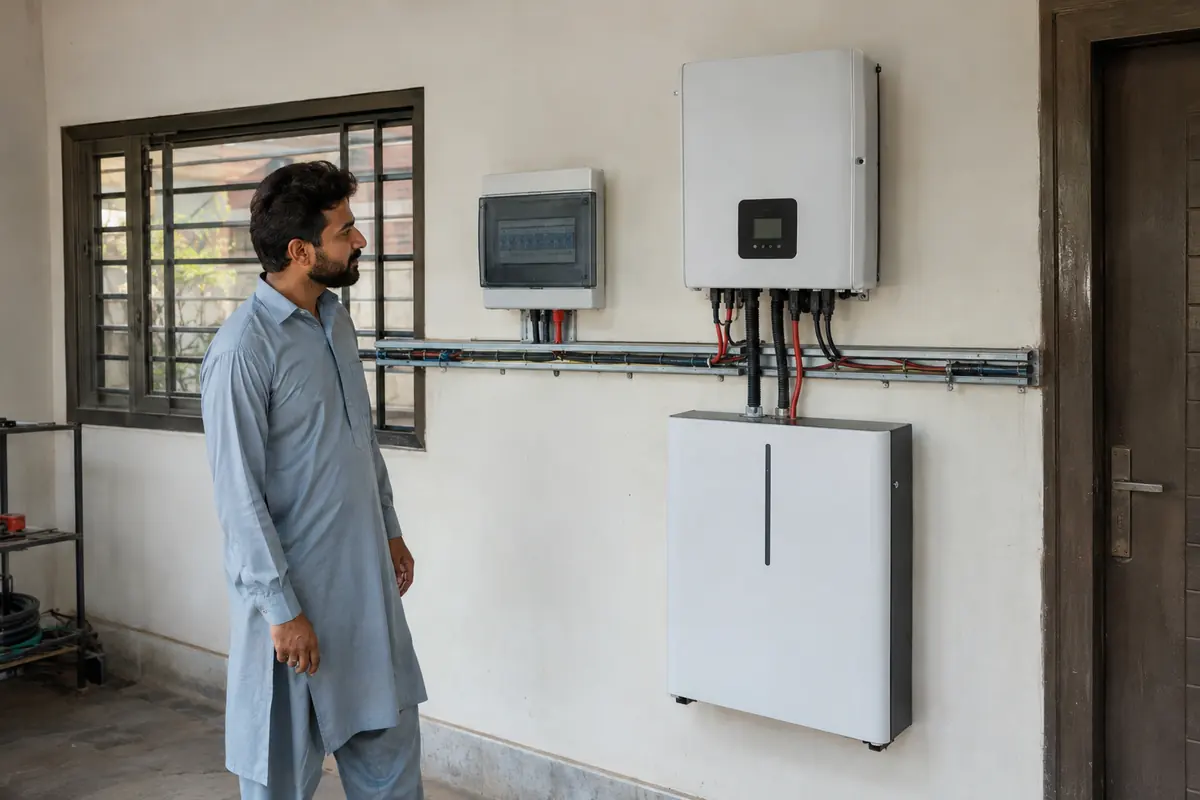
A battery is now the most expensive single item in many Pakistani solar systems, often costing more than the panels on the roof. This guide gives the solar panel battery price in Pakistan as of October 2026 for lithium and tubular options, shows how many hours of backup each size really gives, and helps you decide whether you need a battery at all.
Quick answer: solar battery price ranges
These ranges come from Pakistani retail listings and market price surveys we checked in early October 2026. Battery prices move with the dollar and with Chinese cell prices, so treat them as a guide, not a quote.
| Battery | Stored energy (nameplate) | Typical price (as of October 2026) |
|---|---|---|
| 12 V tubular lead-acid, 125 to 200 Ah | 1.5 to 2.4 kWh | Rs 33,000 to 85,000 each |
| 12.8 V 100 Ah lithium (LiFePO4) | 1.28 kWh | Rs 85,000 to 115,000 |
| 25.6 V (24 V) 100 Ah lithium | 2.56 kWh | Rs 127,000 to 195,000 |
| 51.2 V (48 V) 100 Ah lithium | 5.12 kWh | Rs 223,000 to 310,000 |
| 51.2 V 200 Ah lithium | about 10 kWh | Rs 445,000 to 570,000 |
| 51.2 V 280 to 314 Ah lithium | 14.3 to 16 kWh | Rs 575,000 to 700,000 |
The cheapest lithium per kWh is usually the large 16 kWh wall or rack packs. The cheapest upfront is a pair of tubular batteries, but they give far fewer usable units and wear out sooner.
How we checked these prices
Battery prices are not on our live panel sheet, so we built these ranges by hand for this page.
- Retail listings. We read the current battery listings of a large Pakistani online solar retailer in early October 2026, covering about 20 lithium models from brands such as Dyness, Pylontech, Knox, Ziewnic, Volnex and Itel.
- Market surveys. We compared those listings with a published market range compiled in July 2026 and with tubular battery listings updated in April 2026.
- Like for like. We grouped batteries by voltage and capacity in kWh, because “100 Ah” means very different things at 12 V and at 48 V.
- No bundles. Inverter-plus-battery bundles and second-hand packs were left out.
- Usable energy. For backup calculations we used typical usable depth of discharge: about 90% for LiFePO4 and 50% for tubular lead-acid, which is how installers size them to protect battery life.
If you are buying in a city market, cash dealers may beat online prices, but check that the warranty is still honoured by the brand.
Solar panel battery types and costs explained
Lithium batteries for solar panels (LiFePO4)
Almost every lithium battery for solar in Pakistan now uses lithium iron phosphate (LiFePO4 or LFP) chemistry. It is safer and longer-lived than the lithium used in phones, and it handles Pakistani heat better than older lithium types.
- Usable capacity: around 90% of nameplate, so a 5.12 kWh pack gives about 4.6 kWh
- Cycle life: many brands claim around 6,000 cycles at high depth of discharge on their datasheets, which is well over a decade of daily use if the pack is kept cool
- Charging: fast, and it can be charged partly without harm
- Maintenance: none, no water topping
- Weight: much lighter than lead-acid for the same usable energy
- Communication: good packs talk to the inverter through a BMS (battery management system) cable, which protects both
For a typical home, a 48 V (51.2 V) pack is the right voltage because most branded hybrid inverters are 48 V.
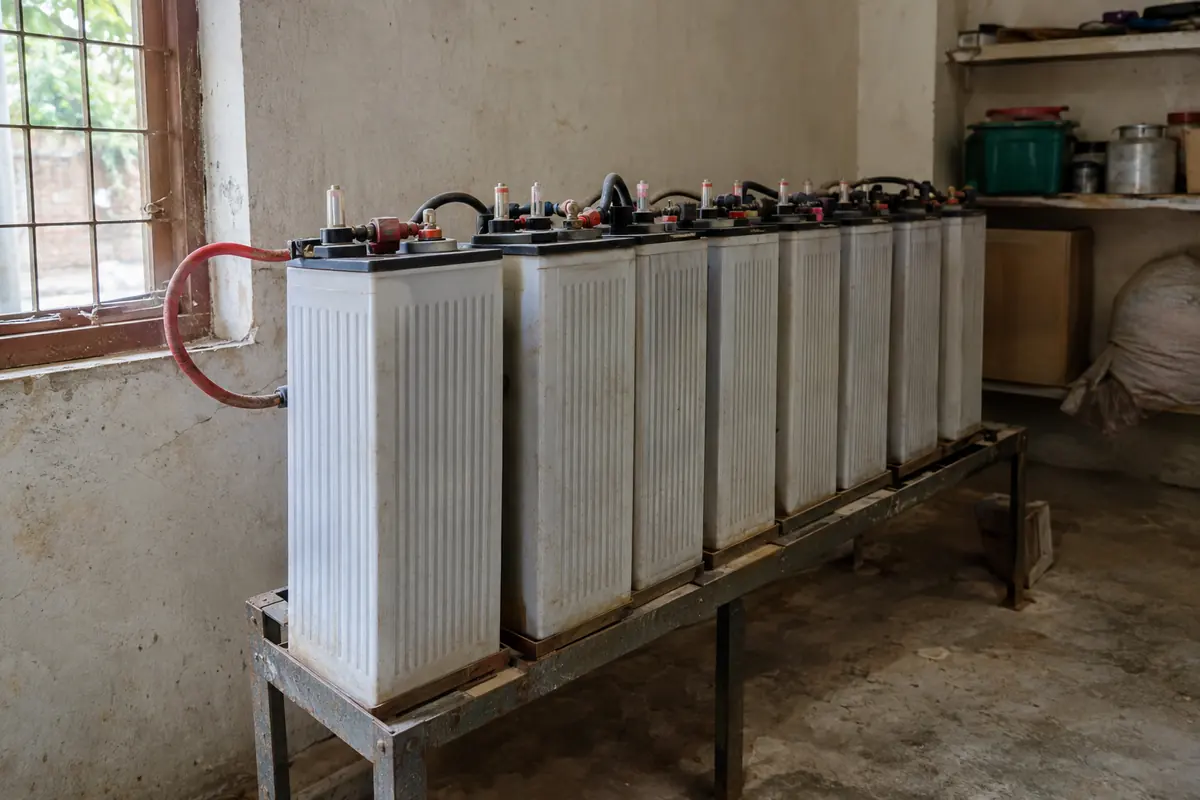
Tubular lead-acid batteries
Tubular batteries are the traditional UPS battery in Pakistan. They are cheap upfront, widely available and easy to replace.
- Usable capacity: only about 50% if you want them to last, so a 12 V 200 Ah battery (2.4 kWh) gives about 1.2 kWh
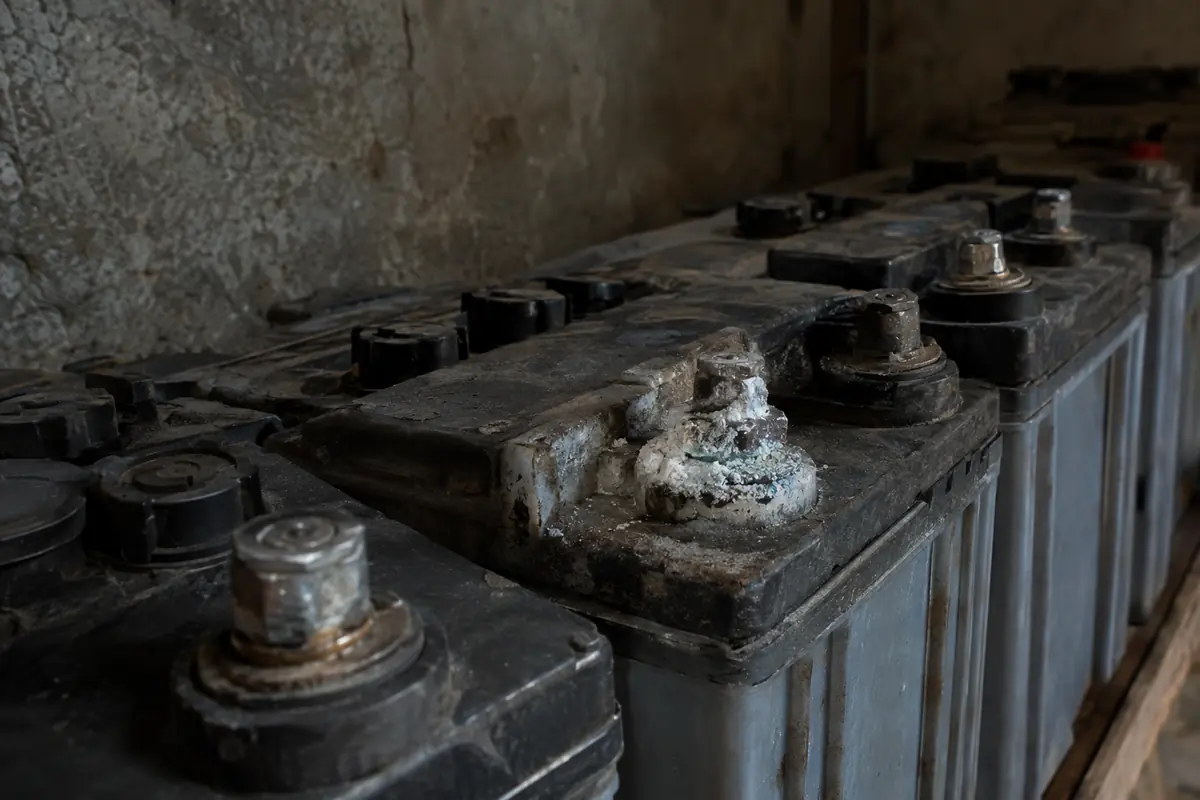
- Life: typically 2 to 5 years depending on depth of discharge, heat and water maintenance
- Maintenance: check and top up distilled water regularly
- Charging: slow, and they suffer if left partly charged for long
- Space and weight: heavy and bulky; a 48 V bank needs four 12 V batteries
Tubular still makes sense for a small UPS system that runs fans and lights for a few hours, or for buyers who cannot spend on lithium yet.
Solar panel battery cost per usable unit
The price tag hides the real comparison. What matters is the cost per kWh you can actually use, and how many years it lasts.
| Battery | Price range | Usable kWh | Cost per usable kWh (approx.) | Typical life |
|---|---|---|---|---|
| 12 V 200 Ah tubular | Rs 44,000 to 85,000 | about 1.2 | Rs 37,000 to 71,000 | 2 to 5 years |
| 51.2 V 100 Ah lithium | Rs 223,000 to 310,000 | about 4.6 | Rs 48,000 to 67,000 | 10+ years |
| 51.2 V 200 Ah lithium | Rs 445,000 to 570,000 | about 9.2 | Rs 48,000 to 62,000 | 10+ years |
| 51.2 V 314 Ah lithium (16 kWh) | Rs 575,000 to 700,000 | about 14.4 | Rs 40,000 to 49,000 | 10+ years |
The upfront cost per usable kWh is similar, but lithium lasts three to five times longer. Over ten years, a tubular bank is usually replaced two or three times, which makes lithium the cheaper option for anyone running backup every day.
How much backup each battery gives
Here is what a battery actually runs during load-shedding or at night. Loads are typical running watts.
| Load | Power draw | 5 kWh lithium (4.6 usable) | 10 kWh lithium (9.2 usable) | Two 12 V 200 Ah tubular (about 2.4 usable) |
|---|---|---|---|---|
| 4 fans, 6 LED lights, router | about 400 W | about 11 hours | about 23 hours | about 6 hours |
| Above plus refrigerator | about 600 W | about 7.5 hours | about 15 hours | about 4 hours |
| One 1.5 ton inverter AC plus fans and lights | about 1,500 W | about 3 hours | about 6 hours | about 1.5 hours |
| Two 1.5 ton ACs plus house load | about 3,000 W | about 1.5 hours | about 3 hours | not practical |
Running ACs all night on battery is expensive. Most homes use the battery for fans, lights and the fridge, and run ACs on solar in the day or on the grid at night.
If you do want night-time cooling, a single inverter AC set to 26°C on a 10 kWh pack is more realistic than two ACs at full power. Inverter ACs draw much less once the room is cool, so real backup is often longer than the table shows on mild nights.
Solar panel without battery
You do not always need a battery. A solar panel without battery works well when:
- You have net metering and an on-grid or hybrid inverter, so daytime surplus goes to the grid
- Your feeder has short or rare load-shedding
- Your main goal is a lower bill, not backup
Without a battery, the system shuts down during outages (on-grid) or runs only while the sun shines (hybrid with no battery). You can add a battery later if the inverter is battery-ready, so choose a hybrid now if you might want backup in future.
Solar panel power bank and portable units
A solar panel power bank is a portable lithium pack with sockets and USB ports, charged by a small folding panel. They suit camping, vans, shops and as emergency backup for a phone, router and a fan. They are not a substitute for a home battery: most hold well under 2 kWh. Check the real capacity in Wh, not just “mAh”, which is often quoted at a low internal voltage and looks bigger than it is.
Solar panel battery charger
For small setups, the solar panel battery charger is a charge controller (PWM or MPPT) between the panel and a 12 V or 24 V battery. A hybrid inverter already includes this, so you only need a separate charger for small DC systems. Our solar panel inverter price guide covers controller prices.
Solar panels and battery cost together
To estimate a full backup system, add the panel cost, the battery and a battery-ready inverter. Panel costs below come from our live sheet:
| System | Panels (585 W) | Panel cost (live) | Suggested battery | Battery range (as of October 2026) |
|---|---|---|---|---|
| 3 kW, fans and lights backup | 6 | Rs 140,400 | 2.56 kWh 24 V lithium or 2 tubular | Rs 88,000 to 195,000 |
| 6 kW, fans, lights, fridge, one AC part-time | 11 | Rs 257,400 | 5 kWh 48 V lithium | Rs 223,000 to 310,000 |
| 10 kW, longer backup | 18 | Rs 421,200 | 10 kWh 48 V lithium | Rs 445,000 to 570,000 |
For the full package including inverter, structure and wiring, see our solar system price and 5 kW solar system pages.
How to size a battery, step by step
Here is the method an honest installer uses. We will work through a 7 marla house in Gujranwala with about three hours of evening load-shedding.
- List the backup loads. Five fans (375 W), eight LED lights (120 W), fridge (200 W), router and TV (150 W). Total: about 850 W.
- Multiply by hours. 850 W x 3 hours = 2,550 Wh, or about 2.6 kWh.
- Add a margin. Inverter losses and idle draw add roughly 10 to 15%. Call it 3 kWh.
- Convert to nameplate. For lithium at 90% usable, 3 / 0.9 = 3.3 kWh. For tubular at 50%, 3 / 0.5 = 6 kWh.
- Pick the nearest size. A 5.12 kWh 48 V lithium pack covers it with room for longer outages. In tubular, you would need four 12 V 150 Ah batteries or more, which is heavy and needs regular water checks.
In this case the lithium pack costs more upfront but is the better buy, because it will still be working long after two sets of tubular batteries have been replaced.
Low-voltage and high-voltage batteries
Most home batteries in Pakistan are low-voltage (LV) packs at 24 V or 48 V (51.2 V nominal). A few premium systems, mainly from Huawei and some three-phase hybrid brands, use high-voltage (HV) stacks of 100 V and above.
| Low-voltage (24 V / 48 V) | High-voltage (100 V+) | |
|---|---|---|
| Inverter needed | Most hybrids sold in Pakistan | Specific HV hybrids only |
| Price per kWh | Lower | Higher |
| Expansion | Add packs in parallel | Add modules to the stack |
| Typical buyer | Houses up to 1 kanal | Large homes, commercial |
If your inverter is a normal 48 V hybrid, an HV battery will not work with it. Check before you buy.
Battery brands you will see in the market
These brands appear in current Pakistani retail listings for solar batteries. Inclusion here is not an endorsement; check warranty support in your own city.
| Brand | What is listed | Common sizes |
|---|---|---|
| Pylontech | 48 V LFP packs | 5.12 kWh, 16 kWh |
| Dyness | 24 V and 48 V LFP packs | 2.56 kWh, 5.12 kWh |
| Knox | Wall and rack LFP packs | 2.56 kWh up to 32 kWh |
| Ziewnic | Wall and box LFP packs | 2.56 kWh, 5.12 kWh, 7.16 kWh |
| Volnex | Large LFP packs | 16 kWh |
| Itel Energy | 24 V and 48 V LFP packs | 2.56 kWh, 16 kWh |
| Phoenix | Tubular lead-acid | 100 to 200 Ah class |
Looking after a battery in Pakistani conditions
- Keep it cool. Battery life drops sharply in heat. An indoor room is far better than a roof cabin or garage facing west.
- Keep it dry and off the floor. In Karachi and monsoon-hit areas of Punjab, use a stand to avoid water damage.
- Set the inverter correctly. Battery type, voltage and charge limits must match the battery datasheet. A wrong setting can shorten life by years.
- Do not drain to zero. Set a cut-off so lithium stops around 10% and tubular around 50%.
- Top up tubular water. Use distilled water only, and check every month in summer.
- Watch the app. If the battery suddenly gives fewer hours, check for a weak cell or a wrong setting before the warranty runs out.
Battery warranty terms decoded
A battery warranty has three numbers, and sellers usually quote only the biggest one. Ask for all three in writing:
- Years: for example 5 or 10 years from the invoice date
- Cycles or energy throughput: for example 6,000 cycles, or a total number of MWh, whichever comes first
- End capacity: the minimum capacity the battery should still hold at the end, usually 60 to 70% of nameplate
Also ask whether the warranty is from the brand or only from the shop, and whether it is void if the pack is used with an inverter brand that is not on the compatibility list.
Does a battery pay for itself with net metering?
Mostly, no, if you look only at the bill. With net metering, the grid already acts like a free battery for your daytime surplus, so a battery adds cost without saving many extra units. A battery pays back in comfort and in avoided generator fuel, not in units. It makes financial sense when load-shedding is long, when you run a business that loses money in outages, or when the rules for exporting power make storing your own solar more valuable than selling it.
Comparison table: best battery for solar panel by situation
| Your situation | Best battery choice | Why |
|---|---|---|
| Net metering, rare outages | No battery, or a small 5 kWh pack | Grid acts as storage; battery is for emergencies |
| Daily 2 to 4 hours load-shedding | 5 kWh 48 V lithium | Covers fans, lights, fridge through outages |
| Long outages, or night use without grid | 10 to 16 kWh lithium | Enough for a full night of house load |
| Small shop or 2-room house, tight budget | Two 12 V tubular or one 24 V lithium | Low upfront cost |
| Farm or remote house, off-grid | 16 kWh lithium or larger | Daily deep cycling kills lead-acid quickly |
| Renting, may move | Portable 24 V or 48 V lithium pack | Easy to take with you |
Any of these work only with an inverter of the matching voltage. Check that the inverter’s battery voltage and BMS communication match the pack before you buy.
Buying checklist: before you pay for a battery
- Decide what you want to run. Make a short list of loads you need in an outage and for how many hours.
- Calculate kWh, not Ah. Multiply voltage by amp-hours: 51.2 V x 100 Ah = 5.12 kWh. Compare batteries in kWh.
- Match the inverter voltage. 24 V inverter needs a 24 V battery; 48 V needs 48 V.
- Ask about BMS communication. Make sure the battery brand is listed as compatible with your inverter brand.
- Read the warranty terms. Years, cycles and the minimum capacity guaranteed at the end. Ask who handles claims in your city.
- Check the cell grade. Ask whether the pack uses new A-grade LFP cells. Very cheap packs may use refurbished cells.
- Plan the location. Keep batteries indoors, shaded, ventilated and off the floor in flood-prone areas. Heat shortens life.
- Budget protection. Add a proper DC breaker, fuse and correct cable size between battery and inverter.
- Size panels to recharge it. A big battery needs enough panels to refill it after a day of use. Our solar panel calculator helps.
- Compare panel prices too. Check the solar panel price list so the battery quote is not hiding an overpriced panel.
Common mistakes to avoid
- Comparing Ah across different voltages. A 12 V 200 Ah battery holds less than half the energy of a 48 V 100 Ah pack.
- Draining tubular batteries flat. Going below about 50% regularly ends their life in a year or two.
- Buying a huge battery with a small panel array. The battery never fully charges in winter and loses capacity.
- Mixing old and new batteries. In a tubular bank, one weak battery drags down the others.
- Ignoring heat. A battery in a tin shed or roof room in June ages much faster. Keep it in the coolest room you can.
- Skipping the BMS cable. Without communication, the inverter guesses the charge level and can over- or under-charge the pack.
- Paying for “lithium” that is not LiFePO4. Ask for the chemistry in writing and the cell datasheet.
- Buying backup you do not need. If load-shedding is rare in your area, spend the money on more panels and net metering instead.
Once you know your battery size, choose panels with the best value per watt on our best solar panels in Pakistan page or the live rates on the home page.
Frequently asked questions
What is the solar panel battery price in Pakistan?
As of October 2026, a 12 V tubular battery costs about Rs 33,000 to 85,000, a 48 V 5 kWh lithium pack about Rs 223,000 to 310,000, and a 16 kWh lithium pack about Rs 575,000 to 700,000. Prices move with the dollar, so get a fresh quote.
Which is the best battery for solar panels?
For daily backup, a 48 V lithium iron phosphate (LiFePO4) battery is the best choice for most homes. It gives about 90% usable capacity, needs no maintenance and lasts far longer than tubular batteries.
Are lithium batteries for solar panels worth the extra cost?
Usually yes if you use backup every day. The cost per usable kWh is similar to tubular, but lithium typically lasts three to five times longer, so you avoid replacing batteries every few years.
Can I use solar panels without a battery?
Yes. With net metering and an on-grid or hybrid inverter, your daytime surplus goes to the grid and you need no battery. The drawback is no power during load-shedding unless you add a battery later.
How many hours will a 5 kWh battery run my house?
A 5 kWh lithium pack gives about 4.6 kWh usable. That runs fans, lights and a router for around 11 hours, or one 1.5 ton inverter AC with fans and lights for about 3 hours.
What is a solar panel power bank?
It is a portable lithium pack with sockets and USB ports, charged by a small folding panel. It suits phones, routers, a fan or camping, but most hold under 2 kWh, so it cannot replace a home battery.
Do I need a separate solar panel battery charger?
Not with a hybrid inverter, which already has a built-in charger. Small DC systems with a 12 V or 24 V battery need a PWM or MPPT charge controller between the panel and the battery.
How long do solar batteries last in Pakistan?
Tubular batteries usually last 2 to 5 years depending on use and heat. Good LiFePO4 packs kept in a cool room typically last more than 10 years of daily cycling.