On this page
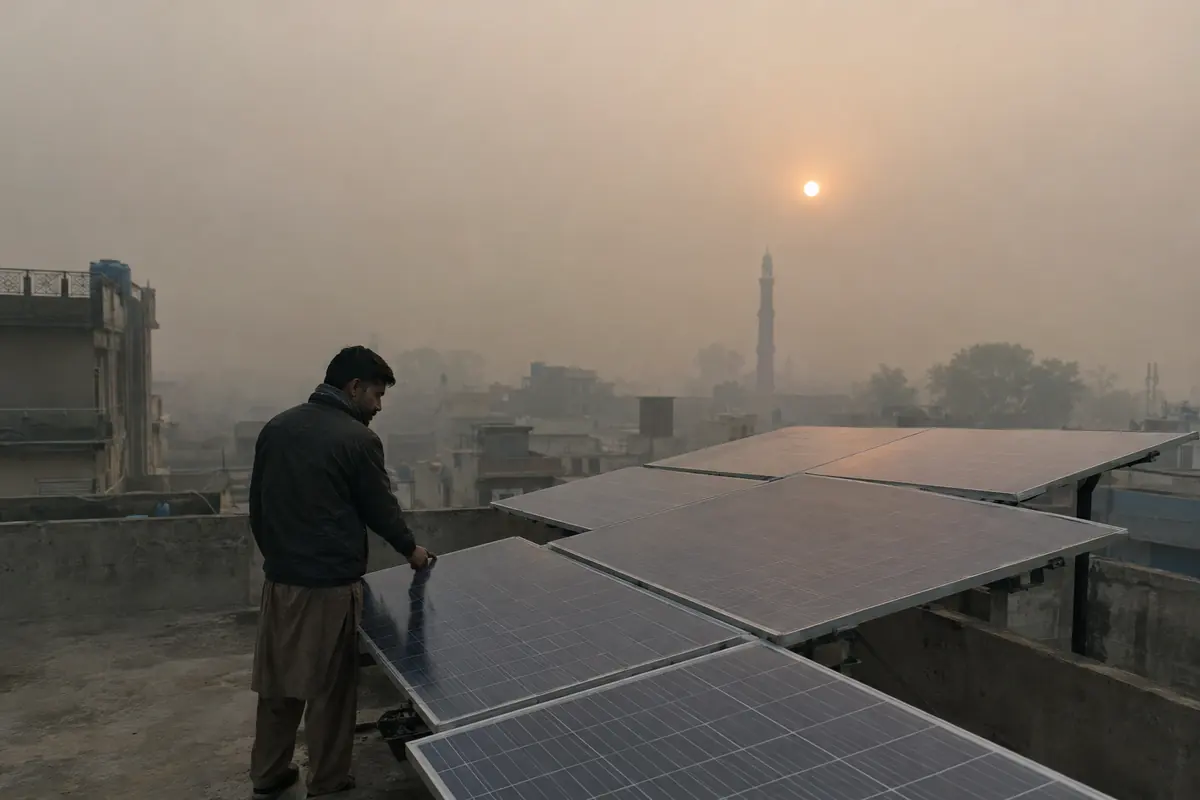
Solar panel output in winter fog and smog drops a lot, but it does not stop. On a clear December day a well-installed system in Punjab still makes roughly two-thirds to three-quarters of a typical summer day’s units; on a heavy smog day that can fall to half of the clear-day figure or less, and dense morning fog can push it lower still. The loss comes from three things stacking up: shorter days, haze blocking sunlight before it reaches the roof, and sticky soot settling on the glass.
If you live in Lahore, Faisalabad, Gujranwala or Multan, you will see this in your monitoring app from late October to January. Here is what is going on, what the research says, and what a homeowner can actually do about it.
Three separate losses, not one
When people say “smog is killing my solar”, they are usually seeing three different effects at once. It helps to pull them apart, because each has a different fix.
- The season itself. In December the sun is lower in the sky and the day is shorter. Even in perfectly clean air, a south-facing panel in Lahore receives noticeably less energy than in May or June.
- Atmospheric haze. Smog particles and fog droplets scatter and absorb sunlight before it reaches the panel. Some of that light still arrives as diffuse light from the whole sky, and panels can use it, but the total is lower.
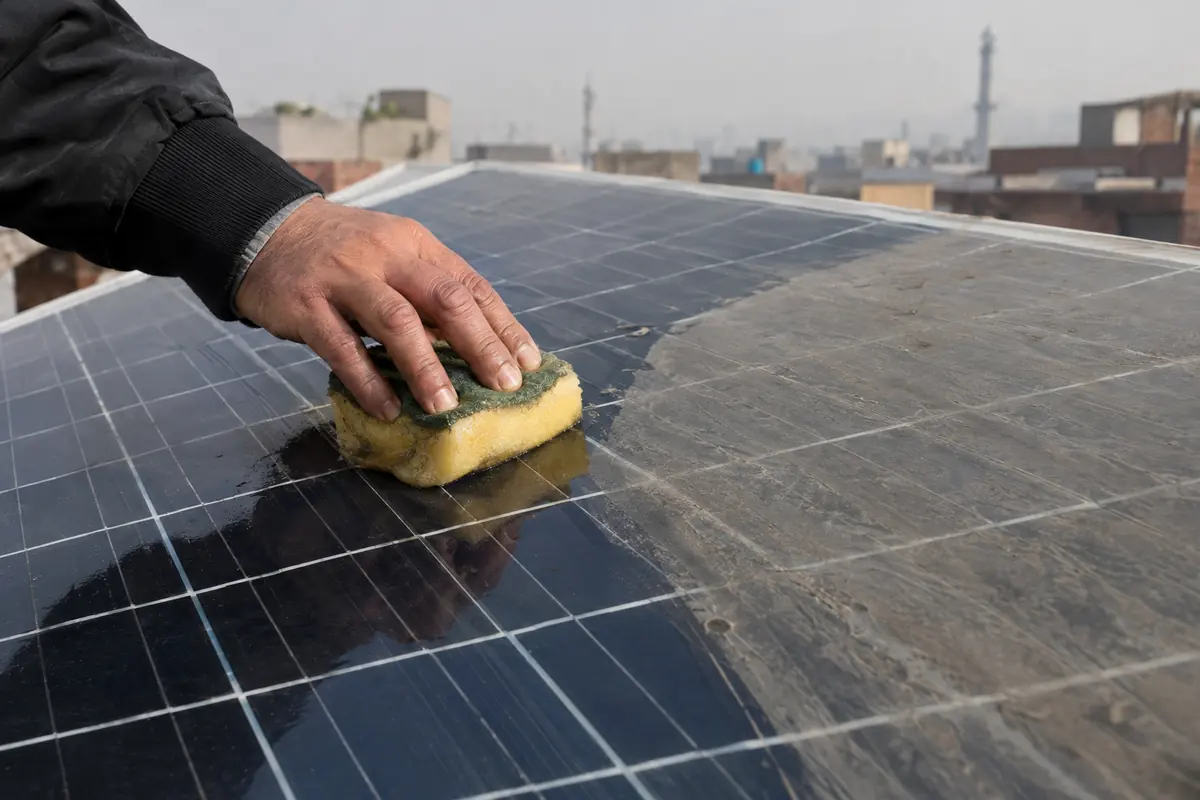
- Dirt on the glass. Smog particles settle and stick, often helped by morning dew that dries into a film. This blocks light right at the panel surface, and unlike haze, it stays until you clean it.
You can do nothing about the first two. The third is fully in your hands, and it is often the biggest of the three on a rooftop that has not been washed for a month.
What the research says about haze and solar
There is not yet much published long-term data specific to Pakistani cities, but two widely cited studies from the region give a sense of scale.
- A 2018 MIT study published in Energy & Environmental Science used two years of data from Delhi and found that air pollution haze reduced the output of silicon solar panels by about 12 percent on an annual average. Preliminary figures for other cities ranged from around 2 percent in Singapore to over 9 percent in Beijing, Dhaka and Kolkata.
- A 2017 study led by Duke University with IIT Gandhinagar, published in Environmental Science & Technology Letters, looked at dust and pollution deposits on panel surfaces. It found that in northern India, eastern China and the Arabian Peninsula, losses could reach 17 to 25 percent or more even with monthly cleaning, and 25 to 35 percent with cleaning every two months. In India and China, man-made particles (soot and other pollutants) mattered more than natural dust, because they block light more effectively.
Lahore’s winter air quality is regularly in the same range as Delhi’s, since both sit in the same Indo-Gangetic smog belt. Two cautions apply. These are annual averages: the losses are concentrated in the smog months, so November and December losses are larger than the yearly figure suggests. And they are not Pakistan-specific measurements, so treat them as a guide to the size of the effect, not an exact forecast for your roof.
Solar panel output in winter, by sky condition
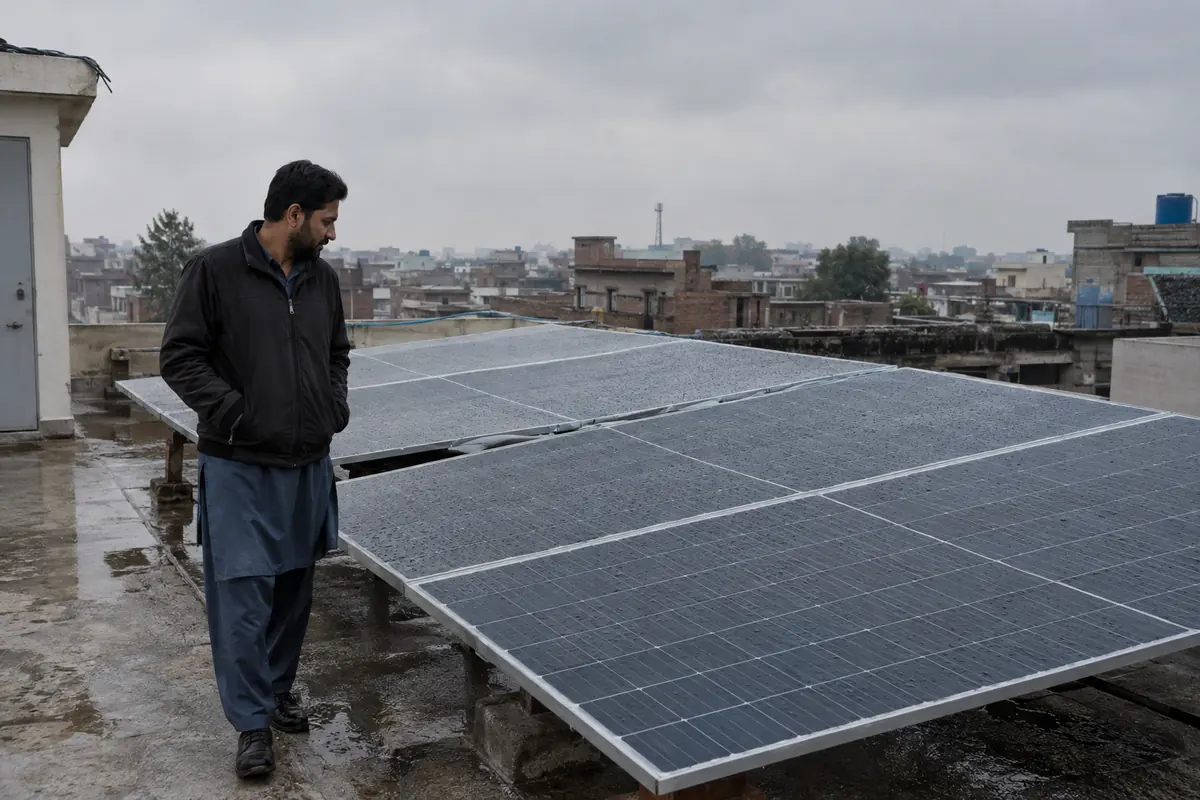
Here is a practical way to think about daily production in the Punjab winter. The figures are our engineering estimates for a south-facing, well-tilted rooftop system in central Punjab in December and early January. They assume clean panels unless stated. Your roof, tilt, shading and inverter will shift them, so compare with your own app.
| Sky condition | Approx. units per kW installed per day | 5 kW system, units per day | What you notice |
|---|---|---|---|
| Clear winter day, clean panels | 3.2 to 4.0 | 16 to 20 | Sharp shadows, steady curve in the app |
| Light haze | 2.6 to 3.2 | 13 to 16 | Sun visible but pale, curve slightly flattened |
| Heavy smog | 1.6 to 2.6 | 8 to 13 | Sun a dull disc you can look near, flat low curve |
| Morning fog, clearing by noon | 1.5 to 2.5 | 7 to 12 | Near zero until late morning, then a short peak |
| Dense fog or overcast all day | 0.4 to 1.2 | 2 to 6 | Only a few hundred watts at best |
| Clear day, panels unwashed for a month in smog season | Can be 15 to 25 percent below the clean figure | Roughly 12 to 17 | Grey film on the glass, output below neighbours |
For comparison, the site-wide annual average sun hours we use for Lahore is 5.2 peak sun hours a day. Winter months run well below that annual figure, and early summer runs above it. Use our solar production calculator for a yearly estimate, then expect December to be your weakest month.
Why the morning hurts most
Fog in the Punjab plains tends to be thickest around dawn and burns off towards midday, while smog often hangs lowest in the still morning air. That means winter production curves are often lopsided: almost flat until 10 or 11 am, then a decent peak from noon to 3 pm. If your app shows that shape, the system is fine. It is the weather.
Reading your monitoring app in winter
Most inverter apps show a daily production curve and a monthly total. In smog season, the daily curve is less useful than a comparison. Two simple habits help:
- Compare clear days with clear days. Note the units on the first bright, sharp-shadowed day after a wash. That is your clean-panel winter baseline. If a later clear day comes in well below it, the glass is probably dirty again.
- Compare strings or neighbours. If your inverter shows two strings, they should track each other closely on the same day. A neighbour with a similar system in the same street is a useful cross-check too, since you both get the same sky.
A wash that brings the next clear day back up to your baseline tells you how much dirt was costing you. Many owners are surprised by the jump.
City by city: who loses most
The smog and fog belt is not evenly spread. Rough patterns from the cities we cover:
- Lahore, Gujranwala, Faisalabad: the heaviest and longest smog season, usually from late October into January, with fog added in December and January. Expect the largest winter dip. City pricing for panels is on our Lahore solar panel prices and Faisalabad pages.
- Multan: strong annual sun (5.5 peak sun hours on average), but fog in the southern Punjab plains can be persistent in December and January.
- Islamabad and Rawalpindi: generally less smog than central Punjab, but cloudier winter weather and occasional rain lower output instead.
- Peshawar: winter haze and fog occur, usually less sustained than in Lahore.
- Karachi: little smog or fog in the Punjab sense; winter is often among the better production periods because of clear skies and mild temperatures.
Five things that actually recover lost units
1. Wash more often, and wash properly
This is the single biggest lever. Smog residue is oily and fine. A dry wipe smears it. Use clean water and a soft brush or sponge, early in the morning or late afternoon when the glass is cool, and avoid hard tap water if it leaves white marks. During the worst smog weeks, every 7 to 14 days is reasonable on a dense city roof. Our solar panel cleaning guide covers safe methods and what not to use.
2. Check your tilt
Most rooftop systems in Pakistan are tilted for good year-round output, which is a compromise. Panels tilted a bit steeper catch more of the low winter sun, and steeper panels also shed dirt and dew more easily. Adjustable stands are not common, but if you are installing now, see the tilt angle calculator for your city’s best fixed and seasonal angles.
3. Watch for winter shading
A water tank, a neighbour’s top floor or a tree that never shaded your panels in June can throw a long shadow across them in December, when the sun is low. Even partial shading of one panel in a string drags down the whole string. Walk the roof at 10 am and 2 pm in winter and look.
4. Shift heavy loads to midday
If you are on net metering or net billing, or running a hybrid, time washing machines, water pumps and irons for 11 am to 3 pm, when the haze is thinnest and production peaks. That way more of your solar is used directly in the house.
5. Do not oversize your battery expectations
Hybrid owners often find the battery does not fully charge on smoggy days. That is normal. If the battery is your load-shedding backup, set its minimum charge level a little higher in winter so the inverter keeps a reserve from grid charging when the sun cannot do it.
What not to worry about
- Cold. Low temperatures actually help: silicon cells lose efficiency as they heat up, so a cool December panel converts sunlight slightly better than a 65 °C panel in June. If you want the physics, see how solar panels work.
- Damage from fog. Moisture from fog does not harm a properly sealed panel. Water collecting on the lower frame edge and leaving a dirt line is a cleaning issue, not a fault.
- One bad week. A few days of very low production in December is not a sign the system is failing. A fall that continues on clear days, or one string much lower than another, is worth a call to your installer.
Planning a system around winter
If you are sizing a new system, do not plan it so tightly that it only covers your bill in a sunny month. Look at your highest-consumption months, then accept that December and January production will be the year’s lowest. Under a net metering arrangement, units exported in summer can help balance the winter gap. Under net billing, exported units are valued at a buyback rate that differs from the price you pay for imported units, so the same summer surplus may be worth less. Check which rules apply to your connection before counting on summer export to cover winter. Our sizing calculator lets you test both scenarios.
Bottom line
Winter smog and fog cut solar output in Punjab by a real, visible amount, and the worst days can be very poor. Much of the loss is weather you cannot control, but a meaningful share is dirty glass and winter shading, which you can. Wash the panels more often from November to January, check for new shadows, run heavy loads at midday, and judge your system over the whole month, not a single foggy morning.
Frequently asked questions
Do solar panels work in smog?
Yes, but output falls. Smog scatters and absorbs sunlight before it reaches the panel, and the soot that settles on the glass blocks more. Expect noticeably fewer units on heavy smog days, and clean the panels more often during the season.
Do solar panels work in fog?
They still produce from diffuse light, but thick fog can cut output to a small fraction of a clear day, especially in the morning. Production usually picks up once the fog lifts around midday.
How many units does a 5kW solar system produce in winter in Lahore?
On a clear winter day a well-installed 5 kW system in Lahore typically makes somewhere around 15 to 20 units. On heavy smog or fog days it can drop to well under 10. Your monitoring app is the best guide for your own roof.
Should I clean my solar panels more often in smog season?
Yes. Smog particles are sticky and do not wash off with light dew the way some dust does. Cleaning every one to two weeks during the worst smog months is reasonable for most rooftops in Lahore, Faisalabad and Gujranwala.
Does cold weather reduce solar panel output?
No, cold actually helps. Solar cells are more efficient when they are cool. The winter drop comes from shorter days, a lower sun angle, haze, fog and dirt on the glass, not from the cold itself.
More from the blog
 Solar Tech Why On-Grid Solar Shuts Off During Load Shedding (and How to Keep Power)
Your on-grid solar goes dark when the grid cuts out, even at noon. Here is why the inverter does it on purpose, and four ways to keep your fans running. · 9 min read
 Solar Tech N-Type vs P-Type Solar Panels (TOPCon vs PERC): Which Should You Buy?
N-type TOPCon or P-type PERC? How the two cell types differ in heat, ageing and price per watt in Pakistan, and when old PERC stock is still a fair buy. · 8 min read
 Net Metering & Bills Electricity Tariff and Fixed Charges in 2026: What Changes for Solar Users
Pakistan's 2026 electricity tariff, new fixed charges and quarterly adjustments explained for solar users, and how they change your bill and payback. · 8 min read