On this page
- What “N-type” and “P-type” actually mean
- The four differences that matter on a Pakistani roof
- Putting a number on it: a 5 kW system over a year
- Price per watt: what to compare
- What about HJT and back-contact panels?
- Where the market is in 2026
- Watch out for these traps
- So which should you buy?
- Frequently asked questions
For most Pakistani rooftops in 2026, an N-type TOPCon panel is the better buy: it loses less power in the heat, degrades more slowly over 25 years, and usually costs little or nothing extra per watt now that it has become the mainstream product. P-type PERC panels are still a reasonable choice if they are genuine, clearly cheaper per watt, and from a brand with a working warranty in Pakistan. The difference in the n type vs p type solar panels debate is real but measured in single-digit percentages, not miracles.
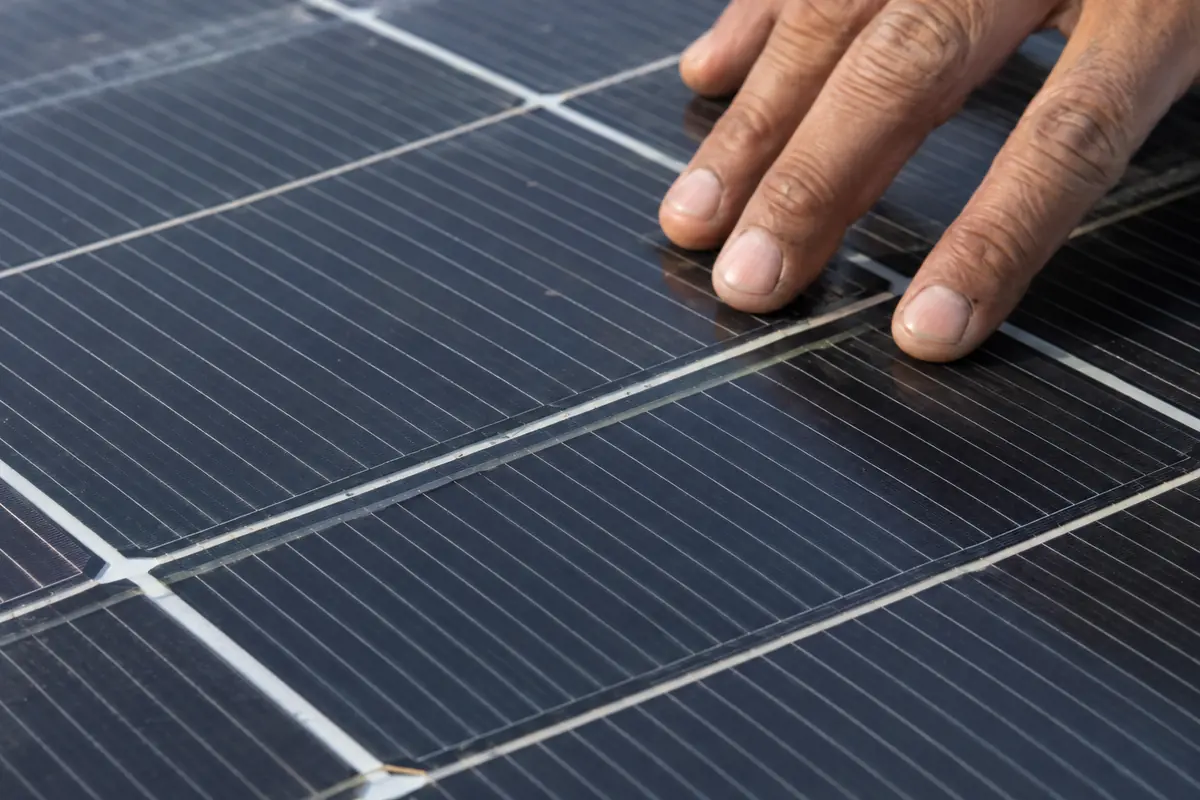
What “N-type” and “P-type” actually mean
A silicon solar cell is made from a wafer that has been “doped” with a small amount of another element. P-type wafers use boron, which leaves the silicon with a positive charge carrier. N-type wafers use phosphorus, which leaves a negative one. For roughly a decade, almost every affordable panel was P-type, because it was cheaper to make at scale.
The cell design built on that wafer is what you see in the model name:
- PERC (Passivated Emitter and Rear Contact) is the P-type workhorse. Most 330 W to 550 W panels sold in Pakistan over the last several years were PERC.
- TOPCon (Tunnel Oxide Passivated Contact) is the N-type design that took over the market. Most 575 W to 590 W panels on M10 wafers, and the 620 W to 720 W large-format panels, are TOPCon.
- HJT (heterojunction) is another N-type design, excellent in heat but less common here.
- BC (back contact), used in some premium LONGi and Aiko lines, moves all the contacts to the back of the cell. It is also built on N-type wafers.
For background on the wider family of panel types, see our guide to solar panel types.
The four differences that matter on a Pakistani roof
Laboratory efficiency figures make for good brochures, but four specifications decide how much energy you actually get over the life of the panel. The table shows typical datasheet values for mainstream panels from major manufacturers. Individual models vary, so always read the datasheet of the exact panel you are buying.
| Specification | P-type PERC (typical) | N-type TOPCon (typical) | Why it matters |
|---|---|---|---|
| Temperature coefficient of Pmax | about -0.34 to -0.35% per °C | about -0.29 to -0.30% per °C | Power lost for every degree the cell runs above 25°C |
| First-year degradation (warranted) | about 2% | about 1% | Power lost in the first year |
| Yearly degradation after year one | about 0.55% | about 0.40% | Slow power loss every year after |
| Module efficiency | about 20.5 to 21.3% | about 22 to 23% | More watts from the same roof area |
| Bifaciality (bifacial models) | about 70% | about 80% | Extra gain from light reaching the back, mainly on raised structures |
1. Heat: the difference you will notice in June
Panels are rated at a cell temperature of 25°C. On a May or June afternoon in Lahore, Multan or Karachi, with air temperatures above 40°C, cells on a rooftop commonly run at 60 to 70°C. That is 35 to 45 degrees above the rating point.
Take a cell running 42°C above 25°C. A PERC panel at -0.35% per °C loses about 14.7% of its rated power. A TOPCon panel at -0.30% per °C loses about 12.6%. So on a hot afternoon, the TOPCon panel delivers roughly 2% more of its nameplate power than the PERC panel. Over a Pakistani year, where hot months are long, that gap adds up.
2. Ageing: the difference you will notice in year 15
P-type cells suffer from light-induced degradation (LID), caused by boron and oxygen reacting in the wafer during the first hours of sunlight, plus a slower heat-related effect called LeTID. N-type cells are largely free of the boron-oxygen problem. That is why manufacturers warrant N-type panels at about 1% loss in year one against about 2% for PERC, and a slower yearly decline after that.
Using the typical warranted figures above, after 25 years a PERC panel is warranted to keep about 84.8% of its original power and a TOPCon panel about 89.4%. That is roughly 4.6 percentage points more output from the TOPCon panel in the last years of the system, and a smaller but growing advantage every year before that. Our solar panel lifespan guide explains what those warranty curves mean in practice.
3. Efficiency: roof space, not energy
Higher efficiency does not give you more energy per watt. A 585 W panel produces about the same units per watt as a 545 W panel in the same conditions, apart from the heat and ageing effects above. What efficiency gives you is more watts per square foot. On a small 5 marla roof, that can mean fitting one or two extra panels.
4. Low light and haze
N-type cells tend to perform slightly better in weak light, such as early mornings and hazy days. Do not overestimate this. In dense Punjab smog or fog, every panel produces very little, and the difference between cell types is small in absolute terms.
Putting a number on it: a 5 kW system over a year
Here is an illustrative comparison for a 5 kW system in Lahore, using the site’s average of 5.2 peak sun hours and a system factor of about 0.79, which gives roughly 4.1 units per kW per day, or about 7,500 units a year for 5 kW.
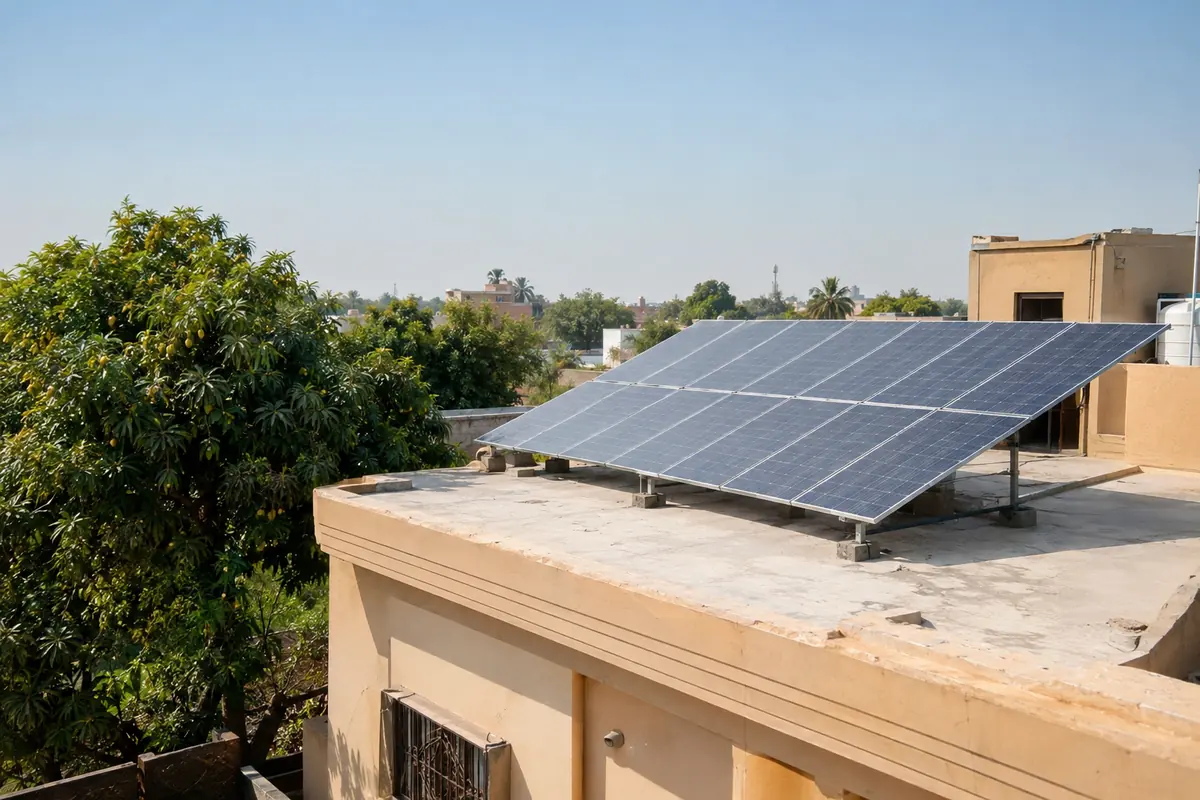
- The temperature advantage of TOPCon is worth roughly 1 to 2% more energy over a full year, since only part of the year is very hot. Call it 75 to 150 extra units in year one.
- The degradation advantage grows each year. By year 10 the TOPCon array is warranted to be producing about 2.4 percentage points more of its rated power than the PERC array, which is about 175 more units that year.
- Added up over 25 years, the TOPCon system can plausibly produce several thousand more units than an identical-sized PERC system.
These are estimates built from datasheet coefficients, not measured results, and actual degradation depends on panel quality. The direction is clear, though: TOPCon is worth a modest premium per watt, not a large one.
Price per watt: what to compare
Compare panels on rupees per watt, not rupees per panel. Today the market average is Rs 41.3 per watt. A 585 W panel (usually N-type TOPCon) costs Rs 40 per watt at the cheapest current listing, and a 545 W panel (usually P-type PERC) costs Rs 39 per watt.
A simple rule of thumb from the energy estimates above: if the N-type panel costs up to about 5% more per watt than a comparable PERC panel, it is the better value over the life of the system. If PERC stock is being cleared at a much bigger discount than that, the PERC panel can be the smarter buy, provided it is genuine and the warranty is honoured. See today’s numbers on the price per watt tracker.
What about HJT and back-contact panels?
TOPCon is not the only N-type option. Two others appear in Pakistani dealer lists, usually at a higher price per watt.
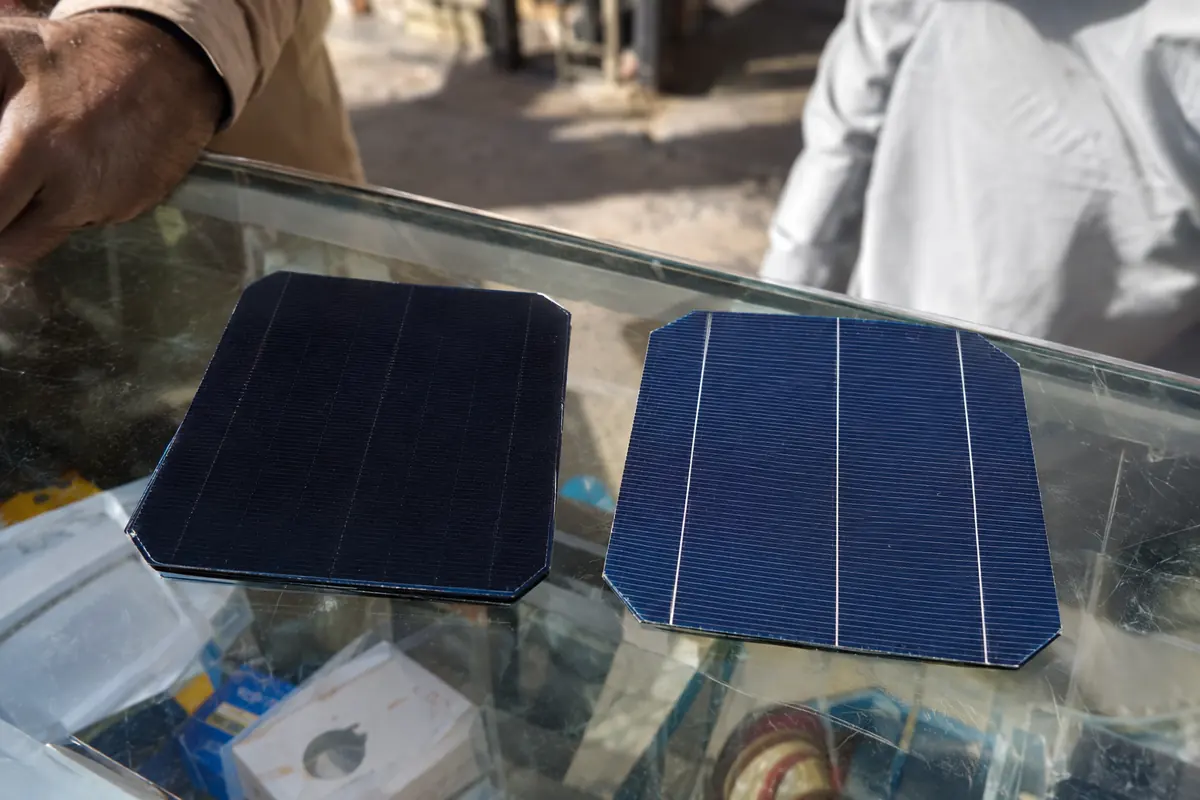
HJT (heterojunction) panels layer thin amorphous silicon on an N-type wafer. Their headline advantage is heat: typical datasheets list temperature coefficients around -0.24 to -0.26% per °C, better again than TOPCon. In a Multan or Jacobabad summer, that is a real gain. The catch is availability and price. Fewer brands sell HJT here, so check that the importer can honour the warranty.
Back-contact (BC) panels, such as LONGi’s Hi-MO X10 range and Aiko’s ABC panels, move all the metal contacts to the rear of the cell, so the front has no busbars. This raises efficiency, which helps on small roofs, and some BC designs are marketed as handling partial shade better. Their temperature coefficients are generally in the TOPCon range or slightly better, depending on the model.
For most homes, TOPCon gives the best balance of price and performance. HJT and BC are worth a look if your roof is small, your city is very hot, and the price per watt gap is small.
Where the market is in 2026
Walk into a dealer on Hall Road or Brandreth Road today and almost every panel on current price lists is N-type, mostly TOPCon in the 585 W to 655 W range, with large-format 700 W and above panels becoming common. P-type PERC has largely disappeared from new listings. When you do see a 540 W or 545 W PERC panel, it is usually older stock being cleared. That is not automatically bad, since a genuine PERC panel from a major manufacturer still works well for 25 years, but it changes the questions you should ask: how old is it, where has it been stored, and will the warranty start from your purchase date or from its manufacture date?
Watch out for these traps
- Wattage is not cell type. Most 540 to 550 W panels are PERC and most 580 W and above are TOPCon, but there are exceptions in both directions. Read the datasheet and the back label.
- “N-type” printed on a sticker proves nothing. Check the model number on the manufacturer’s own datasheet. Brands such as Jinko let you verify serial numbers; see our Jinko panel verification guide.
- Old stock relabelled as new. Some PERC stock has been in warehouses for a long time. Ask for the manufacturing date, which is usually encoded in the serial number or printed on the label.
- Mixing types in one string. Do not put PERC and TOPCon panels in the same string. Their voltages and currents differ, and the weaker panel drags down the string. If you are expanding an older PERC system, put the new TOPCon panels on a separate MPPT input.
- Comparing efficiency across sizes. A 720 W panel is not more efficient just because it is bigger. Compare the efficiency percentage on the datasheet.
So which should you buy?
| Your situation | Better choice |
|---|---|
| New system, normal budget | N-type TOPCon, such as a 585 W panel |
| Small roof, need maximum watts | N-type TOPCon or BC, higher-efficiency models |
| Hot city (Multan, Karachi, Sukkur) | N-type, the heat advantage is larger |
| Tight budget, PERC available at a clear discount | Genuine PERC from a known brand is acceptable |
| Expanding an existing PERC system | Either, but wire new panels on a separate MPPT |
| Raised structure with light-coloured roof beneath | Bifacial N-type, the rear-side gain is higher |
For a new install today, start with the 585 watt panel price, which is currently around Rs 23,400 at the cheapest listing, and compare it to brand options on our best solar panels list. If you want to see what comes after TOPCon, the latest solar panel technology page covers BC and HJT in more depth.
Frequently asked questions
Is N-type better than P-type for Pakistan?
For most buyers, yes. N-type TOPCon panels lose less power in heat and degrade more slowly, which matters in Pakistani summers. The gap is a few percent, so a clearly cheaper genuine P-type panel can still be a fair buy.
How can I tell if a panel is N-type?
Check the datasheet and the label on the back. N-type panels usually say TOPCon, HJT, BC or N-type in the model name or cell description, and typically list a temperature coefficient around -0.29 to -0.30 percent per degree.
Are 545 W panels P-type?
Most 540 to 550 W panels sold in Pakistan are P-type PERC models from the earlier generation. Some manufacturers have released N-type panels at similar sizes, so check the datasheet rather than assuming from the wattage.
Do N-type panels work better in winter fog?
Slightly. N-type cells generally handle low light a little better, but in thick fog all panels produce very little. The bigger advantage of N-type is in summer heat.
Is HJT better than TOPCon?
HJT has an even lower temperature coefficient and is very good in heat, but it is less common and usually costs more per watt in Pakistan. TOPCon is the mainstream choice for most rooftops.
More from the blog
 Solar Tech How Much Do Solar Panels Produce in Winter Fog and Smog?
Smog and fog can cut solar output sharply in Punjab's winter. What a 5 kW system really makes on hazy days, why, and what you can do to recover lost units. · 8 min read
 Solar Tech Why On-Grid Solar Shuts Off During Load Shedding (and How to Keep Power)
Your on-grid solar goes dark when the grid cuts out, even at noon. Here is why the inverter does it on purpose, and four ways to keep your fans running. · 9 min read
 Net Metering & Bills Electricity Tariff and Fixed Charges in 2026: What Changes for Solar Users
Pakistan's 2026 electricity tariff, new fixed charges and quarterly adjustments explained for solar users, and how they change your bill and payback. · 8 min read