On this page
- What the inverter is doing when the grid goes down
- Solar system during load shedding: the four ways to keep power
- Option 1: swap to a hybrid inverter
- Option 2: add a battery inverter beside the old one (AC coupling)
- Option 3: a separate UPS for fans and lights
- How much battery do you actually need?
- What happens at night, and when the grid comes back
- Common mistakes we see
- What to do now
- Frequently asked questions
An on-grid solar system shuts off during load shedding because its inverter is designed to stop exporting the instant the grid disappears, so that no electricity flows back into lines that linemen think are dead. Your panels are still producing; the inverter simply refuses to use that power without a live grid to follow. To keep a solar system working during load shedding you need a battery and an inverter that can form its own mini-grid, which in practice means a hybrid inverter or an added battery inverter.
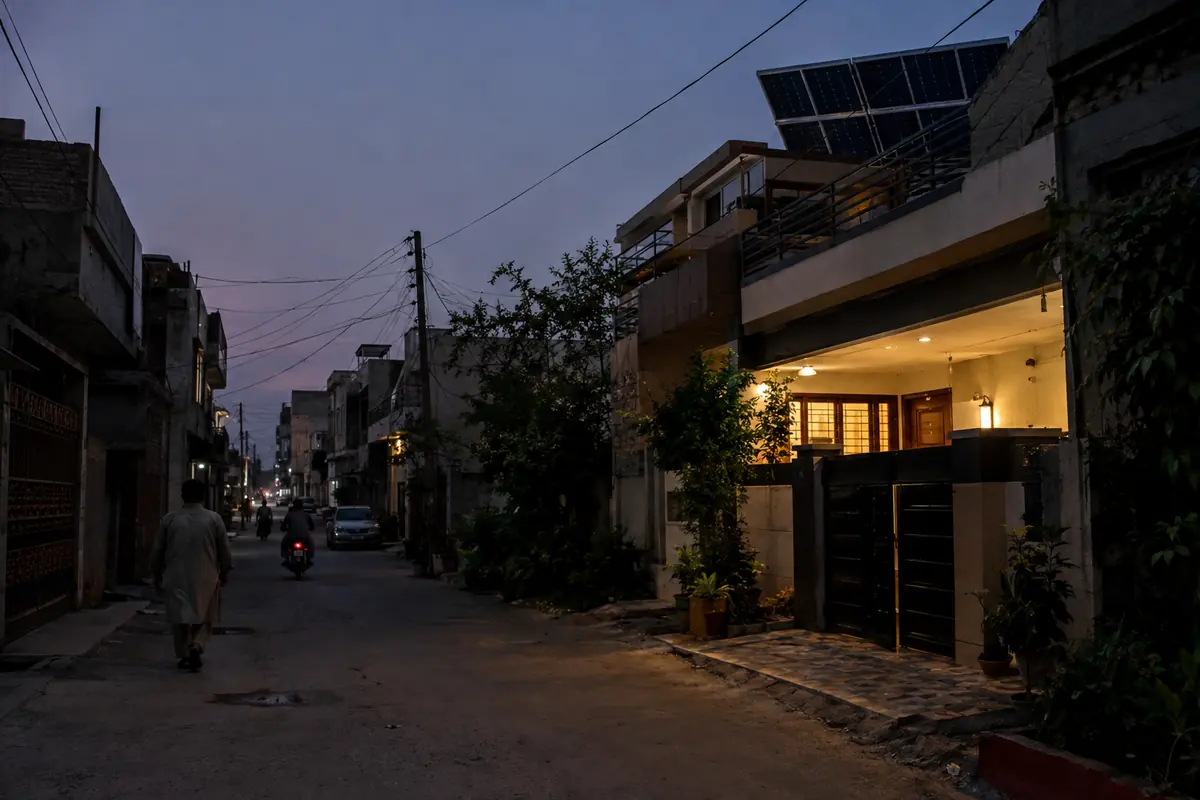
This catches a lot of people out. They spend lakhs on panels, the first afternoon cut comes, and the house goes dark under a bright sun. Nothing is broken. Here is what is happening inside the box on your wall, and what you can do about it without throwing away what you already own.
What the inverter is doing when the grid goes down
A grid-tied inverter does not create its own voltage and frequency. It listens to the grid, locks onto its 230 V, 50 Hz waveform, and pushes current in step with it. Think of it as a passenger who can only walk in step with someone else. When LESCO, IESCO, K-Electric or any other DISCO cuts the feeder, there is nothing left to follow.
At that point the inverter runs a check called anti-islanding. It watches for sudden changes in voltage, frequency and phase that signal a lost grid, and if it sees them it opens its output relay. The international test standard for this behaviour is IEC 62116, and inverters approved for net metering connections in Pakistan are expected to have it. The disconnect happens in well under a couple of seconds, often much faster.
The reason is human safety. When a feeder is switched off for load shedding or repairs, a lineman may climb the pole and touch conductors he believes are dead. If hundreds of rooftop inverters kept feeding those lines, the transformer on the pole would step that 230 V up to 11 kV on the primary side. An “island” of live wire inside a switched-off network is exactly what anti-islanding prevents.
So the shutdown is not a fault, not a cheap inverter, and not your installer’s mistake. It is the inverter doing its job.
Why the panels cannot just run the house directly
People often ask why the inverter cannot simply switch off the export side and still feed the house. Two reasons. First, a pure grid-tied design has no internal transfer switch and no ability to set its own frequency. Second, solar output moves around constantly. A passing cloud can drop production by half in a few seconds. Without a battery to absorb those swings, a fridge compressor or an AC starting up would pull the voltage down and the inverter would trip anyway. A stable home supply needs a buffer, and that buffer is a battery.
Solar system during load shedding: the four ways to keep power
If you already have on-grid solar and load shedding is a real problem in your area, you have four practical routes. They differ in cost, in how much of your existing kit you keep, and in how much of the house stays powered.
| Option | What you add or change | What runs in a cut | Keeps net metering? | Best for |
|---|---|---|---|---|
| 1. Replace with a hybrid inverter | Hybrid inverter plus lithium or tubular battery bank | Backup circuits from battery, recharged by panels in daytime | Yes, if the hybrid model is approved for grid export | Most homes planning a long-term setup |
| 2. AC-couple a battery inverter | Separate battery inverter and battery, existing on-grid inverter stays | Backup circuits; on-grid inverter can restart on the battery inverter’s mini-grid if the pair is compatible | Yes | Larger systems where the on-grid inverter is new and expensive |
| 3. Keep a separate UPS for essentials | A normal home UPS with batteries on a few circuits | Fans and lights only, charged from grid (and from solar while the grid is on) | Yes | Tight budgets, short daily cuts |
| 4. Accept daytime outages | Nothing | Nothing | Yes | Areas with rare or night-only load shedding |
Note what is missing: a generator used as a “fake grid”. Some people run a small petrol generator so the on-grid inverter thinks the grid is back. The inverter then pushes power into the generator, which cannot accept it. Generators trip, alternators overheat and inverters log faults. Unless an installer has designed a proper generator-and-solar control system, avoid this.
Option 1: swap to a hybrid inverter
A hybrid inverter does three jobs in one box: it runs the panels, it charges and discharges a battery, and it can either sync to the grid or create its own 230 V supply when the grid fails. When the cut comes it opens an internal relay to isolate your house from the street (so anti-islanding is still respected) and keeps feeding your backup circuits from battery and sun.
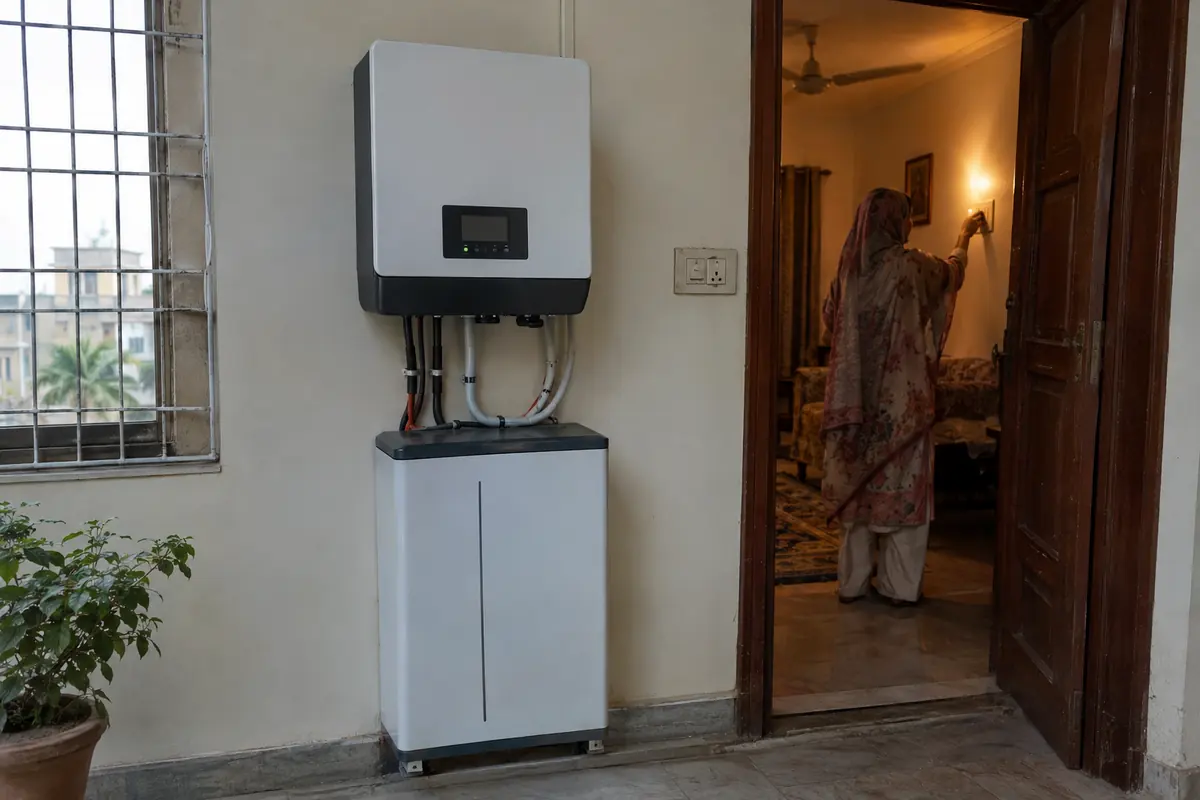
Your panels, mounting structure and DC cabling usually stay. What changes:
- The inverter. It must accept your string voltage. A hybrid with a lower maximum PV input voltage than your old on-grid unit may need the strings rewired into shorter series runs. Our guide to series and parallel panel wiring explains why this matters.
- A battery bank. Low-voltage hybrids typically run on 24 V or 48 V banks; high-voltage hybrids use stacked lithium modules. The battery voltage must match the inverter exactly.
- A split in your distribution board. Most installers create a “backup” bus for the circuits that should run in a cut, and leave heavy loads on the grid side.
Current inverter prices move with the dollar and with stock, so check the live list on our solar inverter price page rather than relying on a number from a forum post.
Watch the export approval
If you have, or plan to get, a net metering or net billing connection, the hybrid inverter must be a model your DISCO accepts for grid-tied export. Many popular hybrids are, but confirm before buying. Ask the installer for the model’s approval or test certificate and keep a copy with your connection file.
Option 2: add a battery inverter beside the old one (AC coupling)
If you installed a large on-grid inverter recently, replacing it hurts. AC coupling is the alternative. A separate battery inverter sits on the AC side of the house, connected to its own battery. During a cut it disconnects from the grid and builds a stable 230 V mini-grid for the backup circuits. Your existing on-grid inverter sees that mini-grid, decides the “grid” is back, and starts producing again. The battery inverter absorbs the surplus into the battery.
This works well when the two inverters are designed to talk to each other, or when the battery inverter can control the on-grid inverter’s output through frequency shifting. With a mismatched pair it can go badly: the on-grid unit produces more than the house uses, the battery fills up, and there is nowhere for the extra energy to go. That is why AC coupling should only be done by an installer who has done it before with your exact brands. Ask them which pairing they have tested.
Option 3: a separate UPS for fans and lights
The cheapest route is to leave the solar system alone and add or keep an ordinary home UPS for essentials. Many Pakistani homes already have one. While the grid is on, the solar system cuts your bill and the UPS charges its batteries. During a cut, the solar stops, and the UPS runs fans, lights, the router and maybe a TV.
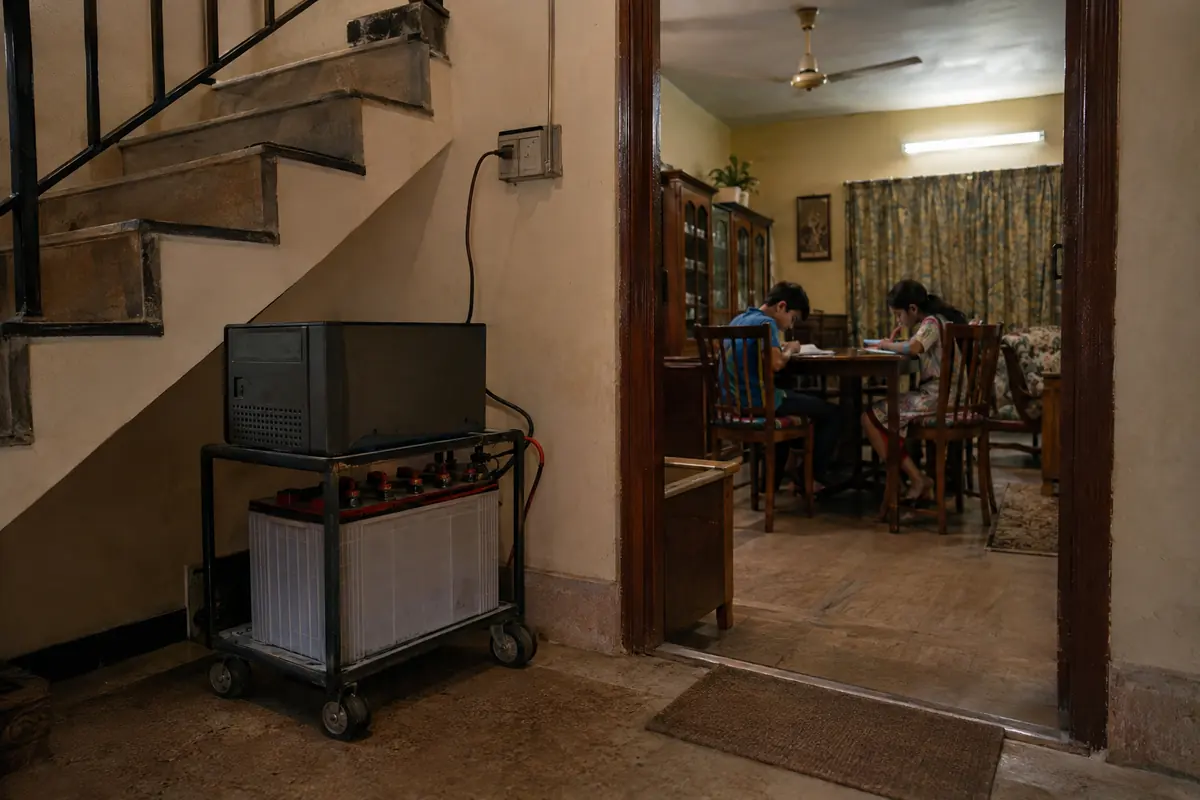
This does nothing to keep the solar producing during the outage, but if your cuts are one or two hours, it is often enough. The weak point is that on long summer afternoons the UPS battery drains while free sunlight goes to waste on the roof. If your area sees four or more hours of daytime load shedding, a hybrid route usually pays back better.
How much battery do you actually need?
The battery is the most expensive part of keeping solar alive in a cut, so size it to your real outage pattern, not to a dealer’s “full house” package. Work it out in three steps:
- List the backup loads. For example: 4 ceiling fans at 75 W, 10 LED lights at 12 W, a router at 15 W and a fridge averaging about 150 W while running. That is roughly 600 W.
- Multiply by the longest cut you want to cover. A two-hour cut at 600 W needs about 1.2 kWh of usable energy.
- Allow for usable depth and losses. Lithium (LiFePO4) banks are normally run to about 80 to 90 percent depth of discharge; lead-acid tubular batteries to about 50 percent if you want them to last. Add 10 to 15 percent for inverter losses.
For that 1.2 kWh example, you would want about 1.5 kWh of nominal lithium capacity, or about 2.7 kWh of nominal tubular capacity. A 48 V, 100 Ah lithium pack holds roughly 4.8 kWh nominal, which would cover that load for well over five hours. Use our solar calculator to estimate how much the panels can recharge on top of that during daylight. For the trade-off between chemistries, see the current solar battery prices.
The AC question
An inverter AC of 1.5 ton draws somewhere around 1 to 1.5 kW once settled, and more at start-up and in peak heat. Running one through a long afternoon cut needs a big battery, a hybrid inverter with enough surge rating, and enough panels to carry the load and recharge at the same time. It is doable, but price it honestly. If cooling during load shedding is your main goal, read our page on running an AC on solar before you buy.
What happens at night, and when the grid comes back
With a hybrid system, night-time cuts are covered by battery only, so the battery size matters even more. When the grid returns, the inverter waits a short time to confirm the supply is stable (often around a minute, set by the grid code programmed in the inverter), then resynchronises and closes its relay. You may notice a brief pause before export restarts. That pause is normal.
With a plain on-grid system, the same restart delay applies. Owners sometimes think the inverter has failed because it does not come back instantly when the lights return. Give it a minute or two before calling the installer.
Common mistakes we see
- Buying a “hybrid” that is really an off-grid inverter. Some low-cost units labelled hybrid can use solar and grid together but cannot export to the grid. If you want net metering, that matters. Read the datasheet for “grid-tie” or “on-grid export” capability.
- Putting the whole house on the backup bus. An electric water pump, iron or kettle on battery will flatten it fast. Keep heavy loads on the grid side.
- Undersized battery cable and no DC breaker. Battery currents at 48 V are high. Thin cable heats up. Insist on correctly rated cable and a DC breaker or fuse at the battery.
- Ignoring the transfer time. Desktop PCs and some appliances can reset on a slow switchover. A transfer time of 10 to 20 ms is typical for hybrids; check the exact model.
What to do now
If you are still choosing a system, decide on load shedding before you buy, not after. A hybrid inverter costs more at the start but saves you buying two inverters later. Compare complete packages on our solar system price guide and the popular 5 kW system breakdown.
If you already have on-grid solar, write down three things for a week: how many hours of cuts you get, at what times, and which appliances you truly need during them. Take that list to two or three installers and ask each to quote a hybrid swap and an AC-coupled battery. The panel side of the cost is the easy part: a 5 kW array of 585 W panels needs about 9 modules and costs around Rs 210,600 in panels today. The battery and inverter are where quotes vary most, so get them in writing, by brand and model.
Frequently asked questions
Does on-grid solar work during load shedding?
No. A plain on-grid inverter switches off within a fraction of a second when the grid goes down, even on a sunny afternoon. This is a safety feature called anti-islanding and every grid-tied inverter has it.
Can I add batteries to my existing on-grid solar system?
Yes, but not to the on-grid inverter itself. You either replace it with a hybrid inverter or add a separate battery inverter (AC coupling). Your panels and structure stay the same.
Will a hybrid inverter run my house during load shedding without batteries?
Some hybrid models can run loads from panels alone during daylight, but output swings with every cloud and most installers do not recommend it for fridges or ACs. Check the inverter manual for a no-battery or PV-only backup mode before relying on it.
How long does the switchover take on a hybrid inverter?
Most hybrid inverters sold in Pakistan switch to battery in roughly 10 to 20 milliseconds, which computers and LED lights usually ride through. Check the transfer time in the datasheet of the exact model.
Is it safe to use a generator to trick my on-grid inverter into working?
It is not recommended. Small generators cannot absorb the power the inverter pushes back, which can trip or damage the generator and the inverter. Use a proper hybrid setup instead.
More from the blog
 Solar Tech How Much Do Solar Panels Produce in Winter Fog and Smog?
Smog and fog can cut solar output sharply in Punjab's winter. What a 5 kW system really makes on hazy days, why, and what you can do to recover lost units. · 8 min read
 Solar Tech N-Type vs P-Type Solar Panels (TOPCon vs PERC): Which Should You Buy?
N-type TOPCon or P-type PERC? How the two cell types differ in heat, ageing and price per watt in Pakistan, and when old PERC stock is still a fair buy. · 8 min read
 Net Metering & Bills Electricity Tariff and Fixed Charges in 2026: What Changes for Solar Users
Pakistan's 2026 electricity tariff, new fixed charges and quarterly adjustments explained for solar users, and how they change your bill and payback. · 8 min read