On this page
- Where grades come from: the end of the production line
- A grade vs B grade solar panels: what the labels usually mean
- Does B-grade actually perform worse?
- How much cheaper should B-grade be?
- Six checks before you pay
- How dealers end up with mixed stock
- Who should consider B-grade at all
- Bottom line
- Frequently asked questions
The difference between A-grade and B-grade solar panels is whether the panel passed every check at the end of the factory line. An A-grade panel met all visual, electrical and power standards and ships with the manufacturer’s full warranty; a B-grade panel failed something, from a scratch on the frame to a weak cell, and is sold at a discount, usually with less warranty or none. Both can be the same brand, the same model number and the same wattage on the label, which is exactly why buyers in Pakistan get confused when two shops on the same road quote different prices.
This guide explains how factories and dealers grade stock, what the words actually cover in the Pakistani market, and what you can check yourself before you pay.
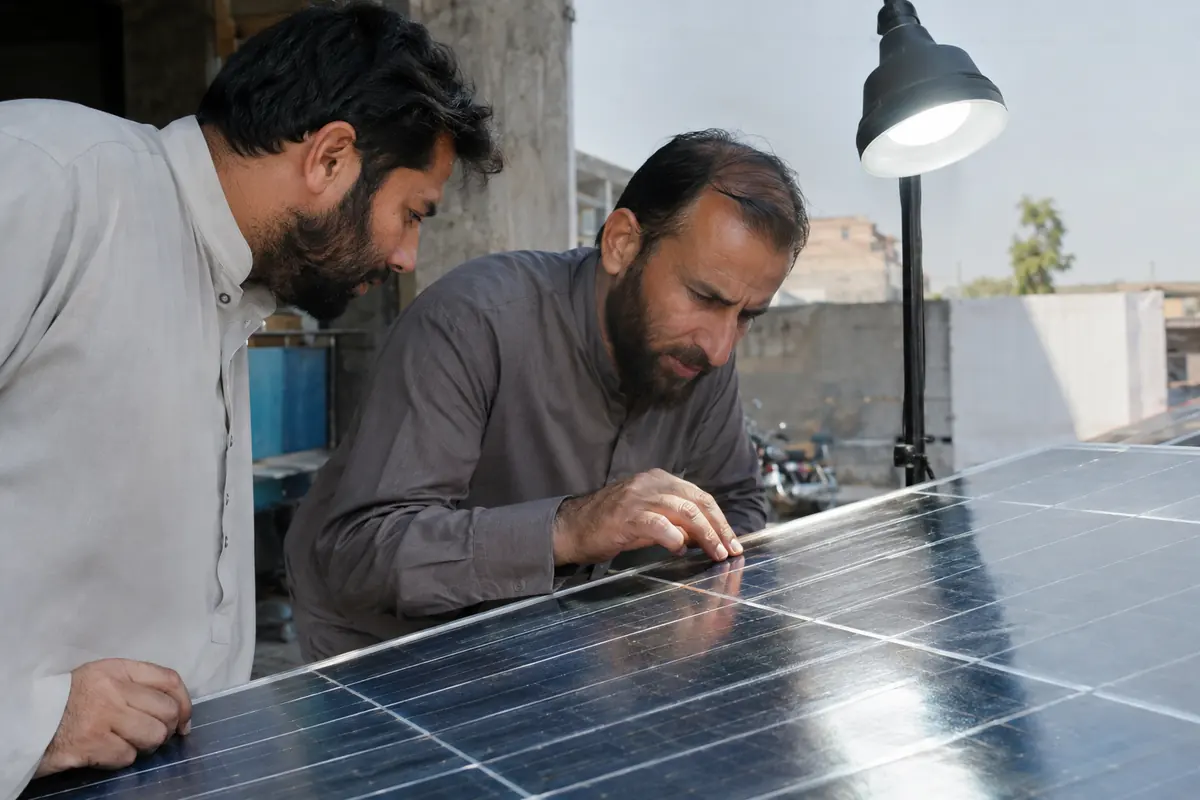
Where grades come from: the end of the production line
Every large panel factory tests each module before packing. The usual sequence is:
- Visual inspection of glass, frame, backsheet, cell colour, soldering and the junction box.
- Electroluminescence (EL) imaging, a kind of X-ray for solar cells. Current is passed through the panel in the dark and a camera records the glow. Cracks, dead areas and broken fingers show up as dark lines or patches.
- Flash testing under a calibrated light pulse at standard test conditions (1000 W/m², 25 °C cell temperature). This measures the actual maximum power, voltage and current of that specific panel.
- Insulation and safety tests to make sure there is no leakage between the cells and the frame.
A panel that clears all of these with power inside the declared tolerance (for most modern panels, 0 to +3 percent or 0 to +5 W) becomes A-grade. A panel that misses on any step is set aside. What happens to it next depends on the factory. Some scrap it, some rework it, and some sell it as B-grade or lower under their own rules.
There is no single official grading standard
This is the point most articles skip. “A-grade” and “B-grade” are not defined by an international standard the way efficiency or temperature coefficient are. Each manufacturer has its own internal definitions, and those definitions are not always published. In the Pakistani market, dealers also use the words loosely, sometimes to describe something quite different from what the factory meant. Treat any grade claim as a claim, not a fact, until you verify it.
A grade vs B grade solar panels: what the labels usually mean
With that caution, this is how the terms are generally used by manufacturers and by importers selling in Pakistan.
| Grade | Typical reason | Power vs label | Manufacturer warranty | Where you see it |
|---|---|---|---|---|
| A / A+ / Grade 1 | Passed all tests | At or above label, within tolerance | Full product and performance warranty | Authorised distributors, branded stock with box labels |
| A- or “A minus” | Small cosmetic issue (colour mismatch between cells, minor frame mark) | Usually at label | Depends on manufacturer, often full | Less common; some importers sell as A |
| B / Grade 2 | Visible defects, minor EL issues, or power slightly below class | Can be below label | Reduced or none | Loose stock, unbranded boxes, cheaper lots |
| C / “stock lot” / cut-piece | Significant cell cracks, repairs or failed tests | Often well below label | None | Very cheap offers, often without serial labels |
| Used or refurbished | Removed from another installation and cleaned | Degraded by age and handling | None from manufacturer | Second-hand market, sometimes resold as “new B-grade” |
That last row is the one to worry about most. A used panel with a fresh sticker is not a B-grade panel. It is a used panel. If you are knowingly buying second-hand, our page on buying used solar panels covers what to test.
Does B-grade actually perform worse?
It depends entirely on why the panel was downgraded, and you will rarely be told.
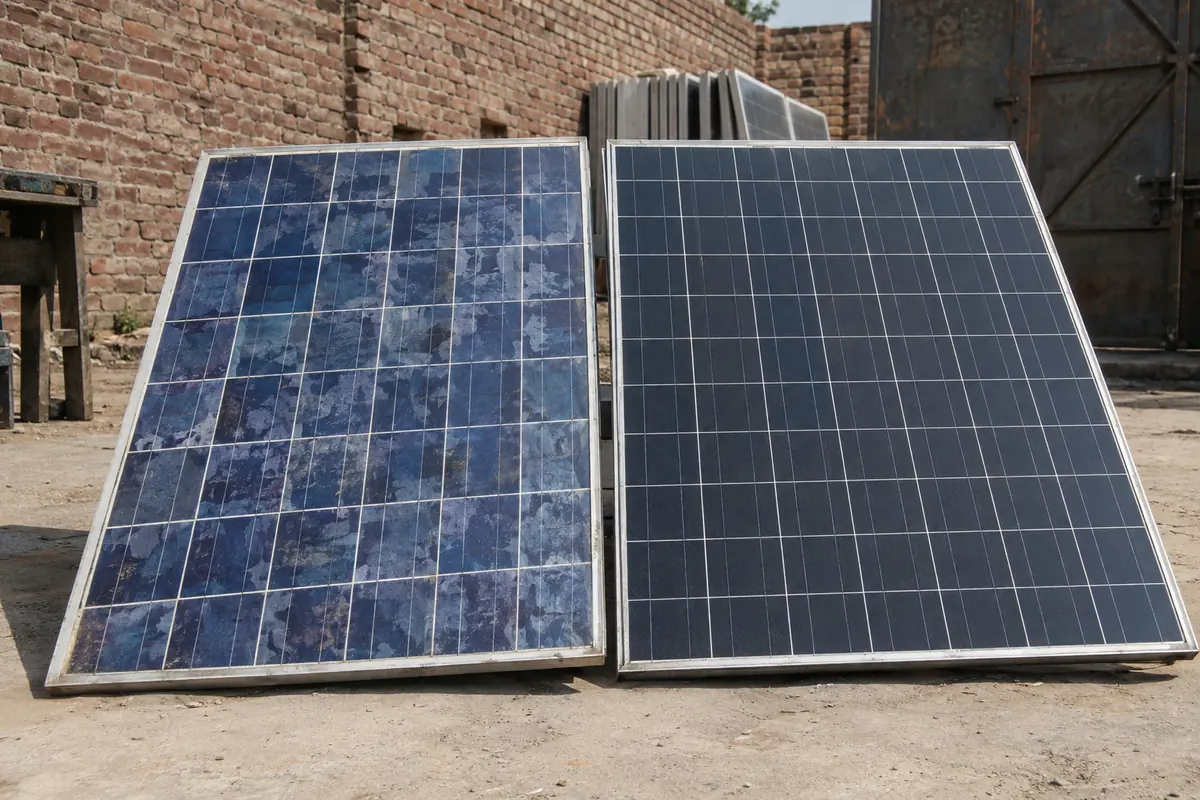
- Cosmetic only (a scratch on the frame, slightly uneven cell colour): output and lifespan can be close to A-grade. This is the best case.
- Power slightly under class (say a panel that flashed at 578 W sold in a 585 W box): you lose a little output for the life of the system. Not dangerous, but you paid for watts you are not getting.
- Micro-cracks found under EL: this is the real risk. A micro-crack may cost nothing on day one, but Pakistani rooftops go through big daily temperature swings, from cool winter mornings to over 60 °C on the glass in June. Each cycle can widen a crack. Over a few years, parts of the cell disconnect, output falls, and in bad cases hot spots form that can brown or burn the backsheet.
Because you cannot see an EL defect with your eyes, the honest summary is this: a B-grade panel is a bet on a fault you cannot see, with no factory warranty to fall back on. Sometimes the bet is fine. The discount needs to be big enough to pay for the risk.
How much cheaper should B-grade be?
We do not publish B-grade prices, because the range is wide and depends on the lot. What you can do is compare against the A-grade market. Check today’s per-watt price on our per-watt price tracker; the current market average is Rs 41.3. For a 585 W panel, the cheapest A-grade listing today is Rs 23,400, or Rs 40.
Now think about what the warranty is worth. A tier-one A-grade panel comes with a product warranty (commonly 12 to 15 years) and a power warranty (commonly 25 to 30 years) from the manufacturer. If a B-grade offer is only a few percent under that, you are giving up a decade or more of cover for a small saving. A sensible rule is that a B-grade price should be clearly lower, and the seller should still put a written shop warranty on it.
Six checks before you pay
None of these needs special equipment beyond a basic multimeter, and most good dealers will not object.
1. Read the label, all of it
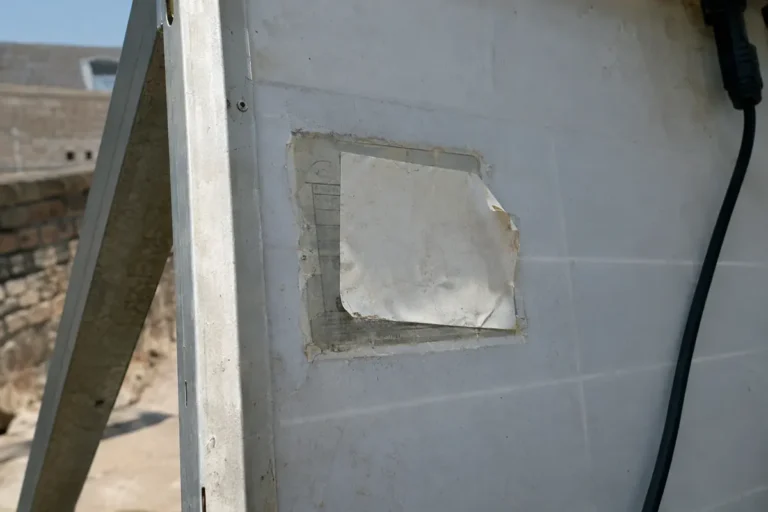
The rear label should show the brand, exact model number, rated power (Pmax), Voc, Isc, Vmp, Imp, a serial number and a barcode or QR code. Check that the model number matches the wattage on the brand’s own datasheet. Missing serials, a paper sticker over another label, or labels that peel off easily are red flags.
2. Verify the serial with the manufacturer
Several major brands let you check a serial number online or through their local distributor. For Jinko, our Jinko panel verification guide walks through the steps. A genuine A-grade serial should return the model and often the production date. If the serial is not found, or returns a different model or wattage, walk away.
3. Ask for the flash data
Factories record flash-test results for every serial. Importers buying direct often receive this as a spreadsheet with the pallet. Ask for the line that matches your panels. A seller who can produce it is usually selling what they say they are.
4. Inspect the face and back in daylight
Look along the glass at a low angle. You are looking for snail trails (thin dark lines across cells, often a sign of cracks), brown or yellow patches, bubbles in the backsheet, bent frame corners and uneven cell spacing. Check the junction box is firmly bonded and the cables and connectors are the same brand and type on every panel.
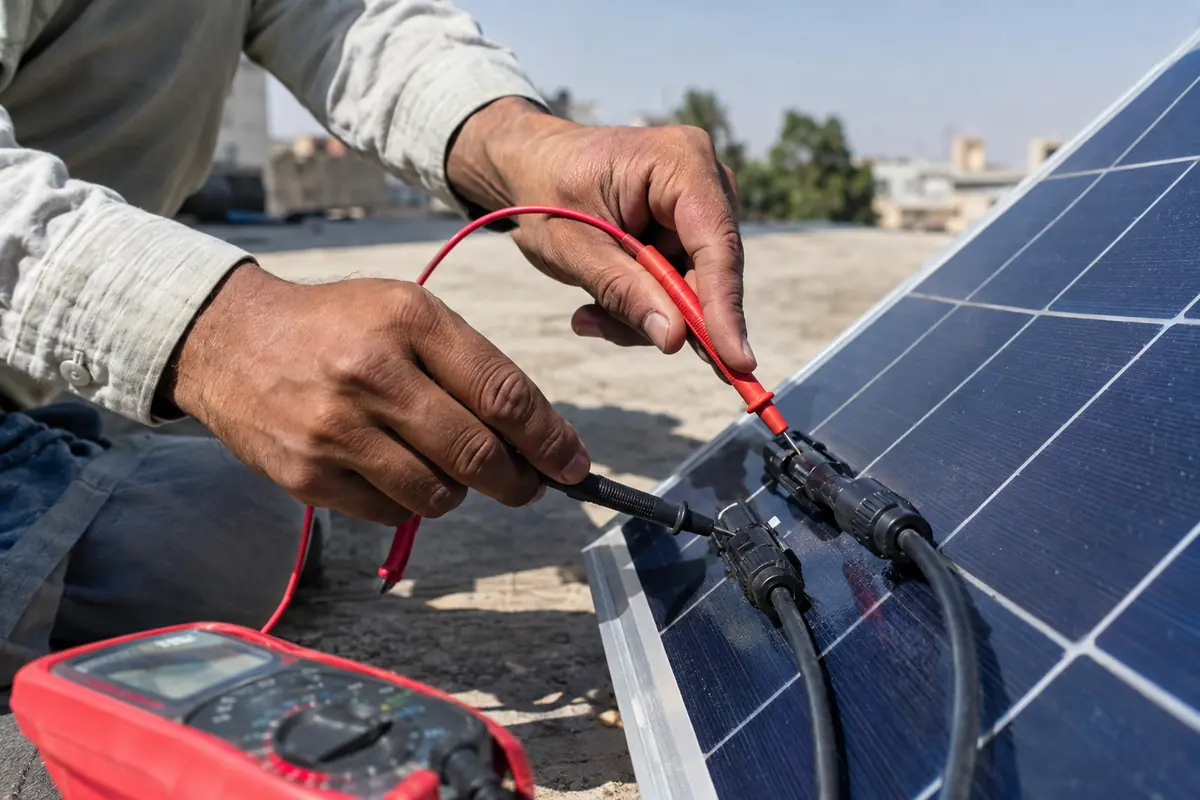
5. Measure open-circuit voltage
Put the panel in sun, connect a multimeter set to DC volts across the two connectors, and compare the reading with the Voc on the label. On a hot day the reading will be lower than the label because voltage drops as cells heat up, typically by roughly 0.25 to 0.3 percent per degree above 25 °C for modern panels. So a reading somewhat under the label in the afternoon is normal. A reading far below it, or one panel noticeably lower than the rest of the same model, is not. This test will not catch everything, but it catches the worst.
6. Get the grade in writing
Your invoice should state the brand, model, wattage, quantity, the words “A-grade” if that is what you are paying for, the serial numbers (or a list attached), and who honours the warranty. A dealer who says “everything is A-grade” but will not write it down is telling you something.
How dealers end up with mixed stock
It helps to understand the supply chain. Panels reach markets like Hall Road in Lahore or the dealers around Brandreth Road through a few routes: authorised distributors importing direct from the brand, larger traders importing full containers, and smaller traders buying part-containers or lots from them. Prices on the same model can differ because of the import date, exchange rate at the time, the power class within a model family, and grade.
Most dealers are not trying to cheat anyone. But a container can hold more than one grade, and once panels are unboxed and stacked, it is easy for a lower grade to sit next to a higher one. The checks above protect you whether the mix-up is deliberate or not.
Who should consider B-grade at all
There are cases where B-grade is a reasonable choice:
- A small off-grid setup for a tubewell motor, a farm hut or a shop’s lights, where a little lost output does not matter much.
- A temporary system you expect to replace within a few years.
- When the seller offers a solid written shop warranty and the discount is large.
For a rooftop home system meant to run 20 years and connected under net metering or net billing, A-grade from a recognised brand is the safer path. The panel is a small part of what goes wrong if output collapses in year four: you also lose the labour, the downtime and the bill savings. Our list of the best solar panels in Pakistan and the full solar panel price list are good starting points.
Bottom line
Grade is about what happened at the end of the factory line, not about the brand name on the box. An A-grade panel comes with proof: a verifiable serial, flash data and a manufacturer warranty. A B-grade panel can be fine, but you are buying without that proof, so pay a price that reflects it, test what you can, and get every promise on paper.
Frequently asked questions
What is the difference between A-grade and B-grade solar panels?
An A-grade panel passed every factory quality check and carries the full manufacturer warranty. A B-grade panel failed one or more checks, usually cosmetic or minor electrical ones, and is sold cheaper, often with a reduced or no manufacturer warranty.
Are B-grade solar panels bad?
Not always. A B-grade panel with a cosmetic flaw may perform close to an A-grade one. The risk is that you cannot see the reason it was downgraded, and the warranty is usually weaker, so the discount has to be large enough to justify that.
How do I know if a solar panel is A-grade?
Check the label and serial number with the manufacturer, ask for the flash test data for that serial, inspect the cells and frame, and measure the open-circuit voltage. An honest A-grade seller will also give you a written invoice stating grade, model and warranty.
Do B-grade panels have a warranty in Pakistan?
Sometimes the dealer gives a short shop warranty, but the manufacturer's 12 to 15 year product warranty usually does not apply. Ask in writing who honours the warranty and for how long before you pay.
Why is the same brand cheaper at one shop than another?
Differences in grade, production batch, import lot, power class and the dealer's own margin all play a part. A large gap for the same model and wattage is a reason to ask what grade you are being offered.
More from the blog
 Buying Guides How to Spot Fake, Refurbished or Mislabelled Solar Panels in Pakistan
Copied brand labels, re-stickered wattages and washed used panels all turn up in Pakistan. How each trick works and how to catch it before you pay. · 8 min read
 Buying Guides Lithium vs Tubular Battery for Solar in Pakistan: Cost per Year, Not Just Price
Tubular batteries cost less to buy, but lithium usually costs less per year and per stored unit. A worked comparison for Pakistani solar homes in 2026. · 8 min read
 Buying Guides How Many Solar Panels Do I Need for a 5 Marla, 10 Marla or 1 Kanal House?
Work out how many solar panels your 5 marla, 10 marla or 1 kanal house needs from your bill, your city's sun hours and your roof, with worked examples. · 7 min read