On this page
- Three different problems, three different tells
- Trick one: the re-stickered wattage
- Trick two: the copied brand
- Trick three: the used panel in new clothes
- What a genuine label should and should not look like
- A ten-minute check at the shop or the gate
- Why fake solar panels reach Pakistani buyers, and who is most at risk
- What to do if you already bought suspicious panels
- Bottom line
- Frequently asked questions
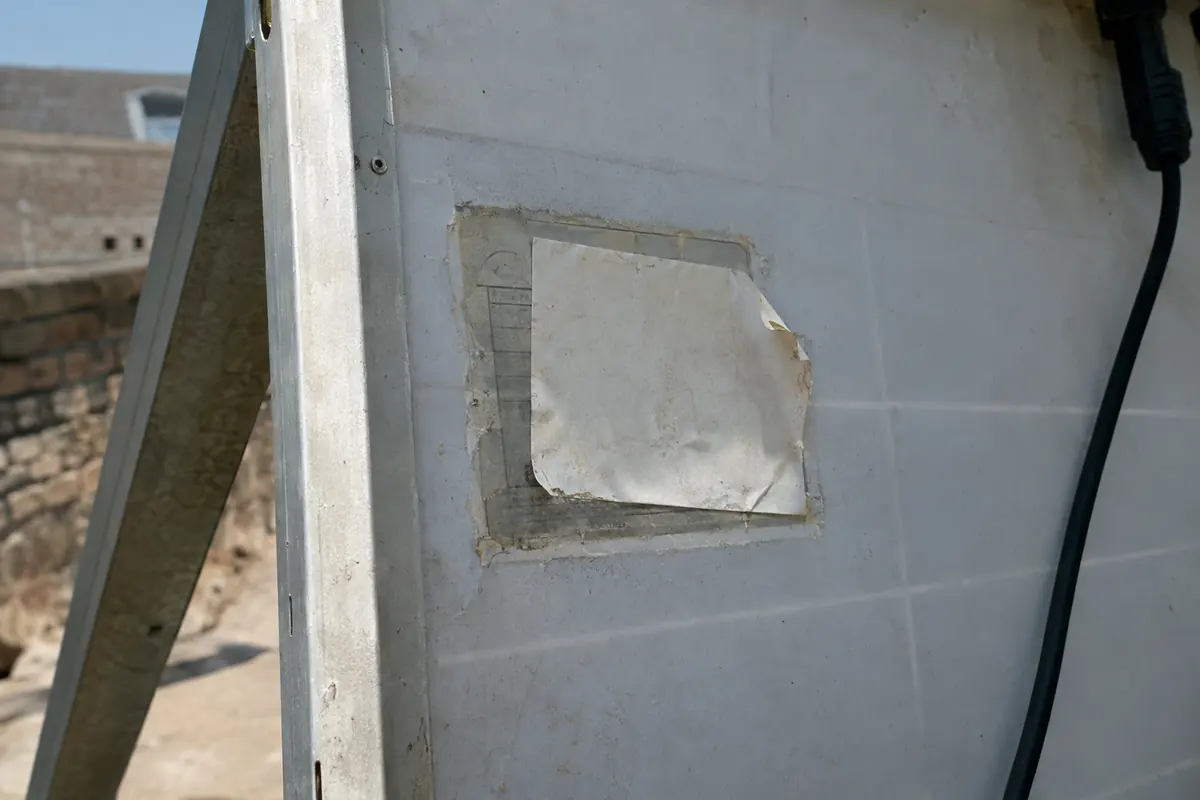
Fake solar panels in Pakistan rarely look obviously fake. The common problems are quieter: a genuine lower-wattage panel wearing a higher-wattage sticker, an unknown-brand panel dressed up with a famous name, or a used panel cleaned and sold as new. You can catch most of them with a datasheet, a measuring tape, a multimeter and a serial number check, and you should do it before the panels go on the roof, not after.
This guide separates the three main problems, shows how each one is done, and gives you a checklist you can run in a shop or at your gate when the delivery arrives.
Three different problems, three different tells
| Problem | How it is done | What it costs you | Fastest way to catch it |
|---|---|---|---|
| Mislabelled wattage | A real panel of a lower power class gets a new label showing a higher wattage | You pay for watts you never get, every day for 25 years | Dimensions, cell count and Voc compared with the datasheet |
| Counterfeit brand | A no-name or low-tier panel carries a copied label, box and frame stamp of a known brand | No manufacturer warranty, unknown cell quality and durability | Serial number verification with the brand or official distributor |
| Refurbished or used sold as new | Panels removed from old installations are cleaned, re-labelled or re-boxed | Already degraded output, possible hidden cracks, no warranty | Physical wear signs and production date in the serial |
Not every cheap panel is one of these. Prices genuinely vary between dealers, and B-grade stock is a separate issue that we cover in our post on A-grade and B-grade panels. But if a deal is far below the market, at least one of these three is worth ruling out. For a reference point, today’s cheapest 585 W listing on our tracker is Rs 23,400 and the market average per watt is Rs 41.3. Keep the full current solar panel price list open on your phone when you shop.
Trick one: the re-stickered wattage
This is the most common and the easiest to pull off, because the panel itself is real. Panel families come in several power classes. A factory might produce the same physical design at, say, 570, 575, 580 and 585 W, with differences only a few watts apart. Larger jumps, like a 550 W label replaced with a 585 W label, usually involve a different panel size or cell layout altogether.
How to catch it
- Download the official datasheet for the exact model number from the brand’s website. Do not use a datasheet the seller hands you on WhatsApp.
- Measure the panel. Length and width are listed on the datasheet to the millimetre. A panel that is several centimetres shorter than the datasheet for the claimed wattage is not that model. Our guide to solar panel sizes in feet and millimetres gives typical dimensions by wattage class.
- Count the cells. Modern high-wattage panels typically use 132 or 144 half-cut cells (or 66 or 72 full-cell equivalents). Compare with the datasheet.
- Measure Voc in sun. Each power class within a family has a slightly different open-circuit voltage. On a hot afternoon your reading will be below the label, but if it is far below, or lower than other panels of the same claimed model, ask questions.
- Check the weight if you can. Datasheets list it, and a large mismatch suggests a different glass, frame or panel altogether.
Trick two: the copied brand
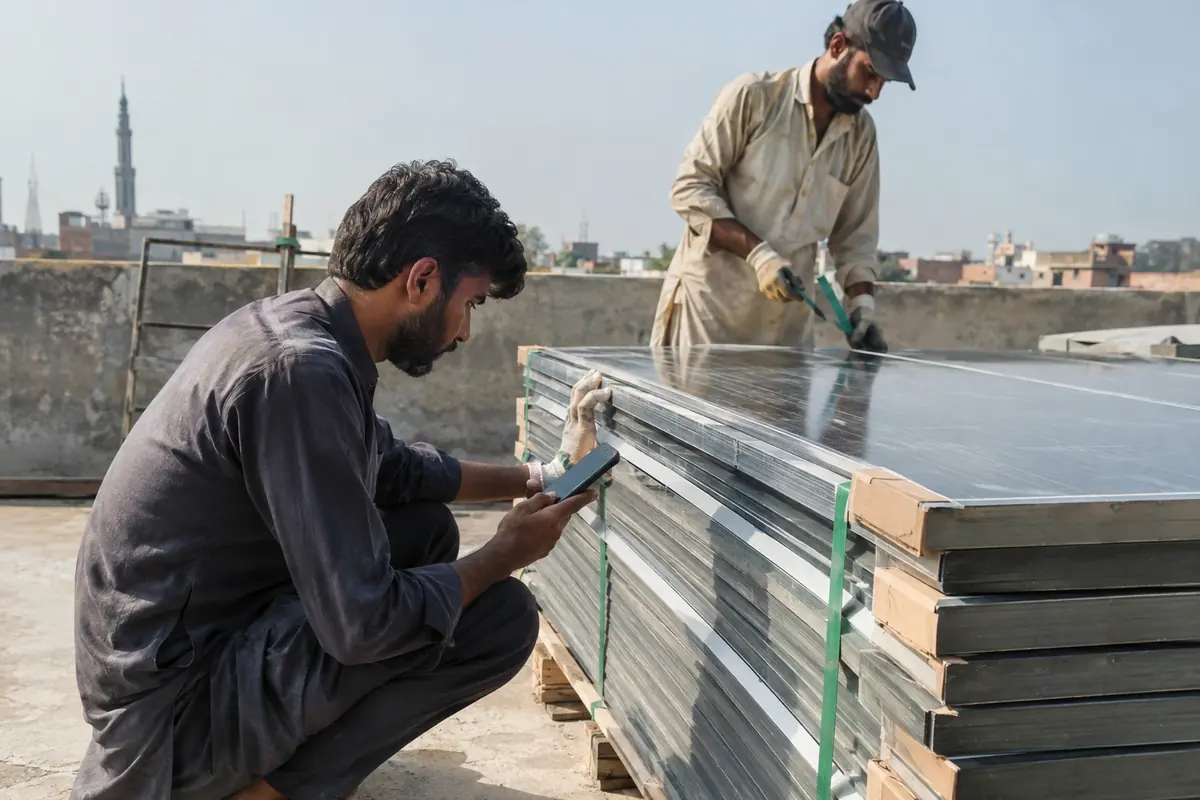
Big names sell, so big names get copied. A counterfeit can have a convincing label and even a printed box. What is hard to fake is a serial number that the real manufacturer recognises.
How to catch it
- Verify every serial, not one. Sellers sometimes show you one genuine panel. Pick panels at random from the stack, or verify all of them when they arrive. For Jinko, follow our step-by-step Jinko serial check. For other brands, contact the brand’s official Pakistan distributor, which our brands overview helps you identify.
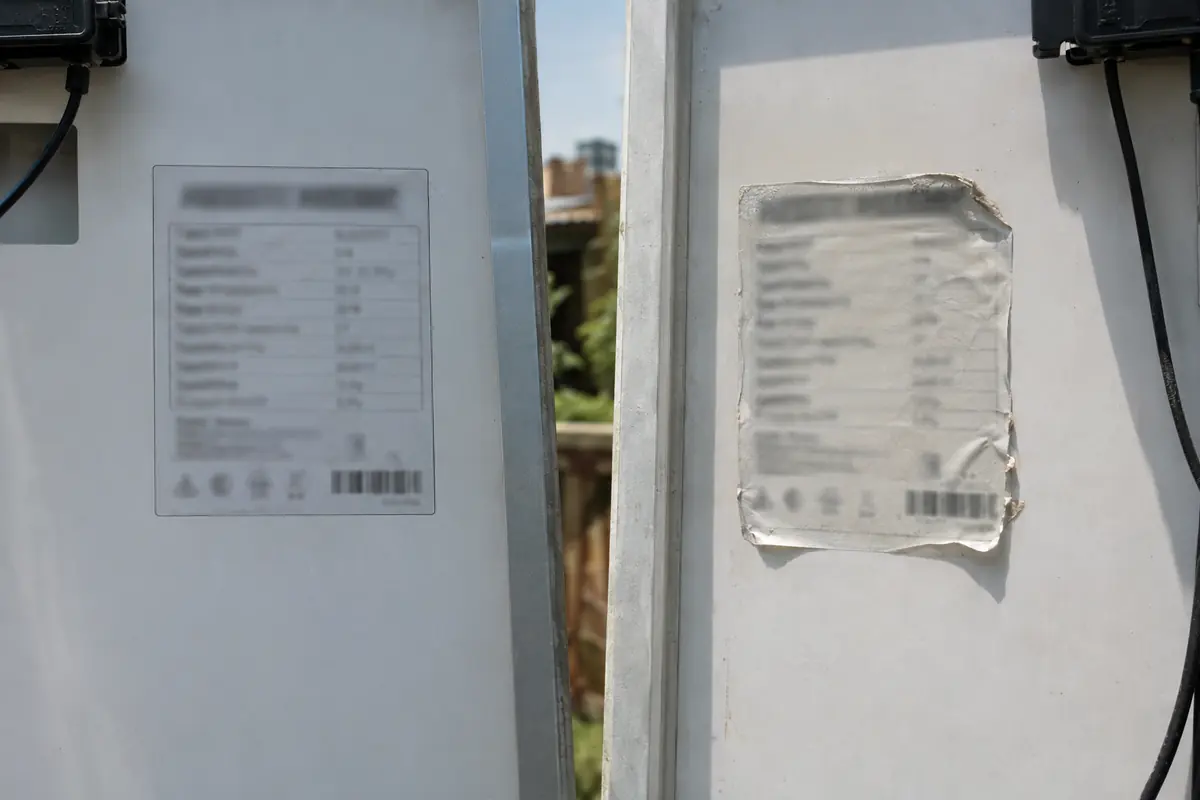
- Compare label details. Look at the fonts, the spacing, the certification logos, and whether the label is a printed and laminated part of the backsheet or a loose sticker. Genuine labels are durable and consistent across a batch.
- Look at the junction box and connectors. Major manufacturers use the same junction box and connector type across a model range. Mismatched connectors, cheap-looking boxes or visible glue repairs are warning signs.
- Check frame stamps and the barcode. Many brands stamp or label the frame, and the barcode on the label should scan to the same serial printed beside it.
- Ask where the stock came from. An authorised distributor or a trader buying from one can usually tell you. A shrug is not an answer.
Trick three: the used panel in new clothes
As older solar farms and rooftops upgrade, used panels come onto the market. Selling them openly as used is perfectly legitimate, and a tested used panel at a fair price can be good value for the right job. The problem is when they are passed off as new. If you are deliberately shopping second-hand, see our page on buying used solar panels safely.
How to catch it
- Frame corners and edges. Mounting clamps leave marks. Look for scrapes or pressure lines where the panel sat on rails.
- Backsheet colour. Years of sun can turn a white backsheet yellowish or chalky. New panels are crisp.
- Snail trails and browning. Thin dark lines across cells, or a brown tint, develop over time in the field.
- Connector wear. Connectors that have been plugged and unplugged, cut and recrimped, or taped are a giveaway.
- Production date. Most serial numbers encode the production year and month, and verification usually confirms it. A “brand new” panel produced several years ago is not new stock, even if it was never installed. Old unused stock is not automatically bad, but it should be priced and described honestly.
- Packaging. New panels normally arrive in sealed manufacturer pallets with corner protectors and box labels listing serials. Loose panels without boxes are not proof of anything, but they remove one layer of evidence.
What a genuine label should and should not look like
Because the label is where most tricks start, it is worth knowing what a good one contains. Line up the label against the datasheet field by field.
| Label field | What to check | Warning sign |
|---|---|---|
| Model number | Exact match with the brand’s datasheet, including the power suffix | Model number that does not exist on the brand’s website |
| Pmax (rated power) | Matches the power class in the model number | Wattage printed in a different font or on a separate sticker |
| Voc, Isc, Vmp, Imp | Same values as the datasheet for that power class | Values that match a lower class, or round numbers that look invented |
| Serial number and barcode | Barcode scans to the printed serial; serial verifies with the brand | No serial, duplicated serials across panels, scratched-off digits |
| Certification marks | Consistent with what the brand lists for the model | Blurred or misaligned logos |
| Dimensions and weight | Match the datasheet | Missing, or different from the physical panel |
Duplicated serials deserve special mention. If two panels in your delivery carry the same serial number, at least one label is not original. It takes thirty seconds to spot when you photograph every label, and it is one of the clearest signs of copied labels.
A ten-minute check at the shop or the gate
Print this or save it on your phone. It works whether you are standing on Hall Road or receiving a delivery at home.
- Match the model number on the label with the brand’s official datasheet.
- Measure length and width with a tape. Compare with the datasheet.
- Count the cells and compare.
- Photograph the label and serial of every panel.
- Verify serials with the brand or its official distributor (do at least a random sample before paying, all of them before installation).
- Inspect the front at a low angle for cracks, snail trails, bubbles or discolouration.
- Inspect the back for yellowing, scratches, bubbles and a loose junction box.
- Check that all connectors are the same type and undamaged.
- Measure Voc in sunlight on several panels and compare them with each other.
- Get an itemised invoice with brand, model, wattage, quantity, grade, serial list and warranty provider.
Why fake solar panels reach Pakistani buyers, and who is most at risk
Solar panel prices in Pakistan have fallen a long way over the last few years and demand has been enormous. That combination draws in many small traders and installers, most of them honest, some not, and creates room for lots of uncertain origin. The buyers most exposed are those who:
- Buy loose panels from a trader with no shop or invoice.
- Let the installer “arrange the panels” without naming a brand and model in the quote.
- Pick the cheapest quote by a wide margin without asking why it is cheaper.
- Accept delivery without checking a single serial.
If you are using an installer, write the exact brand, model and wattage into the agreement, and say that you will verify serials on delivery. Good companies will not mind. Our directory of solar companies in Pakistan is a starting point for shortlisting.
What to do if you already bought suspicious panels
Do not panic, and do not start pulling panels off the roof on a hunch. Work through it in order:
- Gather your evidence. Invoice, quote, WhatsApp messages, photos of labels and serials.
- Verify the serials. This alone settles most cases.
- Compare your production. Check the inverter or app reading on clear days against what the system size should produce. A system that is consistently well below expectations on clear, clean days in the same season points to a real shortfall.
- Talk to the seller first, in writing. Many disputes are settled with a replacement once evidence is on the table.
- Contact the brand’s distributor if the serials do not verify. They have an interest in counterfeits of their brand.
- Use the consumer court route if the seller refuses. Pakistan’s provinces have consumer protection laws and consumer courts that deal with defective or misrepresented goods; the invoice is what makes a claim workable.
Bottom line
The label is the cheapest part of a solar panel to change. The datasheet, the tape measure and the serial number are much harder to fake. Insist on a brand and model in writing, check the physical panel against the official datasheet, verify serials before installation, and keep every invoice and message. A seller who resists any of that has answered your question for you.
Frequently asked questions
How can I check if my solar panel is original?
Verify the serial number with the brand or its authorised distributor, check that the model number, wattage and dimensions match the official datasheet, and compare the label printing and junction box with a panel you know is genuine.
Are there fake Jinko or Longi panels in Pakistan?
Popular brands are the most likely to be copied or relabelled anywhere they sell well, and Pakistan is a large market. That is why serial verification through the brand or its official distributor matters more than the name on the frame.
How do I know if a solar panel is used or refurbished?
Look for scratches and wear on the frame corners, faded or yellowed backsheet, snail trails across cells, mismatched or replaced connectors, and a production date on the serial that is years older than the seller claims.
Can a 550 watt panel be sold as a 585 watt panel?
Yes. Relabelling a lower power panel with a higher wattage sticker is one of the most common tricks. The panel's dimensions, cell count, Voc and Isc should all match the datasheet for the claimed wattage; if they match a lower model instead, the label is wrong.
What should be written on my solar panel invoice?
The brand, full model number, wattage, quantity, grade, the list of serial numbers, the price and who provides the warranty. A proper invoice is your only real evidence if something turns out to be wrong.
More from the blog
 Buying Guides A-Grade vs B-Grade Solar Panels: How Dealers Grade Stock and How to Check
What A-grade and B-grade really mean on a solar panel, why Hall Road prices differ for the same brand, and six checks to do before money changes hands. · 8 min read
 Buying Guides Lithium vs Tubular Battery for Solar in Pakistan: Cost per Year, Not Just Price
Tubular batteries cost less to buy, but lithium usually costs less per year and per stored unit. A worked comparison for Pakistani solar homes in 2026. · 8 min read
 Buying Guides How Many Solar Panels Do I Need for a 5 Marla, 10 Marla or 1 Kanal House?
Work out how many solar panels your 5 marla, 10 marla or 1 kanal house needs from your bill, your city's sun hours and your roof, with worked examples. · 7 min read