On this page
- Step 1: Get your real consumption from your bills
- Step 2: Convert units into kilowatts for your city
- Step 3: Turn kilowatts into a panel count
- Step 4: Check the roof, because the plot size is not the roof size
- Worked examples: 5 marla, 10 marla and 1 kanal
- Why bigger is no longer automatically better
- Common sizing mistakes
- The quick rule
- Frequently asked questions
Most 5 marla houses in Pakistan need 6 to 9 panels (a 3 to 5 kW system), most 10 marla houses need 9 to 18 panels (5 to 10 kW), and a 1 kanal house usually needs 18 to 26 panels (10 to 15 kW), assuming modern 585 W panels. Plot size only sets the roof limit. The real answer to “how many solar panels do I need” comes from your units, your city’s sun hours and how much of the roof you can actually use.
Below is the method a good installer uses, followed by worked examples for each house size.
Step 1: Get your real consumption from your bills
Your electricity bill shows the last twelve months of units on the back (or in the history section of the online duplicate bill). Write down all twelve figures. You need three numbers from them:
- Yearly total, then divide by 365 to get average units per day.
- Peak month, usually June, July or August.
- Lowest month, usually December or January.
Do not size from a single summer bill. A 10 marla house that used 1,400 units in July may have used only 350 in January. Sizing for July means paying for panels that sit mostly idle, or export at a low rate, for half the year.
Step 2: Convert units into kilowatts for your city
One kilowatt of panels produces about its peak sun hours multiplied by a system efficiency factor. After inverter losses, wiring, heat and dust, a realistic factor for a well-installed rooftop in Pakistan is around 0.78 to 0.80. That gives these yearly averages:
| City | Peak sun hours (annual average) | Units per kW per day | Units per kW per month |
|---|---|---|---|
| Karachi | 5.6 | about 4.4 | about 133 |
| Multan | 5.5 | about 4.3 | about 130 |
| Faisalabad | 5.3 | about 4.2 | about 126 |
| Lahore | 5.2 | about 4.1 | about 123 |
| Gujranwala | 5.1 | about 4.0 | about 121 |
| Peshawar | 5.1 | about 4.0 | about 121 |
| Islamabad / Rawalpindi | 5.0 | about 3.9 | about 119 |
The formula is simple: system size in kW = average daily units ÷ units per kW per day. A Lahore house using 20 units a day needs about 20 ÷ 4.1 = 4.9 kW. Round to 5 kW.
These are averages. In December and January, particularly in central Punjab where fog and smog are heavy, output can fall well below them for days at a time. Seasonal estimates for Lahore put typical winter output per kW around 45% lower than in spring and summer. In May and June output is higher, but panels also lose some efficiency in the heat. The averages already account for this over a full year.
The swing matters for sizing. A system that exactly covers your yearly average will produce more than you use from March to October and less than you use from November to February. Under the old net metering rules those two halves cancelled out unit for unit. Under net billing they do not, because summer surplus is exported cheaply and winter shortfall is imported at full price. That is one more reason to look at your monthly pattern, not only the yearly total. If your winter bills are already low, which is common in homes that heat with gas, a system sized on the yearly average is usually fine.
Step 3: Turn kilowatts into a panel count
Divide the system size in watts by the panel wattage and round up. Here is what that looks like with the most common panel sizes in the market:

| System size | 545 W panels | 585 W panels | 720 W panels | Panel cost with 585 W today |
|---|---|---|---|---|
| 3 kW | 6 | 6 | 5 | Rs 140,400 |
| 5 kW | 10 | 9 | 7 | Rs 210,600 |
| 8 kW | 15 | 14 | 12 | Rs 327,600 |
| 10 kW | 19 | 18 | 14 | Rs 421,200 |
| 15 kW | 28 | 26 | 21 | Rs 608,400 |
The panel cost column updates from our daily price table. It covers panels only. The inverter, structure, cabling and installation come on top, and the complete solar system price guide shows how they add up.
Bigger panels mean fewer pieces, fewer clamps and less wiring, but they are heavier and longer. A 720 W panel is close to 7.8 ft long, which can be awkward on a small roof with a staircase room and a water tank. On a 5 marla roof, 585 W panels often fit the space better.
Step 4: Check the roof, because the plot size is not the roof size
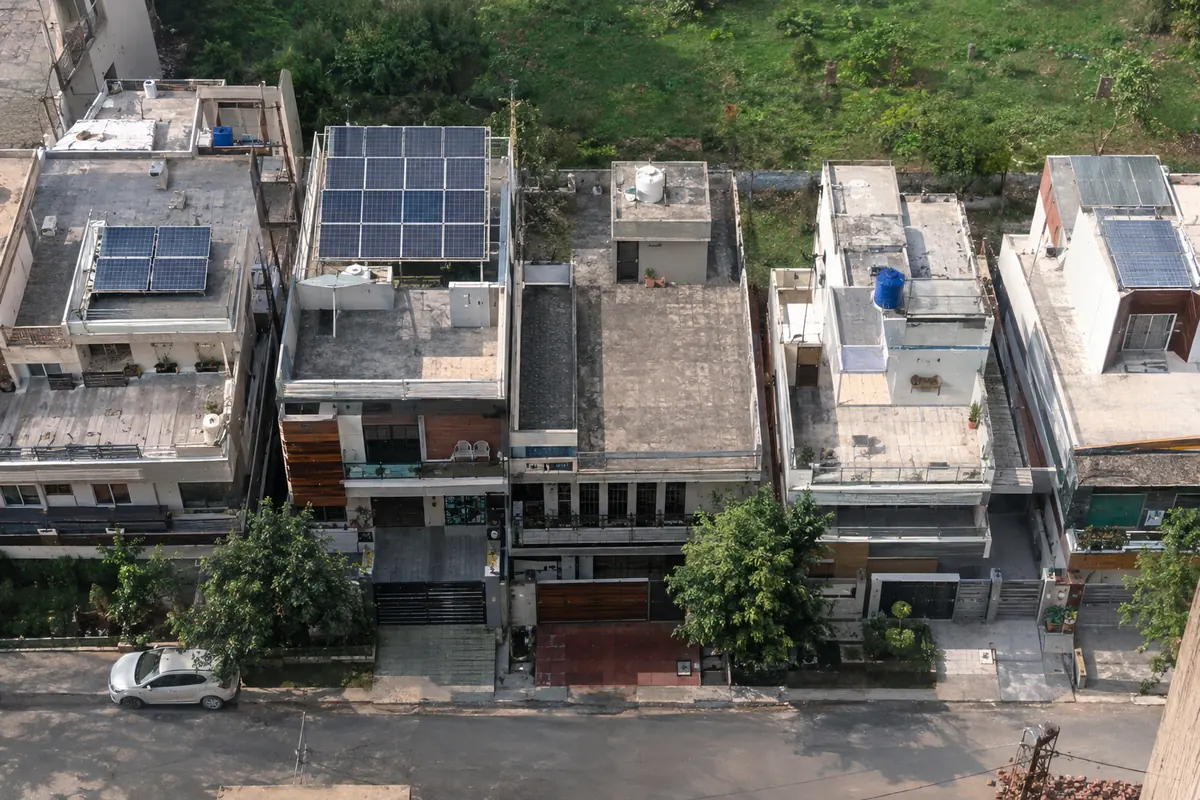
This is where marla and kanal come in. A marla is commonly taken as 225 square feet in Punjab housing societies, though some older areas still use 272. So a 5 marla plot is about 1,125 sq ft, a 10 marla plot about 2,250 sq ft and a 1 kanal plot about 4,500 sq ft.
The usable roof is much smaller. Subtract the front lawn and setbacks, the mumty (stair room), water tanks, the drying area your family wants to keep, and shade from a neighbour’s taller house. A rough guide for planning is that each kW needs about 80 to 100 sq ft of open, unshaded roof once you allow for rows, gaps and walking space. A single 585 W panel is about 7.5 ft by 3.7 ft (see the full panel size chart in feet).
| House | Typical usable roof | Realistic maximum on roof |
|---|---|---|
| 5 marla (single unit) | 350 to 550 sq ft | 4 to 6 kW |
| 10 marla | 700 to 1,000 sq ft | 8 to 11 kW |
| 1 kanal | 1,400 to 2,000 sq ft | 15 to 22 kW |
These ranges are rough. Measure your own roof, and treat any shaded corner as unusable. Shade on one panel in a string pulls down the whole string. If roof space is tight, an elevated steel structure over the water tanks or a portion of the drying area can add space, at extra cost.
Worked examples: 5 marla, 10 marla and 1 kanal
5 marla in Lahore, family of five, one AC
Bills show 3,900 units over the year, peaking at 560 in July and dropping to 170 in January. Average daily use is 3,900 ÷ 365 = 10.7 units. Divide by 4.1 and you get 2.6 kW. A 3 kW system would cover the yearly average. To bring summer bills down meaningfully, 4 kW is a better fit. With 585 W panels that is 7 panels (about 4.1 kW), which fits comfortably on most 5 marla roofs.
10 marla in Faisalabad, two ACs, a water motor
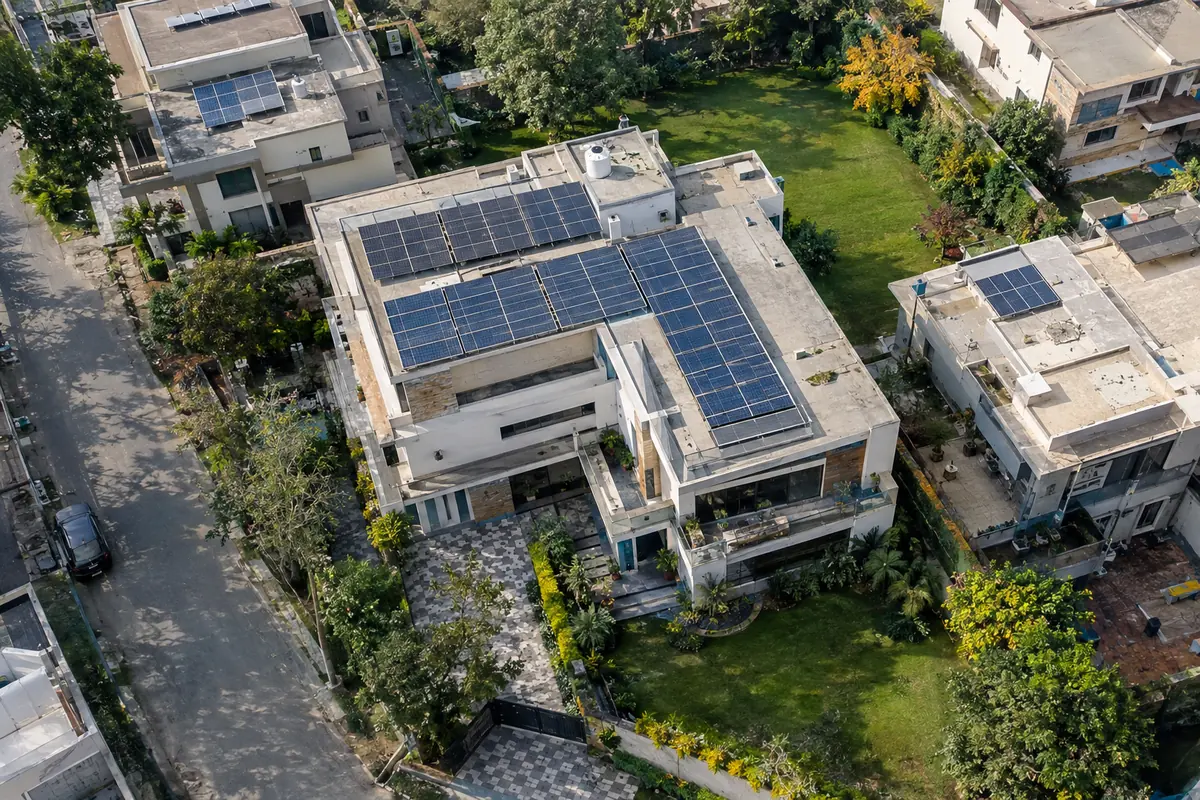
Yearly total of 7,700 units, with July at 1,150. Average daily use is 21 units. Divide by 4.2 and you get exactly 5 kW. The family runs both ACs on summer afternoons, so 6 to 7 kW gives better summer coverage without heavy winter export. That is 11 or 12 panels of 585 W. The roof has space for more, but more panels only make sense if the family plans to add another AC or an EV charger.
1 kanal in Islamabad, four ACs, home office
Yearly total of 15,300 units, peaking at 2,300 in July. Average daily use is 42 units. Divide by 3.9 and you get 10.8 kW. Rounding to 12 kW gives 21 panels of 585 W or 17 of 720 W. The roof could take 18 kW or more, but under net billing the extra winter export earns little, so the family keeps the extra space for a later expansion if their use grows.
Your own numbers will differ. Plug them into the solar calculator for your city to check the result.
Why bigger is no longer automatically better
Before 2026, many installers told every customer to fill the roof, because surplus units could be exported and credited against imported units at close to the same rate. Under NEPRA’s 2026 Prosumer Regulations, new connections are on net billing, where exported units are bought back at a much lower rate than you pay for imported ones. The buyback rate is linked to the National Average Energy Purchase Price and was reported at about Rs 10 to 11 per unit, while imports are billed at your full slab rate. Confirm the current rate with your DISCO, because it can change at each tariff determination. Existing net metering users who applied by 8 February 2026 keep their old terms until their agreement expires.
The practical effect is that each panel beyond your own consumption earns noticeably less than the panels that cover your own use. So:
- Size to cover your yearly average, then add a modest margin for summer and future loads.
- If you want to fill the roof anyway, consider a battery so more of the surplus is used in the evening.
- Under the 2026 rules your system size is capped at your sanctioned load, so a house with a 5 kW sanctioned load cannot simply put 10 kW on the roof and export it. Raising the sanctioned load is possible but means a separate application and charges.
- DISCOs also stop accepting new applications on a transformer once solar on it reaches 80% of the transformer’s capacity. In well-solarised neighbourhoods, ask your DISCO before you buy.
Common sizing mistakes
- Counting panels, not watts. “Ten panels” means nothing on its own. Ten 545 W panels and ten 720 W panels are very different systems.
- Ignoring the inverter. The panel array and inverter must match. A typical design puts slightly more panel power on the roof than the inverter’s AC rating, but each inverter has a maximum PV input and voltage limit. Your installer should show you the string design.
- Bad tilt and direction. Panels laid flat lose output and collect dust. In most of Pakistan, south-facing at roughly the site latitude works well over the year. Use the tilt angle calculator for your city.
- Forgetting winter. If your January bill matters to you, especially with gas heaters being replaced by electric ones, check that your system still covers a decent share on a hazy winter day.
- Buying old stock to save money. Older, lower-wattage panels take more roof space per kW. On a small roof, a higher-wattage panel such as the 585 W panel often gives a better system for the same space.
The quick rule
Take your yearly units, divide by 365, divide again by about 4 (or the figure for your city in the table above), and you have your system size in kW. Divide that by the panel wattage in kW and round up for your panel count. Then check the roof and your sanctioned load. For most families this gives a sensible answer within a panel or two. A good installer should arrive at the same number from your bills, and if their quote is far larger, ask them to explain why.
When you have a size, compare full package prices on the 5 kW solar system price page and the wider system guides.
Frequently asked questions
How many solar panels do I need for a 5 kW system?
With 585 W panels you need 9 panels, which gives about 5.27 kW. With 720 W panels you need 7. Always round up, never down, and keep the total within your inverter's input limits.
How many units does 1 kW of solar produce per day in Pakistan?
Roughly 4 units per day as a yearly average in most Punjab cities, closer to 4.5 in Karachi and Multan. Summer days give more, and foggy winter days can drop to half or less.
How much roof space does one solar panel need?
A 585 W panel is about 7.5 ft by 3.7 ft, roughly 28 square feet. Allow about 80 to 100 square feet of roof per kW once you include walkways, gaps between rows and clearance from the parapet.
Is a 5 kW system enough for a 10 marla house?
It is enough if your average consumption is around 600 units a month or less. A 10 marla house running two or three ACs through summer often uses more than that, so check your yearly average from the bills before deciding.
Should I size solar on my summer or winter bill?
Size on your yearly average, then check the summer months. Under net billing, oversizing to cover the hottest month means exporting a lot in winter at a low buyback rate, which weakens payback.
More from the blog
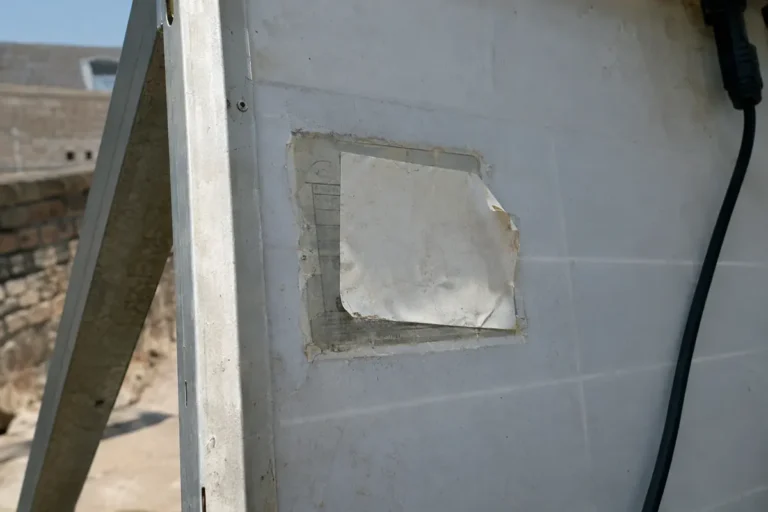 Buying Guides How to Spot Fake, Refurbished or Mislabelled Solar Panels in Pakistan
Copied brand labels, re-stickered wattages and washed used panels all turn up in Pakistan. How each trick works and how to catch it before you pay. · 8 min read
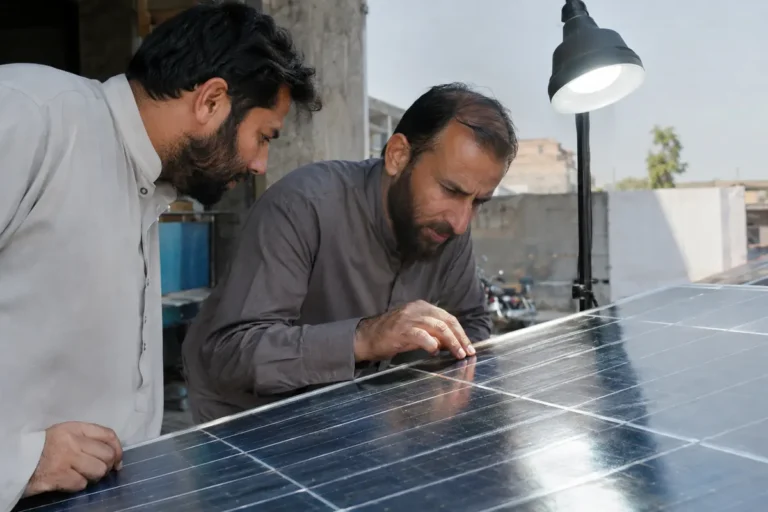 Buying Guides A-Grade vs B-Grade Solar Panels: How Dealers Grade Stock and How to Check
What A-grade and B-grade really mean on a solar panel, why Hall Road prices differ for the same brand, and six checks to do before money changes hands. · 8 min read
 Buying Guides Lithium vs Tubular Battery for Solar in Pakistan: Cost per Year, Not Just Price
Tubular batteries cost less to buy, but lithium usually costs less per year and per stored unit. A worked comparison for Pakistani solar homes in 2026. · 8 min read