On this page
- Where datasheet numbers come from: STC and NMOT
- Solar panel specifications explained: the electrical table, line by line
- Temperature coefficients: the section that matters most in Pakistan
- Mechanical data: size, weight and load
- Warranty, certifications and the small print on page two
- Comparing two panels side by side
- What to do now
- Frequently asked questions
To read a solar panel datasheet for Pakistani conditions, start with three lines: the wattage (Pmax), the temperature coefficient of Pmax, and the NMOT power rating. Wattage tells you what you are paying for, the temperature coefficient tells you how much of it survives a 45 degree afternoon, and NMOT shows you a more honest real-world figure. Everything else on the sheet, from Voc to the fuse rating, is mainly for the person designing your strings, but it is worth understanding so you can check their work.
Below, we go through a typical 585 watt N-type datasheet section by section, then show how the specifications explained here change your actual units in Lahore, Multan or Karachi.
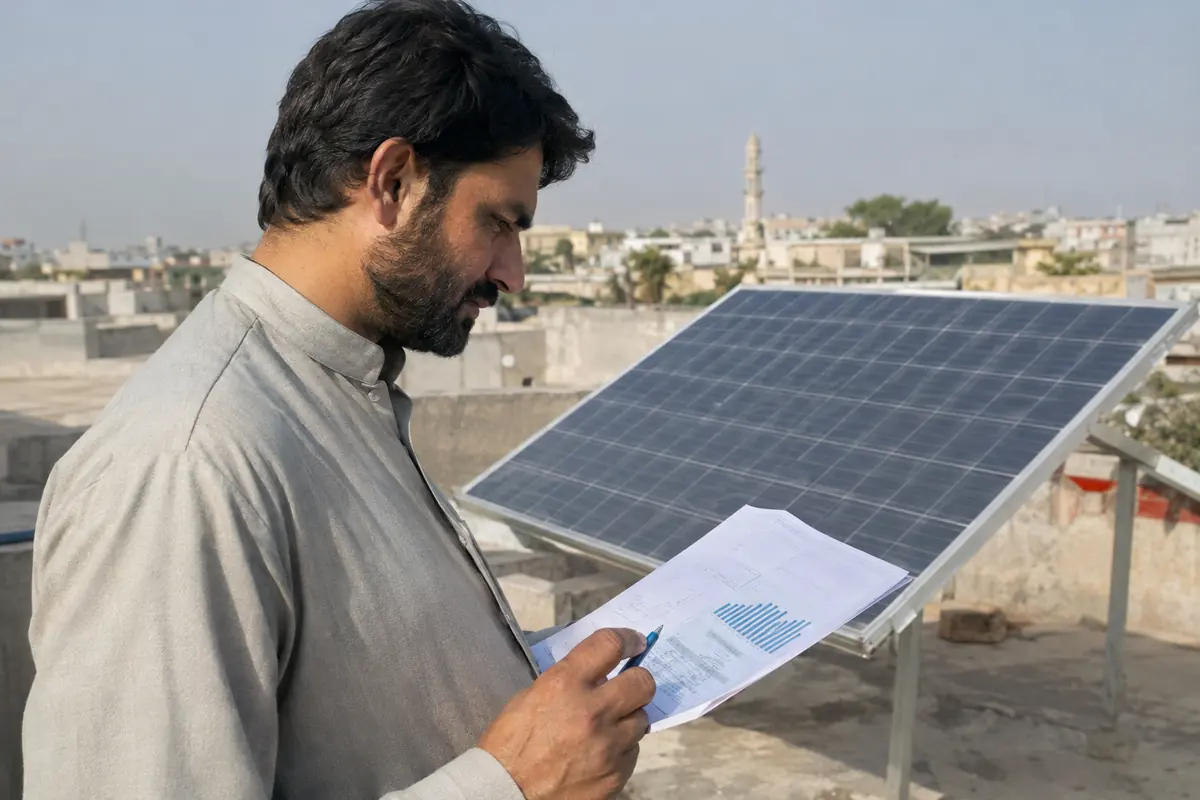
Where datasheet numbers come from: STC and NMOT
Every electrical number on the front page of a datasheet is measured under a fixed test condition. There are two you will see.
- STC (Standard Test Conditions): 1000 watts of sunlight per square metre, cell temperature 25 C, air mass 1.5. This is where the headline wattage comes from.
- NMOT (Nominal Module Operating Temperature), sometimes still labelled NOCT on older sheets: 800 watts per square metre, 20 C ambient air, light wind of 1 metre per second. The panel’s cells settle at the NMOT temperature, usually printed as somewhere around 42 to 45 C.
A 25 C cell almost never happens on a Pakistani roof during productive hours. Even on a mild March day, cells under full sun run 20 to 30 degrees above air temperature. That is why the NMOT column, which most buyers skip, is closer to what your panel will do.
Solar panel specifications explained: the electrical table, line by line
Here is what each row of the electrical characteristics table means. The example values are typical of current 585 W, 144 half-cell N-type panels; exact figures differ between brands and models, so read your own sheet.
| Datasheet line | Typical value (585 W N-type) | What it means for you |
|---|---|---|
| Maximum power (Pmax) | 585 W | The rated wattage at STC. Price per watt is calculated on this. |
| Power tolerance | 0 to +3% | The panel will test at or above its label. Avoid sheets showing a negative tolerance. |
| Voltage at max power (Vmp) | around 43 V | Operating voltage per panel. Multiply by panels in a string to check it sits inside the inverter’s MPPT range. |
| Current at max power (Imp) | around 13.5 A | Operating current. Must not exceed what the inverter’s MPPT input accepts. |
| Open-circuit voltage (Voc) | around 52 V | The highest voltage the panel makes. Used for the cold-weather safety check. |
| Short-circuit current (Isc) | around 14 A | The highest current. Cables, fuses and the inverter’s max short-circuit input are sized from it. |
| Module efficiency | around 22 to 23% | Watts per square metre of panel. Matters most when roof space is tight. |
| Maximum system voltage | 1500 V DC | The insulation limit of the panel. Residential strings stay far below it. |
| Maximum series fuse rating | 25 to 30 A | Relevant when strings are paralleled; tells the installer the fuse limit. |
You can check efficiency yourself. A panel measuring roughly 2.28 m by 1.13 m has an area of about 2.58 square metres. At 1000 W per square metre, that area receives about 2,580 W of sunlight. Divide 585 by 2,580 and you get about 22.7%. If a seller’s sheet claims an efficiency that does not match its own dimensions and wattage, ask questions.
Temperature coefficients: the section that matters most in Pakistan
Find the “Temperature Characteristics” box. It usually has three numbers.
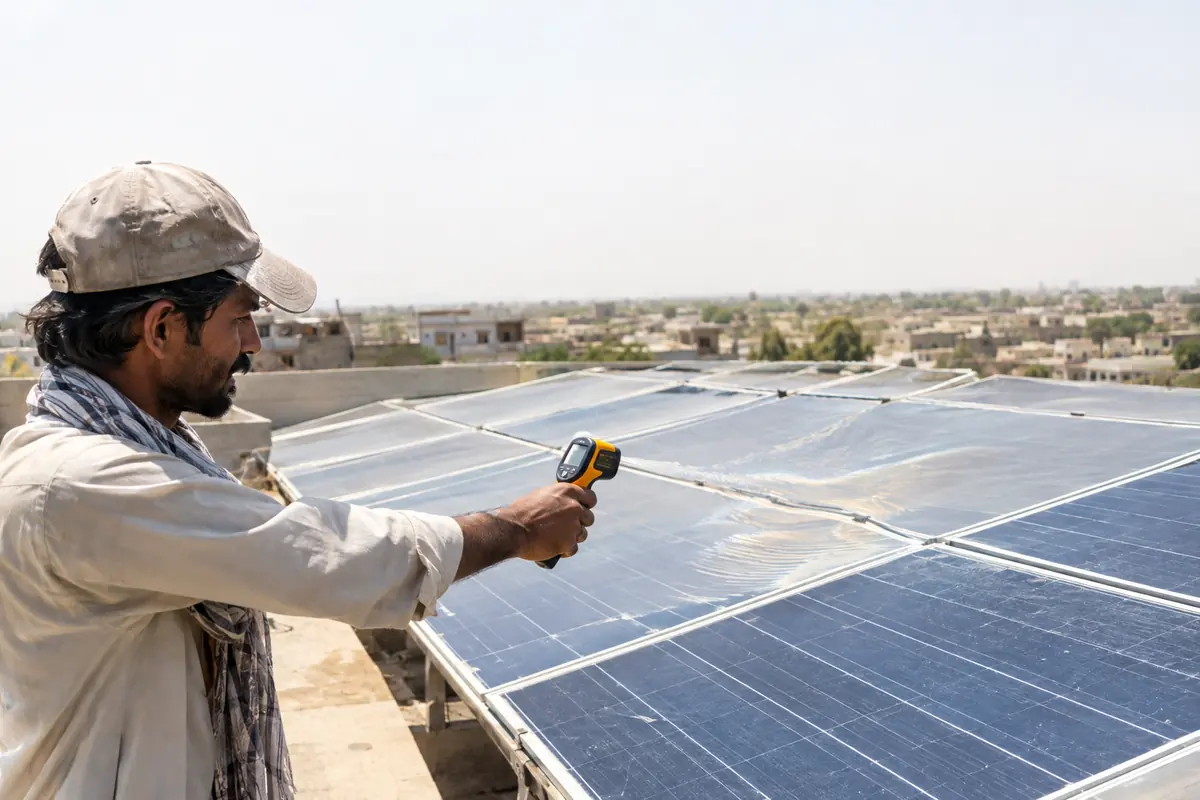
- Temperature coefficient of Pmax: typically around -0.29 to -0.30% per C for N-type TOPCon panels and around -0.34 to -0.35% per C for older P-type PERC panels. This is the one to compare.
- Temperature coefficient of Voc: negative, typically around -0.25% per C. Voltage drops as panels heat up and rises as they cool.
- Temperature coefficient of Isc: a small positive number, around +0.045% per C. Current rises slightly with heat, which is not enough to offset the voltage loss.
Here is what the Pmax coefficient does to a 585 W panel. Cell temperature on a fixed rooftop stand is roughly air temperature plus 25 to 30 C at full sun.
| Situation | Approx. cell temperature | Loss at -0.30%/C (N-type) | Loss at -0.35%/C (PERC) | 585 W panel delivers (N-type) |
|---|---|---|---|---|
| Islamabad, clear January noon (air 15 C) | 40 C | 4.5% | 5.3% | about 559 W |
| Lahore, April noon (air 32 C) | 60 C | 10.5% | 12.3% | about 524 W |
| Multan, June noon (air 42 C) | 70 C | 13.5% | 15.8% | about 506 W |
These figures are only the heat loss, before dust, wiring and inverter losses. They also assume full sunlight; in summer haze the irradiance itself is lower. The gap between the two technologies looks small per panel, but on a 10 kW system through a long summer it is a few percent of your production, every year. This is the main practical reason N-type panels took over the market. Our guide to solar panel types covers the other differences.
Air flow matters as much as the coefficient. A panel mounted flat against a hot slab runs hotter than one on a raised stand with a gap underneath. A good stand is not only about tilt.
Voc and the winter morning check
The Voc temperature coefficient is the number your installer should care about most when designing strings. Because voltage rises as panels get cold, a string that is safe at noon in May can exceed the inverter’s maximum DC input voltage at sunrise on a cold January day in Islamabad or Peshawar.
A worked example, using a panel with Voc of 52 V and a Voc coefficient of -0.25% per C:
- Coldest likely cell temperature on a winter morning: about 0 C, which is 25 C below STC.
- Voltage rise: 25 x 0.25% = 6.25%. Cold Voc = 52 x 1.0625, about 55.3 V per panel.
- If the inverter’s maximum DC input voltage is 550 V, then 550 / 55.3 = 9.9, so no more than 9 panels in series on that input.
Check your own inverter’s datasheet for its maximum input voltage and MPPT range, because they vary a lot between models. Then also check the hot end: on a summer afternoon, Vmp drops, and the string voltage must stay above the inverter’s minimum MPPT voltage. Our guide to series vs parallel wiring explains how strings and MPPT inputs fit together.
Mechanical data: size, weight and load
The mechanical box tells you whether the panel fits your roof and your stand.
- Dimensions: current 144 half-cell panels in the 580 to 620 W range are commonly around 2.28 m by 1.13 m. The 700 W class panels are larger, around 2.38 m by 1.30 m. Our page on solar panel size in feet converts the common sizes for planning a roof layout.
- Weight: roughly 27 to 33 kg for most large-format panels. Double-glass panels are heavier than glass-backsheet ones.
- Frame and glass thickness: thicker frames and glass resist bending during storms and careless handling.
- Mechanical load: often shown as front load 5400 Pa and rear load 2400 Pa. The rear (wind uplift) figure matters for open rooftops during pre-monsoon storms. Make sure the stand and clamps are designed for it too.
- Junction box and connectors: IP68 rating and the connector type (MC4 or compatible). Mixing connector brands is a common cause of hot, melted joints.
Warranty, certifications and the small print on page two
Page two of a datasheet carries the warranty graph and the certifications. Look for:

- IEC 61215 and IEC 61730: the standard design and safety qualifications for crystalline panels. Every genuine mainstream panel should list them.
- Product and performance warranty years, plus the first-year and annual degradation figures. For what these mean in practice and what dealers actually honour, see our separate post on panel warranties.
- Bifaciality, if it is a bifacial panel: the share of front-side power the rear side can add. On most Pakistani rooftops the gain from the rear side is small unless the panel is raised high over a light-coloured surface.
- Model number and version date: datasheets get revised. Make sure the sheet you are reading matches the exact model printed on the panel label and your invoice.
Check the label on the back of the panel
Every genuine panel carries a rating label on its back that repeats the key datasheet figures: model, Pmax, Vmp, Imp, Voc, Isc, maximum system voltage, fuse rating and the serial number with a barcode. Before the panels go up, compare the label with the datasheet you were given. The model number should match exactly, including any suffix that marks a version or a bifacial variant, and the electrical values should match the column for that wattage. Labels that look reprinted, stuck over another label, or show values that do not appear anywhere on the official datasheet are a reason to stop and ask questions. Photograph each label too; once the panels are mounted the serial numbers are hard to reach.
Most panels on sale in 2026 come in two families: the 585 to 655 W range in the familiar large format, and newer 700 W plus panels that are physically bigger and heavier. Larger formats need a stand designed for their length and a check that your roof layout still fits, so the mechanical page of the datasheet becomes just as important as the electrical one.
Comparing two panels side by side
When two dealers quote different brands at similar wattage, put the sheets next to each other and check, in this order:
- Price per watt. Today’s market average is around Rs 41.3 per watt; the cheapest 585 W panel is Rs 40 per watt. Track it on our price per watt page.
- Temperature coefficient of Pmax. A difference of 0.05% per C is worth paying a little for in southern Punjab and Sindh.
- Power tolerance. Positive only.
- First-year and annual degradation on the warranty graph.
- Dimensions and weight, against your roof layout and stand design.
- Electrical fit with your inverter: Voc, Vmp and Isc against its input limits.
Efficiency comes last on this list on purpose. On a 10 marla roof with open space, two extra points of efficiency do not add units; they only reduce the number of square feet used.
What to do now
Ask your dealer for the datasheet PDF of the exact model before you pay, not after. If a dealer cannot provide one, or the sheet’s model number does not match the label, treat that as a warning. Then run the temperature check above for your city: take your summer noon air temperature, add about 28, subtract 25, and multiply by the Pmax coefficient. That one calculation tells you more about summer output than the headline wattage.
For current prices on the most popular size, see the 585 watt panel price in Pakistan, where the cheapest option today is Rs 23,400. If you want to understand how the newer cell designs on these sheets differ, our explainer on the latest solar panel technology goes further.
Frequently asked questions
What is the most important number on a solar panel datasheet for Pakistan?
After wattage, the temperature coefficient of Pmax. It tells you how much power the panel loses for every degree its cells run above 25 C, and Pakistani rooftops push cells well above 60 C in summer.
Why does my 585 watt panel never produce 585 watts?
The 585 W rating is measured at Standard Test Conditions with cells at 25 C. On a hot rooftop the cells run much hotter and dust, wiring and inverter losses add up, so 470 to 520 W at peak is normal for a 585 W panel in summer.
What is the difference between STC and NMOT ratings?
STC is a lab rating at 1000 W per square metre and 25 C cell temperature. NMOT is a more realistic rating at 800 W per square metre with a warm cell, so the NMOT wattage is always lower and closer to what you see on a roof.
What does Voc mean on a solar panel?
Voc is open-circuit voltage, the panel's voltage with nothing connected. It rises in cold weather, so installers use it to make sure a string of panels never exceeds the inverter's maximum DC input voltage on a winter morning.
Is higher panel efficiency always better?
Higher efficiency means more watts from the same roof area, which helps on small roofs. If you have plenty of space, compare price per watt and temperature coefficient first, because a slightly less efficient panel can deliver the same units for less money.
More from the blog
 Solar Tech Winter Solar Checklist: 9 Things to Do Before December
Fog, smog and short days cut solar output every winter. These 9 checks on panels, tilt, battery, inverter and bills help your system get through December. · 8 min read
 Solar Tech Bifacial Solar Panels: Are They Worth It on Pakistani Rooftops?
Bifacial panels add real output only when light reaches the back. Here is how mounting height, roof colour and price decide if they pay off on your roof. · 9 min read
 Solar Tech How Much Do Solar Panels Produce in Winter Fog and Smog?
Smog and fog can cut solar output sharply in Punjab's winter. What a 5 kW system really makes on hazy days, why, and what you can do to recover lost units. · 8 min read