On this page
Good solar panel maintenance in winter comes down to nine checks you can finish in a weekend: wash off the smog film, fix shading from the low sun, steepen the tilt if your stand allows it, look after the battery, adjust inverter settings for short days, check earthing and wiring before the rains, keep birds out, read your bill properly and record a winter baseline. Do them before December and your system will lose far fewer units to fog season.
Winter in Pakistan is hard on solar output, especially across Punjab and parts of Khyber Pakhtunkhwa. The checklist below runs from the roof down to the paperwork.
| # | Task | Who can do it | Time needed |
|---|---|---|---|
| 1 | Wash off dust and smog film | Owner | 30 to 60 minutes |
| 2 | Check for new winter shading | Owner | 15 minutes at three times of day |
| 3 | Adjust tilt (adjustable stands only) | Installer or careful owner | 1 to 3 hours |
| 4 | Battery health check | Owner, installer for repairs | 20 minutes |
| 5 | Inverter settings for short days | Owner with care, or installer | 15 minutes |
| 6 | Earthing, surge protection and cables | Electrician | 1 hour |
| 7 | Bird and rodent proofing | Installer | 1 to 2 hours |
| 8 | Read your bill and meter properly | Owner | 15 minutes |
| 9 | Record a winter baseline | Owner | A few minutes a day |
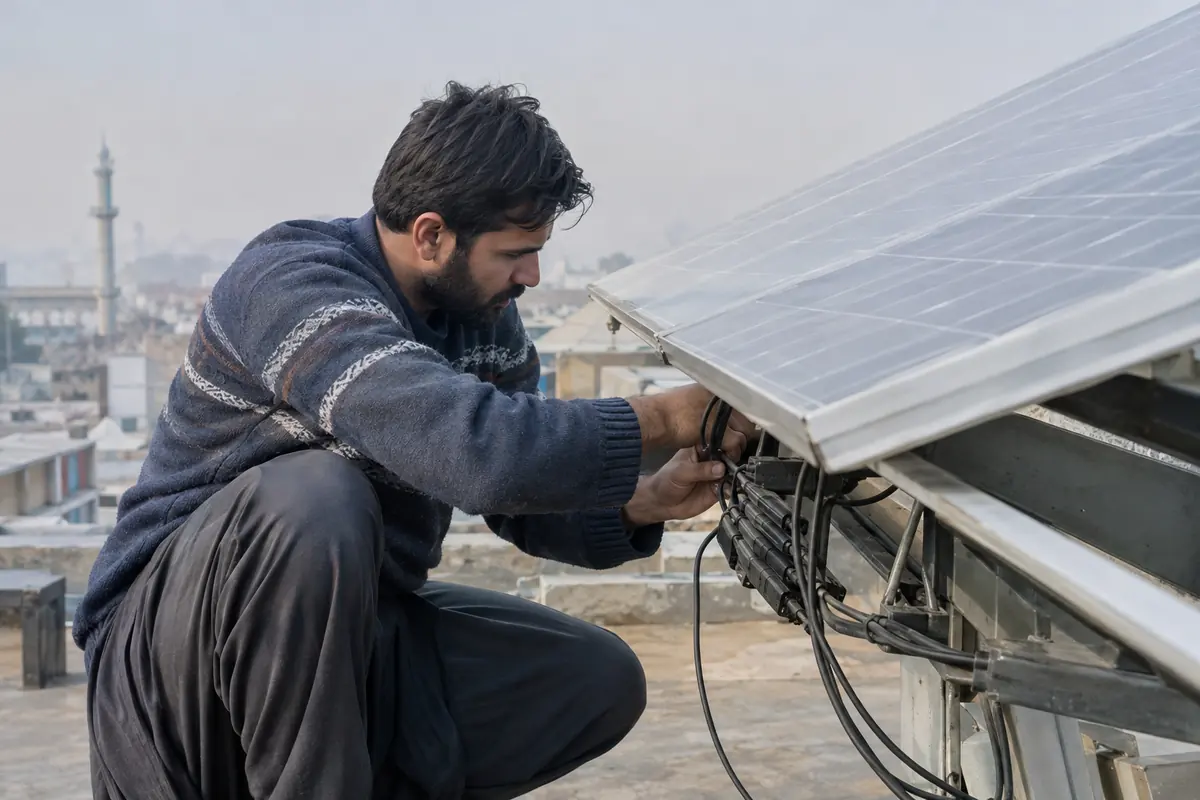
On the roof: light is scarce, so do not waste any
1. Wash off the smog film
From November, Lahore, Faisalabad, Gujranwala and Multan see heavy smog. Overnight dew settles on cool glass, mixes with fine particles and dries into a grey film. Unlike summer dust, it sticks, and a light drizzle often just smears it.
- Rinse with plain water and a soft brush or sponge. Avoid washing powder, abrasive pads and pressure washers.
- Wash early in the morning or near sunset. Cold water on hot glass is not a big risk in December, but the habit is good, and you will not be standing on a hot roof.
- Do not walk on panels. Use a long-handled brush from the walkway or the stand frame.
- Through fog season, a rinse every one to two weeks is reasonable. Compare the app reading the day before and the day after to see whether it is worth doing more often.
Why bother? Researchers at MIT found that urban haze cut solar output in Delhi by about 12 percent over a year, and Lahore shares the same winter smog belt. No one has published a verified figure for Lahore itself, but the lesson holds: you cannot clear the sky, so at least clear the glass.
Our step-by-step panel cleaning guide covers safe methods in more detail, including what not to use on anti-reflective glass.
2. Check for winter shading
The winter sun sits much lower in the southern sky than in June. Objects that never shaded your panels in summer can throw long shadows across them from November to February: the water tank, the stair room (mumty), a neighbour’s extra floor, a parapet wall or a tree.
Go up at about 10 am, 12 noon and 2 pm on a clear day and look. Even a shadow across a few cells of one panel can drag down the whole string. If you find one, options include moving the tank, trimming the tree, re-stringing panels onto a separate MPPT input, or, on newer systems, adding optimisers to the affected panels.
3. Steepen the tilt, if your stand allows it
Panels collect the most energy when they face the sun squarely. With the sun low in winter, a steeper tilt helps. A common rule of thumb is latitude plus 10 to 15 degrees for the winter months.
| City | Approximate latitude | All-year tilt (around latitude) | Winter tilt (rule of thumb) |
|---|---|---|---|
| Karachi | 25 degrees | about 25 degrees | about 35 to 40 degrees |
| Multan | 30 degrees | about 30 degrees | about 40 to 45 degrees |
| Lahore | 31.5 degrees | about 28 to 30 degrees | about 45 degrees |
| Peshawar | 34 degrees | about 33 degrees | about 45 degrees |
| Islamabad | 33.7 degrees | about 33 degrees | about 45 degrees |
Only adjust if the structure was built with adjustable legs and is rated for the higher wind load a steeper panel catches. Steeper rows also cast longer shadows on the row behind, so check spacing. Most fixed rooftop stands in Pakistan are set at an all-year angle, and that is a reasonable compromise. For Lahore, one solar resource tool (profileSOLAR) suggests about 28 degrees as the best fixed angle and about 46 degrees in winter if the stand is adjustable, which matches the rule of thumb. Use the tilt angle calculator for your exact location, and see solar stand options if you are considering an adjustable frame.
Inside the house: battery and inverter
4. Give the battery a health check
Winter is when batteries get exposed. Solar charging is weaker, so a tired battery that coped in October may not last through evening load shedding in January.
For tubular (lead-acid) batteries:
- Check electrolyte levels and top up only with distilled water, never tap water.
- Clean white or green corrosion from terminals and tighten connections.
- Look for swelling, cracks or one battery in the bank that runs hotter than the others.
- Lead-acid batteries left partly charged for long periods sulphate. If solar cannot fully charge them, a periodic full charge from the grid helps.
For lithium (LiFePO4) batteries:
- Open the BMS or inverter app and check that cell voltages are close to each other.
- Lithium iron phosphate cells should not be charged below freezing. In the plains this is not a concern for an indoor battery. In Murree, Quetta, Gilgit or other cold areas, keep the battery in a heated or insulated room and confirm the BMS low-temperature charge protection is active.
- Check that communication between battery and inverter is working, so the inverter is reading the real state of charge.
If your battery is near the end of its life, it is better to know in November than in a foggy January week. The battery price guide compares lithium and tubular replacements.
5. Adjust inverter settings for short days
Settings that worked in summer may not suit winter. A few worth reviewing with your installer:
- Output priority: on many hybrid inverters this is solar first, then battery, then grid (often shown as SBU), or solar, utility, battery (SUB). If your battery is draining by evening and leaving nothing for load shedding, switching to a mode that saves battery for outages can help.
- Grid charging: on foggy days the panels may not refill the battery. Allowing grid charging at off-peak hours keeps it ready for outages. Weigh this against the cost of grid units.
- Discharge cut-off: raising the minimum battery level reserves capacity for load shedding rather than using it all on routine evening loads.
- Clock and time-of-use windows: check that the inverter’s clock is right so any timed charging or discharge happens in the intended hours.
Change one setting at a time and note what you changed. If you are unsure what a setting does, ask your installer rather than guessing. Our inverter guide explains hybrid modes in plain terms.
Safety: before the winter rains
6. Check earthing, surge protection and cables
Winter rain from western weather systems often brings lightning to northern Punjab, Islamabad and Khyber Pakhtunkhwa. Before then:
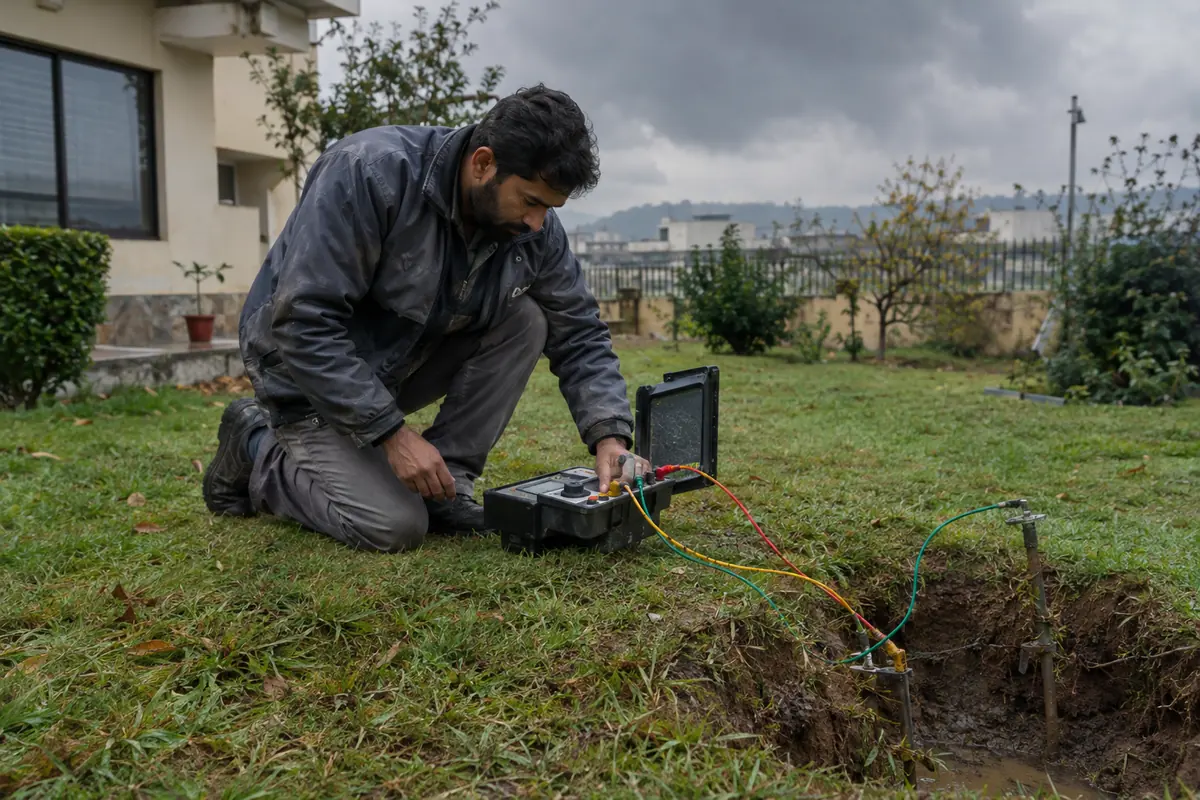
- Have an electrician test the earthing of the panel frames and the inverter. Earth pits dry out over summer and resistance can rise.
- Look at the DC and AC surge protection devices in the combiner box. Many have a window that changes colour when the device has failed and needs replacement.
- Inspect cables on the roof. Summer heat and UV make cheap insulation brittle. Look for cracked sheathing, cables lying loose on the roof surface and MC4 connectors that are discoloured or loose.
- Check that the DC isolator switch works and that everyone in the house knows where it is.
7. Keep birds and rodents out
The shaded, warm gap under panels attracts pigeons and sparrows in winter. Nests trap dirt, droppings eat into frames and glass, and birds and rats chew cable insulation. A mesh skirt fixed around the edge of the array keeps them out without touching the panels. Clear any existing nests first, and do not use anything that damages the panel frame or drills into it.
Paperwork: read your bill with winter eyes
8. Check your meter and bill readings
If you have net metering or net billing, winter is when import from the grid rises and export falls. Make sure you understand which figures on your bill are import, which are export, and how the credit is being carried. Compare the readings on your bidirectional meter with the bill at least once.
Two things to keep in mind this winter. First, since February 2026 new applicants are on net billing under NEPRA’s Prosumer Regulations: exports earn a rate linked to the national average purchase price, reported at about Rs10 to 11 per unit, while imports are charged at your full slab rate, and surplus credit now carries forward month to month. Homes approved before 9 February 2026 stay on their old net metering terms until their agreement ends. Second, the fixed monthly charge on domestic bills, roughly Rs200 to 675 depending on your slab, applies whether or not you export, so a zero-import month still produces a bill.
If your net billing or net metering application has been stuck since the regulations changed, the Power Division reported in September 2026 that most of the pending backlog had been cleared, and you can check your status on PITC’s verification portal (nmverification.pitc.com.pk). There is no processing fee for this check.
Many homes also switch to electric heaters, geysers or heat pumps in winter, especially where gas pressure is low. These loads mostly run in the morning and at night, when solar is weak or absent. Do not assume your system covers them. If heating is a large part of your winter bill, consider timing what you can, such as an electric geyser, to midday hours.
Monitoring: know what normal looks like
9. Record a winter baseline
Write down daily units for a few clear days in late November and a few foggy ones. Divide by your panel kW to get units per kW. This gives you a winter “normal” to compare against later, so you can tell a fault from bad weather.
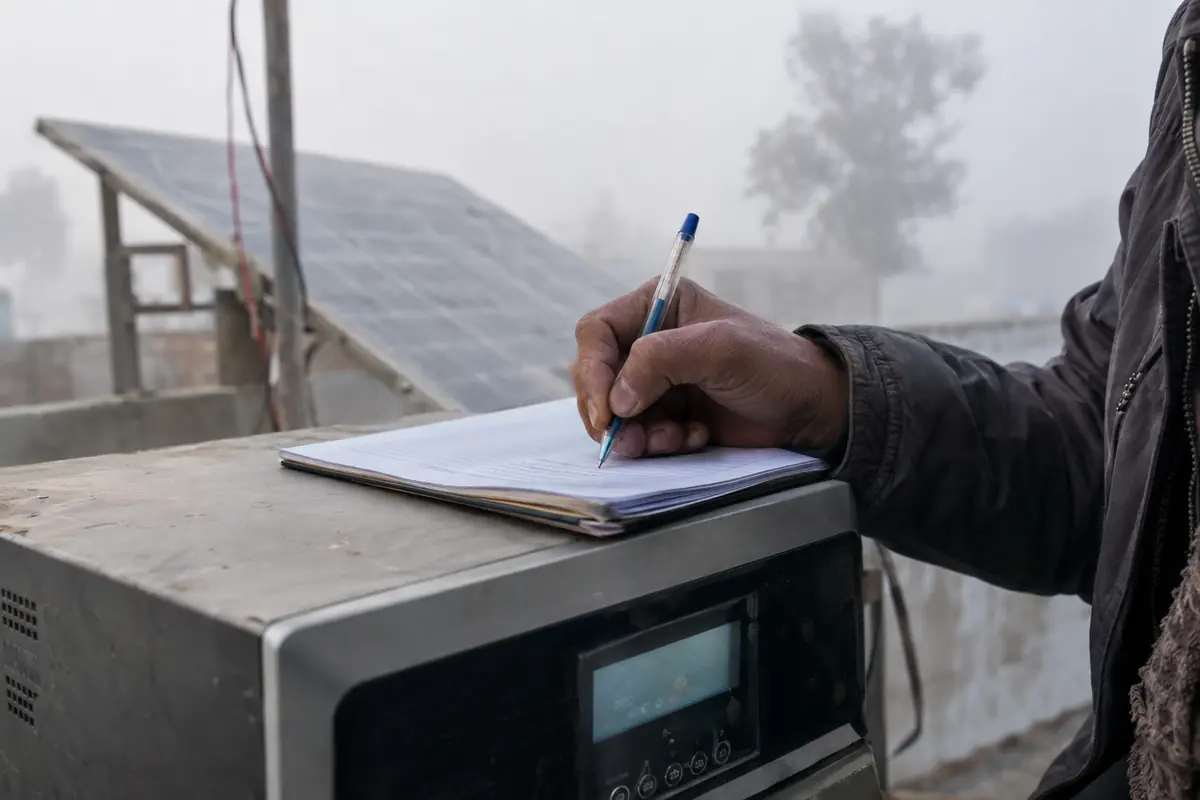
- A sudden drop on a clear day, compared with your clear-day baseline, points to dust, shading or a fault.
- One MPPT input reading far lower than the other suggests a string problem.
- Repeated inverter error codes deserve a call to the installer, not a reset and hope.
Expect lower numbers than spring. Shorter days and fog alone can push daily output well below the yearly average, and that is normal. What you are looking for is the gap between what the weather allowed and what your system delivered. For a sense of how long well-maintained panels last, see our page on solar panel lifespan.
Bottom line
Winter will always cost you units in Pakistan. You cannot fix fog. You can make sure the light that does arrive reaches clean glass with no shadows, that your battery and inverter are set up to cover load shedding on short days, and that your system is safe before the rains. Tick off these nine checks before December and you will go into fog season knowing exactly what your system can and cannot do.
Frequently asked questions
Should I clean solar panels more often in winter?
In Punjab, yes. Morning dew mixes with smog and dust to leave a sticky film that rain does not always remove. A gentle rinse every one to two weeks, done early morning or evening with plain water, usually keeps output up.
What is the best tilt angle for solar panels in winter in Pakistan?
A steeper tilt helps in winter because the sun is lower. A common rule is your latitude plus about 10 to 15 degrees, which works out to about 45 degrees in Lahore and a little less in Karachi. Only adjust if your stand is built for it.
Why does my solar produce so little in December?
Shorter days, a low sun angle, fog and smog all reduce the light reaching your panels. Output can drop to around half of spring levels in a bad fog spell. Dust and shading from low winter sun make it worse.
Can lithium batteries handle Pakistani winters?
In the plains, an indoor LiFePO4 battery is fine. Lithium iron phosphate cells should not be charged below freezing, so in Murree, Quetta, Gilgit or other cold areas keep the battery indoors and check the BMS low-temperature settings.
Should I change my inverter settings for winter?
Often, yes. If solar cannot fill your battery on short, foggy days, you may want grid charging at off-peak times or a lower discharge cut-off so the battery still covers load shedding. Change settings carefully or ask your installer.
More from the blog
 Solar Tech How to Read a Solar Panel Datasheet (for Pakistani Heat)
Pmax, Voc, temperature coefficient, NMOT: what each datasheet line means, which ones matter in a Pakistani summer, and how to compare two panels properly. · 8 min read
 Solar Tech Bifacial Solar Panels: Are They Worth It on Pakistani Rooftops?
Bifacial panels add real output only when light reaches the back. Here is how mounting height, roof colour and price decide if they pay off on your roof. · 9 min read
 Solar Tech How Much Do Solar Panels Produce in Winter Fog and Smog?
Smog and fog can cut solar output sharply in Punjab's winter. What a 5 kW system really makes on hazy days, why, and what you can do to recover lost units. · 8 min read