On this page
- The three warranties on one panel
- Product warranty: the one that actually gets claimed
- Performance warranty: how to read the numbers
- Solar panel warranty in Pakistan: why the manufacturer cover often does not reach buyers
- What dealers actually honour
- The paperwork file to keep
- Bottom line
- Frequently asked questions
A solar panel warranty in Pakistan is really three separate promises: a product warranty against defects (typically 12 to 15 years on current panels), a performance warranty on power output (25 to 30 years), and the dealer’s own written warranty. The first two come from the manufacturer and only help you if your panels can be traced to a recognised import channel. The third is often the only one you can enforce quickly, so read it as carefully as the datasheet.
This guide explains what each one covers, where Pakistani buyers usually lose their claim, and the paperwork that makes a claim possible years later.
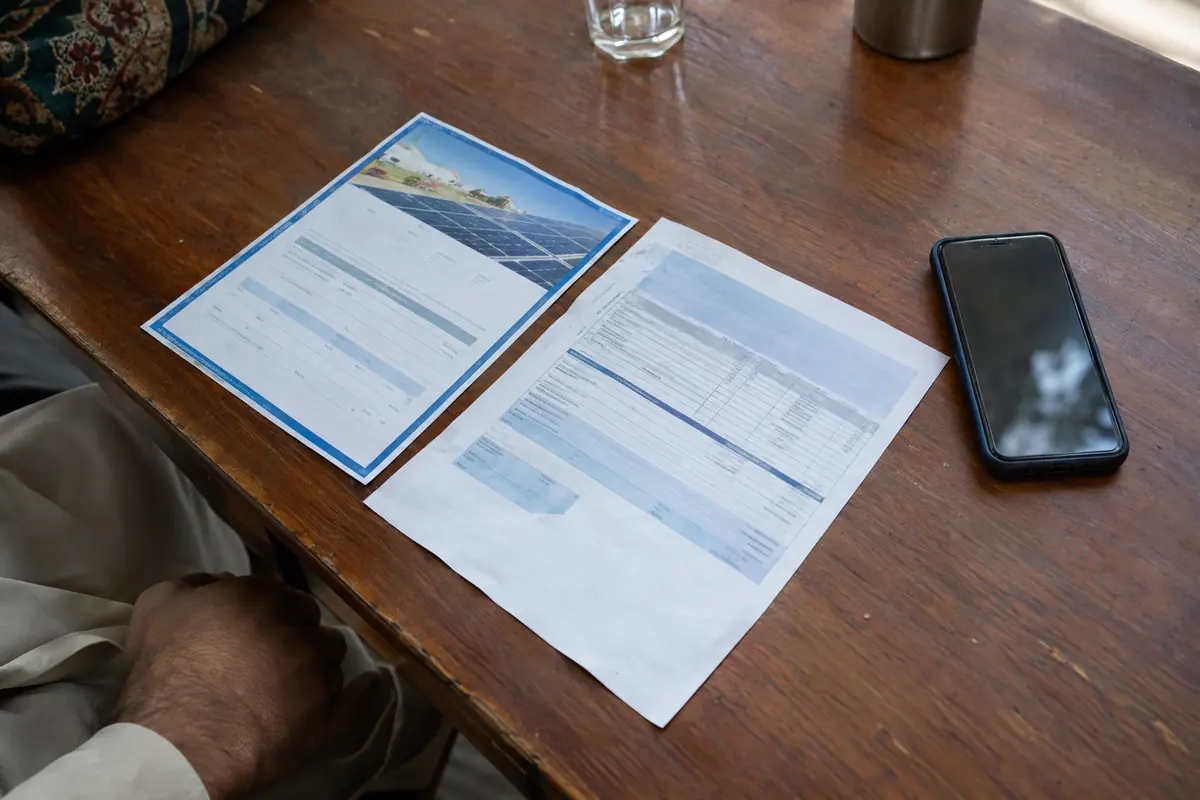
The three warranties on one panel
When a dealer on Hall Road or Brandreth Road says “25 saal warranty”, he is usually quoting the performance figure printed on the brand’s datasheet. That number is real, but it is not the whole picture. Here is how the three layers compare.
| Warranty | Who gives it | Typical length | What it covers | Who you deal with |
|---|---|---|---|---|
| Product (materials and workmanship) | Manufacturer | 12 to 15 years on most current N-type panels from large brands | Manufacturing defects: junction box failure, bypass diode faults, delamination, backsheet cracking, frame or glass defects not caused by handling | Importer or brand office, usually through your dealer |
| Performance (linear power) | Manufacturer | 25 to 30 years | Output staying above a stated share of nameplate power each year | Importer or brand office, with test evidence |
| Dealer or installer warranty | The shop or installation company | Anywhere from a few months to a few years; varies widely | Whatever is written on your invoice: replacement, workmanship, wiring, mounting | The dealer directly |
The lengths above are typical figures from manufacturer datasheets and warranty documents. Each model has its own terms, so always check the datasheet and warranty PDF for the exact model number on your invoice, not the brand in general.
Product warranty: the one that actually gets claimed
Most real claims in Pakistan are product claims, not performance claims. A panel does not quietly lose 20% over a decade; it fails visibly. The common failures we see on rooftops are:
- Junction box problems: burnt connectors, a loose or failed bypass diode, or a box that has come away from the backsheet.
- Hot spots: one cell running much hotter than the rest, often visible as a brown mark, sometimes caused by a cracked cell.
- Delamination and bubbles: the encapsulant separating from the glass, letting moisture in.
- Backsheet cracking or yellowing, more common on older or low-cost panels exposed to years of summer heat.
- Snail trails: dark lines across cells, a sign of micro-cracks.
What a product warranty does not cover matters just as much. Damage in transport, a cracked panel from someone stepping on it, a frame bent by a badly made stand, lightning, flooding, and panels that were drilled or modified are normally excluded. So is damage from a pressure washer or from chemicals used during cleaning. If your installer used the wrong clamps or clamped outside the zones marked in the installation manual, a brand can reject the claim on that basis alone.
The practical point: a product warranty is a defect warranty. It protects you from a bad panel, not from a bad installation.
Performance warranty: how to read the numbers
The performance warranty is the graph on the back of every datasheet. It usually has two parts: a larger drop allowed in year one, then a small fixed drop each year after. For many current N-type (TOPCon) panels from the big brands, datasheets show roughly 1% in the first year and around 0.4% per year after that, ending near 87 to 89% of nameplate at year 30. Older P-type PERC panels commonly allowed about 2% in year one and around 0.55% a year after, over 25 years. Treat these as typical patterns, and confirm the exact figures on the datasheet for your model.
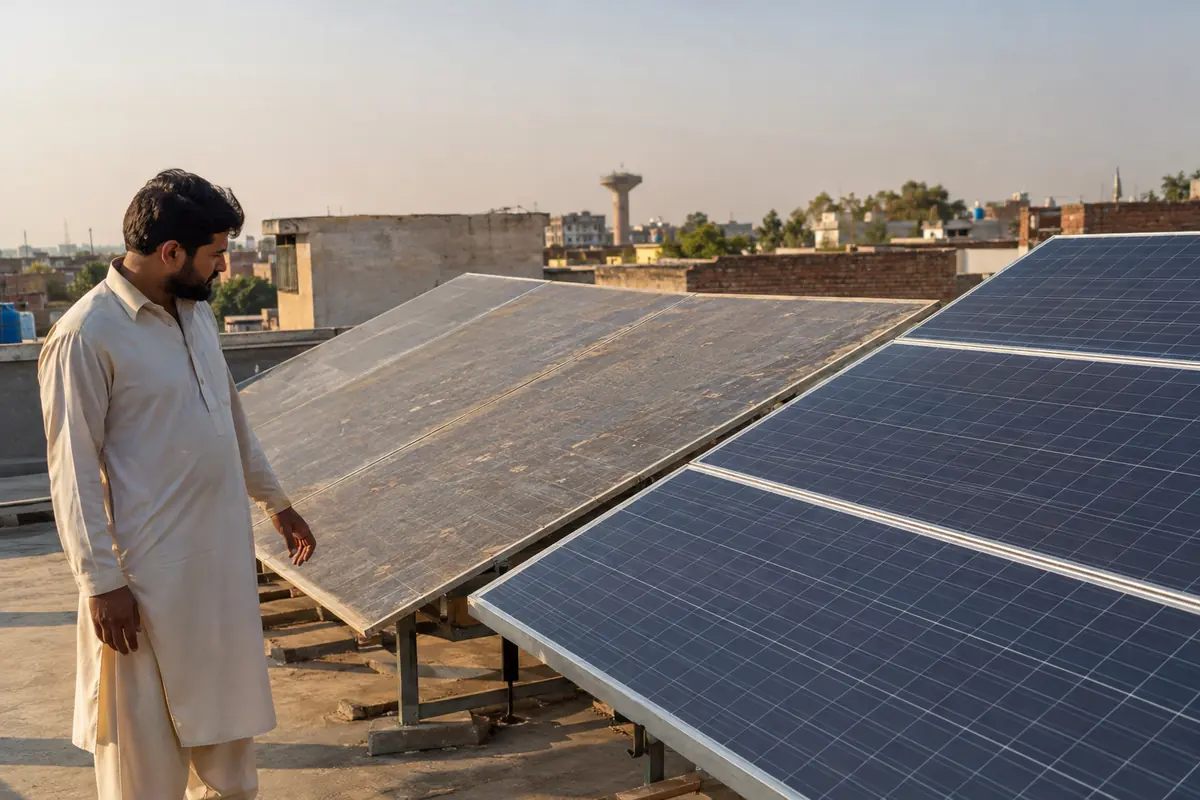
Here is what that pattern looks like for a 585 watt panel, using the typical N-type figures above.
| Year | Guaranteed minimum (share of nameplate) | Guaranteed minimum for a 585 W panel |
|---|---|---|
| End of year 1 | 99.0% | about 579 W |
| Year 10 | 95.4% | about 558 W |
| Year 20 | 91.4% | about 535 W |
| Year 30 | 87.4% | about 511 W |
Two things trip people up here. First, these numbers are measured at Standard Test Conditions (1000 W per square metre of sunlight, 25 degree cell temperature). Your rooftop in Multan in June is nowhere near 25 degrees, so a panel producing 470 W at noon in summer is not a warranty failure. Second, proving a performance shortfall needs a proper test, usually an I-V curve trace done by a qualified technician or lab, corrected back to STC. An inverter app showing lower daily units than last year is not evidence; dust, haze, shading and inverter clipping can all explain that.
For a deeper look at how long panels realistically last in Pakistani conditions, see our guide on solar panel lifespan and degradation.
Solar panel warranty in Pakistan: why the manufacturer cover often does not reach buyers
This is the uncomfortable part of the solar panel warranty Pakistan question. A global brand’s warranty is normally tied to how the panel entered the country. Brands work through authorised distributors or importers. When panels arrive through other channels, or are resold several times through the wholesale market, the brand may not recognise them for a warranty claim, even if the panel itself is genuine.
Several things decide whether your manufacturer warranty is usable:
- Serial number traceability. Each genuine panel has a serial number and barcode on the label and usually on the frame. Some brands let you check serials online. For Jinko, our page on verifying a Jinko panel by serial number walks through it.
- Proof of purchase. A proper invoice showing the model, wattage, quantity and serial numbers, from a business you can find again.
- Importer identity. Ask the dealer which company imported the stock. If he cannot or will not say, assume the manufacturer warranty will be hard to use.
- Grade of stock. A-grade panels carry the full warranty. B-grade, factory seconds and used panels usually carry none from the manufacturer.
None of this means grey-channel panels are bad. Many work perfectly for years. It means your real protection is the dealer’s warranty, and you should price and choose accordingly. Our list of established solar companies in Pakistan is a reasonable starting point for dealers who have been around long enough to honour a claim.
What dealers actually honour
Dealer warranties vary more than anything else in this market, so there is no single standard to quote. What matters is what is written down. Verbal promises at the counter are worth very little two years later. Before you pay, ask for these on the invoice or a signed warranty card:
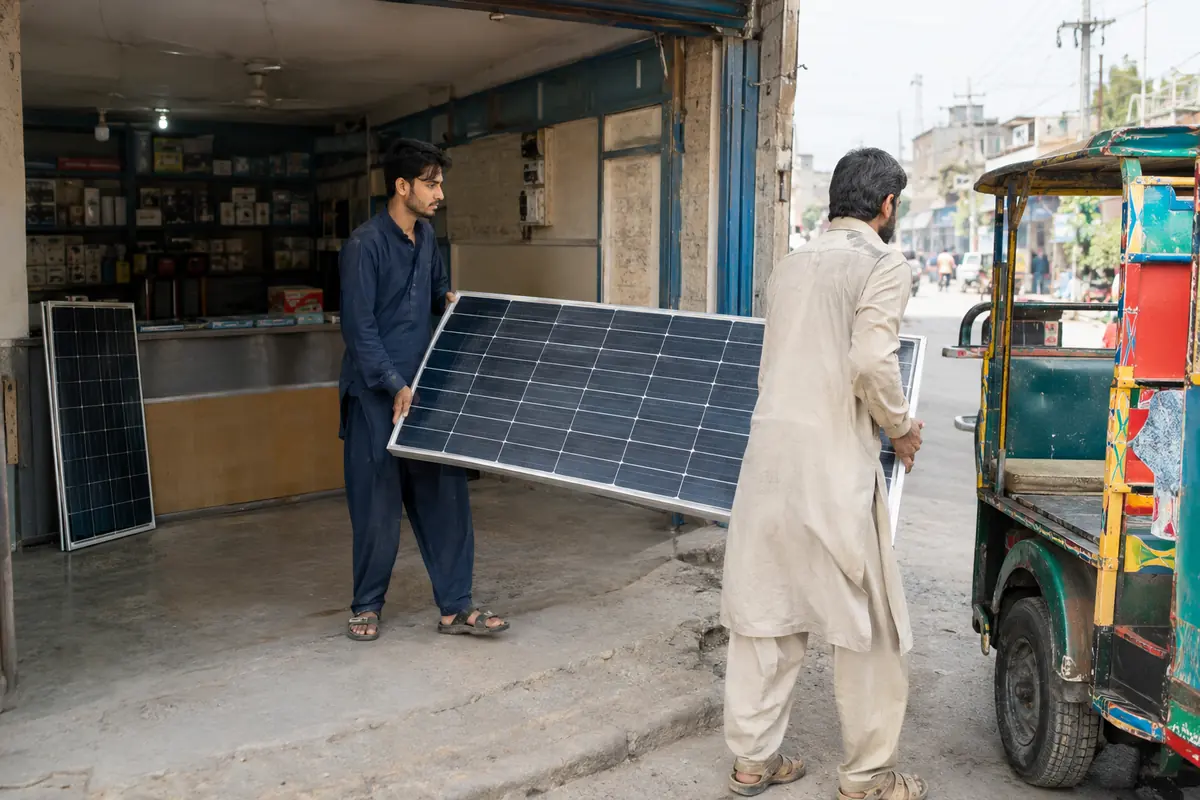
- The period the dealer will replace defective panels directly from his stock, without sending you to the brand.
- Like-for-like replacement terms. If your 585 W model is discontinued, will he replace it with the nearest current model of equal or higher wattage? Mixing panels in one string needs matching current, so this matters.
- Who pays for removal and reinstallation. A free panel is less useful if you pay a team to take down and remount it.
- Turnaround time once a fault is confirmed.
- Escalation path: the name of the importer or brand office he will escalate to for long-term product or performance claims.
Installers who supply the whole system often give a separate workmanship warranty on wiring, earthing and the mounting structure. That is worth having, because many “panel faults” in the first year turn out to be loose MC4 connectors or water getting into a badly sealed junction.
Common ways buyers void their own warranty
Most rejected claims are not about brands refusing to pay. They are about evidence that the installation or maintenance broke the rules in the installation manual. Avoid these:
- Walking on panels to reach other parts of the roof, or letting cleaners stand on them.
- Pressure washing, using detergents or abrasive pads. Plain water and a soft brush is enough; see our panel cleaning guide.
- Drilling extra holes in the frame to fit a cheap stand.
- Clamping panels outside the manufacturer’s marked clamping zones.
- Laying panels flat on the roof with no airflow, which pushes cell temperatures and stresses the backsheet.
- Cutting off or swapping the original MC4 connectors with a different brand.
- Removing or painting over the label with the serial number.
The paperwork file to keep
A claim made in year eight is won or lost on records from day one. Keep a simple folder, paper and phone, with:
| Document | Why it matters |
|---|---|
| Invoice with model, wattage, quantity and serial numbers | Proves what you bought, when and from whom |
| Photo of every panel label before installation | Serial numbers fade and are hard to reach once mounted |
| Datasheet and warranty PDF for the exact model | Terms can change between model years |
| Installation photos of clamps, stand and wiring | Shows the mounting followed the manual |
| Inverter commissioning report or app screenshot of string voltages on day one | A baseline to compare against when a string drops |
| Dealer’s written warranty card | Your fastest route to a replacement |
How to make a claim, step by step
- Find the faulty panel. Compare string voltages and currents in your inverter app. One weak string out of several points to a panel or connector in that string.
- Rule out the easy causes. Clean the panels, check for new shading, and have a technician check connectors and fuses.
- Document the fault. Photos of visible damage, the serial number, and multimeter readings of the panel’s open-circuit voltage and short-circuit current compared with its datasheet values on a clear day.
- Go to the dealer first, with the invoice and the evidence. Ask for replacement under his warranty.
- Escalate in writing if needed, to the importer or brand office, attaching the same file.
Bottom line
When comparing quotes, do not treat “25 year warranty” as a tie-breaker; nearly every brand prints a similar figure. Compare the things that change your outcome: whether the stock is traceable, whether serial numbers check out, and what the dealer will write down. A panel that costs slightly more from a dealer who gives a clear written replacement policy is often the cheaper choice over 25 years.
If you are still choosing, our comparison of the best solar panels in Pakistan covers which brands and models are easiest to trace, and the brand-by-brand overview lists what is commonly available. If you are tempted by cheap stock, read our notes on buying used solar panels first, because that is where warranty cover disappears completely.
Frequently asked questions
What is the difference between product warranty and performance warranty on a solar panel?
Product warranty covers defects in the panel itself, such as a failed junction box, delamination or a broken frame, usually for 12 to 15 years. Performance warranty promises the panel will still produce a stated share of its rated power after 25 or 30 years.
Is the 25 or 30 year solar panel warranty valid in Pakistan?
The manufacturer's warranty applies only if the panel was imported through a channel the brand recognises and you can prove where you bought it. Many panels sold in Pakistan come through grey channels, so in practice the dealer's own written warranty is what you can actually claim.
How do I claim a solar panel warranty in Pakistan?
Go first to the dealer or installer who sold the panel, with your invoice, the serial numbers and evidence of the fault such as photos or inverter string readings. The dealer either replaces the panel from stock or escalates to the importer or brand office.
Does washing or walking on panels void the warranty?
Walking on panels, using pressure washers, harsh chemicals or drilling into the frame can all void a product warranty. Clean with plain water and a soft brush and keep the installation photos to show the panels were mounted properly.
Are B-grade or used panels covered by any warranty?
Usually not by the manufacturer. Some dealers give a short shop warranty on B-grade or used stock, so get the terms in writing and price the panel as if it had no long-term cover.
More from the blog
 Buying Guides Solar for Shops and Small Businesses in Pakistan: Sizing and Payback
How to size a solar system for a shop or small business in Pakistan from your bill and your loads, and how to work out payback at your commercial rate. · 8 min read
 Buying Guides 15 Questions to Ask Your Solar Installer Before You Pay
Before you pay a solar installer in Pakistan, ask these 15 questions about panels, inverter, structure, wiring, net metering, payment and after-sales. · 8 min read
 Buying Guides Hybrid Inverter Brands in Pakistan Compared: What Actually Matters
The best hybrid inverter in Pakistan is the one that matches your panels, battery and grid plans. Compare brands on the specs that matter, not on stickers. · 8 min read