On this page
- Equipment: what exactly are you buying?
- Installation work: how will it be built?
- Grid connection: net metering and the DISCO
- Money and after-sales: what happens when something goes wrong?
- Answers that should worry you
- How to check a solar installer in Pakistan before you hire
- On commissioning day, before the last payment
- Before the meeting
- Frequently asked questions
Before you pay any solar installer in Pakistan, ask questions that force exact answers: which panel and inverter models, what structure and cable, who handles net metering, how payment is staged and what happens when something fails in year two. A good installer will answer all fifteen below without irritation. If an installer dodges more than two or three, keep looking.
The questions are grouped by the stage of the job they protect: the equipment, the installation work, the grid connection, and the money and after-sales. Print the list, take it to every quotation meeting, and write down the answers.
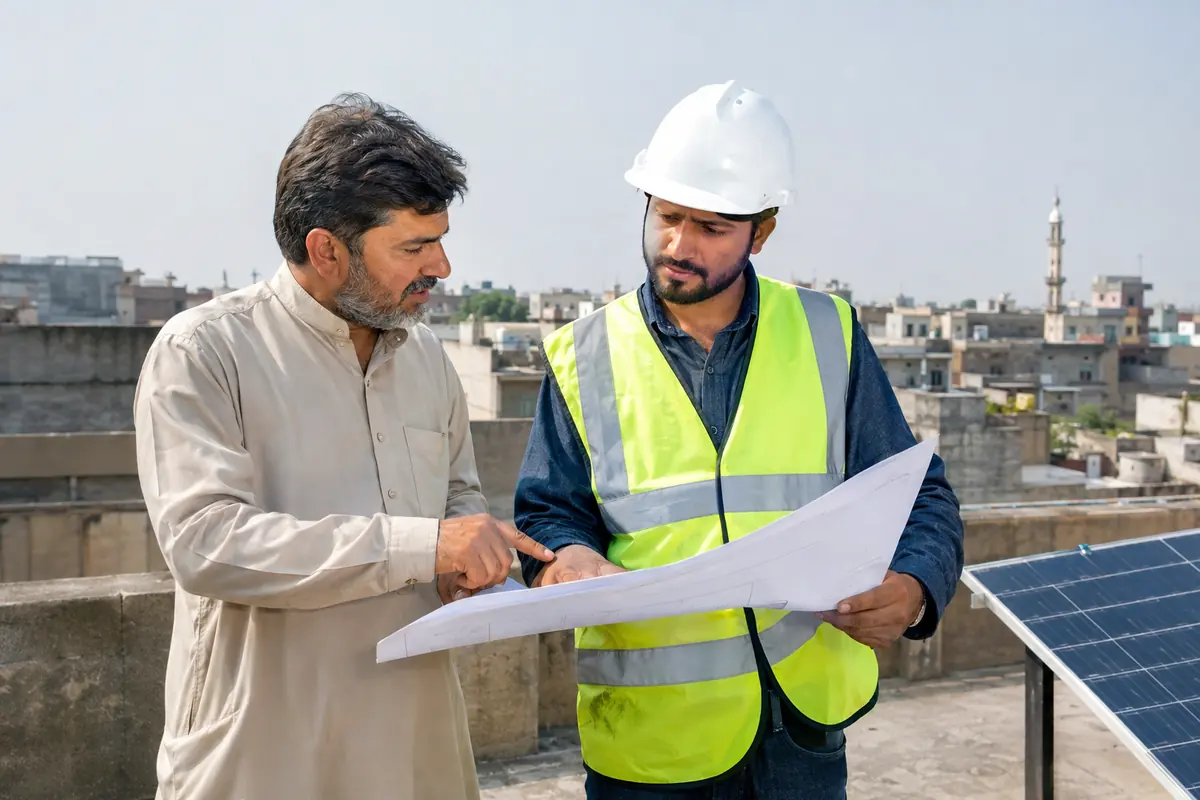
Equipment: what exactly are you buying?
1. Which exact panel model, wattage and grade are you quoting?
“Jinko 585” is not enough. Ask for the full model number, the datasheet PDF and confirmation that the stock is A-grade. A quotation that only says “Tier 1 panels” leaves room to deliver whatever is cheapest in the market that week. You can check today’s rates yourself on our solar panel price list before the meeting, so you know whether the panel line is reasonable.
2. Can I check the serial numbers before installation?
Genuine panels carry serial numbers that some brands let you verify online. Ask the installer to let you photograph every label when the panels arrive, before they go on the roof. For Jinko stock, our guide to checking a Jinko serial number shows how. An installer who resists this step is telling you something.
3. Which inverter model, and why that size?
Ask for the model number and a plain reason for the size. Is it on-grid or hybrid? What is its maximum DC input voltage and MPPT range, and how will your strings fit inside it? A competent installer explains why a 6 kW inverter suits your 6.4 kW of panels, or why it does not. Compare the quoted brand against current inverter prices in Pakistan.
4. If batteries are included, what chemistry, capacity and cycle rating?
For lithium batteries, ask for usable kWh (not only Ah), rated cycles at a stated depth of discharge, and whether the battery communicates with the inverter. For tubular batteries, ask the Ah rating and expected life in years. Batteries are the part of a hybrid system most likely to be quietly swapped for a cheaper model.
Installation work: how will it be built?
5. What is the structure made of, and what are its dimensions?
Ask for the material (hot-dip galvanised steel, aluminium or painted mild steel), the thickness of the main members, the front and rear leg heights, and the tilt angle. Painted mild steel rusts within a few monsoons. Our page on solar panel stand types and prices explains the differences. Ask how the stand will be fixed to your roof and how they will seal any holes so the roof does not leak.
6. Will the panels face south, and is there any shading?
In Pakistan, south-facing panels tilted at roughly your city’s latitude give the best year-round output. Ask the installer to point out any water tank, parapet, neighbour’s floor or tree that will shade the array in winter, when the sun is low. A single shaded panel can pull down a whole string.
7. What cable sizes, and is it copper solar DC cable?
DC cable from panels to inverter should be proper UV-resistant solar cable, sized for the current and the run length. Ask the size in square millimetres for DC and AC runs and the brand. Undersized or non-solar cable is one of the commonest shortcuts and the cause of many hot joints and melted connectors.
8. What protection devices are included?
Ask specifically about DC breakers or isolators, DC surge protection, AC breaker, AC surge protection and the distribution box. These should appear as separate lines on the quotation, not hidden in “accessories”.
9. How will the system be earthed?
Ask whether they will install a dedicated earth pit, how deep, with what material, and whether panel frames and the structure will be bonded to it. Ask if they will measure earth resistance and give you the reading. Poor earthing is a safety problem, not only a performance one, especially during lightning season.
10. Who is on the installation team and who supervises?
Find out whether the company uses its own team or subcontracts, and whether a qualified electrician or engineer will check the wiring before switching on. Ask what they will do to avoid walking on panels or damaging your roof.
Grid connection: net metering and the DISCO
11. Will you handle net metering or net billing, and is it included in the price?
Ask who prepares and submits the application to your distribution company, whether there is an extra charge, and what happens if the approval takes months. Ask the installer to explain the terms that apply to a new connection today. Under NEPRA’s Prosumer Regulations 2026, new applicants since 9 February 2026 go onto net billing: exported units earn a buyback rate linked to the national average purchase price (reported at about Rs10 to 11 per unit), imported units are billed at your normal tariff, agreements run for 5 years, and the system cannot exceed your sanctioned load. NEPRA also removed the licence fee for systems up to 25 kW, so be wary of an installer who still adds one for a small home system. An installer who promises the old unit-for-unit swap for a new connection is either out of date or not being straight with you. Confirm the details with your DISCO. Get the installer’s promise in writing, including whether they will chase the file until the bidirectional meter is installed. You can also track a pending application yourself on the PITC net metering verification portal, so ask for your application reference number.
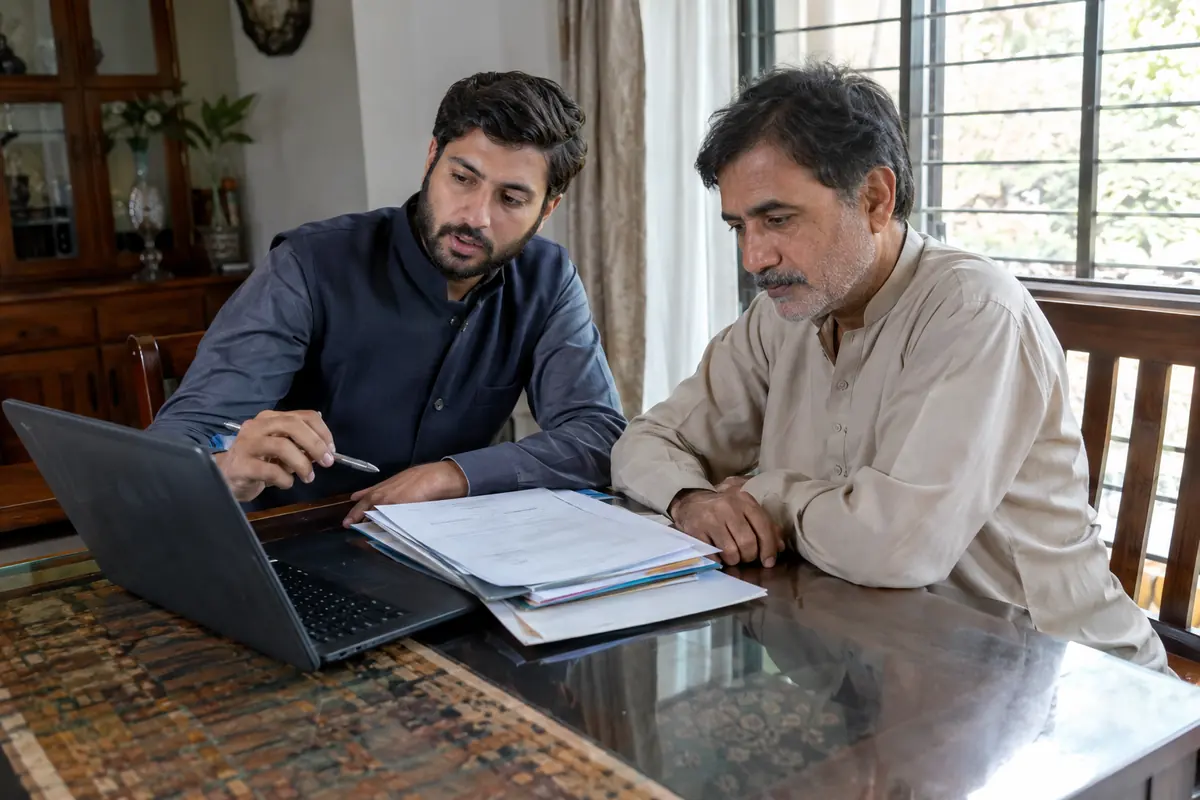
12. Does the inverter meet the DISCO’s requirements for grid connection?
For a net metering application, the inverter model normally needs to be acceptable to the DISCO. Ask the installer whether this model has been approved in other applications with your company, for example LESCO, IESCO or K-Electric, recently.
Money and after-sales: what happens when something goes wrong?
13. Can I have an itemised quotation?
A one-line “complete 10 kW system” price makes comparison impossible. Ask for each item on its own line. Here is what a properly itemised quotation should show:
| Line item | What should be stated | Common shortcut to watch for |
|---|---|---|
| Solar panels | Brand, full model, wattage, quantity, grade | “Tier 1” with no model; B-grade stock |
| Inverter | Brand, model, kW, on-grid or hybrid | Older model or lower kW than discussed |
| Batteries | Chemistry, kWh or Ah, quantity, cycle rating | Usable capacity not stated |
| Structure | Material, thickness, leg heights, tilt | Painted mild steel described as “galvanised” |
| DC and AC cable | Size in mm2, length, brand | Thinner cable or non-solar cable on DC side |
| Protection and DB | Breakers, SPDs, isolator, enclosure | Missing surge protection |
| Earthing | Pit, depth, material, bonding | Frame bonded to a water pipe only |
| Labour and transport | Included or separate | Extra charges added on installation day |
| Net metering | Included or separate, scope of work | “Will help” with no commitment |
For a sense of how the labour and balance-of-system part compares to the equipment, see our breakdown of solar installation cost in Pakistan.
14. What is the payment schedule?
Avoid paying the full amount before anything reaches your site. A safer pattern ties payments to milestones: a partial advance, a further payment when panels and inverter are delivered and checked, and the balance after commissioning, once you have seen the system running and the inverter app set up on your phone. Pay through a bank transfer or cheque that leaves a record, and get a receipt for every payment.
15. What warranty and after-sales service do you give, in writing?
Separate three things: the manufacturer warranties on panels and inverter, the installer’s own warranty on workmanship (wiring, structure, leaks), and the service response. Ask how quickly they come out if production drops, whether there is a charge for a visit, and whether they offer periodic checks. Ask who you call, by name and number.
Answers that should worry you
Most installers in Pakistan are honest small businesses. But certain answers come up again and again before jobs go wrong.
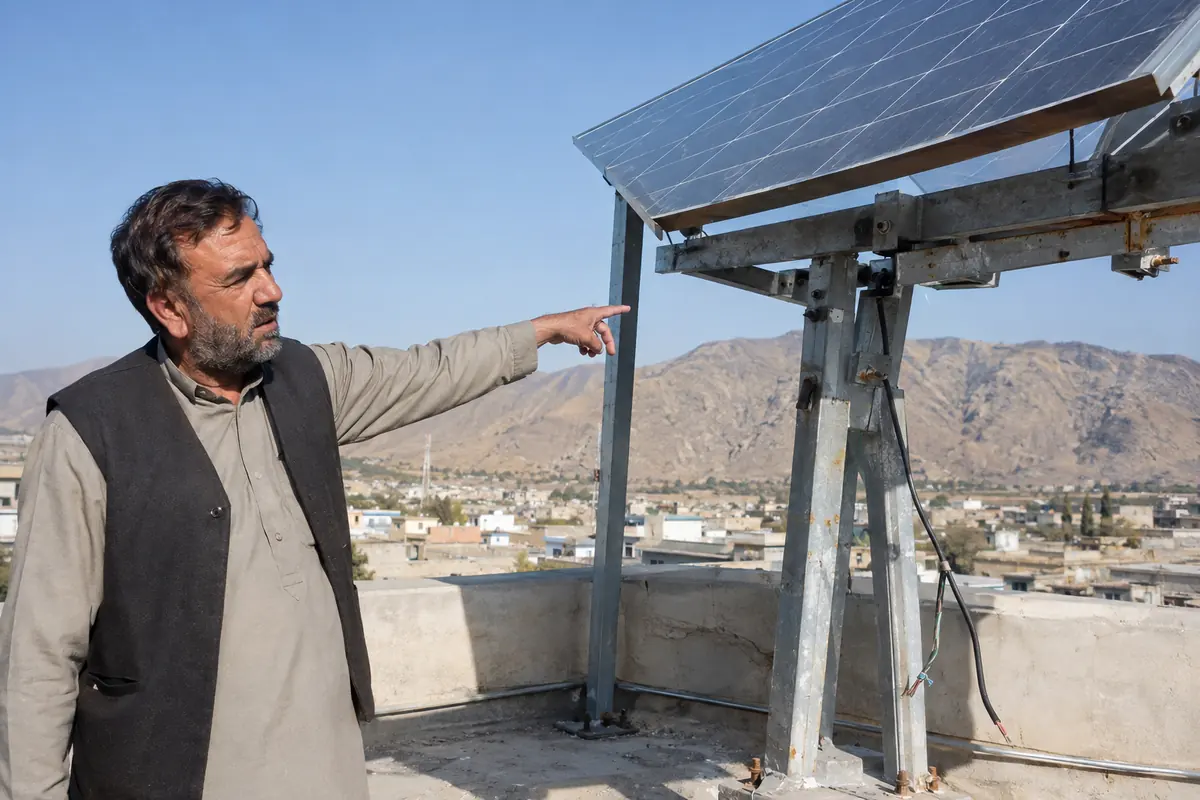
- “Panels are panels, the brand doesn’t matter.”
- “We’ll decide the inverter on the day, depending on stock.”
- “No need for an earth pit, the structure is on the roof.”
- “Full payment first, then we order.”
- “Net metering is guaranteed in two weeks.”
- Reluctance to put any warranty on paper.
Equally, a quotation that is far below every other one usually saves money somewhere you cannot see: cable, structure, protection or panel grade.
How to check a solar installer in Pakistan before you hire
Ask for two or three addresses of systems they installed at least a year ago, and visit one. Look at the structure for rust, the cable routing, whether the DC cables are clipped and protected or hanging loose, and whether the distribution box is neat and labelled. Ask the owner how quickly the installer responded to any problem. One honest conversation with a past customer tells you more than any brochure. Our directory of solar companies in Pakistan can help you build a shortlist to contact.
On commissioning day, before the last payment
The fifteen questions protect you before you sign. A short handover check protects you before you release the balance. Ask the installer to walk you through these on the day the system is switched on:
- Panel count and labels. Count the panels on the roof and match the serial numbers against the photos you took on delivery.
- String readings. Ask to see the voltage and current of each string in the inverter app. Strings with the same number of panels facing the same way should read almost the same.
- Isolation and switching. Have them show you how to switch off the DC isolator and the AC breaker, and in what order, so you can shut the system down safely in an emergency.
- Monitoring app. The inverter should be connected to Wi-Fi and the app set up on your own phone, under your own account, not only the installer’s.
- Roof condition. Check that holes are sealed, offcuts and packaging are removed, and the roof surface has not been cracked.
- Documents. Collect the invoice with serial numbers, the datasheets, the warranty cards and a simple wiring diagram.
Only when all six are done should the final payment go across.
Before the meeting
Arrive with your own numbers. Take your last twelve electricity bills, note your highest monthly units, and run them through our solar system size calculator. Note today’s panel rate too: the cheapest 585 W panel is Rs 23,400 as of 25 Nov 2026, and a 10 kW array of 585 W panels needs 18 panels costing about Rs 421,200. When you already know roughly what size you need and what the panels alone cost, it becomes much easier to see which quotation is fair and which installer is padding it.
Frequently asked questions
How do I choose a good solar installer in Pakistan?
Ask for an itemised quotation with exact panel and inverter models, visit at least one system they installed over a year ago, and get the warranty and after-sales terms in writing. A good installer answers technical questions directly and does not push you to pay in full before installation.
How much advance should I pay a solar installer?
There is no fixed rule, but avoid paying the full amount upfront. A common safer pattern is a partial advance for equipment, a further payment on delivery of panels and inverter to your site, and the balance after commissioning and testing.
Should the installer handle net metering paperwork?
Many installers offer to handle the application with your DISCO, sometimes for an additional fee. Ask whether it is included, who signs the documents, and what happens if the approval is delayed, and get the answer in writing.
What should a solar quotation in Pakistan include?
Panel brand, model and wattage, number of panels, inverter brand and model, battery details if any, structure type and material, DC and AC cable sizes, protection devices, earthing, labour, transport and any net metering charges, each as a separate line.
How long does a home solar installation take?
A typical home rooftop system is usually mounted and wired in one to three days once equipment is on site. Net metering approval through the DISCO takes much longer and depends on the company and your paperwork.
More from the blog
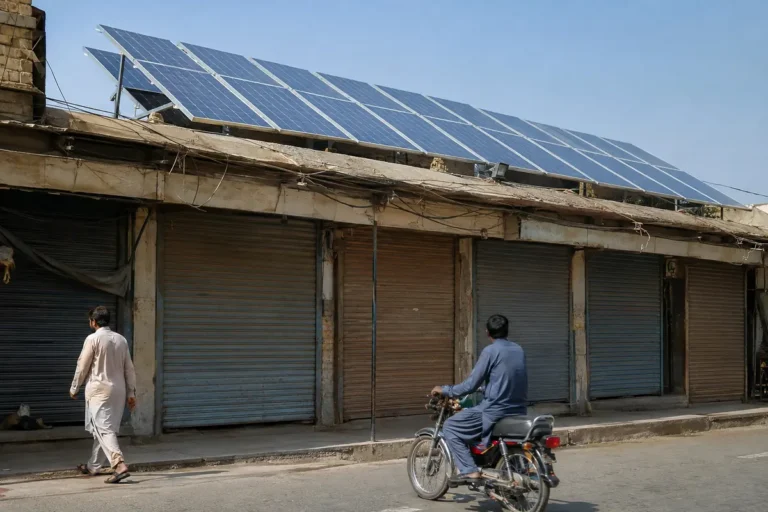 Buying Guides Solar for Shops and Small Businesses in Pakistan: Sizing and Payback
How to size a solar system for a shop or small business in Pakistan from your bill and your loads, and how to work out payback at your commercial rate. · 8 min read
 Buying Guides Solar Panel Warranty in Pakistan: Product vs Performance, and What Dealers Honour
Product warranty, performance warranty and dealer warranty are three different promises. Here is what each covers in Pakistan and how to claim it. · 8 min read
 Buying Guides Hybrid Inverter Brands in Pakistan Compared: What Actually Matters
The best hybrid inverter in Pakistan is the one that matches your panels, battery and grid plans. Compare brands on the specs that matter, not on stickers. · 8 min read