On this page
Net billing in Pakistan replaced net metering for new solar users on 9 February 2026. Under the old system, every unit you exported cancelled out a unit you imported. Under net billing, imports are charged at your normal tariff while exports earn a much lower rate, reported at about Rs10 to 11 per unit and linked to the national average energy purchase price. If you applied before 9 February, you keep the old terms until your agreement ends.
That is the core of it. The detail matters, though, because it changes how big your system should be, whether a battery makes sense and what your bill will look like. Everything below is as of October 2026.
How the old net metering worked
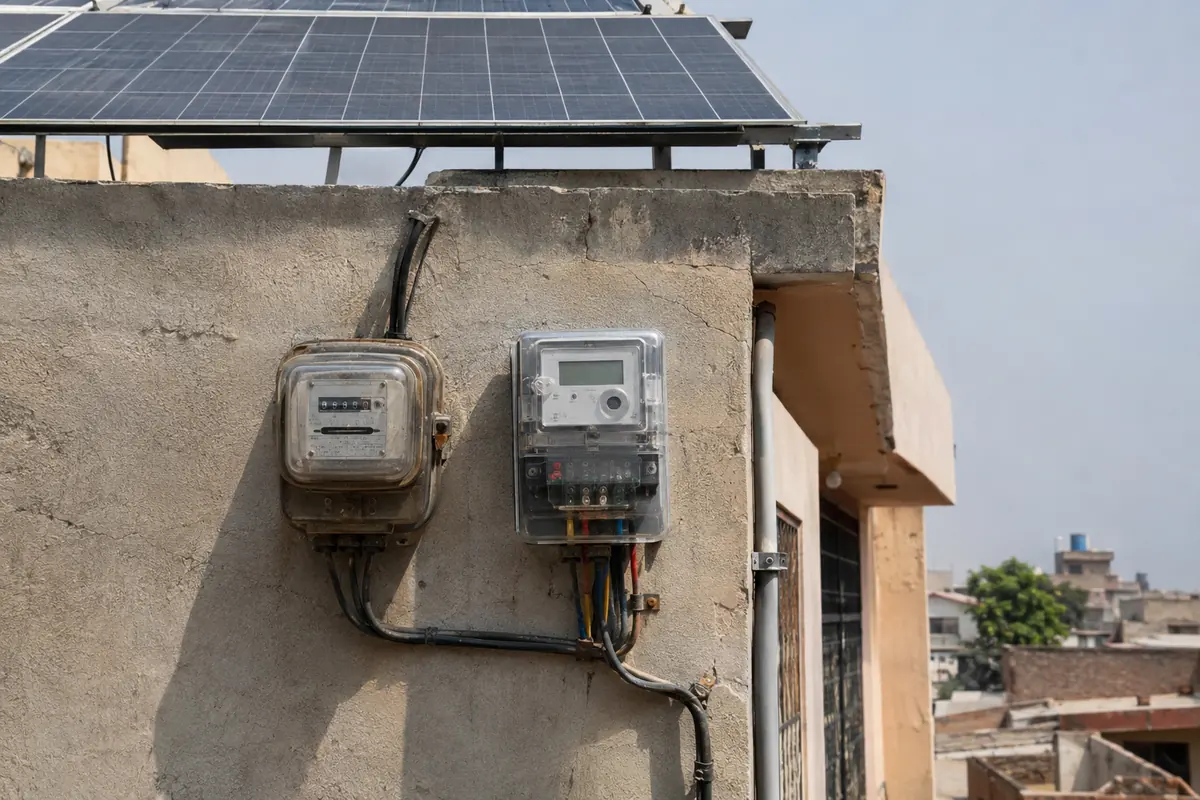
Under the 2015 net metering rules, your bidirectional meter recorded units imported and exported, and the two were netted against each other. Export 300 units and import 400, and you paid for roughly 100. Surplus exports were credited at a buyback rate that Dawn put at about Rs26 per unit under old contracts. Agreements ran for 7 years and credit was settled quarterly.
Because an exported unit was worth nearly as much as an imported one, the smart move was simple: put as many panels on the roof as your sanctioned load allowed. Daytime surplus effectively paid for your night-time use. That is why so many 10 kW systems appeared on houses that only needed 5 kW in the daytime.
What net billing changes
NEPRA notified the Prosumer Regulations 2026 on 9 February 2026. Dawn reported the main changes the next day. Here is the side-by-side picture.
| Feature | Net metering (old) | Net billing (new) |
|---|---|---|
| How units are counted | Exports and imports netted unit for unit | Exports and imports priced separately |
| Value of an exported unit | About Rs26 under old contracts | About Rs10 to 11, linked to NAEPP |
| Cost of an imported unit | Normal slab tariff, after netting | Normal slab tariff on every unit imported |
| Agreement length | 7 years | 5 years, renewable by mutual consent |
| Credit carry forward | Quarterly | Monthly |
| System size | Up to sanctioned load | 1 kW to 1 MW, capped at sanctioned load |
Two more rules apply to new applicants. DISCOs stop accepting applications on a transformer once distributed generation on it reaches 80% of its capacity. And, as Dawn reported in April 2026, NEPRA dropped the licence requirement and the Rs1,000 per kW fee for systems up to 25 kW, backdated to 9 February 2026. Larger systems pay a one-time Rs1,000 per kW.
The buyback rate, and why you will see different numbers
The new export rate is tied to the National Average Energy Purchase Price (NAEPP), the average price the power system pays generators. Dawn reported it in February 2026 as about Rs10 to 11 per unit. Profit (Pakistan Today) reported Rs8.13 the same day, and the Express Tribune used both figures in different passages. Because the rate follows NAEPP, it can be revised whenever the purchase price is redetermined, so treat any single figure as a snapshot. In this post we use “about Rs10 to 11 per unit” and recommend checking the rate printed on your own agreement.
The import side is the bigger change
Most discussion focuses on the low export rate, but for your bill the real change is that every unit you import is charged at your full slab rate. Dawn put normal domestic tariffs at roughly Rs37 to 55 per unit before taxes. So a unit you export in the afternoon earns about Rs10 to 11, and a unit you import at night costs several times that. The gap between the two is what makes net billing so different.
Who keeps net metering: the grandfathering rules
The first version of the regulations would have moved existing users to the new terms as well. That caused an uproar. Business Recorder reported in February 2026 that Prime Minister Shehbaz Sharif directed the Power Division to protect existing users, and the Division petitioned NEPRA for a review on 14 February.

The Nation reported on 3 April 2026 that NEPRA had finalised an amendment, effective from 9 February 2026:
- If you had a signed net metering agreement, or had submitted an application up to 8 February 2026, you keep the old rate and netting mechanism until your agreement expires.
- When your 7-year agreement ends, you move to the new 5-year net billing framework.
- Anyone applying on or after 9 February 2026 is on net billing from the start.
If you are grandfathered, check your agreement’s start date and work out when it expires. That is the date your export income drops, and it is worth planning for now, for example by adding a battery or shifting heavy loads to daytime a year or two before.
The backlog
Thousands of applications were caught mid-process when the rules changed. Dawn reported in September 2026 that 16,654 applications had been pending during the transition, of which 11,695 had been cleared and 4,959 were still under verification. Applicants can check their status on the PITC verification portal (nmverification.pitc.com.pk), and no processing fee is charged. PITC has been sending updates by SMS and WhatsApp. If a dealer or agent asks you for money to “clear” a stuck application, be careful.
A worked example: one month, two systems
Numbers make this clearer. Take a house in Lahore with a 10 kW system producing about 40 units a day, roughly 1,200 units a month in a good month. The family uses 500 units of solar directly during the day, exports 700, and imports 600 at night. For illustration only, assume each imported unit costs Rs40 before taxes. Your real rate depends on your slab and DISCO.
| Net metering (old) | Net billing (new) | |
|---|---|---|
| Units imported | 600 | 600 |
| Units exported | 700 | 700 |
| How the bill works | Exports exceed imports by 100; no energy charge, 100 units credited | 600 x Rs40 = Rs24,000 charged; 700 x about Rs10.5 = about Rs7,350 credited |
| Net energy position | Credit | About Rs16,650 to pay |
Fixed charges and taxes come on top in both cases. The point is not the exact rupee figure. It is that under net billing the same roof and the same family can go from a credit to a substantial bill. The fix is not to give up on solar. It is to change how the system is designed and used.
How to design a solar system for net billing
The rule of thumb under net billing in Pakistan is simple: a unit you use yourself is worth your full tariff, and a unit you export is worth about a quarter of that. Everything follows from it.
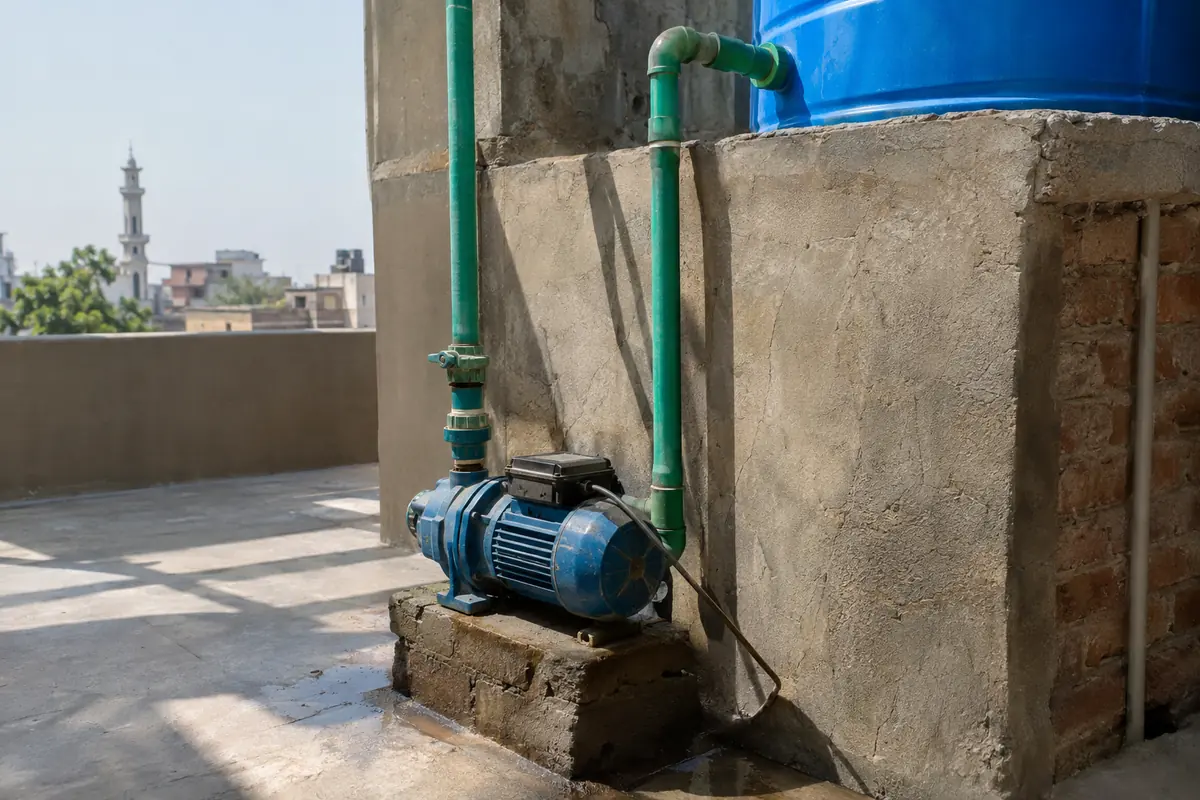
- Size for daytime use, not for export. Look at what actually runs between 9 am and 4 pm: ACs, fridge, water pump, washing machine, iron, office equipment. Size the array to cover that comfortably, with some headroom for winter. Our solar size calculator does this from your bill.
- Move loads into the day. Run the motor, laundry and ironing while the sun is up. Pre-cool rooms in the afternoon. Every unit shifted from night to day is worth the gap between your tariff and about Rs10 to 11.
- Look again at batteries. Under the old rules a battery mainly gave backup during load shedding. Now it also stores afternoon surplus for the evening instead of exporting it cheaply. Whether that pays depends on the battery price and your night-time tariff. Check current lithium battery prices and compare.
- Choose an inverter that can do both. A hybrid inverter that exports and charges a battery keeps your options open. See inverter prices and types before you choose.
- Check your transformer early. If distributed generation on your transformer is already near 80% of its capacity, your DISCO can refuse a new connection. Ask before you buy panels.
As a reference point, a 5 kW system with 585 W panels needs 9 panels, which cost about Rs 210,600 at today’s rates. For many homes using 400 to 700 units a month, that is a better fit under net billing than the 10 kW systems that made sense under the old rules. Our 5kW system price guide breaks down the full cost.
Fixed charges: the part solar cannot touch
A month after the net billing change, NEPRA extended fixed monthly charges to more domestic consumers. Profit reported in February 2026 that charges range from about Rs200 to Rs675 a month depending on slab, with the stated reason being that DISCOs need to recover costs as rooftop solar cuts their sales. Reports differ on the exact amount for each slab, so check the line on your own bill.
For a solar home this matters because a fixed charge does not change with consumption. Even if you import nothing in a month, you still pay it, plus taxes. Build it into any savings estimate.
Common misunderstandings about net billing
- “Net metering is banned.” It is not. Existing agreements, and applications submitted up to 8 February 2026, keep the old terms until the agreement expires. New applicants get net billing instead, which still lets you export.
- “Exported units are now worthless.” They are worth less, about Rs10 to 11 each, but they still earn a credit that is carried forward monthly.
- “Solar no longer saves money.” The saving now comes mainly from units you use yourself, each of which replaces a unit charged at your full slab rate. For most homes on the middle and upper slabs that is still a large saving.
- “A bigger system is always better.” Under the old rules, roughly yes. Under net billing, panels beyond your daytime load mostly export at the low rate and stretch your payback.
- “I need a NEPRA licence.” Not for a system up to 25 kW, after NEPRA withdrew that requirement in April 2026 with effect from 9 February.
What has not changed
- You still apply through your DISCO, such as LESCO, IESCO, FESCO, MEPCO, GEPCO or PESCO, or through K-Electric in Karachi, with an approved installer and an approved inverter.
- The system is still capped at your sanctioned load. If you want a bigger system, you need a load extension first.
- A grid-tied system still shuts off during load shedding unless it has a hybrid inverter and battery.
- As of October 2026 we have found no further NEPRA change to the buyback mechanism since the April amendment, though minor notifications can be missed. We check every week.
What to do now
If you already have net metering, find your agreement date, enjoy the old terms while they last, and plan for the switch. If you are about to apply, size the system around your daytime load and consider a hybrid inverter so you can add a battery later. If your application is stuck in the backlog, check the PITC portal before paying anyone to chase it.
Net billing has made solar a little less generous, but not a bad deal. A unit from your roof still costs you nothing once the system is paid for, and a unit from the grid costs several times the export rate. Get the size right, use your solar in the daytime, and the economics still work. For a full rupee-by-rupee payback, start with the complete solar system price for your size and compare it with your annual bill.
Frequently asked questions
What is net billing in Pakistan?
Net billing is the system NEPRA introduced on 9 February 2026 for new solar users. Units you import from the grid are charged at your normal tariff, while units you export are bought at a separate, much lower rate linked to the national average energy purchase price.
What is the net billing buyback rate in Pakistan?
As of October 2026 it is about Rs10 to 11 per unit, linked to the National Average Energy Purchase Price, according to Dawn's February 2026 report. Other outlets reported different figures, and because it is tied to that price it can change at each tariff determination.
Will my old net metering agreement change?
Not until it expires. NEPRA's April 2026 amendment lets anyone with an agreement or an application submitted up to 8 February 2026 keep the old net metering rate and mechanism until the agreement ends, after which they move to the 5-year net billing framework.
Do I need a NEPRA licence for a 10 kW solar system?
No. NEPRA removed the licence requirement and the Rs1,000 per kW fee for systems up to 25 kW, with effect from 9 February 2026. Systems above 25 kW pay a one-time fee of Rs1,000 per kW.
How can I check my pending net metering application?
The Power Division's verification portal at nmverification.pitc.com.pk shows application status, and Dawn reported in September 2026 that no processing fee is charged. PITC has also been notifying applicants by SMS and WhatsApp.
Is solar still worth it under net billing?
For most homes, yes, but the value now comes from using solar units yourself during the day, since each one replaces a unit you would otherwise buy at the full slab rate. Exported units earn far less, so oversizing a system just to export is no longer a good deal.
More from the blog
 Net Metering & Bills Electricity Tariff and Fixed Charges in 2026: What Changes for Solar Users
Pakistan's 2026 electricity tariff, new fixed charges and quarterly adjustments explained for solar users, and how they change your bill and payback. · 8 min read
 Net Metering & Bills Is Solar Still Worth It in Pakistan in 2026? A Real Payback Calculation
Is solar worth it in Pakistan after net billing? A step-by-step payback calculation for a 5 kW home system, with the numbers to check your own case. · 8 min read
 Buying Guides How to Spot Fake, Refurbished or Mislabelled Solar Panels in Pakistan
Copied brand labels, re-stickered wattages and washed used panels all turn up in Pakistan. How each trick works and how to catch it before you pay. · 8 min read