On this page
A solar tubewell in Pakistan is a set of panels feeding a solar pump inverter, which drives your existing or a new AC motor directly during daylight, with no batteries and no fuel. Size it from how much water you need and how deep it comes from, then add roughly 30 to 50 percent more panel capacity than the motor rating. As of October 2026, Punjab’s tubewell subsidy (Rs5 lakh to Rs10 lakh depending on size) is the main government support farmers have used, but we could not confirm a new application round, so treat any “registration open” message with caution.
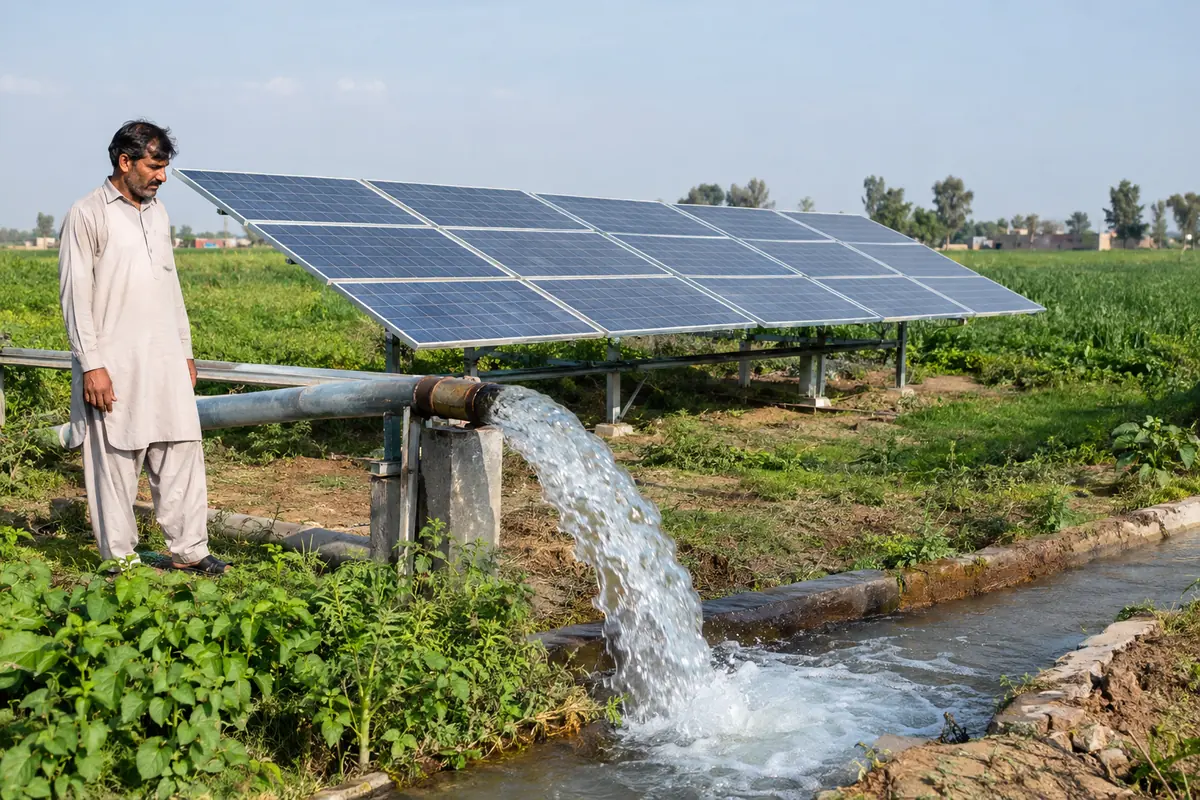
How a solar tubewell actually works
A home solar system has to match a household’s evening use, so it needs batteries or the grid. A tubewell is simpler. The pump only has to run when the sun is up, and the water you lift goes into the field, the khaal or a storage pond. That is why farm solar is one of the best uses of panels anywhere in the country.
The key part is the solar pump inverter, often called a VFD or solar pump drive. It takes the DC power from the panels, converts it to three-phase AC and changes the motor speed with the sunlight. At 8 am the motor turns slowly and gives a small flow. By 11 am it reaches full speed. As clouds pass, it slows down rather than tripping. A normal home inverter cannot do this, so do not let anyone sell you a household on-grid or hybrid inverter for a tubewell motor.
There are three common setups in Pakistan:
- Submersible pump with solar drive: the usual choice for deeper water tables in central and southern Punjab and Balochistan.
- Surface (centrifugal) pump or a turbine with the motor above ground: common where the water table is shallow, for example in canal-fed areas.
- Hybrid drive (solar plus grid or generator input): some drives accept a second AC input so the pump can run at night from a generator or the grid. Useful when the crop needs water after sunset, but it costs more.
Solar tubewell sizing: start from the water, not the motor
Many farmers simply copy the motor size from the old diesel engine. That often oversizes the system, because diesel engines were picked for whatever was available. A better method uses two numbers you can measure: how much water you need per hour and the total head, which is the depth to the water during pumping plus the height you lift it above ground plus pipe losses.
The power the pump needs is roughly:
Pump power (kW) = flow (cubic metres per hour) x total head (metres) / (367 x pump efficiency)
Use a pump efficiency of 0.45 to 0.6 for older pumps and 0.6 to 0.7 for a new, well-matched submersible. Here is a worked example. A farmer wants about 60 cubic metres an hour (roughly 16 to 17 litres a second) from a total head of 30 metres, with an older pump at 50 percent efficiency:
60 x 30 / (367 x 0.5) = about 9.8 kW at the motor
That points to a motor of about 10 to 12.5 hp (7.5 to 9.3 kW) running near full load, or a 15 hp motor with spare margin. Water tables in many Punjab districts drop during the hot months, so measure the head in May or June, not after the monsoon. If you size on a post-monsoon reading, the pump will deliver less water when you need it most.
From motor size to panel capacity
Panels rarely produce their nameplate rating in real field conditions. Heat, dust and the low sun in the morning all cut output. Installers therefore put more panel capacity on the drive than the motor rating. The table below shows the common rule of thumb. It is a starting point for quotes, not an engineering design.
| Motor size | Motor power (approx.) | Typical panel array | 585 W panels (approx.) |
|---|---|---|---|
| 5 hp | 3.7 kW | 5 to 5.5 kW | 9 to 10 |
| 7.5 hp | 5.5 kW | 7.5 to 8 kW | 13 to 14 |
| 10 hp | 7.5 kW | 10 to 11 kW | 17 to 19 |
| 15 hp | 11 kW | 15 to 16 kW | 26 to 28 |
| 20 hp | 15 kW | 20 to 22 kW | 34 to 38 |
| 25 hp | 18.5 kW | 25 to 27 kW | 43 to 47 |
The 10, 15 and 20 kW rows line up with the size bands Punjab used for its subsidy. The solar pump inverter must be rated at least for the motor’s full current. Panel strings must also fit inside the drive’s DC voltage window, so the number of panels in series matters as much as the total kW. If you want to understand that part, read our guide to series and parallel panel wiring.
Daily water you can expect
Across most of Punjab, a well-sized array gives useful pumping for about 6 to 8 hours on a clear day. Seasonal output figures for Lahore show what that means across the year. Each installed kilowatt produces about 6.3 to 6.5 kWh a day in spring and summer, about 4.8 in autumn and about 3.55 in winter. Your December pumping volume can therefore be roughly half of your June volume. For most farms that is acceptable, because rabi wheat needs far less water than cotton, rice or sugarcane in the hot months. If you grow winter vegetables that need heavy watering, add panels rather than motor size.
What a solar tubewell costs to build
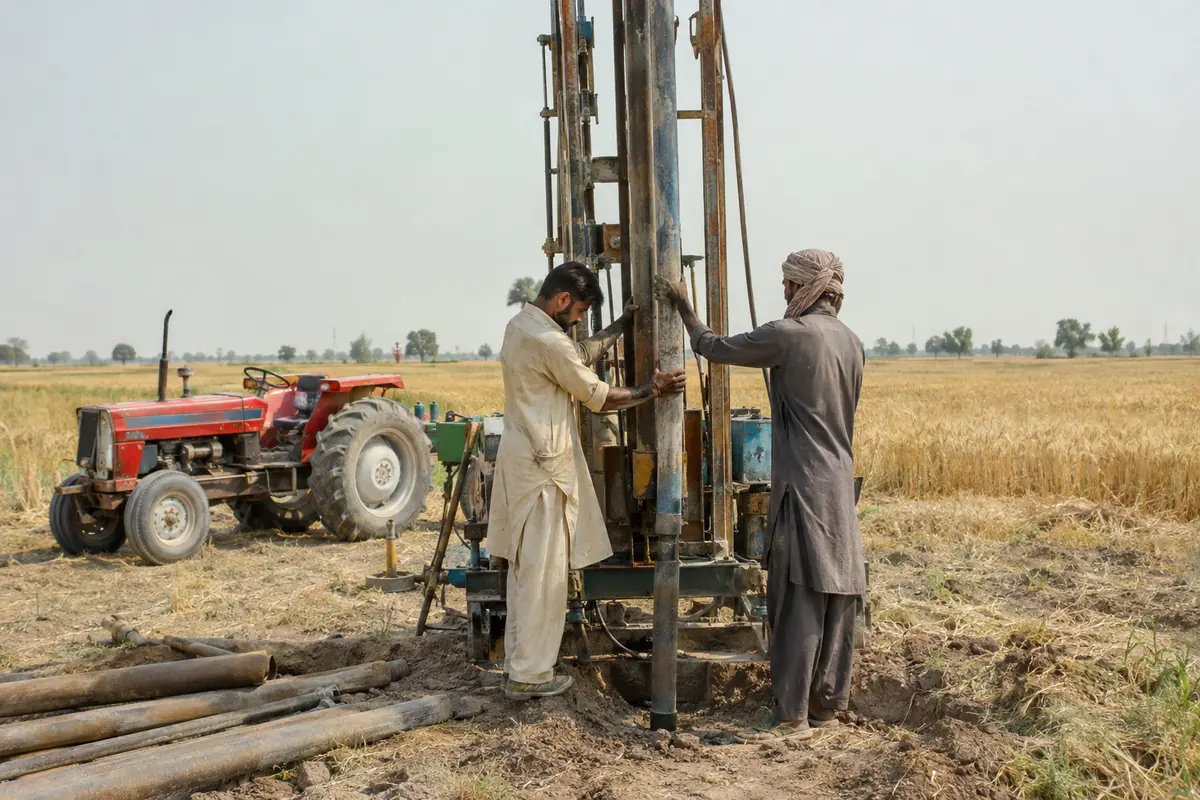
A solar tubewell quote has five main parts. Panel prices move often, so the figure below is pulled live from today’s market rates on this site. For the other items we give no rupee figure, because brand and size change them a lot. Get two or three written quotes and compare them line by line.
| Item | What drives the cost | Today’s guide |
|---|---|---|
| Panels (10 kW example) | Wattage, brand, N-type vs older stock | Rs 421,200 for 18 panels of 585 W |
| Solar pump inverter (VFD) | Rated kW and current, brand, MPPT range, dust and heat protection | Get quotes; compare against our inverter price guide |
| Mounting structure | Galvanised steel gauge, height (to keep cattle and floodwater off), ground fixing | See current solar stand prices |
| DC cable, breakers, earthing, lightning protection | Distance from array to bore, copper quality | Ask for this as a separate line item |
| Pump or motor changes | Whether your existing motor and pump can be reused | Only if the old unit is worn or badly mismatched |
Two money points get missed. First, keep the array close to the bore. Long DC runs need thicker copper, and copper is not cheap. Second, budget for security. Panel theft from open fields is a real risk in many districts, so a fenced enclosure, anti-theft bolts or a raised frame near a dera are worth paying for.
Working out payback against diesel or grid
Diesel prices and agricultural tariffs both change, so plug in your own numbers rather than trusting a salesman’s “two-year payback”:
- Note how many litres of diesel your engine burns per hour (your own log is best).
- Multiply by the hours you pump in a year and by the current diesel price. Add servicing, oil changes and repair costs.
- If you are on an electric connection, take your last 12 agricultural bills instead.
- Divide the total solar quote by that yearly running cost. The result is a simple payback in years, before any subsidy.
Diesel tubewells usually show the quickest payback, because fuel is the biggest running cost and solar removes almost all of it. A good panel set lasts well beyond 20 years. Our article on how long solar panels really last covers what to expect from a rural, dusty site.
Solar tubewell schemes for farmers as of October 2026
Punjab: CM solarisation of agricultural tubewells
Punjab launched its tubewell solarisation programme in February 2025 for 8,000 tubewells in phase one. The subsidies reported by the Express Tribune and Profit at launch were:
| System size | Government subsidy |
|---|---|
| 10 kW | Rs5 lakh |
| 15 kW | Rs7.5 lakh |
| 20 kW | Rs10 lakh |
More than 530,000 farmers applied and about 385,000 were declared eligible for a digital ballot. Winners could choose an approved vendor in their own district. Dawn reported in January 2025 that the province would cover about 67 percent of the cost, with the farmer paying the rest. Dawn also reported that the scheme’s website listed criteria including a maximum 15 kW tubewell load, a water table limit and a tubewell installed before 31 March 2024. Dawn noted that the criteria were confusing and differed between the department and the website.
The rollout was not smooth. In May 2025, Profit reported that the scheme had moved from the Agriculture Department’s Water Management Wing to the Energy Department, and that support had not reached many selected farmers months after launch. Some reporting from mid-2025 described phase one’s 8,000 farmers as selected. Dawn’s January 2025 report mentioned plans for a second phase of 10,000 tubewells with federal help.
Where it stands now: as of October 2026 we could not find a confirmed report in Dawn, the Express Tribune, Business Recorder or Profit of a new phase opening or a fresh ballot. Many websites claim a “2026 registration” with application links and helpline numbers. Do not hand over your CNIC, land record or any fee on the strength of those pages. The safe route is to ask your district Agriculture (Extension or Water Management) office, or check the Punjab government’s own portal. For the separate household scheme, see our page on the CM Punjab free solar panel scheme.
Other provinces and the federal level
A May 2026 Dawn opinion piece referred to a Rs55 billion tubewell solarisation project in Balochistan. We could not confirm its current status or how farmers apply. We found no open federal subsidy for farm tubewells as of October 2026. Our roundup of government solar schemes in Pakistan is updated when anything new is announced.
Free pumping is not free water
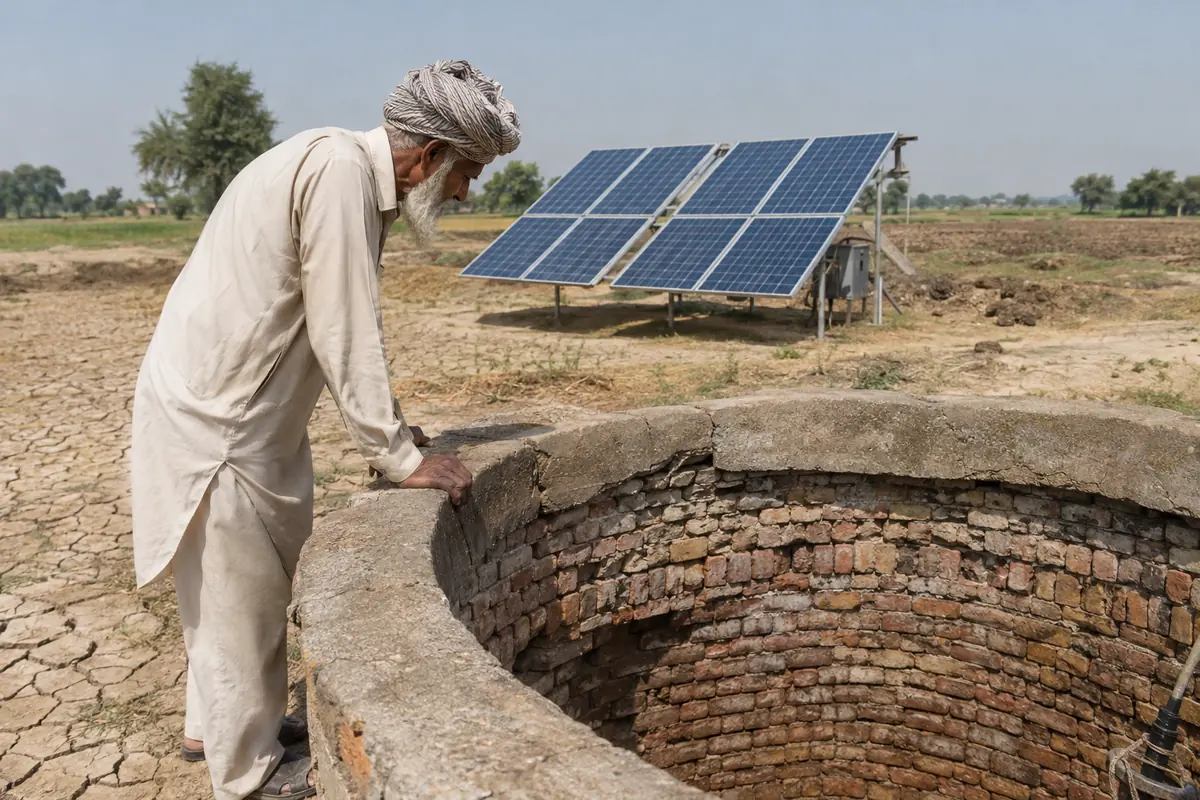
A solar tubewell removes the cost of each extra hour of pumping, and that changes behaviour. Dawn’s 2025 reporting quoted irrigation officials worried that free pumping could speed up groundwater decline in Punjab. Others said that decline started long before solar and needs a proper groundwater management plan. Either way, a falling water table is your problem too. Every metre it drops adds head, cuts your flow and can leave a shallow bore dry by the summer.
Some practical habits help:
- Pump to the crop’s need, not to the sun. A timer or a simple float switch on a storage pond prevents waste.
- Pair solar with laser land levelling, lined watercourses or drip and sprinkler systems where the crop allows.
- Selling surplus water to neighbours is common, but agree fair hours so your own bore is not over-drawn in peak summer.
- Keep a record of the static water level each May. If it falls year after year, plan for a deeper setting before the pump starts sucking air.
Field checklist before you sign
- Measure the pumping water level and flow with your current pump in May or June.
- Ask for the motor and drive ratings in writing, including drive current and DC voltage range.
- Check the panel string design: panels per string, open-circuit voltage on a cold winter morning, and whether it stays inside the drive’s limit.
- Set the tilt correctly. A fixed array in central Punjab works well around 28 degrees facing south. Some farmers use an adjustable frame, steeper in winter and flatter in summer. Our tilt angle calculator gives the figure for your district.
- Raise the frame high enough to clear floodwater, cattle and tractor work, with solid concrete footings.
- Plan cleaning. Farm dust and crop-burning smoke settle quickly. A weekly rinse in dry months makes a visible difference to morning flow.
- Get warranty terms in writing for the panels, the drive and the pump separately, with the dealer’s name and address.
What to do now
If you are still on diesel, the case for a solar tubewell is strong even without a subsidy. Measure your water needs and head, use the table above to get an array size, and collect itemised quotes. If you are waiting for Punjab’s scheme, do not stop your own planning. As of October 2026 no new phase is confirmed, and a scheme-approved vendor will still need the same measurements. To estimate panel numbers for other loads on the farm, such as the dera, a fridge or fans, use our solar panel calculator.
Frequently asked questions
How many solar panels are needed for a 10 hp tubewell?
A 10 hp motor is about 7.5 kW, and most installers put roughly 10 to 11 kW of panels on it so the pump keeps running in the morning, late afternoon and on hazy days. With 585 W panels that is about 17 to 19 panels.
Does a solar tubewell need batteries?
No. A solar tubewell runs directly from the panels through a solar pump inverter (VFD) during daylight, and the water itself is the storage. Batteries would add a large cost for very little benefit on a farm.
Is the Punjab solar tubewell scheme still open in 2026?
The Punjab scheme launched in February 2025 with subsidies of Rs5 lakh for 10 kW, Rs7.5 lakh for 15 kW and Rs10 lakh for 20 kW for 8,000 tubewells in phase one. As of October 2026 we could not confirm a new phase or a fresh application window in mainstream news, so check with the Punjab Agriculture or Energy Department before paying anyone who claims to register you.
Can I convert my diesel or electric tubewell to solar without changing the motor?
Usually yes. Most existing three-phase AC motors and submersible pumps can run from a solar pump inverter of the right rating. The installer should check the motor's rated power, voltage and condition first, because a worn motor wastes solar power.
How many hours a day will a solar tubewell run?
On a clear day in Punjab a well-sized system pumps at useful flow for roughly 6 to 8 hours, centred on midday. In December and January output is lower and the effective pumping window is shorter, which usually matches the lower water demand of wheat compared with summer crops.
More from the blog
 Buying Guides Solar for Shops and Small Businesses in Pakistan: Sizing and Payback
How to size a solar system for a shop or small business in Pakistan from your bill and your loads, and how to work out payback at your commercial rate. · 8 min read
 Buying Guides 15 Questions to Ask Your Solar Installer Before You Pay
Before you pay a solar installer in Pakistan, ask these 15 questions about panels, inverter, structure, wiring, net metering, payment and after-sales. · 8 min read
 Solar Tech How to Read a Solar Panel Datasheet (for Pakistani Heat)
Pmax, Voc, temperature coefficient, NMOT: what each datasheet line means, which ones matter in a Pakistani summer, and how to compare two panels properly. · 8 min read